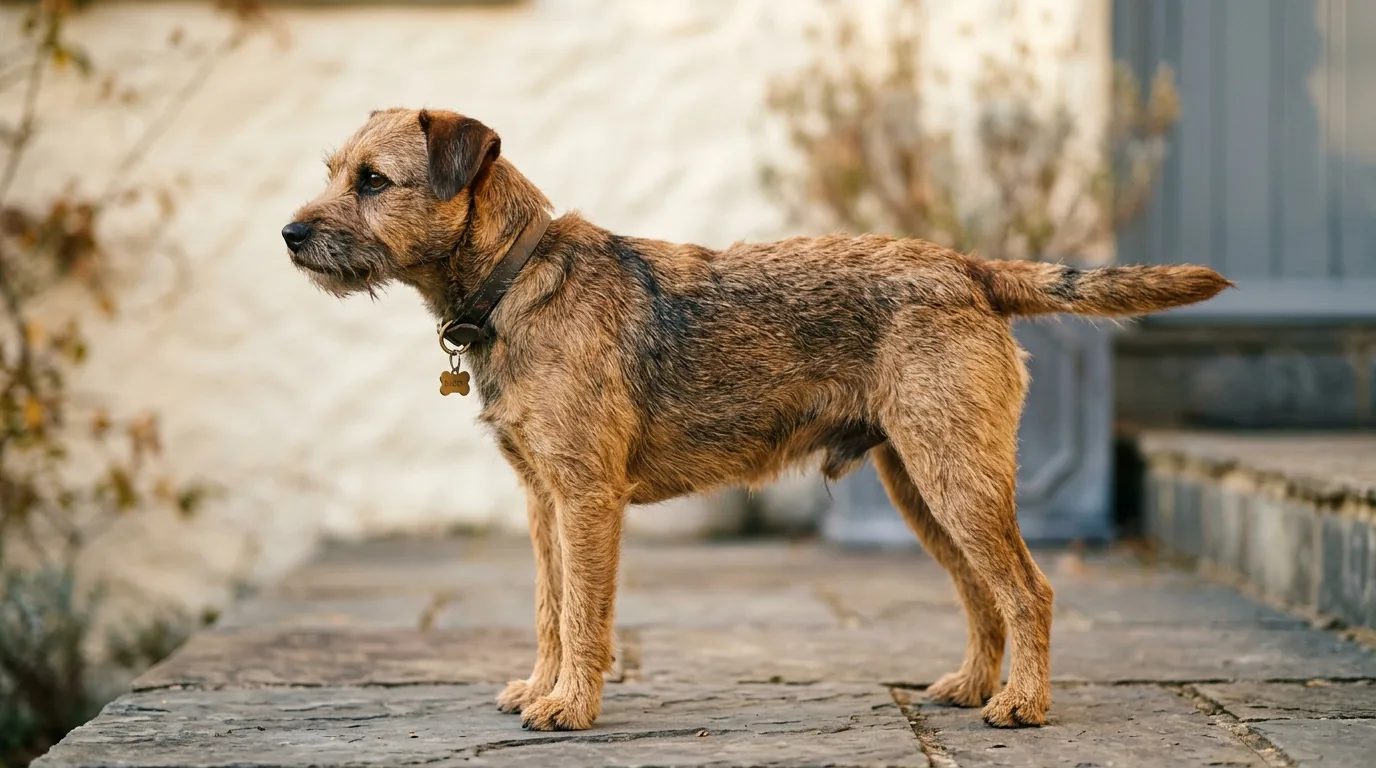
TL;DR. Tail position carries more information than tail motion. A wag is not a synonym for friendliness — wagging means arousal, which can be positive, negative, or conflicted. Position (where the tail sits relative to the spine) carries the emotional register. Motion modulates intensity within that register. Read them together, alongside ears, eyes, lip line, and posture.
This article is the deep version of the tail section in the dog body language guide. It walks through every position and motion, the lateralized-brain research behind right- and left-biased wagging, and what changes for breeds with non-standard tail anatomy.
Why position matters more than the wag
Owners default to reading the wag because it is the most visible signal a dog produces. It moves, it catches the eye, and it is the only piece of canine body language most people are explicitly taught — usually in the form of "wagging means happy." That teaching is the problem.
Wagging is an arousal signal. The activation can be affiliative (greeting a familiar human), predatory (locked onto a squirrel), conflicted (a strange dog approaching), or defensive in the seconds before a bite. The wag does not differentiate between these states.
Position does. A tail held high and stiff over the back signals confidence or threat-display regardless of motion. A tail tucked against the belly signals fear or appeasement regardless of whether the tip is twitching. The static angle carries the emotional category; motion modulates intensity within that category.
Tail positions — what each one means
Five primary positions are worth learning. Some dogs do not display all five because of breed anatomy; that limitation is covered further down.
High and stiff, with or without vibration. The tail rises above the spine and locks into place. The musculature is tense; the fur along the top compresses. The function is a long-distance visual signal: a high tail makes the dog more visible to other dogs across a field and announces commitment to a position. In ethological terms this is the confident or aroused-toward-confrontation register. A fast low-amplitude tremor at this height marks acute arousal. Regularly misread as a friendly wag by owners who saw movement and stopped reading.
High and loose. The tail sits above the spine but the musculature is relaxed. The fur lies flat. The tip drapes naturally. The engaged-and-comfortable register — common during play, familiar greetings, exploration of a non-threatening new environment. Same height as high-stiff, but the absence of muscular lock-in flips the meaning.
Mid-level, parallel to the spine. The tail extends behind the dog at roughly the height of the back. Neutral observation — gathering information without committing to a response. Most dogs spend most of their day here. The resting baseline for comparison.
Low. The tail drops below the line of the spine but does not tuck. Low has two meanings depending on breed. For breeds whose natural set sits high (German Shepherds, retrievers, most terriers), low signals uncertainty, mild stress, or low arousal in an unfamiliar context. For breeds whose natural set sits low — Greyhounds, Whippets, Salukis, Beagles, Basset Hounds — the same position is the resting baseline. A Greyhound with their tail at the hocks is simply standing.
Tucked between the legs. The tail presses tight against the belly, often curving forward between the hocks. The most consistently reliable stress signal a dog produces. Across breeds, ages, and contexts, a tucked tail signals high-grade fear or active appeasement — the dog is reducing their visible profile. No benign reading exists. Remove the source of discomfort and stop approaching.
Tail motions — what each one means
Motion modulates position. Five motions are worth learning.
Slow sweep. A wide, unhurried side-to-side movement. Often misread as the "happiest" wag because it looks calm. In context — at the door, around an unfamiliar dog — a slow sweep is more often cautious uncertainty than relaxed friendliness. Slow sweep at mid-level is mild curiosity; slow sweep at high-stiff is a warning sign.
Fast wide wag with whole-body movement. The tail swings broadly and the dog's hips, back, and sometimes shoulders move with it. The closest signal dogs produce to what owners think of as "happy" — affiliative greeting. The whole-body involvement is the key. If only the tail moves and the spine is still, the read is different.
Helicopter. A circular motion in which the tail rotates around its base rather than sweeping. Almost universally a strong affiliative signal in adult dogs, most often during high-intensity greeting of a familiar person.
Fast narrow vibration. A high-frequency, low-amplitude tremor near the tip. High arousal. Can tip positive (locked on a favorite tug toy) or negative (locked on a strange dog across the street). Position decides. A narrow vibration with a high-stiff tail near another dog is a serious warning.
Twitching tip while otherwise still. The body is motionless, the tail base is still, only the last few inches flick. Predatory focus — the same signal a cat shows in hunting mode. Tip-twitch at a squirrel means the dog is about to launch. Tip-twitch at another dog is not playing.
The right-bias wag research
A small body of published work shows that the left-right asymmetry of a wag carries meaning. Most owners have never heard of it.
The original study is Quaranta, Siniscalchi, and Vallortigara (2007), Current Biology, "Asymmetric tail-wagging responses by dogs to different emotive stimuli." The researchers filmed thirty dogs viewing four stimuli through a slot — their owner, an unfamiliar human, an unfamiliar dominant dog, and a cat — and measured the angular bias of the wag. Dogs wagged with a pronounced right-side bias toward their owner, a milder right bias toward the unfamiliar human and the cat, and a clear left-side bias toward the unfamiliar dominant dog. The result was statistically robust.
The interpretation rests on lateralized brain function. In dogs, as in most vertebrates, each brain hemisphere processes specific categories of stimulus and controls the opposite side of the body. The left hemisphere handles approach behavior and positive affect; it controls the right side, including right-biased tail movement. The right hemisphere handles withdrawal and threat-related states; it controls the left side. A right-biased wag is the motor signature of the approach circuit; a left-biased wag is the motor signature of the withdrawal circuit.
The follow-up matters for owners. Siniscalchi, Lusito, Vallortigara, and Quaranta (2013), also in Current Biology, "Seeing left- or right-asymmetric tail wagging produces different emotional responses in dogs," showed that other dogs read the asymmetry too. The researchers played video of left-biased and right-biased wags to new dogs and measured cardiac response and behavioral signs of stress. Dogs watching a left-biased wag showed elevated heart rates and stress behaviors. Dogs watching a right-biased wag remained calm. The asymmetry is not a private neurological artifact — it functions as a communicative signal between dogs.
The bias is subtle and best observed on video at half speed. The takeaway: the wag is at least two signals layered together, and dogs are reading the layer most owners never see.
Reading position and motion together
Position and motion combine. The same height with a different motion is a different signal.
- High stiff with fast narrow vibration. High-stakes arousal toward a target. Near another dog this is a warning — back away.
- High stiff with slow sweep. Confident assessment, sometimes preceding confrontation. Read the rest of the body carefully.
- High loose with helicopter. Strong affiliative greeting. The dog is reliably comfortable.
- High loose with fast wide wag and whole-body movement. Happy excitement, often play-solicitation.
- Mid-level with slow sweep. Mild curiosity, gathering information.
- Mid-level with fast wide wag. Friendly engagement, low ambiguity.
- Low with slow sweep. Uncertain greeting. The dog is hedging.
- Tucked with twitching tip. Acute fear with residual arousal. Remove the dog from the trigger immediately.
None of these read cleanly without the rest of the body — ears, eyes, lip line, weight. The tail is one channel, not the whole signal.
What breeds change about this reading
Breed anatomy modifies which positions and motions a dog can produce.
Docked tails. Boxers, Dobermans, Rottweilers, several spaniels and terriers — historically docked at birth where the practice was legal. A docked dog has lost the long-distance visual signal entirely and cannot produce high-stiff or tucked positions in a way other dogs read clearly. Leaver and Reimchen (2008) tested this with a robotic dog model and found that real dogs approach docked dogs with more caution because the available signal is degraded. Read the tail base and the rest of the body more heavily.
Naturally curled tails. Pugs, Akitas, Shiba Inus, Chow Chows, Basenjis, Pomeranians. The tail curls over the back at rest. "High and stiff" in a Labrador means nothing in a Pug. Curled-tail breeds signal through tightening and loosening of the curl. A Pug whose curl tightens against the back is showing arousal. A Pug whose curl drops to the rump is showing low arousal or mild stress.
Short tails. Pembroke Welsh Corgis, Australian Shepherds, French Bulldogs, certain spaniels. A short tail can still wag, vibrate, and twitch, but the angular range is compressed. Read motion and base movement rather than full-length angles.
The rule across all three: the less tail there is, the more heavily the rest of the body carries the signal.
What not to assume
A wagging tail does not mean a friendly dog. Wagging is arousal. A dog in defensive arousal seconds before a bite is wagging. A dog locked onto prey is wagging. A dog freezing in fear is sometimes still wagging at the tip. The pattern most owners use — see wag, assume friendly, approach — is the pattern most often associated with bites to strangers and children in the published data. See the dog body language guide for the wider signal cluster. The wag is information, not a verdict.
What to do
Do
- Read tail position before tail motion.
- Photograph or video your own dog at rest to know their baseline carriage.
- Treat a tucked tail as an unambiguous request for space — remove the trigger.
- Account for breed anatomy. A Greyhound's low tail is not a Labrador's low tail.
- Combine the tail read with at least three other signals.
Avoid
- Reading a wag as friendliness without checking the position.
- Approaching an unfamiliar dog with a high-stiff tail, with or without motion.
- Punishing a dog whose tucked tail is asking for space — the tuck is communication, not disobedience.
- Generalizing across breeds without noting natural carriage.
- Trying to read tail asymmetry in real time. Use video at slower playback.
When to call a professional
If you observe tail signals that consistently indicate high-grade stress — repeated tucking in everyday contexts, frequent low-with-still-tail at home, signs of pain at the tail base — start with a veterinary exam to rule out medical causes (impacted anal glands, intervertebral disc issues, limber tail syndrome), then a credentialed behavior professional.
Look for CDBC, CSAT, IAABC, KPA-CTP, or Fear Free credentials. Avoid trainers who reference dominance, alpha rolls, or pack leadership; the AVSAB has explicitly rejected these methods. For tail signals tied to fear specifically, see the fear body language reference.
Try it on your own dog
Tail reading develops with deliberate practice. Watch your own dog in moments where you already know what they are feeling — at rest on the couch, during play, at the door before a walk, when a stranger rings the bell. Catalog the positions and motions you see. The baseline becomes obvious within a few weeks.
PetTranslator.ai uses the same framework. Upload one clear photo at /analyze and the analysis returns the visible tail position, the inferred emotional register, and a structured behavioral interpretation that accounts for breed anatomy.
Sources
- Quaranta, A., Siniscalchi, M., Vallortigara, G. "Asymmetric tail-wagging responses by dogs to different emotive stimuli." Current Biology, 17(6), R199–R201 (2007). The original right-bias / left-bias study.
- Siniscalchi, M., Lusito, R., Vallortigara, G., Quaranta, A. "Seeing left- or right-asymmetric tail wagging produces different emotional responses in dogs." Current Biology, 23(22), 2279–2282 (2013). The follow-up showing other dogs read the asymmetry.
- Karen Overall. Manual of Clinical Behavioral Medicine for Dogs and Cats. Elsevier, 2013. The clinical reference for behavioral observation across breeds.
- Patricia McConnell. The Other End of the Leash. Ballantine, 2002. For the communication-asymmetry framework between dogs and humans.
- Leaver, S. D. A., Reimchen, T. E. "Behavioural responses of Canis familiaris to different tail lengths of a remotely-controlled life-size dog replica." Behaviour, 145(3), 377–390 (2008). For the docked-tail communication degradation finding.
- AVSAB Position Statement on Humane Dog Training (2021).
Khabir Mughal is the founder of PetTranslator.ai. This article was reviewed against the AVSAB Position Statement on Humane Dog Training and Karen Overall's Manual of Clinical Behavioral Medicine before publication.