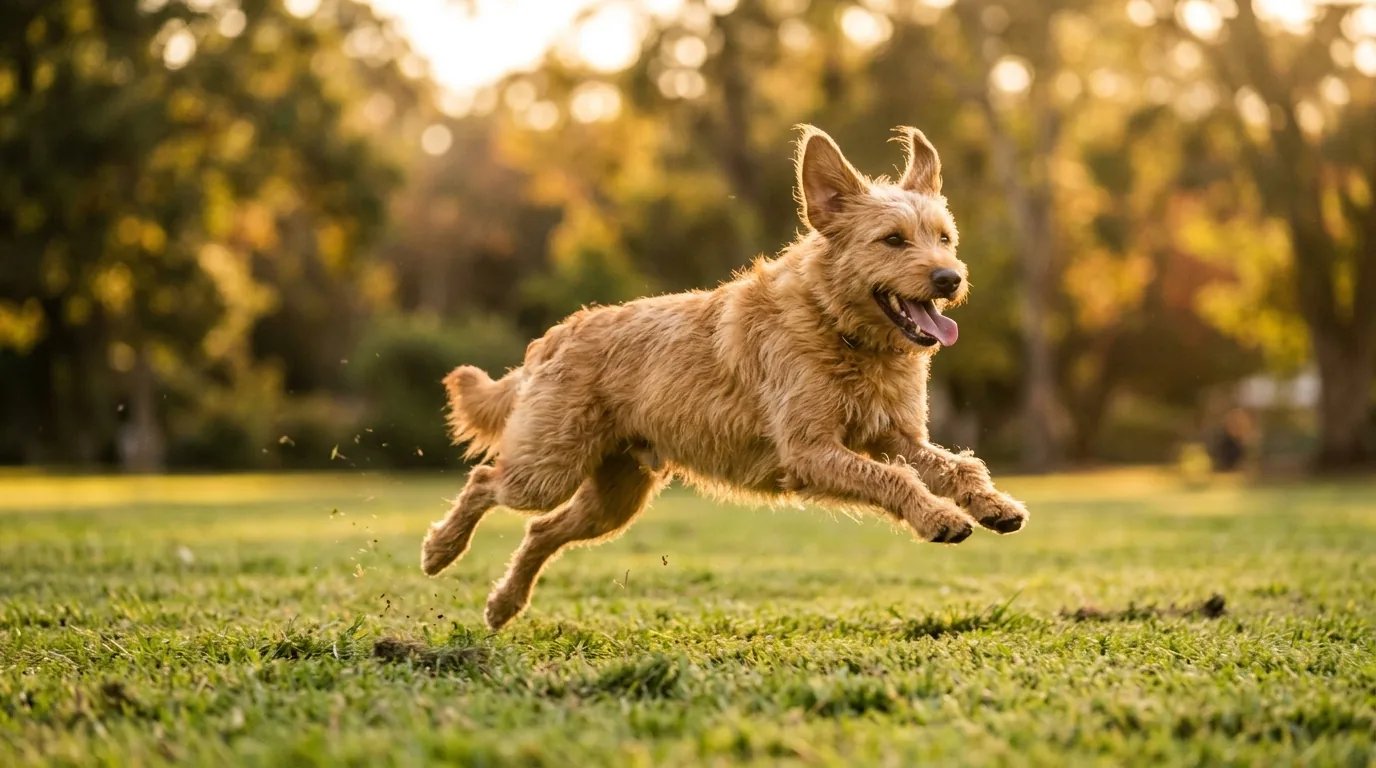
A dog who explodes into a sprint after a bath, tears tight figure-eights across the living room, and then drops onto the rug as if nothing happened isn't malfunctioning. They've just run a FRAP — a Frenetic Random Activity Period — which is the formal name behavioral researchers use for what most owners call the zoomies. It's normal canine arousal regulation, it's well documented, and in almost every case it's a sign the dog's nervous system is working correctly.
The cases where it isn't are the ones worth knowing about. This guide covers both.
TL;DR
Zoomies are bursts of high-speed, erratic, often bouncy movement that dogs use to discharge pent-up arousal. They're more common in puppies and adolescents but happen at any age. The behavior is play-system activity, not aggression and not seizure activity. A FRAP is usually one to five minutes, ends on its own, and leaves the dog calmer than before. There's a small set of patterns — constant zoomies that never settle, repetitive same-direction spinning, sudden onset in a senior dog — that aren't FRAPs at all and warrant a vet visit.
What zoomies look like
A typical FRAP has a recognizable shape:
- A sudden burst of high-speed running with no obvious lead-up
- Tight circles, figure-eights, or back-and-forth charges across a fixed path
- Bouncy, exaggerated, almost cartoonish movement — front-end drops, leaps, sudden direction changes
- A loose open mouth, often described as a "smile"
- Soft eyes, frequently with play bows mixed into the run
- Fast wide tail wagging with whole-body movement
- A duration somewhere between one and five minutes
- A sudden, clean stop — the dog goes from full sprint to standing still or flopping down
The movement is recognizable because it's structurally different from running with intent. A dog chasing a squirrel runs in a straight line. A dog in a FRAP runs as if the floor were trampolining underneath them.
Why dogs do it — the ethological framework
The term FRAP comes out of the play-behavior research literature, and the behavior is most clearly described in Marc Bekoff's work on canine play. Bekoff, an ethologist at the University of Colorado Boulder, spent decades documenting how dogs, wolves, and coyotes use play to regulate arousal and rehearse motor patterns. His framing — laid out at length in Canine Confidential (2018) — treats FRAPs as a self-organized burst inside the larger play system. The dog's nervous system has accumulated arousal it needs to discharge, the play-system fires, and the discharge takes the form of high-speed, low-purpose movement.
Three things are happening at once during a FRAP:
Arousal regulation. The dog is moving from a higher state of nervous-system activation toward a lower one. The burst spends the excess energy and lets the system return to baseline faster than waiting it out would.
Energy release. Dogs who have been physically constrained — crated, restrained for grooming, held on leash through a long walk — accumulate motor energy with nowhere to go. A FRAP discharges it.
Play solicitation. In multi-dog households or at the park, a FRAP often functions as an invitation. The dog launches into bouncy movement and the second dog either joins or doesn't. Play bows mid-run are the formal play signal embedded in the burst.
Underneath all of it is dopamine. The play system in mammals is dopaminergic, which is part of why dogs look as if they're enjoying themselves during a FRAP — they are. John Bradshaw's In Defence of Dogs (2011) describes the same circuitry: a dog in play is in a reward-positive state, and the burst itself is reinforcing.
Common triggers
FRAPs cluster around predictable moments. The most common:
- After a bath. Sometimes called the "Wet-Dog Boogie." The combination of restraint, novel sensation, and water on the coat reliably triggers a discharge burst the moment the dog hits dry ground.
- After eating. Common in puppies and young dogs, less common in adults. A surge of metabolic energy meets a still-developing arousal regulation system.
- During play with another dog. FRAPs and social play interleave constantly. The two dogs will play-wrestle, break, run a FRAP, and re-engage.
- At reunion. The dog who explodes into a lap when a household member comes home is running a low-grade FRAP scaffolded onto the greeting.
- Outdoor transition. Stepping out of the house into open space — the yard, a field, a beach — frequently triggers a burst as the dog encounters the larger environment.
- No visible trigger. Sometimes a dog who has been resting on the couch will sit up and launch into a FRAP from a still position. The internal arousal state was building under the surface.
What's happening neurologically
A FRAP is a brief sympathetic nervous system surge. Heart rate climbs, dopamine rises in the reward circuitry, the motor system fires hard, and then the parasympathetic system pulls everything back. Karen Overall's Manual of Clinical Behavioral Medicine (Elsevier, 2013) frames bursts of this kind as self-regulating — the dog's autonomic system uses the burst to reset, the way a stretch resets postural muscles. The post-burst calm is the recovery phase.
This is the difference between a normal FRAP and a clinically concerning behavior pattern. A normal FRAP recovers. A concerning pattern doesn't.
When zoomies are normal (and welcome)
The behavior is a positive sign when:
- The burst is brief — one to five minutes — and ends on its own
- The dog looks loose and joyful during the burst (soft eyes, open mouth, play bows)
- The dog recovers afterward and returns to a settled state without prompting
- The burst happens in a safe environment with no risk of injury
- The dog remains responsive to recall, even if recall has to wait for the burst to finish
- The behavior doesn't escalate into destruction or anxiety
A dog who runs a FRAP after a bath and then flops onto the bed is showing exactly the regulation the play system is built for. There's nothing to fix.
When zoomies signal something concerning
There's a narrow set of patterns that aren't FRAPs at all, even though they can look superficially similar. These warrant a vet or behavior consultation:
Constant high arousal that never settles. A dog who runs from one burst to the next, with no recovery phase, isn't regulating — they're stuck in elevated arousal. This pattern often appears in under-exercised, under-enriched, or chronically stressed dogs.
Bursts followed by destructive behavior. When a FRAP rolls into chewing, biting at furniture, or mouthing at humans, the underlying state isn't play — it's frustration arousal that the burst failed to discharge.
Compulsive same-direction spinning. A dog who circles repeatedly in one direction, can't be interrupted easily, and shows no contextual trigger is not running a FRAP. This is a stereotypic pattern (more on this below).
Bursts in dangerous environments. A FRAP near a road, near unfenced water, or in a space full of hard furniture isn't dangerous because of the burst — it's dangerous because of the environment. The same behavior in a safe space is fine.
Sudden onset in an older dog. A senior dog who has never zoomed and suddenly begins bursting into circular movement isn't discovering a new habit. Late-onset repetitive movement in older dogs can signal cognitive dysfunction, vestibular disease, or pain-driven displacement. See a vet first.
The difference between FRAPs and compulsive spinning
This is the differential most worth getting right, because the two patterns look similar from across a room and have completely different implications.
A FRAP has variable movement. The dog changes direction, switches between running and bouncing, mixes in play bows, and follows the contours of the space. A compulsive spin is repetitive in the same direction, often the same diameter, often the same speed.
A FRAP is recoverable. Calling the dog, opening the back door, or simply letting the burst run its course resolves it. A compulsive spin is hard to interrupt and often resumes after interruption.
A FRAP has a contextual trigger. Something happened — a bath, a meal, a reunion, an environmental shift. A compulsive spin can fire without context and can repeat across hours or days.
A FRAP stops voluntarily. The dog ends the burst and returns to baseline. A compulsive spin persists, sometimes to the point of self-injury or exhaustion.
Landsberg, Hunthausen, and Ackerman's Behavior Problems of the Dog and Cat (3rd ed., Saunders 2013) lay out this differential in clinical detail. The short version is that any repetitive, fixed-pattern, hard-to-interrupt movement that doesn't fit the FRAP profile above is a vet visit. It could be obsessive-compulsive disorder, a vestibular issue, a partial seizure presenting atypically, or pain-driven behavior. None of those resolve on their own, and trying to manage them as if they were play behavior makes them worse.
What to do when zoomies happen
The handling for a normal FRAP is light-touch:
- Move fragile items out of the path if the burst is happening indoors
- Don't chase. Chasing reinforces the high-arousal state and turns the burst into a longer session
- If recall is needed for safety, call the dog away calmly rather than trying to physically catch them
- Let the burst run in a safe space — the yard, a fenced run, a clear room
- Once the dog reorients to a settled state on their own, mark and reward the calm. This is the moment that reinforces self-regulation, not the burst itself
Patricia McConnell's The Other End of the Leash (Ballantine, 2002) makes the same point in slightly different language — owners often reward the wrong half of the arousal curve. The behavior to encourage isn't the spike; it's the recovery.
What not to do
Three common owner responses make the behavior worse rather than better:
Don't punish. A FRAP is normal arousal regulation. Punishing it doesn't suppress the underlying state — it adds a stress overlay on top of an already activated nervous system. The dog learns that bursting is unsafe but still needs to discharge the arousal, which usually surfaces as a different problem behavior.
Don't try to suppress. Restraining a dog through a FRAP — holding them, crating mid-burst, blocking the path — converts the arousal into frustration. The same energy comes out somewhere else, usually in a less manageable form.
Don't treat it as misbehavior. Zoomies aren't disobedience. They're a healthy nervous system doing what it's designed to do. Frame them as a signal that the dog had energy to discharge, not as a failure of training.
Try it on your own dog
The fastest way to learn the FRAP-versus-something-else distinction is to film a few of your dog's bursts on your phone and watch them back slowly. Movement variability, recoverability, contextual trigger, and voluntary stop are all easier to see in playback than in real time.
PetTranslator.ai analyzes the same behavioral markers from photos and short clips — body shape, facial signals, posture, contextual cues — and returns a structured report rather than a cartoon caption. It's built on the same framework this article uses. For daily behavior reading, it's a useful instrument.
Related reading
- Dog body language: a behaviorist's field guide — the full signal framework these patterns sit inside
- Puppy body language — why FRAPs are more frequent and more intense in puppies
- Signs your dog is stressed — for distinguishing healthy arousal from chronic stress
- Cognitive dysfunction in senior dogs — the differential for sudden-onset repetitive movement in older dogs
Sources
- Marc Bekoff, Canine Confidential (University of Chicago Press, 2018) — the play-behavior framework this article draws on, including Bekoff's documentation of FRAPs as a self-organized burst in the larger play system.
- John Bradshaw, In Defence of Dogs (Penguin, 2011) — for the dopamine and play-system context.
- Karen Overall, Manual of Clinical Behavioral Medicine for Dogs and Cats (Elsevier, 2013) — the clinical reference for autonomic regulation and the FRAP-versus-stereotypy differential.
- Patricia McConnell, The Other End of the Leash (Ballantine, 2002) — for arousal-curve handling and the reward-the-recovery framing.
- Landsberg, Hunthausen, and Ackerman, Behavior Problems of the Dog and Cat (3rd ed., Saunders, 2013) — for the stereotypic-spinning differential.
Khabir Mughal is the founder of PetTranslator.ai. This article was reviewed against Marc Bekoff's published work on canine play and the Landsberg et al. clinical differential for stereotypic movement before publication.