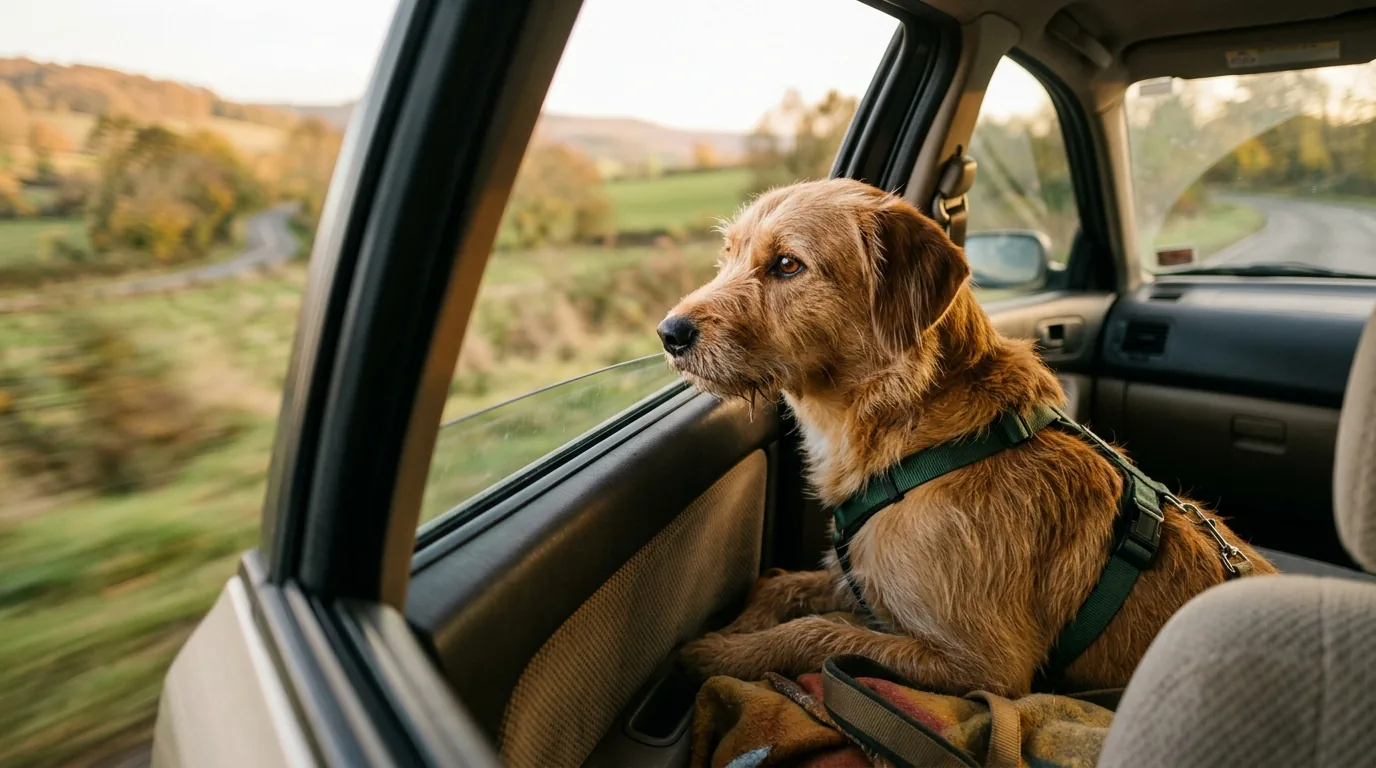
Most "pet travel anxiety" advice treats the problem as a single condition with a single fix — a calming chew, a pheromone spray, a Thundershirt. The clinical picture is more granular than that. Travel anxiety in dogs and cats sorts into five distinct trigger categories, and each one responds to a different intervention. Buying the wrong remedy for the wrong trigger is why so many owners report that "nothing works."
This guide walks through the five triggers, how to identify which one applies to your pet, and a three-phase protocol — desensitization, counter-conditioning, and travel-day management — drawn from veterinary behavior medicine. It covers dogs and cats together because the underlying mechanics are similar, even when the surface behavior looks different.
TL;DR
Pet travel anxiety has five distinct triggers: motion-induced nausea (vestibular), confinement panic, novelty stress, destination association (vet, groomer), and pre-departure cue reading. Each responds to different interventions, which is why most "anxiety remedies" sold to owners fail — they don't address the underlying cause. The protocol that actually works is layered: desensitization first (before any trip), counter-conditioning to positive destinations, then management on travel days. Medication exists and is appropriate for many pets when prescribed by a vet who knows the trigger. Punishment, "they'll get used to it," and last-minute pheromone sprays don't work.
The five trigger categories
Identifying which trigger is driving the behavior is the single most useful diagnostic step. Pets often show more than one, but one usually dominates.
1. Motion-induced nausea (vestibular). The pet's vestibular system — the inner ear apparatus that processes balance — is sensitive to the conflicting motion signals of a moving vehicle. The result is true motion sickness, complete with hypersalivation, vomiting, and the visible misery that goes with it. This is common in puppies and kittens because the vestibular system isn't fully mature, and it often improves with age. It's also the trigger most likely to respond to a single pharmaceutical intervention.
2. Confinement panic. The trigger isn't the car or the trip — it's being shut inside a crate or carrier. Pets with confinement panic will often travel fine in a vehicle if they're loose or leashed, and panic immediately when the carrier door closes. This is its own clinical picture and responds to dedicated carrier training, which we cover in depth in the cat carrier training guide.
3. Novelty stress. The pet is overwhelmed by unfamiliar visual, auditory, and olfactory input — the windows, the road noise, the smells of other places. Novelty stress is more common in adult pets who weren't conditioned to travel during their socialization window, and in animals adopted later in life who may have little prior travel experience.
4. Destination association. The pet has learned that the carrier or the car predicts an aversive outcome — the vet, the groomer, boarding. The travel itself may be tolerable, but the predictive cue chain triggers anticipatory stress. This is the most common trigger in adult cats, because most cats only see the carrier on vet days.
5. Pre-departure cue reading. The pet has learned to read the owner's pre-departure routine — picking up keys, putting on shoes, taking the carrier out of the closet — and starts panicking before the trip begins. This is the same mechanism behind the early signs of separation anxiety in dogs, and it tells you the conditioning has built up over many trips, not just one.
The five triggers respond to different interventions. A motion-sick pet doesn't need carrier training. A confinement-panicked pet won't be helped by an antiemetic. A pet with destination association needs counter-conditioning, not desensitization to the car itself.
Reading the signals
The signals look different in dogs and cats, and they look different on each end of the severity scale.
Dogs. Hypersalivation (drool down the chin and onto the upholstery), persistent panting in a cool vehicle, whining or yelping, vomiting, refusal to approach the car, freezing once inside, hiding in the footwell, trembling. Some dogs vocalize. Some go silent and still — silence in a normally vocal dog is not calmness, it's inhibition under stress.
Cats. Loud vocalization (often a low, drawn-out yowl), hypersalivation, urination or defecation inside the carrier, hiding before departure, expressed anal glands, dilated pupils, ears in airplane position, refusal to come out at the destination. Some cats freeze and present as "calm" — flat-bodied, motionless, eyes wide. This isn't calm.
A pet showing more than two of these signals on multiple trips is not having an off day. The pattern is the diagnosis.
Phase 1 — Desensitization (before any actual trip)
Desensitization means gradually exposing the pet to the trigger at an intensity low enough that no fear response is elicited, and slowly raising the intensity over many sessions. It is done before the next real trip, not during one.
For dogs (car desensitization). The progression has five stages, and each stage is held until the dog is visibly relaxed before moving to the next.
- Car neutral while parked, doors open, engine off. The dog sits or lies in the car with high-value food. Two to three short sessions a day, two minutes each.
- Same setup, doors closed.
- Engine on, still parked, doors closed.
- Engine on, slow movement around the driveway or block.
- Short drives to a neutral destination (not the vet).
Most dogs cycle through these stages over one to three weeks. Pets with severe baseline anxiety take longer. Rushing the progression is the most common reason desensitization fails.
For cats (carrier desensitization). The carrier needs to become a default piece of furniture before it becomes a transport device. The carrier sits open in a high-traffic room for weeks, with bedding, treats, and quiet positive associations built inside it. The full protocol is covered in the cat carrier training guide.
Phase 2 — Counter-conditioning (pair travel with positives)
Desensitization makes the trigger tolerable. Counter-conditioning makes it predictive of something good. The two phases overlap in practice, but counter-conditioning is what builds the positive association bank that lets a pet absorb the occasional vet trip without regressing.
The practical move is simple. Short trips to positive destinations come first. A drive to a quiet park. A drive to a friend's house where the dog gets a slow greeting and a chew. A carrier trip to a new room of the house for a feeding. The trip itself becomes the predictor of a good outcome.
Build that positive bank to at least five trips before introducing a vet or grooming visit. Then alternate. For every vet trip, schedule two or three positive trips in the surrounding weeks. The goal is to keep the average predictive value of the car or carrier weighted toward positive, so the occasional aversive trip doesn't shift the conditioning back.
This is also where you treat destination association as its own intervention. If the carrier currently equals vet, the only way to break that equation is to use the carrier far more often for non-vet things than for vet things.
Phase 3 — Management during actual travel
Once desensitization and counter-conditioning are in progress, travel-day management reduces the load further.
Empty stomach for nausea-prone pets. Withhold food for four hours before departure (water is fine). Most motion sickness episodes are dramatically reduced on an empty stomach.
Secure restraint. Dogs ride in a crash-tested harness clipped to a seatbelt anchor, or in a secured crate. Cats ride in a hard-sided carrier that is itself seatbelted in. An unsecured pet is a projectile in a collision and a distraction the entire drive.
Cool environment. Stress amplifies thermoregulatory load. A cool, quiet cabin reduces the panting and hyperventilation that compound anxiety. Direct air conditioning is helpful for dogs; cats often do better with airflow that isn't blasted at the carrier.
Cover the carrier. A light cover over a cat carrier — a thin towel, leaving ventilation gaps — reduces visual novelty and lets most cats settle faster. The same principle works for dogs in crates.
Calming acoustic environment. Through a Dog's Ear and Through a Cat's Ear are commercial audio products developed from psychoacoustic research on species-specific arousal responses. The underlying research (Wagner, Spector, and others) found that bioacoustically structured music can lower heart rate and behavioral arousal markers in shelter dogs and clinic cats. Owner-friendly translation: a slow, low-frequency-weighted track playing during transit measurably reduces stress for many pets. Heavy bass and rapid percussion do the opposite.
Pheromones used correctly. Adaptil (for dogs) and Feliway (for cats) require time to take effect. A spray applied to the carrier or vehicle thirty minutes before loading is the lower bound. A diffuser running in the home for several days before a trip is better. A last-minute spray as the pet is already loaded does not work — pheromones are not anxiolytics in the pharmacological sense.
Medication options (work with your vet)
Several veterinary medications are appropriate for travel anxiety, and a vet who knows your pet's trigger can match the medication to the cause. None of these should be used without a prescribing vet's involvement.
Cerenia (maropitant). A neurokinin-1 receptor antagonist labeled for the prevention of acute vomiting and motion sickness in dogs (also used off-label in cats). It targets the vomiting reflex directly and is the most appropriate first-line choice when the dominant trigger is motion-induced nausea. It is not an anxiolytic.
Trazodone. A serotonin antagonist and reuptake inhibitor used in dogs (and increasingly in cats) as a short-acting situational anxiolytic. Onset is roughly sixty to ninety minutes, duration four to eight hours. It works well for vet visits and travel-day use, and is one of the most commonly prescribed situational medications in current veterinary behavior practice.
Gabapentin. Originally an anticonvulsant, now widely used off-label for situational anxiety, particularly in cats. It is the single medication that has most changed feline vet visits in the last decade — a single oral dose of gabapentin two hours before a vet trip dramatically reduces handling stress for many cats. It is also used in dogs, often paired with trazodone.
Sileo (dexmedetomidine oromucosal gel). FDA-approved in dogs for noise aversion (fireworks, thunderstorms). It is appropriate for specific event anxiety and is sometimes prescribed off-label for predictable travel events. It is not a general-purpose travel anxiolytic.
CBD products. Emerging clinical research exists, but at the time of writing, the evidence base for CBD as a treatment for canine or feline anxiety is not strong enough to recommend it as a first-line intervention. Some products are unregulated, some interact with other medications, and the dosing literature is incomplete. This may change as research matures.
A vet visit dedicated to building a travel anxiety protocol is a more useful expenditure than another untested calming chew.
What doesn't work
Three approaches are commonly tried and consistently fail.
"They'll get used to it." Pets generally do not habituate to travel anxiety through repeated exposure alone. The opposite — sensitization — is more common. Each aversive trip strengthens the association. Pets who travel five times a year for five years without intervention often present at age six with worse travel anxiety than at age one.
Punishment for vomiting, urination, or defecation in transit. These are involuntary autonomic responses to stress. The pet did not choose them. Punishment after the fact adds an additional aversive event to the trip and worsens the underlying anxiety. The right response is to clean it up and lower the stress load on the next trip.
Last-minute pheromone sprays. Pheromone products are real, but they take time to work. A spray applied during a panic episode is unlikely to do anything useful. The same product applied thirty minutes before loading, or used as a diffuser in the days leading up to a trip, is a different intervention.
When to call a professional
Some travel anxiety presentations are beyond what an owner can resolve with desensitization and over-the-counter management. Work with a credentialed behavior professional if any of the following apply:
- The pet self-injures during transit (broken nails or teeth, scraped paws against the carrier).
- The pet shows aggression during loading or unloading.
- The anxiety has generalized — the pet now reacts to keys, shoes, or any predictive cue.
- Medication has been tried and the response was inadequate or paradoxical.
- The pet is otherwise stable but travels frequently and the situational distress is affecting quality of life.
Look for a credentialed positive-reinforcement professional — a veterinary behaviorist (DACVB), a Certified Cat Behavior Consultant or CDBC through IAABC, or a Fear Free Certified practitioner. The AVSAB and IAABC directories list practitioners by region.
Try it on your own pet
The first useful step is identifying which of the five triggers is dominant for your animal. Photo and short-video evidence from a recent trip — the loading moment, the first five minutes of motion, arrival — tells you more about which trigger is driving the behavior than a written description does.
PetTranslator.ai is built around the same observational framework used in veterinary behavior medicine. Upload one or two clear images of your pet during the relevant moment and the AI returns a structured read — biometric markers it can identify, the most likely category of distress, and a graded action plan. For complex cases it isn't a replacement for working with a DACVB or a CDBC. For identifying the trigger and building a starting protocol, it is a useful instrument.
Sources
The framework in this guide is drawn from:
- Karen Overall, Manual of Clinical Behavioral Medicine for Dogs and Cats (Elsevier, 2013) — the clinical reference for situational anxiety presentations and medication protocols.
- AAFP / ISFM Feline-Friendly Handling Guidelines — the standard reference for low-stress handling of cats in transit and at the clinic.
- Fear Free Pets training and certification materials — protocols for low-fear, low-anxiety, low-stress veterinary and travel handling.
- Sileo (dexmedetomidine oromucosal gel) FDA label and supporting clinical data — Zoetis, on file with the FDA Center for Veterinary Medicine.
- Malena DeMartini-Price, Treating Separation Anxiety in Dogs (Dogwise, 2014) — the foundational protocol for pre-departure cue desensitization, which applies directly to travel anxiety.
For owners working with a specific case, the IAABC, AVSAB, and American College of Veterinary Behaviorists (ACVB) websites maintain searchable directories of credentialed professionals by region.
Khabir Mughal is the founder of PetTranslator.ai. This article was reviewed against Karen Overall's Manual of Clinical Behavioral Medicine and the AAFP/ISFM Feline-Friendly Handling Guidelines before publication.