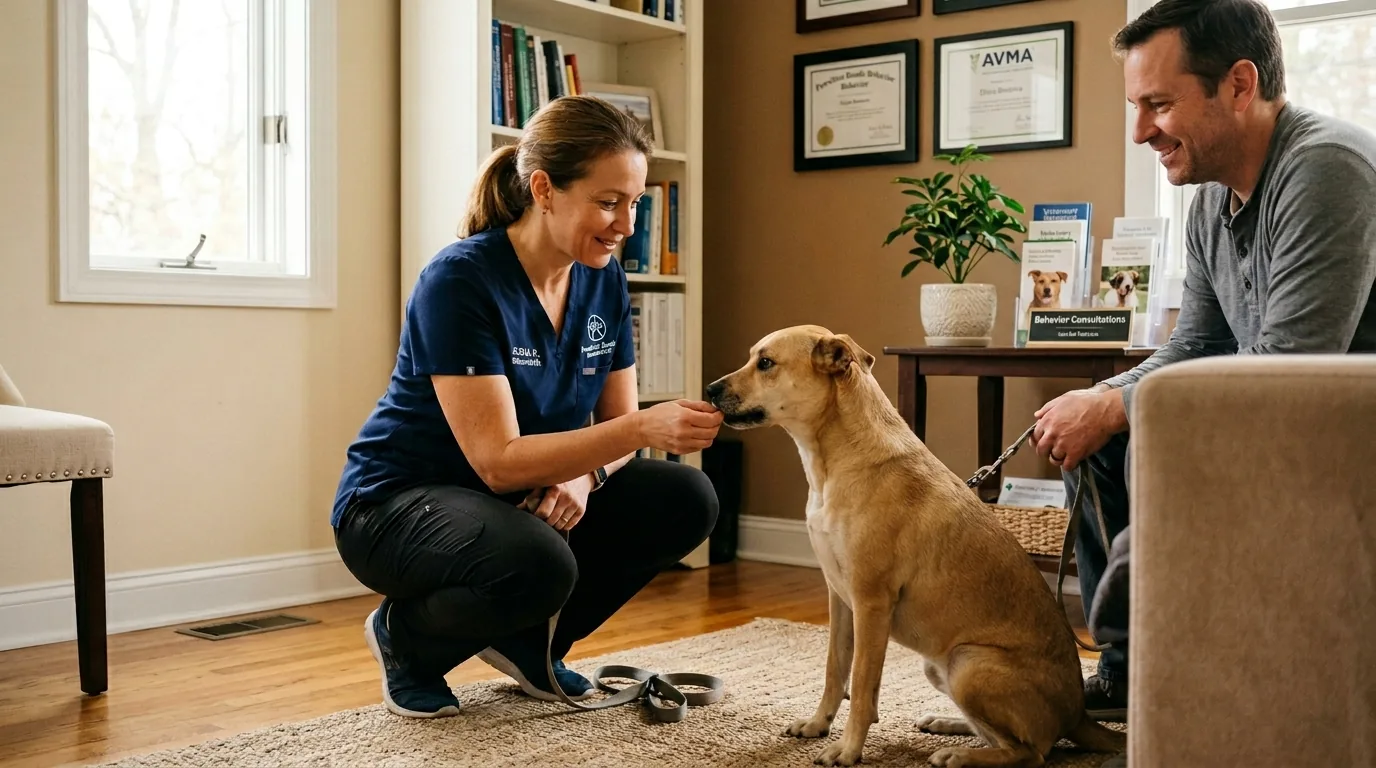
TL;DR. Pet behavior is an unregulated field. Anyone can call themselves a "trainer" or "behaviorist" — there's no licensing body, no required exam, no minimum standard. Seven credentials reliably signal evidence-based, force-free methodology: CSAT, CDBC, CCBC, Fear Free, KPA-CTP, CPDT-KA, and Dip. ACVB. This guide explains what each one means, when to use which, how to find one in your region, and the red flags that mean someone isn't credentialed at all.
Remote help can be appropriate for some cases, but the provider still needs verifiable credentials. Use the online dog behaviorist guide to compare formats, limitations and questions to ask before booking.
Why credentials matter — the unregulated-field problem
In the United States and most of Europe, there is no licensing body for "dog trainer" or "pet behaviorist." A person can register a business, build a website, charge $200 an hour, and call themselves a behavior consultant tomorrow — with zero training, zero exam, zero clinical hours. That isn't an exaggeration. It's the regulatory baseline.
The consequence is that the field has split. On one side, a body of credentialed professionals who completed coursework, sat exams, logged supervised hours, and committed to written codes of ethics anchored in the behavioral-science literature. On the other, a much larger pool of self-described trainers operating from television-era dominance theory — methods the American Veterinary Society of Animal Behavior has explicitly rejected as both ineffective and harmful (AVSAB Position Statement on Humane Dog Training, 2021).
The credentials below are the closest available proxy for evidence-based methodology. They aren't a guarantee of skill — no credential is — but they are a floor. Without one, you're hiring on vibes.
The 7 credentials, by use case
CSAT — Certified Separation Anxiety Trainer
Created by Malena DeMartini-Price, author of Treating Separation Anxiety in Dogs (Dogwise, 2014) and the clinician who effectively built the modern protocol for SA work. CSAT training is intensive — coursework, supervised case-work, ongoing CEU requirements — and the certification is specific to separation-related disorders. If you suspect separation anxiety, this is the credential to look for first.
Find one: malenademartini.com/csat-directory
CDBC — Certified Dog Behavior Consultant
Issued by the International Association of Animal Behavior Consultants. CDBCs are positioned for complex behavior cases — aggression, fear, reactivity, multi-dog household conflict — and the certification requires documented case experience, written case studies, mentor review, and adherence to IAABC's Least Intrusive, Minimally Aversive (LIMA) standard.
Find one: iaabc.org
CCBC — Certified Cat Behavior Consultant
The feline equivalent, also through IAABC. Cat behavior gets shorted in most training conversations, and the CCBC is the credential that closes that gap. Use for inter-cat conflict, litter-box breakdowns, fear-based aggression, or any complex feline case.
Find one: iaabc.org
Fear Free Certified Professional
Created by Dr. Marty Becker, the Fear Free certification trains veterinary staff, groomers, and trainers in low-stress handling — the techniques that keep a dog or cat under threshold during procedures most pets find aversive. Use Fear Free certification as a filter when choosing a vet, a groomer, or a daycare facility. It's also a strong secondary signal on a trainer's resume.
Find one: fearfreepets.com
KPA-CTP — Karen Pryor Academy Certified Training Partner
Karen Pryor was one of the original architects of clicker training in companion animals, and KPA-CTP is her academy's certification. The program is six months, includes supervised practical work, and is rooted in operant conditioning research. Strong fit for basic and intermediate training, puppy work, sport-dog foundations, and anyone whose primary need is reliable, force-free reinforcement-based instruction.
Find one: karenpryoracademy.com
CPDT-KA / CPDT-KSA — Certified Professional Dog Trainer
The Certification Council for Professional Dog Trainers issues both the Knowledge Assessed (KA) and Knowledge & Skills Assessed (KSA) versions. CPDT-KA is the most common rigor-tested trainer credential in the United States: required experience hours, a proctored exam, and continuing-education requirements. It's the right baseline credential for general training — obedience, manners, basic behavior modification.
Find one: ccpdt.org
Dip. ACVB — Diplomate, American College of Veterinary Behaviorists
The gold standard, and not close. A Diplomate of the ACVB is a licensed veterinarian who completed an additional three-year residency in clinical animal behavior and passed the board examination. There are roughly 100 of them practicing in North America. They can prescribe medication, conduct full medical workups, and handle the most severe cases — generalized anxiety, panic disorder, refractory aggression, complex polypharmacy. If a case has any medical component or any consideration of psychopharmacology, this is the credential.
Find one: dacvb.org
How to choose between them
A working decision tree:
- Separation anxiety → CSAT
- Aggression, fear, reactivity, or complex behavioral concerns → CDBC, CCBC, or Dip. ACVB
- Veterinary-clinic stress, grooming fear, husbandry handling → Fear Free Certified Professional
- Basic training through advanced obedience → CPDT-KA or KPA-CTP
- Any case where medication may be on the table → Dip. ACVB (only DVMs can prescribe)
- Cat-specific behavior cases → CCBC
Several of these credentials overlap in practice. A behavior consultant working a fear-aggression case may hold CDBC plus Fear Free plus a KPA-CTP — stacked credentials are common in the field. What matters is that at least one credential on the resume covers the specific case type.
What credentials don't fully signal
A credential is a floor, not a ceiling. Three things it does not tell you:
Whether the professional is right for your specific case. Two CDBCs may have radically different sub-specialties — one focused on resource guarding, one focused on dog-dog reactivity. Ask about case experience that matches yours before committing.
Whether your personal fit is good. Behavior work is collaborative. The professional is going to ask you to change daily routines, manage environments, and execute homework between sessions. That requires trust. Most credentialed professionals offer a free fifteen-to-thirty-minute discovery call — take it.
Whether an uncredentialed professional is necessarily bad. A small number of excellent practitioners are uncredentialed for legitimate reasons — they trained under a named behaviorist as an apprentice, they work in a country without strong certification infrastructure, they're early in their career. The test isn't the credential alone. It's whether they're openly aligned with AVSAB's force-free methodology and can name the science behind their approach. If they can't, the credential matters more.
Red flags — when someone is not credentialed (and you should walk away)
The dominance-based training industry is a real harm. It increases aggression, decreases obedience, and damages the human-animal bond. The data isn't ambiguous on this point — Herron, Shofer, and Reisner (Journal of Veterinary Behavior, 2009) surveyed owners using confrontational methods and found that techniques like alpha rolling, scruffing, and jowl-shaking produced aggressive responses from the dog at rates above 40%. Hitting the dog produced aggression in 43% of cases. These are not edge cases.
The following are walk-away signals. Any one of them is enough.
References to "alpha," "dominance," "pack leader," or "balanced training" on the website. The dominance model in domestic dogs has been formally retracted by the researcher who originated it (L. David Mech, 1999). A trainer who still uses this language is years behind the science. Cross-link: why dominance theory is wrong.
Use or recommendation of prong collars, e-collars (shock collars), choke chains, or "remote training collars." AVSAB explicitly recommends against aversive tools. A credentialed force-free professional will not have these on a price list.
Fixed-timeline guarantees. "Solve any behavior issue in four weeks." "Guaranteed results in one session." Behavior is not a four-week problem. Anyone promising a fixed outcome on a fixed schedule is either inexperienced or selling something.
"Alpha rolling," scruffing, "showing the dog who's boss," or any physical correction framed as discipline. These are the exact techniques Herron's data flagged as producing aggressive responses in over 40% of dogs.
Explicit endorsement of Cesar Millan's methodology. Millan's approach has been formally critiqued by the AVSAB, the ASPCA, and the American Animal Hospital Association. A trainer naming him as a reference is signaling alignment with a methodology the professional behavior community has rejected.
Cannot or will not cite specific behavioral-science sources. A credentialed professional should be able to name the literature behind their approach — AVSAB, ACVB, Overall, Yin, McConnell, Mech's retraction, the Herron paper. If the answer is "well, in my experience," and there's no science behind it, that's a signal.
The vet-first rule
Before booking any behavior professional, one rule overrides everything else: for any sudden behavior change in a previously stable pet, the first visit is the regular veterinarian. Not the behaviorist.
Pain, thyroid dysfunction, neurological events, dental disease, urinary-tract infection, gastrointestinal distress, vision loss, hearing loss, and dozens of other medical conditions present as behavioral changes — aggression, house-soiling, withdrawal, increased reactivity, restlessness, vocalization. A behaviorist working on a case that turns out to be medical is a behaviorist running a treatment plan against a moving target. Rule out the body first.
Karen Overall's Manual of Clinical Behavioral Medicine for Dogs and Cats (Elsevier, 2013) is explicit on this point: any behavior workup begins with a medical workup. Diplomates of the ACVB do both because they're licensed veterinarians. Non-vet behaviorists will refer back to your regular vet before opening a case.
What to expect from a first session
A first session with a credentialed behaviorist is not a quick training tip. The structure looks roughly the same across credentials:
- History-taking, 45-60 minutes. Acquisition history, medical history, daily routine, previous training, household composition, specific incidents with dates and context, video review where available. Expect to send paperwork in advance.
- Observation. In-home for complex cases (aggression, severe anxiety, multi-animal dynamics) — the professional needs to see the actual environment. Video review for cases that can be assessed remotely. Telehealth has become standard for portions of the workup since 2020.
- Written behavior plan. Concrete steps, sequenced, with environmental management changes first and training protocols second. A plan with no environmental management is not a plan.
- Follow-up sessions or check-ins. Behavior work is iterative. Expect at least one follow-up two-to-four weeks out, sometimes more depending on complexity.
If the first session is 30 minutes of generic advice and no written plan, you've hired the wrong professional.
Costs — set expectations
Rough national ranges, US, 2026 pricing:
- CPDT-KA basic training: $50-150/hour for group classes or single sessions
- KPA-CTP basic and intermediate training: $75-150/hour
- CDBC or CCBC consultation: $150-300/session, with packages typically running 3-5 sessions
- Fear Free veterinary behavior visits: vet-clinic standard pricing plus the underlying medical workup
- CSAT separation anxiety programs: typically structured as multi-week programs, $1,200-3,000 total
- Dip. ACVB: $300-500 initial consultation, $150-250 follow-ups, plus any pharmacology and medical workup
Most general health insurance does not cover behavior work, but several pet-insurance carriers have added behavioral-health coverage in the last few years — check the policy. The cost difference between a credentialed professional and an uncredentialed one is usually small. The outcome difference is not.
Try the at-home reading tool
The credentialed-behaviorist visit is the right call for serious, complex, or escalating cases. For everything else — daily reading practice, low-grade stress signals you want to catch early, the steady work of understanding your own animal — the at-home tool is sufficient.
PetTranslator.ai is built around the same observable-signals framework a behaviorist uses on a first session. Upload one clear photo of your dog or cat and the AI returns a structured report: biometric markers it can see, behavioral interpretation, an action plan. It won't replace a behaviorist on a complex case. For the daily reading that catches problems before they need a behaviorist, it works.
Sources
- AVSAB Position Statement on Humane Dog Training (2021) — American Veterinary Society of Animal Behavior. The professional standard for force-free, evidence-based methodology and the explicit rejection of aversive techniques.
- Herron, M. E., Shofer, F. S., Reisner, I. R. (2009). "Survey of the use and outcome of confrontational and non-confrontational training methods in client-owned dogs showing undesired behaviors." Journal of Veterinary Behavior, 4(4). The dataset behind the aggression rates cited in the red-flags section.
- DeMartini-Price, M. (2014). Treating Separation Anxiety in Dogs. Dogwise. The clinical protocol behind the CSAT certification.
- Overall, K. (2013). Manual of Clinical Behavioral Medicine for Dogs and Cats. Elsevier. The clinical reference for the medical-workup-first approach.
- American College of Veterinary Behaviorists — dacvb.org. Public credential standards for the Dip. ACVB pathway.
For owners working with a specific behavior concern, the IAABC, CCPDT, ACVB, and AVSAB websites each maintain searchable directories of credentialed positive-reinforcement professionals by region.
Khabir Mughal is the founder of PetTranslator.ai. This article was reviewed against the AVSAB Position Statement on Humane Dog Training, the Herron et al. (2009) dataset, and the public credential standards of the ACVB, IAABC, and CCPDT before publication.