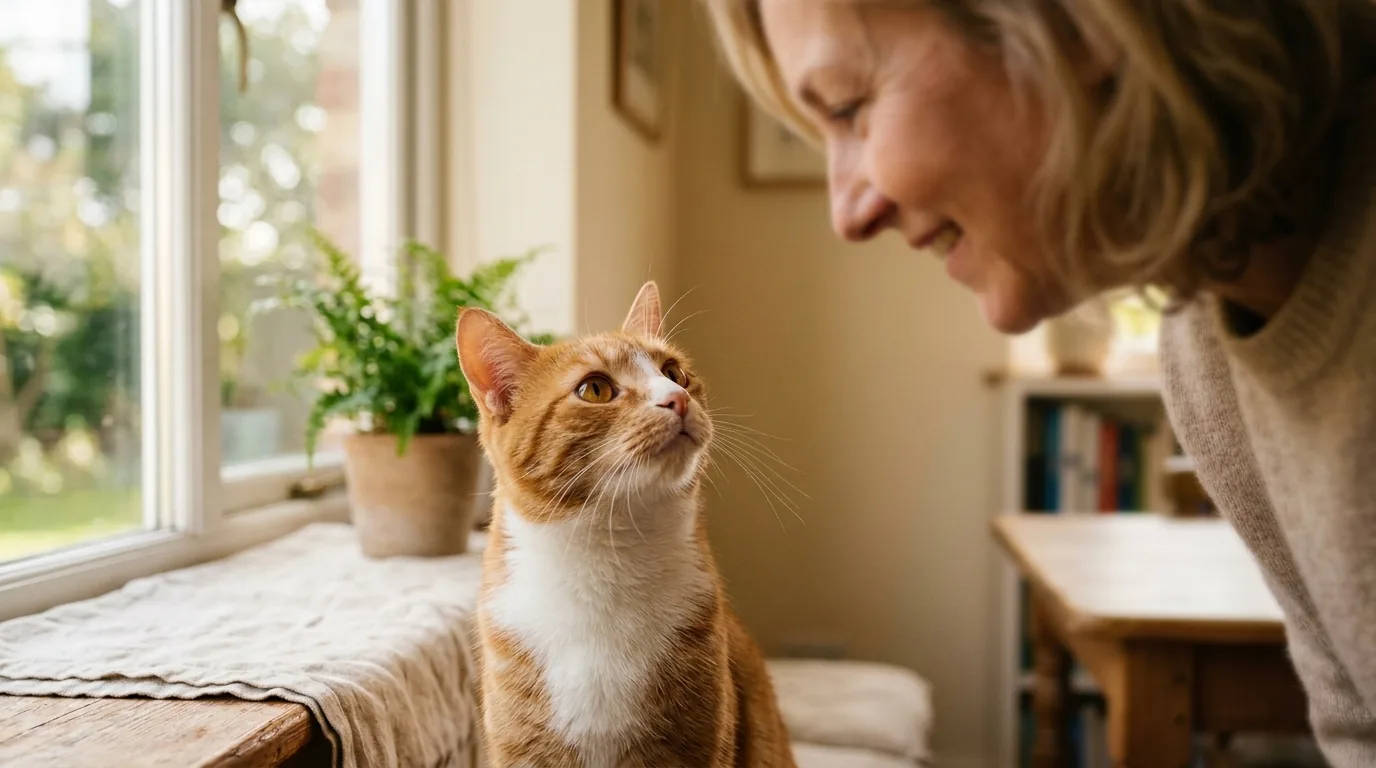
TL;DR. Cats discriminate human emotional displays — tone of voice, facial expression, scent — though the literature is younger and thinner than what exists for dogs. They recognize their own name when spoken aloud (Saito et al. 2019). They behave differently around familiar and unfamiliar people. They don't appear to understand emotion in a cognitively rich way. But they do respond to your emotional state, often more than their owners realize, and they form genuine attachment bonds that look a lot like the ones dogs form.
Why cat research is harder than dog research
For most of the last fifty years, cats were studied less than dogs because they don't perform well in laboratory testing. That's a methodological problem, not a cognitive one. A Border Collie taken into a lab will work for praise, food, or a clicker; a cat will sit under the table and wait for the experimenters to leave. The behavior researchers wanted to measure — choice, attention, social referencing — was being suppressed by the testing environment itself.
The fix has been to move the work into the home. Most usable cat cognition research from the last decade was done in the cat's own living room, with the owner present and the experimenter staying out of the room as much as possible. That methodology produces less data per session than a dog lab does, but the data it produces is real. The result is that what we now know about cats is more recent, more limited, and more honest about its limits than what we know about dogs.
That backdrop matters for the rest of this guide. When the article says "cats appear to do X," it usually means a small number of studies with sample sizes in the dozens, replicated less often than the equivalent dog work. The signal is there. The literature is just newer.
Cats recognize their own names
The clearest published finding in cat cognition is the name-recognition study by Saito, Shinozuka, Ito, and Hasegawa (2019, Scientific Reports): Domestic cats (Felis catus) discriminate their names from other words. Seventy-eight cats — household pets and cats living in cat cafés — heard their own name read aloud in a sequence of four similar-sounding nouns. The cats habituated (stopped responding) to the unfamiliar nouns and then showed a measurable behavioral response — ear movement, head turn, tail flick — when their own name came up.
The effect held when the name was spoken by a stranger rather than the owner. It held in the café cats too, though more weakly. The authors were careful in their language: they did not claim cats understand a name as a referential symbol the way a human child does. They claimed cats discriminate the acoustic pattern of their name from other similar words. That's a meaningful, narrowly defined cognitive ability — and it was the first peer-reviewed demonstration of it.
For owners, the practical takeaway is simple. Your cat hears their name. The cat who doesn't come when called is making a choice, not failing to recognize the cue.
Cats follow human pointing — sometimes
A separate line of research has tested whether cats can use human gestural cues to find hidden food, the way dogs do. Miklósi and colleagues (2005) ran cats and dogs through the same pointing task. Cats followed the pointing gesture above chance — the gesture worked — but they were less consistent than dogs, and they more often gave up and tried to solve the task on their own.
Pongrácz and Onofer (2020, Animal Cognition), in Cats show an unexpected pattern of response to human ostensive cues in a social referencing task, extended this. They found that cats use ostensive cues (eye contact, name-calling, directed attention) from humans, but in a pattern that isn't a perfect match for the dog pattern. Cats appear to attend to the human, take the social cue as useful information, and then weight that information differently — they don't defer to the human handler the way dogs do.
The interpretation is that cats have adapted to read human communicative cues during ten thousand years of domestication, but they didn't adapt the same way dogs did. Dogs evolved alongside humans as cooperative working animals, and their social cognition leans heavily on the human's signal. Cats evolved alongside humans more as commensal hunters, and their social cognition treats the human's signal as one input among several.
Cats discriminate happy from angry faces
Galvan and Vonk (2016, Animal Cognition) ran the foundational study on cat reading of human emotion: Man's other best friend: domestic cats (F. silvestris catus) and their discrimination of human emotion cues. Twelve cats were shown photographs of their own owners with either a smiling or a frowning facial expression, paired with audio of the owner's voice.
The cats showed measurably different behavior to the smiling owner — more approach, more positive-affect signals, more time in contact — than to the frowning owner. When the same test was run with photographs of strangers, the discrimination effect was much weaker. The cats responded more strongly to the emotional displays of the person they lived with than to a generic human face.
The authors interpreted this as learned discrimination rather than innate emotion-reading. The cats had spent years observing a specific human's facial patterns and the consequences that followed each pattern. They had built an associative model of "what comes after this face." That model didn't transfer well to strangers.
For owners, the implication is direct: your cat reads your face, and the more time you've spent together, the better they read it. They aren't reading emotion in the abstract. They're reading your emotion, and they've been working on the model the whole time they've lived with you.
Cats form attachment bonds — at rates comparable to children
The Vitale, Behnke, and Udell study (2019, Current Biology), Attachment bonds between domestic cats and humans, applied the Ainsworth Secure Base Test — the same paradigm used to classify infant attachment styles — to seventy adult and kitten cats. The cat spent two minutes in an unfamiliar room with their owner, two minutes alone, and then two minutes after the owner returned. The reunion behavior was scored against the standard human-infant classification.
About sixty-five percent of the cats showed a secure attachment pattern — they greeted the returning owner and then resumed exploring the room, treating the owner as a secure base. About thirty-five percent showed an insecure attachment pattern — excessive contact-seeking, avoidance, or ambivalence. Those proportions are comparable to what's seen in human-infant studies and in earlier dog-attachment work.
This study punctured a particular myth. Cats are not transactional roommates who tolerate humans for food. The attachment bond is real, and it's measurable using the same methodology developmental psychologists use on human infants.
What cats don't appear to do
Three claims commonly made about cats are not supported by the current research.
Cats don't appear to understand the cause of a human emotion. Reading a face is not the same as reading a mind. Galvan and Vonk's finding is that cats associate "smiling face + warm voice" with one kind of follow-up and "frowning face + sharp voice" with another. There's no evidence cats build a model of why the human is happy or sad. That's theory of mind, and there's no published cat evidence for it.
Cats are less consistent than dogs at human-social tasks. This is a finding, not a deficiency. In direct head-to-head testing on pointing tasks, social referencing tasks, and impossible-task paradigms (where the animal has to look to a human for help), dogs solve the social problem more readily. Cats often solve the non-social version of the same problem more readily. The two species are adapted to different cognitive niches.
The "aloof cat" stereotype is wrong, but cats do signal more subtly than dogs. A dog who's happy to see you may bounce, wag, and vocalize across an entire room. A cat who's happy to see you may slow-blink, sit nearby, and orient their body toward you. Both are attachment signals. The cat's version is smaller, slower, and easier to miss — which is why owners often think their cat doesn't care when, behaviorally, the bond is intact.
What this means for living with cats
A few practical takeaways follow directly from the research above.
Your cat reads your tone and your face. They know when you're angry, anxious, or relaxed — and the longer you've lived together, the better they read it. If you walk in tense from work, your cat is already processing the data before you've put down your keys.
Your emotional state affects their stress level. This isn't sentimentality. Cats in chronically high-arousal households show more stress-related behavior — overgrooming, inter-cat aggression, lower-urinary-tract symptoms — than cats in calmer environments. Reducing your own arousal around the cat is part of behavioral husbandry.
Slow-blink is bidirectional communication. Humphrey, Mansfield, Mills, and Ellis (2020, Scientific Reports), in The role of cat eye narrowing movements in cat-human communication, showed that when humans slow-blink at cats, the cats are more likely to slow-blink back and more likely to approach. The behavior is a low-arousal affiliative signal that works in both directions across the species line. (More on the full repertoire in our cat body language guide and the slow-blink deep dive.)
The attachment is real. Vitale et al.'s finding is that the cat-human bond meets the same behavioral criteria used to identify attachment in human infants. The cat isn't only there for the food.
What it does not mean
A handful of overreaches are easy to slide into and worth heading off.
Your cat doesn't understand why you're sad. They register the signal — flat voice, slumped posture, withdrawn interaction — and they respond to it. They don't model the breakup, the job loss, or the bad news that caused it. Cat empathy, to the extent it exists, is contagion of emotional state rather than perspective-taking.
Behavioral neutrality from a cat doesn't mean indifference. A cat who's lying still, eyes half-closed, body relaxed across the room from you is not ignoring you — they're in a low-arousal affiliative state. That's a content cat in your company. The signaling is subtler than a dog's, not absent. (For more on the failure mode of treating cat behavior like dog behavior, see do pet translator apps work.)
Try it on your own cat
The same framework researchers use in the home environment is the framework PetTranslator.ai uses on the photos and short clips you upload — ear set, eye state, body orientation, contextual posture. The AI returns a structured read of what the cat is signaling and a behavioral interpretation grounded in the literature above. For routine observation it's a useful instrument. For a complex behavior case, work with a credentialed feline behavior consultant.
Sources
- Saito, A., Shinozuka, K., Ito, Y., Hasegawa, T. (2019). Domestic cats (Felis catus) discriminate their names from other words. Scientific Reports 9, 5394.
- Galvan, M., Vonk, J. (2016). Man's other best friend: domestic cats (F. silvestris catus) and their discrimination of human emotion cues. Animal Cognition 19, 193–205.
- Vitale, K. R., Behnke, A. C., Udell, M. A. R. (2019). Attachment bonds between domestic cats and humans. Current Biology 29, R864–R865.
- Humphrey, T., Mansfield, L., Mills, D. S., Ellis, S. (2020). The role of cat eye narrowing movements in cat-human communication. Scientific Reports 10, 16503.
- Pongrácz, P., Onofer, D. L. (2020). Cats show an unexpected pattern of response to human ostensive cues in a social referencing task. Animal Cognition 23, 1003–1015.
- Miklósi, Á., Pongrácz, P., Lakatos, G., Topál, J., Csányi, V. (2005). A comparative study of the use of visual communicative signals in interactions between dogs and humans and cats and humans. Journal of Comparative Psychology 119, 179–186.
- Bradshaw, J. (2013). Cat Sense: How the New Feline Science Can Make You a Better Friend to Your Pet. Basic Books.
- Ellis, S., Bradshaw, J. (2016). The Trainable Cat. Penguin.
For owners working through a specific behavior concern, the IAABC Cat Division and the American College of Veterinary Behaviorists maintain searchable directories of credentialed feline-focused practitioners by region.
Khabir Mughal is the founder of PetTranslator.ai. This article was reviewed against the peer-reviewed cat cognition literature cited above before publication.