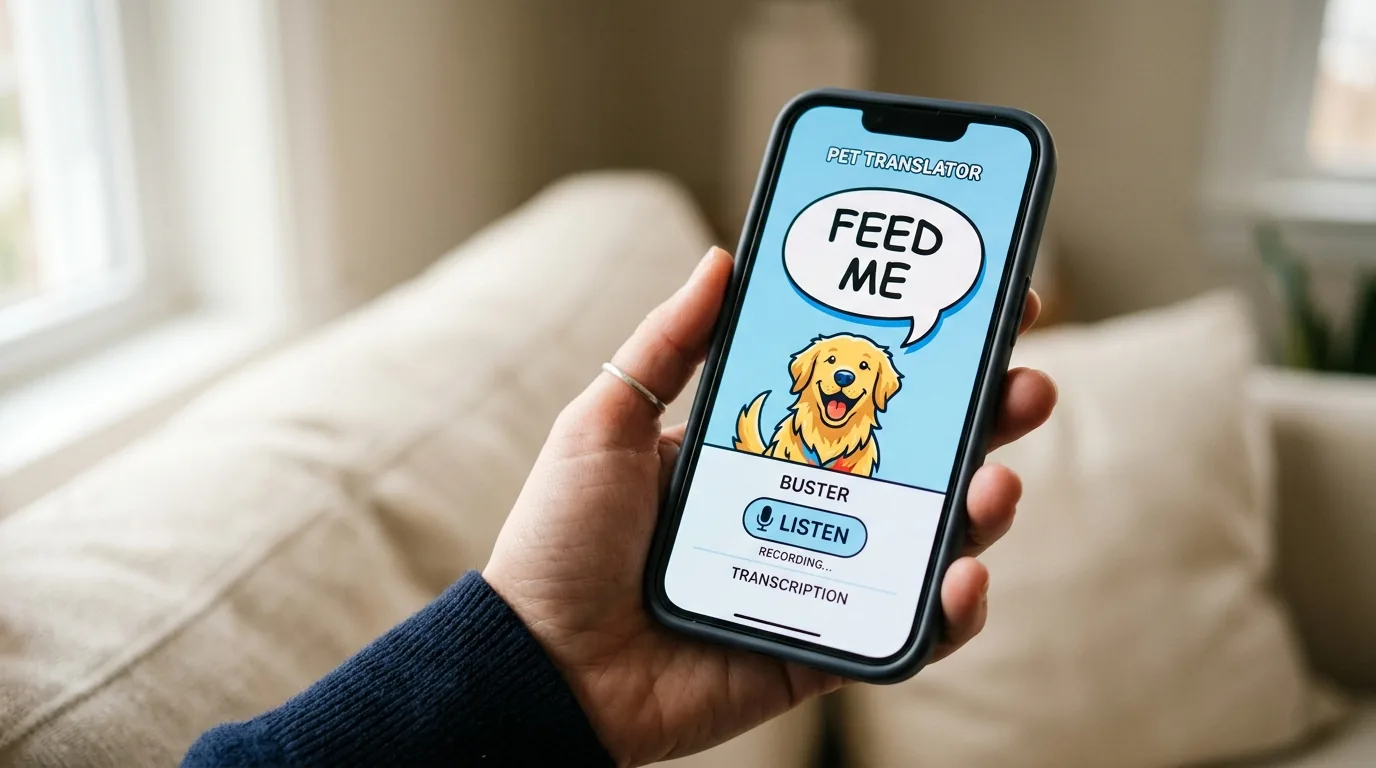
Most consumer pet translator apps do not translate a bark or meow into a sentence. Many create entertainment captions. More useful tools may classify sound patterns or organize visible body-language signals, but the result is still an interpretation and should make uncertainty clear.
The practical alternative is structured behavior analysis from a photo or short video: observable markers are recorded first, interpretation is kept separate, and uncertainty stays visible.
What "pet translator" apps usually do
Open the App Store, search "dog translator" or "cat translator," and you get a recognizable pattern. The dominant entries in this category as of 2025 share a near-identical product loop:
- The user holds the phone near the pet.
- The app records a short audio clip — a bark, a meow, a whine.
- After a brief loading animation, the app returns a cartoon speech bubble with text like "I'm hungry!" or "Take me outside!" or "I love you."
- The user laughs, screenshots it, and shares it.
That last step is the actual product. These apps aren't sold as diagnostic instruments. They're sold as social-media content generators, and the "translation" is a narrative device, not a measurement. A handful of the top-grossing entries don't even use the recorded audio — internal teardowns by independent reviewers have shown that the caption is selected from a short list before the recording finishes processing.
A few apps in the category attempt something slightly more substantive. They classify a bark into one of a small number of buckets — alert, playful, anxious — and then return a phrase associated with that bucket. The classification step is real audio analysis. The phrase that gets returned to the user is still a stylized caption, not a translation.
Either way, the user walks away with a sentence that has the grammatical shape of human speech. And that's where the trouble starts.
Why this can't work in the way it claims to
The deeper problem isn't whether the audio model is accurate. It's that the entire framing — bark goes in, sentence comes out — has no grounding in how dogs or cats actually communicate.
Dogs don't have sentence-level cognition. This is the consensus position across the contemporary animal-cognition literature, and it's the starting point for any serious behavior framework. Stanley Coren's How Dogs Think (Free Press, 2004) summarizes the evidence: dogs operate with associative and emotional cognition, not propositional cognition. A dog can learn that a specific cue predicts a specific outcome — the leash means a walk, the bowl means dinner — but a dog isn't constructing a sentence like "I would like to go for a walk now" in any neurological sense and then encoding that sentence into a bark.
John Bradshaw, in In Defence of Dogs (Penguin, 2011), makes the related point that dog communication is overwhelmingly visual and chemical, not vocal. The bark is a relatively crude signal compared to the precision of ear position, eye state, tail carriage, and lip line. When researchers want to know what a dog is feeling, they don't analyze the bark — they watch the body. The bark adds context. It rarely carries the primary signal.
Patricia McConnell, whose The Other End of the Leash (Ballantine, 2002) is the standard reference on the asymmetry between dog and human communication, puts it more directly: humans are a primarily auditory-linguistic species, dogs are a primarily visual-postural species, and the gap between those two systems is exactly why owners misread their dogs so often. A translator app that converts a bark into an English sentence is reinforcing the wrong direction of that asymmetry. It's training the owner to keep listening for words when the dog has been signaling with their body the entire time.
Karen Overall's Manual of Clinical Behavioral Medicine for Dogs and Cats (Elsevier, 2013) — the clinical reference used by board-certified veterinary behaviorists — doesn't include vocalization analysis as a primary diagnostic tool for the same reason. The clinical workflow is observational. A behaviorist watches a dog for an extended period, codes the body language, and only then considers vocalization as context. The bark is data. It isn't the data.
Cats are even further from the framing. Adult domestic cats don't meow at other adult cats with any regularity — the meow is a vocalization that cats developed specifically to communicate with humans, and the meaning of any given meow is almost entirely dependent on the individual cat and the context. Two cats in the same household can use a near-identical meow to mean two different things. Any app that returns a universal translation for a meow is, by definition, making it up.
None of this is to say that vocalization is meaningless. A growl is a communication signal. A pitch-shifting bark sequence carries arousal information. A purr can indicate contentment or self-soothing under stress depending on the context. These signals are useful — they're just not sentences, and treating them as sentences leads owners to act on a story the app generated rather than on what the animal is actually doing.
What dogs and cats DO communicate through
Here's the part most translator apps skip past entirely. Animal communication is mostly visual, and most of it is happening on a timescale of a half-second to two seconds — fast enough that an inattentive owner misses it, slow enough that a camera can catch it.
The observable markers a behaviorist reads, in rough order of information density:
- Ear position. Forward, neutral, pinned, airplane. Read together with eye state and body posture.
- Eye state. Soft eye, hard stare, whale eye, squint, blink rate.
- Lip line. Loose, long C-shape, tight, lip lick out of context.
- Tail position and motion. Position (high, mid, low, tucked) carries more information than motion (slow, wide, helicopter, narrow).
- Body posture and weight distribution. Settled, forward-shifted, back-shifted, crouched, stiff and still.
- Hackles. Indicator of arousal, not aggression by itself.
- Vocalization context. Pitch, spacing, modulation, and whether the vocalization fits the body language or contradicts it.
For a more granular walkthrough of each of these, see Dog Body Language: A Behaviorist's Field Guide and Cat Body Language: A Behaviorist's Field Guide. The short version is that an owner who can read these clusters in real time is doing what a credentialed behaviorist does in a consultation room. An app that captions a bark isn't.
What a legitimate AI pet tool CAN do
There's a defensible technical product in this space, and it isn't translation. It's behavioral observation from visible markers.
The pipeline looks like this. The user uploads a clear photo or short video of their pet. A computer-vision model — image classification plus pose estimation, the same family of models used in clinical gait analysis and sports biomechanics — extracts a set of observable features: ear angle, eye openness, lip retraction, tail position, weight distribution, hackle state. Each feature is scored with a confidence value. A behavioral-interpretation layer then applies a published framework — Overall's clinical observation criteria, Rugaas's calming-signal taxonomy, the AVSAB-aligned positive-reinforcement framework — to translate the feature set into a probability distribution over internal states. Relaxed. Aroused. Stressed. Fearful. In conflict.
The output isn't "I'm hungry." The output is closer to "this dog is showing three displacement-stress markers at moderate intensity; recommend reducing the environmental trigger before continuing the interaction." That's not a sentence the dog is saying. That's an observation about what the dog's body is doing, framed in the same language a behaviorist would use in a consultation note.
This is what PetTranslator.ai does, and it's the only kind of "pet AI" claim that holds up to scrutiny. The framing matters: this is image classification with a behavioral-science interpretation layer, not translation. The tool reads what's visible. It doesn't invent what isn't.
A useful test for any tool in this category: ask whether the output could be produced by a competent behaviorist looking at the same photo. If the answer is yes, the tool is doing observation. If the answer is "no, because no behaviorist would write 'Walkies!' as a clinical note," the tool is doing entertainment.
How to evaluate any pet-AI tool
Four questions separate the defensible products from the rest. Run any tool you're considering — including PetTranslator.ai — through this checklist.
1. Does it claim to translate words or sentences? This is the loudest red flag. A tool that returns "I want food" or "Take me out" as the output of a bark-analysis pipeline is making a claim the underlying science doesn't support. The honest framing is observation: "this dog appears alert and oriented toward the door." If the marketing copy uses the word translate in the linguistic sense, treat it as entertainment.
2. Does it cite primary behavioral-science sources? A defensible tool can name the framework it's working from. Overall's Manual. Rugaas on calming signals. The AVSAB position statements. Bradshaw, McConnell, Coren. If the product page doesn't reference any primary literature, the tool is probably operating on a custom rule set that hasn't been validated against the clinical standard.
3. Does it return confidence scores honestly? Real behavioral assessment is probabilistic. A photo of a dog with pinned ears, a closed mouth, and a still body is probably showing high-grade caution — but probably, not definitely. A tool that returns "stressed: 87%" is being more honest than a tool that returns "stressed!" with no calibration. Watch for products that overstate certainty.
4. Does it default to "consult a professional" for serious behaviors? Aggression toward humans or other animals, severe separation distress, stereotypic behaviors, sudden personality change — none of these belong in an AI tool's recommendation surface. A defensible product routes serious behaviors to credentialed positive-reinforcement professionals (IAABC, CDBC, CSAT, Fear Free, KPA-CTP) rather than offering a fix in the chat. A tool that confidently prescribes a training plan for a biting dog is overreaching its scope.
A bonus question, which most owners forget to ask: does the tool tell you when it doesn't know? A behaviorist will say "I can't read this dog from this angle, can you reposition the camera?" An entertainment-tier app will return a caption no matter what you upload — including photos of objects that aren't animals, which several reviewers in the category have demonstrated.
What the honest answer to the headline question is
So — do pet translator apps actually work?
Most of the ones marketed under that name do not, because the thing they claim to do isn't a thing that can be done. Dogs and cats aren't producing sentence-encoded vocalizations for a model to decode. The science doesn't support the framing, and the products built on the framing are entertainment.
A different category of tool — one that reads body language against a published behavioral framework and returns calibrated observations rather than captions — can be genuinely useful. It functions as a reading-practice instrument for owners learning to interpret their own pet, and as a structured second opinion on observable markers. It is not a substitute for a credentialed behaviorist on a serious case, and any tool that claims otherwise is overreaching.
The difference between the two categories is roughly the difference between a horoscope app and a clinical questionnaire. Both involve a screen, a tap, and a result. Only one of them is trying to be accurate.
Frequently asked questions
Are dog translator apps real?
The apps are real, but a generated phrase is not a literal translation of a bark. Some products analyze audio patterns; others return entertainment captions. Check what the app actually measures and whether it explains uncertainty.
Can AI understand what a dog or cat is feeling?
AI can identify patterns in sound, posture, movement or facial features. Those patterns may support a cautious interpretation, but they do not reveal a pet's thoughts or prove one emotional state from a single clip.
What makes a pet behavior tool more trustworthy?
Look for observed markers before interpretation, clear confidence limits, no mind-reading claims, transparent sources, and a veterinary or behavior-professional referral when the visible pattern could involve pain, illness or bite risk.
Try the alternative on your own pet
PetTranslator.ai is built on the observation-and-interpretation framework described above. Upload one clear photo and the tool returns a structured report — the biometric markers it can see, the behavioral interpretation drawn from Overall and Rugaas, and an action plan that defaults to "consult a professional" for any pattern that warrants it. It isn't translation, and the product copy doesn't pretend otherwise.
Sources
The framework and citations in this review are drawn from:
- Karen Overall, Manual of Clinical Behavioral Medicine for Dogs and Cats (Elsevier, 2013) — the clinical reference for behavioral observation and diagnosis used by board-certified veterinary behaviorists.
- John Bradshaw, In Defence of Dogs (Penguin, 2011) — for the argument that dog communication is primarily visual and chemical rather than vocal.
- Patricia McConnell, The Other End of the Leash (Ballantine, 2002) — for the asymmetry between human auditory-linguistic communication and dog visual-postural communication.
- Stanley Coren, How Dogs Think (Free Press, 2004) — for the contemporary summary of dog cognition as associative and emotional rather than propositional.
- AVSAB Position Statement on Humane Dog Training (American Veterinary Society of Animal Behavior, 2021) — the professional standard for force-free, evidence-based behavior work.
- Turid Rugaas, On Talking Terms with Dogs: Calming Signals (Dogwise, 2nd edition 2005) — the foundational work on displacement and appeasement signals.
For owners working through a serious behavior concern, the IAABC and AVSAB websites both maintain searchable directories of credentialed positive-reinforcement professionals by region.
Khabir Mughal is the founder of PetTranslator.ai. This review was written against the AVSAB Position Statement on Humane Dog Training and Karen Overall's Manual of Clinical Behavioral Medicine, and the critique of the consumer pet-translator category applies equally to PetTranslator.ai when measured against the same checklist.