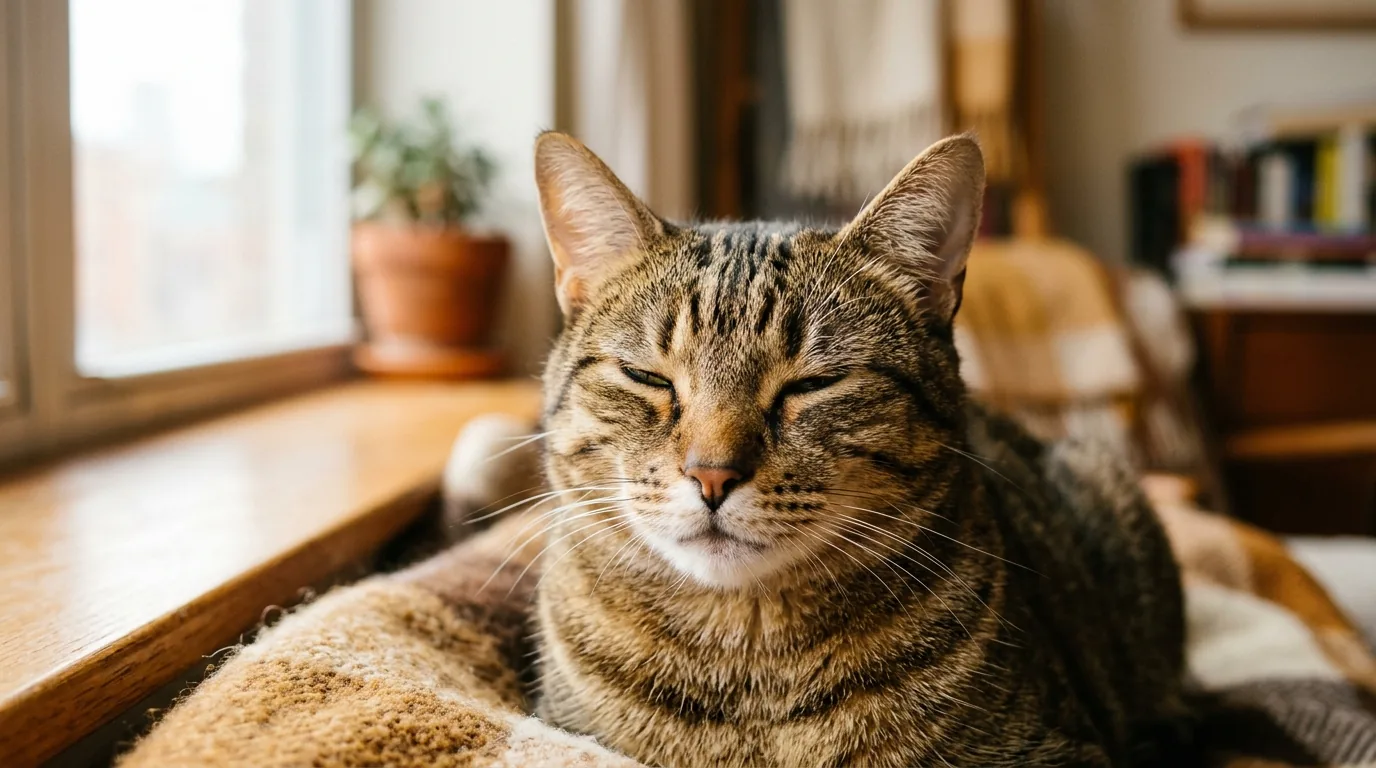
Cats are harder to read than dogs. Their signaling evolved for a solitary hunter, not a pack communicator, and most of what a cat tells you is delivered in millimeters — a half-rotation of the ear, a one-second pupil change, a whisker that drops a few degrees against the cheek. Owners who learn to watch at that resolution stop being surprised by their cat. This guide walks through every region a board-certified feline behaviorist reads, with what each pattern typically means and the misreads that cost owners trust with their animal.
It's the same framework PetTranslator.ai uses to analyze the photos you upload. No anthropomorphic guesswork. No "she's just being dramatic." Just signals.
Why cats are harder to read than dogs
The domestic cat (Felis catus) descends from Felis silvestris lybica, the African wildcat — a solitary, territorial, ambush predator. Domestic dogs descend from group-living canids whose survival depended on broadcasting state across distance to keep the group coordinated. The signaling systems reflect those evolutionary histories. Dog body language is high-amplitude and designed to be read at twenty paces. Cat body language is low-amplitude and designed to be read at arm's length, mostly by the cat itself making distance-management decisions about whether to approach or withdraw.
John Bradshaw, in Cat Sense (Basic Books, 2013), makes the point that most cat-to-cat signaling is about regulating distance — keeping unwanted social contact away while preserving territory. A cat who has lived alongside another cat for years may still be using subtle distance-increasing signals their owner has never noticed. The owner sees two cats sharing a couch; the cats see a delicate ongoing negotiation about who passes whom on the stairs.
This is why owners routinely report being "ambushed" or "bitten out of nowhere." The cat almost never strikes out of nowhere. The signals were there — they were just below the resolution most humans habitually watch at. The first job of reading cats is recalibrating that resolution.
A second consideration: cats hide pain and illness with extraordinary efficiency, a behavior that almost certainly traces to their evolutionary history as small predators who were themselves prey for larger animals. A cat showing reduced grooming, increased hiding, altered posture at the litter box, or a slight tail change after a window-watching incident is broadcasting something. Owners who learn the resting baseline can spot the deviation.
The reading framework
A feline behaviorist never reads one signal in isolation. Ears, eyes, whiskers, tail, body, and context are read together. A purr in a cat curled on your chest is not the same signal as a purr in a cat at the emergency vet, and treating them as the same is how owners miss the moment their cat is asking for help.
The same rule applies when a cat slaps with one paw: target, trigger, tension and the movement that follows matter more than the raised paw alone.
Five rules guide every read:
- Read at least four signals before drawing a conclusion.
- Watch for change against the cat's own resting baseline, not against a textbook cat.
- Weigh signals against the context the cat is in — environment, presence of other animals, recent events.
- Account for breed-specific features (a Scottish Fold's folded ear can't pin; a Persian's flat face hides the whisker line).
- When two signals conflict, the more stressed signal usually leads — and in cats, the more stressed signal is often the smaller one.
Now the body regions.
Ears
Cat ears have over thirty muscles and can rotate nearly 180 degrees independently. They're one of the fastest-changing signals on the animal and one of the most diagnostic.
Neutral. Ears upright and facing forward, base relaxed, no tension in the surrounding fur. The cat is calm and ambient — taking in the room without committing attention to any single source. This is the baseline a healthy cat returns to between events.
Forward. Ears rotate slightly more forward than neutral, the base lifts. This signals focused interest — a sound, a bird at the window, a treat being unwrapped. Forward ears with forward whiskers and dilated pupils against a target is a predatory-attention combination, not a friendly approach.
Sideways or "airplane." Ears flare outward, the tips angling away from each other. This is a conflict or low-grade caution signal — the cat has signals pulling in two directions and is unsure whether to engage or withdraw. Owners often misread airplane ears as "annoyed" when the cat is closer to nervously assessing. More on this pattern in cat airplane ears.
Flat or pinned. Ears drop and rotate back until they're pressed against the skull, sometimes nearly disappearing into the fur. This is high-grade caution or defensive arousal. A cat with pinned ears is preparing to either bolt or strike — give space, don't reach. Karen Overall, in Manual of Clinical Behavioral Medicine for Dogs and Cats (Elsevier, 2013), classes pinned ears as one of the most reliable feline aggression-precursor signals.
Twitching. Ears flick or rotate rapidly without settling. In a cat at rest this is often auditory tracking — picking up faint sounds humans don't register. In a cat already showing other stress markers it can indicate sensory overload, which is common in households with sudden noise events or in multi-cat conflicts.
Eyes
Cat eyes carry more information per square millimeter than almost any other region. Pupil shape is the key variable owners under-watch.
Soft eye. Lids relaxed, the surface not held wide, the cat blinks at a normal slow rhythm. This is the resting baseline. A soft eye in a familiar context is a strong signal the cat is comfortable.
Slow blink. The cat half-closes its eyes in your direction, holds the closure for a beat, then reopens. This is associated with affiliative signaling in cats — Humphrey, Mancini, and Proops (2020, Scientific Reports) found that cats slow-blinked more in response to slow-blinking humans, and that this pattern correlated with greater approach behavior. It's the closest thing to a friendly handshake the species offers. Full breakdown in cat slow blink meaning.
Hard stare. Pupils fixed, lids open, no blinking for several seconds. As in dogs, this is rarely affection. It's intense focus — on prey, on a perceived rival, or on a person the cat is uncertain about. A hard stare with a low body and tense whiskers is a high-grade caution signal.
Half-closed. Lids drop to about half their range, the cat may seem dozy. In a familiar context with the cat curled in their resting spot this is calm-bordering-sleep. In an unfamiliar context — a vet exam room, a new household — half-closed eyes alongside other stress signals can indicate shutdown rather than comfort. The two presentations look almost identical and are separated only by context.
Fully dilated pupils. The black of the pupil expands until almost no iris is visible. In low light this is mechanical. In normal light it indicates high arousal — fear, defensive readiness, or the moment before a predatory pounce. The cat's arousal is high; the valence (positive or negative) comes from the rest of the body.
Pinpoint pupils. The pupil contracts to a vertical slit. In bright light this is mechanical. In normal light, especially paired with a hard stare and forward-tipped whiskers, it indicates focused predatory or offensive arousal. A cat with pinpoint pupils locked on something has committed attention; if that something is your hand approaching their food bowl, the body will tell you the rest.
Whiskers
Whiskers are an under-read region, partly because most owners don't realize how mobile they are. The mystacial whiskers (on the cheek pads) carry the most signal weight.
Forward. Whiskers fan out toward the front of the face. This indicates active interest, predatory focus, or curiosity — the cat is reaching out with its sensory field to a target. Forward whiskers in play context is one of the clearer affiliative signals.
Neutral. Whiskers held at rest, roughly perpendicular to the face. The cat is ambient and uncommitted.
Flattened against the cheeks. Whiskers drop and lay back against the cheek pads, sometimes disappearing into the fur. This is a fear or appeasement signal — the cat is reducing its sensory profile alongside reducing its visual one. Flattened whiskers with pinned ears and a tucked tail is a clear high-stress combination; the cat is asking for the situation to end.
Whisker line is a fast read once you've trained your eye to it. It changes within a second of the cat's internal state changing, often before the ears finish moving.
The dedicated guide to cat whisker positions explains why forward whiskers can appear during curiosity, hunting, conflict or pain, and why the rest of the face must change the interpretation.
Tail
Tail is the signal most owners do try to read in cats, and it's also the one most often misread because cat tail meaning doesn't translate from dog tail meaning. A high tail in a cat is friendly; a high tail in a dog is high arousal of unspecified valence. The vocabulary doesn't cross species. Cross-reference: dog body language. A deeper map of every position lives in cat tail meanings.
Position.
- Upright, straight up. Friendly greeting signal, often with a slight curve at the tip. Cats use this to greet familiar humans and bonded conspecifics. Cameron-Beaumont's work at the University of Southampton, cited in Bradshaw's Cat Sense, identified the upright tail as a primary feline affiliative greeting.
- Question mark. Tail upright with a hook at the tip. A relaxed, sociable invitation — often the precursor to approach for petting or food. One of the most reliable positive-affect signals in adult cats.
- Held horizontally. Neutral observation, no strong affect either way.
- Low or tucked under the body. Uncertainty, mild fear, or appeasement. A tail held low and close to the back legs is a stress signal worth noting against the cat's baseline.
- Puffed and arched ("Halloween cat"). The tail piloerects (hair stands on end) and the body sometimes arches sideways. This is defensive arousal — the cat is making itself larger to deter a threat. It's not playfulness, even if a kitten does it during a play sequence (kittens rehearse defensive postures in play).
Motion.
- Still. Calm, or focused observation depending on the rest of the body.
- Twitching tip. Mild interest or low-grade arousal. A cat watching a bird through the window will often have just the last inch or two of the tail flicking.
- Thumping against a surface. Frustration, conflict, or escalating annoyance. A cat lying on the couch thumping their tail while you stroke them is asking you to stop, not signaling pleasure.
- Swishing side to side. Higher-grade frustration or pre-pounce arousal — context decides.
- Lashing. Whole tail moving fast and hard. High-grade arousal, often the last warning before a defensive swat or bite. If you see lashing during petting, the interaction has gone past the cat's tolerance.
Tail motion in cats inverts dog tail motion in one critical way: more motion generally means more arousal, and more arousal generally tilts negative unless the rest of the body is clearly affiliative. A still tail with a relaxed body is friendlier than a moving tail.
Body posture
Whole-body posture is where the signal-cluster reading pays off. A few patterns are diagnostic on their own.
Relaxed. Lying or sitting with weight evenly distributed, muscles soft, breathing slow. Eyes may be half-closed. The cat may "loaf" — front paws tucked under the chest. Loafing is associated with calm but alert observation; the cat is at rest but their paws are positioned to spring if needed. In a cold or unfamiliar environment, loafing can also be a mild self-soothing posture.
Crouched. The cat lowers the body close to the ground with the limbs ready to move. Hunting, fear, defensive tension and pain can all produce a low posture, while a soft loaf may simply be rest. The cat crouching body-language guide compares the face, weight, tail, trigger and medical warning signs.
Side-on, arched ("Halloween cat"). The cat stands sideways to a perceived threat with the spine arched up and the tail puffed. This is the iconic defensive posture, making the cat appear larger. It's a distance-increasing signal — the cat is saying back away. Reaching toward a cat in this posture is one of the most reliable ways to get bitten.
Exposed belly. The cat rolls onto their back or side with the belly exposed. In dogs, belly exposure is sometimes an invitation to interact. In cats, it almost never is. Most cats who roll over and expose the belly are displaying trust in their environment, not requesting a belly rub. The belly is one of the most sensitive and defended regions on the cat's body. Touching the belly even of a trusting cat will frequently trigger a defensive grab with all four paws and teeth. The signal is "I'm comfortable enough to be vulnerable in this room," not "please pet me here."
Frozen stillness. A cat that locks their body into stillness — especially during handling or in a new environment — is almost always in shutdown, not relaxation. A "well-behaved" cat at the vet who hasn't moved for ten minutes is usually a cat too overwhelmed to move. This is the same pattern dogs show under high inhibition. Behaviorists treat frozen stillness as a higher-grade stress signal than active resistance, because the cat has stopped attempting to manage the situation.
Vocalizations
Cat vocal communication has one feature that distinguishes it from dog vocal communication: most of it is directed at humans, not other cats. Bradshaw documents that adult cats almost never meow at each other — they meow at people. The meow appears to be an adaptation that emerged through co-evolution with humans, with cats learning that vocalizing toward humans produces resources (food, doors opened, attention).
Meow. Variable in pitch, length, and modulation. Almost always a cat-to-human signal in adult cats. Different cats develop different meow vocabularies with their owners — a short chirp-like meow for greeting, a longer modulated meow for food, a higher insistent meow for unmet need. Pay attention to the change against your own cat's pattern, not to a generic table of meow meanings.
Purr. Produced on both inhalation and exhalation by laryngeal muscle activity at roughly 25 to 50 Hz. The textbook reading is contentment, but the picture is more complicated. Cats purr when relaxed, when nursing, when injured, when frightened, and at end-of-life. McComb et al. (2009, Current Biology) identified a "solicitation purr" in domestic cats that combines a normal purr with a higher-frequency cry-like component, which humans rate as more urgent and harder to ignore. Purring is a state-broadcast signal, not strictly a happiness signal. A cat purring at the emergency vet is communicating something, and "she's content" is the wrong reading.
Trill or chirrup. A short rolling vocalization, often used in greeting between a queen and her kittens, and transferred in adult cats to greeting bonded humans. Generally a positive affiliative signal.
Chirp or chatter. A staccato sound, often produced when watching prey through a window. The exact function is debated; one hypothesis is involuntary motor activation tied to the predatory motor sequence.
Growl. Always a communication signal — a warning the cat is uncomfortable. Punishing the growl removes the warning but leaves the underlying discomfort intact, and the next signal up the escalation ladder is the swat or bite.
Hiss. A sharp expulsion of air. Defensive arousal. A hissing cat is asking for space. Hissing is almost always paired with other defensive body signals — pinned ears, dilated pupils, sideways body posture. Take the hiss as the explicit verbal version of what the body is already saying.
Yowl. A loud, drawn-out vocalization. In intact adult cats this is mating-related. In altered adult cats it can indicate distress, disorientation (common in cognitive dysfunction in senior cats), pain, or territorial confrontation. A new-onset yowl in a senior cat warrants a veterinary visit.
Common signal combinations
The signals above almost never appear one at a time. Behaviorists read them in clusters. A few common combinations and what they typically mean:
Relaxed/affiliative. Soft eyes, half-closed lids, slow blink, neutral or forward-tipped ears, neutral whiskers, mid-level or upright relaxed tail, loafed or curled body, slow steady purr. The cat is comfortable and engaged. This is the moment they're most likely to accept interaction.
Play solicitation. Dilated pupils (mild), forward whiskers, forward or slightly twitching ears, tail upright or curved with twitch at the tip, weight forward, sometimes a sideways-bouncy approach. The cat is inviting play. Kittens show this pattern most often; adult cats show a subtler version with toys or with a familiar conspecific.
Alert orienting. Forward ears, dilated pupils, forward whiskers, body still with weight forward, tail held still. Curious focused attention on a target. Not aggression — but if the target is a moving small object, the predatory motor sequence may follow.
Low-grade displacement stress. Tail twitch, slight ear shift toward sideways, brief look-away, sudden grooming bout out of context, slight lip-lick. The cat is uncomfortable but not committed to flight or fight. This is the moment to ease whatever the trigger is — reduce noise, slow your approach, let them disengage. Owners who catch the signal at this stage almost never get to the next one.
The dedicated guide to cat stress signs extends this momentary body-language read to chronic changes in hiding, grooming, appetite, play, social behavior and litter-box use.
High-grade caution. Pinned ears, flattened whiskers, dilated pupils, low or tucked tail, body crouched or sideways-arched, weight low, possibly a soft growl or hiss. The cat is asking for distance. Back away. Don't reach toward them, don't pick them up, don't lock eyes. Give them a clear exit path.
Defensive arousal. Halloween-cat posture, fully puffed tail, pinned ears, dilated pupils, open-mouth hiss or growl, weight on all fours or up on toes. The cat is preparing to either flee or strike. This signal needs at least several feet of space and several minutes of recovery. Reaching in to "comfort" the cat in this state is one of the most common bite scenarios in the home.
Predatory drive. Pinpoint pupils, forward whiskers, forward ears, body low and creeping, tail still or with a slow tip-twitch, weight back-loaded onto the hindquarters before the pounce. The cat has fully committed attention to the target. This is the predatory motor sequence — stalk, pounce, kill-bite — and it's normal behavior. Direct it toward toys, not your moving hand. Sarah Ellis and John Bradshaw (The Trainable Cat, Penguin, 2016) cover redirecting this sequence in detail.
What not to read into
Three patterns are commonly misread, even by experienced owners.
A slow blink isn't always reciprocation. A cat who slow-blinks back at you is communicating affiliative signal. But a cat with half-closed eyes who isn't blinking back, who's just sitting with their lids dropped, may be in mild shutdown rather than serenity. Read the rest of the body — relaxed cat with slow blink is affiliative; tense cat with half-closed eyes is something else.
Belly exposure isn't a belly-rub invitation. Discussed above, but worth repeating because it's the single most consistent misread in cat behavior. A cat who exposes their belly is showing comfort in the environment. Touching the belly often triggers a defensive grab. If you want to acknowledge the gesture, talk softly and offer a hand for them to head-bunt — leave the belly alone.
Purring isn't always contentment. Cats purr in pain, fear, illness, and end-of-life as well as in comfort. If your cat is purring in a context where comfort doesn't fit — at the vet, after a fall, with a sudden change in appetite — purring is data, not reassurance. The state of the rest of the body decides what the purr means.
A bonus pattern, because owners ask about it constantly:
Cats hiding under the bed aren't "being dramatic." A cat who relocates to a hiding spot after a change in the household (a visitor, a new pet, a renovation, a vet visit) is regulating their own arousal in the most species-typical way available. The hide is functional, not emotional theater. Forcing them out almost always extends the recovery time. More in cat hiding under bed.
When to consult a professional
This guide is for reading behavior, not for treating it. If you observe any of the following patterns, work with a credentialed positive-reinforcement professional rather than trying to handle it alone:
- Aggression toward humans or other animals in the home
- Inter-cat conflict in a multi-cat household that doesn't resolve in a week or two
- House-soiling outside the litter box (rule out medical first — a vet visit before a behavior consult)
- Stereotypic behavior — overgrooming to the point of bald patches, wool-sucking, pica, any repetitive pattern the cat can't interrupt
- Sudden behavior change in a previously stable cat (rule out medical first)
- Severe noise-phobia, separation distress, or shutdown that's affecting eating or litter use
Look for credentials: CCBC (Certified Cat Behavior Consultant), CFBC (Certified Feline Behaviorist), IAABC Cat Division (International Association of Animal Behavior Consultants), Fear Free Certified Professional, DACVB (Diplomate of the American College of Veterinary Behaviorists — the veterinary behaviorist credential, the highest level of training in the field). All of these signal force-free, evidence-based methodology. The AVSAB Position Statement on Humane Dog Training (2021) — which applies equally to cats — explicitly rejects punishment-based training methods.
Try it on your own cat
Reading cat body language is a skill that develops with deliberate practice. The fastest way to build it is to read your own cat several times a day in moments when you already know what they're feeling — curled on the bed at rest, watching a bird at the window, hearing the can opener, after a stressful event like a vet trip. Note the cluster: ears, eyes, whiskers, tail, body, vocalization. Note what changes when the context changes.
PetTranslator.ai is built around this same framework. Upload one clear photo of your cat and the analysis returns a structured report — biometric markers it can see, a behavioral interpretation, an action plan — using the framework from this guide. The AI cat body language analyzer guide explains how to capture useful media, read confidence and understand the tool's limits. It won't replace working with a behaviorist on a complex case. For daily reading practice, it's a useful instrument.
Sources
The framework in this guide is drawn from:
- John Bradshaw, Cat Sense: How the New Feline Science Can Make You a Better Friend to Your Pet (Basic Books, 2013) — the most comprehensive trade reference for the evolution and behavior of the domestic cat.
- Karen Overall, Manual of Clinical Behavioral Medicine for Dogs and Cats (2nd edition, Elsevier, 2013) — the clinical reference for behavioral observation and diagnosis in both species.
- Sarah Ellis and John Bradshaw, The Trainable Cat: A Practical Guide to Making Life Happier for You and Your Cat (Penguin, 2016) — for applied behavioral work with feline patients.
- AVSAB Position Statement on Humane Dog Training (2021) — American Veterinary Society of Animal Behavior. The position applies to cats as well as dogs, and is the professional standard for force-free behavior work.
- Humphrey, T., Mancini, C., & Proops, L. (2020). "The role of cat eye narrowing movements in cat–human communication." Scientific Reports, 10(1), 16503 — the slow-blink study.
- McComb, K., Taylor, A. M., Wilson, C., & Charlton, B. D. (2009). "The cry embedded within the purr." Current Biology, 19(13), R507–R508 — the solicitation-purr study.
For owners working with a specific behavior concern, the IAABC, AVSAB, and American College of Veterinary Behaviorists websites all maintain searchable directories of credentialed positive-reinforcement professionals by region.
Khabir Mughal is the founder of PetTranslator.ai. This article was reviewed against the AVSAB Position Statement on Humane Dog Training, Karen Overall's Manual of Clinical Behavioral Medicine, and John Bradshaw's Cat Sense before publication.