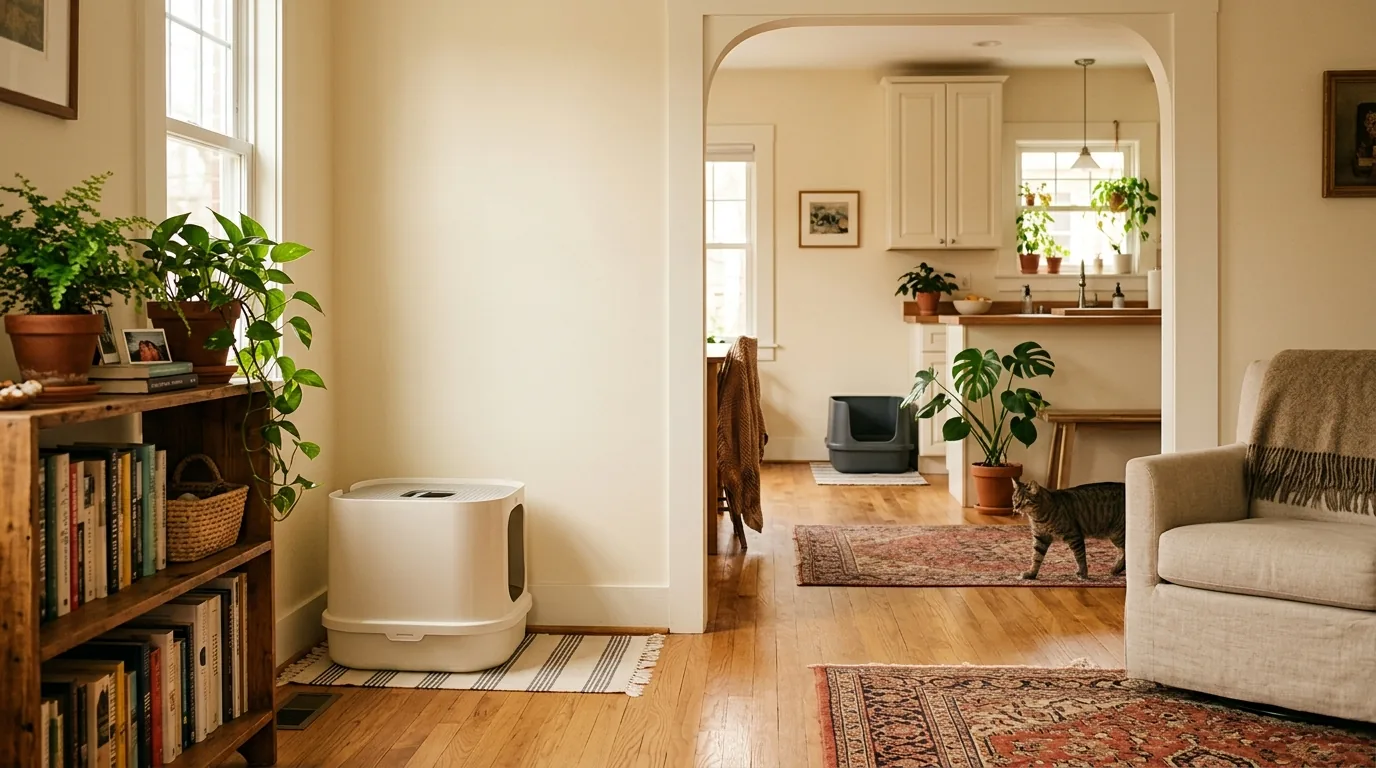
Most owners in multi-cat households who report "one of the cats is having accidents" are looking at a litter box problem before they are looking at a behavior problem. The math is usually wrong. Two cats sharing one box is a setup for failure, three cats sharing two is the same setup with more pressure, and the cat who eliminates outside the box is often the one the household sees as the problem when they're functionally the symptom.
The standard fix is straightforward, and it's been the published professional position for more than a decade.
What the N+1 rule actually says
The arithmetic is the entire rule:
- 1 cat = 2 boxes
- 2 cats = 3 boxes
- 3 cats = 4 boxes
- 4 cats = 5 boxes
The "plus one" is not a buffer suggestion. It accounts for the box that becomes unavailable when a cat is using it, the box that becomes unappealing for any reason (a clump missed during scooping, a litter the cat dislikes, a location that became loud), and the box one cat in the household has informally claimed.
A common pushback — "we had one box for years and never had a problem" — is usually true of single-cat homes or of households where one cat has consistently taken the role of higher-status occupant and the others have been suppressing their preferences. That suppression is real, and it doesn't show up until something else changes (a move, a new pet, a renovation, a litter brand swap), at which point the household sees "sudden" inappropriate elimination that wasn't sudden at all.
Why N+1 matters, not just "more boxes"
The reason for the rule is territorial, not hygienic. Cats are solitary hunters who evolved to time-share and space-share resources rather than queue for them.
Cats have territorial preferences for elimination. A cat may prefer one box for urination and a different box for defecation. A cat may prefer a box on one floor of the house and refuse a box on another. These preferences don't have to be reasonable to humans to be real.
Cats guard the box. Sometimes the guarding is visible — one cat sits in the hallway or the doorway near the box and the other cat avoids it. Often the guarding is invisible, because the guarded cat has already learned not to attempt access when the higher-status cat is around. Owners frequently describe their cats as "getting along fine" while one cat is quietly being denied resources.
The broader guide to resource guarding in cats maps the same quiet access problem around food, water, resting places, rooms and people without relying on a dominance label.
When resource pressure escalates into chasing or wrestling after dark, use the nighttime cat-fighting guide to distinguish play from conflict.
One blocked exit means the cat avoids the box entirely. A box backed into a corner or wedged against a wall has effectively one entry point. The cat in the box can't see what's coming, and the cat outside the box can intercept on the way in or out. Two exit routes — meaning the cat can leave the box without crossing into another cat's path — is the practical minimum for any household with more than one cat.
Different cats prefer different surfaces and locations. One cat may prefer a deeper litter bed, another may prefer a shallower one. One may tolerate a covered box, another may not. Adding more boxes is partly about volume and partly about giving each cat the chance to settle into the configuration that fits.
Where to put them
Placement is half the rule. Five boxes in one row in the basement is functionally one box from a cat's perspective.
- Different rooms. Boxes spread across the home reduce the chance that any single cat can control access to all of them at once.
- Different levels. In a multi-floor home, every floor a cat occupies needs at least one box. A senior cat with mild arthritis may not climb stairs to eliminate, and an anxious cat may not pass another cat's preferred resting spot to reach the only box.
- Away from food and water. Cats don't eliminate near where they eat. A box next to the food bowl is a box the cat is more likely to avoid.
- Low-traffic areas. Hallways that family members walk through frequently, doorways near the entrance, and rooms with high household movement create pressure to leave the box quickly. A cat who can't relax in the box won't fully use it.
- Multiple exit routes. Place the box so the cat can leave in more than one direction. A box in the open middle of a quiet room often outperforms a box wedged into a corner.
- Quiet. Washing machines, dryers, slamming doors, and HVAC vents that cycle loudly are all reasons a cat may avoid an otherwise well-placed box.
Box specifications
The container matters as much as the count.
Size. The box should be at least 1.5 times the length of the cat from nose to base of tail. Most commercial litter boxes are too small for the average adult cat. Many households end up using storage tote bins (with one wall cut down for entry) because retail boxes don't scale to the cat.
Type. Open boxes are preferred by most cats. Covered boxes feel like ambush zones — the cat inside can't see what's approaching and the cat outside can wait at the only opening. Some cats tolerate covered boxes well; many don't, and the only way to know is to offer both and observe which one each cat actually uses.
Litter. Unscented clumping clay is the most consistently preferred substrate in preference studies. Scented litters target human noses, not cat noses, and the perfumes that humans find pleasant are often the same compounds cats avoid.
Cleaning. Scoop daily — twice daily in multi-cat homes. Full litter change weekly. Wash the box itself with unscented soap, not citrus or ammonia-based cleaners. Ammonia smells like urine to a cat and citrus smells like a deterrent.
Multi-cat conflict signs around the box
The conflict pattern usually telegraphs itself if owners know what to look for.
- One cat physically blocks access to the box — sitting in the doorway, on the route, or in line of sight.
- One cat ambushes another while they're using the box or as they're leaving it.
- One cat eliminates outside the box, often in a location with sight lines to the main living area. This is most commonly the lower-status cat.
- Spraying near the box — small vertical urine marks on a wall or piece of furniture close to the box's location. Spraying is communication, not elimination, and it usually points at social pressure rather than a litter problem alone.
Solving inappropriate elimination in multi-cat homes
The sequence matters. Adding boxes is the first move because it resolves a meaningful share of cases on its own.
Rule out medical first. A cat eliminating outside the box may have feline idiopathic cystitis, a urinary tract infection, kidney disease, or another medical driver. Buffington and colleagues have documented the link between environmental stress and feline idiopathic cystitis directly — the medical and behavioral causes are not separable in cats the way they are in dogs. A vet workup belongs at the front of the process, not after every behavioral intervention has been tried.
Add boxes. Run the N+1 math against the household. If the count is short, fix the count. Many cases resolve at this step alone before any other intervention is needed.
Separate the boxes into different rooms. If all the boxes are already in one location, distributing them across the home is a separate intervention from adding more.
Identify the conflict pattern. Which cat is targeting which? Where do the confrontations happen? Mapping the household's social geometry — who blocks whom, who avoids whom, which routes are contested — is more useful than treating the cats as an undifferentiated group.
Pheromone diffusers. Synthetic feline facial pheromone products (the multi-cat formulations) have moderate evidence behind them and a low downside. They are not a substitute for box count or placement; they are an adjunct.
Work with a credentialed behavior consultant if the conflict persists after the environment is corrected.
The covered-versus-uncovered debate
Owner preference and cat preference rarely align here.
Owners tend to prefer covered boxes because they contain odor and scattered litter. Cats tend to prefer open boxes because they offer visibility and unobstructed escape. The hood that helps the owner is the hood the cat is reading as a single-exit enclosure.
Some cats tolerate covered boxes without issue, and a small number prefer them. The only useful approach is to offer both configurations in a multi-box setup and observe which boxes each cat actually uses over a one-to-two-week window. The cat's behavior is the data.
Common mistakes
A short list of the patterns that come up repeatedly:
- "One box was enough before, why add more?" It usually wasn't — one cat was suppressing access, and the suppression broke down when something in the environment shifted.
- All the boxes in one room. Functionally one box from a cat's perspective.
- Scented litter. Targets the wrong species.
- Citrus or ammonia-based cleaners. Both read as aversive or as urine to a cat.
- Boxes that are too small. Most retail boxes are sized for marketing photography, not for adult cats.
- Covered boxes assumed to be universal. A cat who uses a covered box once isn't necessarily using it as a preference.
When to consult a professional
Persistent multi-cat conflict, inappropriate elimination that doesn't resolve after the environment is corrected, or escalating tension between cats are all reasons to bring in a credentialed behaviorist rather than continuing to iterate alone.
Look for IAABC CCBC (Certified Cat Behavior Consultant), CFTBS (Certified Feline Training and Behavior Specialist), or a veterinarian with DACVB credentials (Diplomate of the American College of Veterinary Behaviorists). Avoid anyone who frames multi-cat conflict in terms of one cat needing to "learn its place." That framing is dominance theory imported into a species where it doesn't apply, and the AAFP/ISFM guidelines explicitly position multi-cat conflict as an environmental and resource problem first.
If the question is whether a specific signal in the household is conflict or something else — guarding, displacement, redirected arousal — that's a body language read, and the same framework used for dogs (Dog Body Language: A Behaviorist's Field Guide) applies in principle, with cat-specific signals. Related reading on the elimination side: why a cat is peeing outside the litter box, the difference between spraying and urinating, how to introduce a new cat to a resident cat, and how to find a credentialed behaviorist.
Frequently asked questions
How many litter boxes do two cats need?
Start with three boxes: one per cat plus one extra. Put them in separate useful locations so one cat cannot guard a single doorway or block access to every option.
Do litter boxes side by side count as separate boxes?
They provide more substrate but function as one resource station because a cat can monitor or block the whole area. Separate locations offer more meaningful choice and safer access.
What if my home cannot fit the full N+1 number?
Use as many large, uncovered boxes as the space safely allows, spread them across distinct locations and clean them frequently. Do not force an unrelated location just to satisfy the count. New house-soiling still needs a veterinary assessment.
Try it on your own cats
Mapping the litter box layout against the N+1 rule is the first audit any multi-cat household can do without specialist help. Count the cats, count the boxes, count the rooms the boxes are in, and check whether each cat has a route to at least one box that doesn't cross another cat's preferred resting spot.
PetTranslator.ai analyzes a photo of a cat against the same framework used in this guide — biometric markers, behavioral interpretation, an action plan keyed to the AVSAB and AAFP/ISFM literature. For multi-cat households, the most useful workflow is uploading a photo of each cat separately and reading the reports side by side; the social asymmetries that drive litter box conflict usually show up in posture and facial signaling before they show up in confrontation.
Sources
The framework in this guide is drawn from:
- AAFP and ISFM Feline Environmental Needs Guidelines (Ellis et al., Journal of Feline Medicine and Surgery, 2013) — the joint professional standard for feline environmental management, including litter box count and placement.
- John Bradshaw, Cat Sense (Basic Books, 2013) — the behavioral and ethological foundation for understanding how domestic cats time-share and space-share resources.
- Karen Overall, Manual of Clinical Behavioral Medicine for Dogs and Cats (2nd edition, Elsevier 2013) — the clinical reference for feline elimination disorders and multi-cat conflict.
- Jacqueline Neilson, "Thinking outside the box: feline elimination" (Journal of Feline Medicine and Surgery) — clinical review of inappropriate elimination diagnosis and environmental management.
- C. A. Tony Buffington et al., "Feline Idiopathic Cystitis" — foundational research on the link between environmental stress and lower urinary tract disease in cats.
For owners working with a specific behavior concern, the IAABC and AVSAB websites both maintain searchable directories of credentialed positive-reinforcement professionals by region.
Khabir Mughal is the founder of PetTranslator.ai. This article was reviewed against the AAFP/ISFM Feline Environmental Needs Guidelines and Karen Overall's Manual of Clinical Behavioral Medicine before publication.