A cat owner who finds urine in the wrong place tends to draw a single conclusion: the cat is having a litter box problem. That conclusion is often wrong, because two distinct behaviors produce that result and they have almost nothing in common. One is communicative marking. The other is failed elimination. They look similar at the cleanup stage. They are not similar at any other stage, and treating them the same way is how owners spend months on the wrong intervention.
TL;DR
Spraying and inappropriate urination look similar after the fact. They mean different things. Spraying is communicative territorial marking — a small amount of urine, deposited on a vertical surface, with the tail held upright and quivering. Inappropriate urination is elimination outside the box — usually a larger horizontal puddle, indicating either litter box aversion or a medical issue. Different causes. Different fixes. Telling them apart is the first task.
The physical posture difference
The behaviors are easiest to separate by what the cat is doing in the moment, not by what gets left behind.
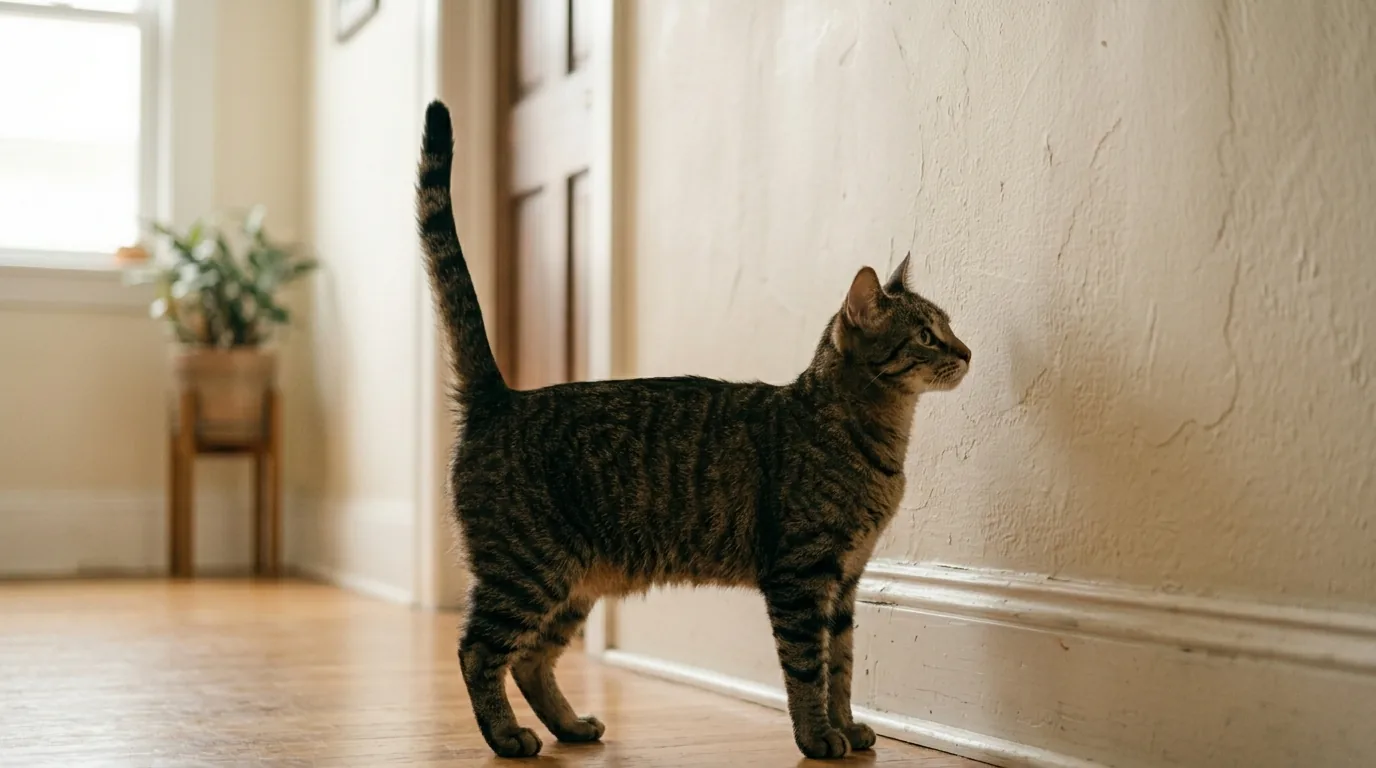
Spraying. The cat stands with the back end raised. The tail is held upright and quivering, often with a fast vertical tremor at the tip. A small amount of urine releases backward onto a vertical surface — a wall, the side of a couch, a door frame, sometimes a piece of luggage that just came home. The volume is small. The intent is signal, not relief.
Urinating. The cat squats in the normal elimination posture, on a horizontal surface. The tail is held neutrally or slightly out from the body. The volume is what the cat would normally void in the litter box — a measurable puddle, not a film. The cat is eliminating, just not where the owner wants.
If the only evidence is the cleanup, the surface and the volume usually give it away. Urine running down a wall is spraying. A round puddle on a rug is urinating.
Spraying — what it actually is
Spraying is not a litter box failure. It's a communication behavior, and it's preserved across the species — domestic and wild felids both do it. Calling it "bad behavior" misframes the conversation, because the cat is not breaking a rule. They are using their species' primary mechanism for signaling identity and territory.
Three drivers account for almost all spraying behavior in domestic cats.
Reproductive. Intact cats spray as part of the mating signal. The urine carries hormonal information about reproductive status and individual identity, and the height of the deposit on a vertical surface is functional — it puts the scent at nose level for another cat passing through.
Territorial. Cats spray to claim space or to push back against a perceived incursion. A resident cat who sees an unfamiliar cat through a window is the most common version of this driver in single-cat homes. In multi-cat homes, inter-cat tension is the more common version, and the spraying tends to localize to contested zones — doorways, food stations, resting perches.
Stress-induced. Some cats spray in response to a household change that overwhelms their existing coping strategies. The signal isn't directed at another cat in this case. It's a self-soothing redistribution of scent in an environment that suddenly feels unfamiliar.
Who sprays
The likelihood of spraying tracks closely with reproductive status, and the differences are larger than most owners realize.
- Intact males. Effectively all of them spray during mating season. Spraying is part of the reproductive repertoire, not a deviation from it.
- Intact females. Roughly thirty percent spray during heat, with the behavior often appearing in the late stages of the cycle.
- Neutered males. About ten percent continue to spray after neutering. Lower than intact males by an order of magnitude, but not zero — and the residual ten percent is what brings most owners of altered cats to a behaviorist.
- Spayed females. Around five percent spray. The smallest group, but it exists, and the underlying driver is almost always stress or inter-cat tension rather than residual reproductive signaling.
Neutering before the spraying habit becomes established sharply reduces the lifetime probability of the behavior. After the habit is established, neutering still helps but doesn't reset the behavior on its own.
Triggers for spraying in altered cats
Altered cats who spray are almost always responding to a specific environmental trigger. Identifying the trigger is the first move, because removing or buffering it does more than any pheromone product on its own.
Common triggers, ranked roughly by frequency in the clinical literature:
- An outside cat visible through a window — especially a window the resident cat patrols
- A new cat added to the household
- A move to a new home, or significant rearrangement of the current one
- New furniture, new housemates, new partners, or new infants
- Multi-cat household conflict — competition over food stations, litter boxes, perches, or human attention
- A recently returned cat who smells like the vet clinic
The pattern is consistent: the cat's existing territorial map has been disrupted, and spraying is the cat's mechanism for redrawing it.
Inappropriate urination — what's actually happening
Inappropriate urination is a different behavior with a different decision tree, and a full version of that decision tree is in why a cat is peeing outside the litter box. The short version: medical causes are ruled out first, because urinary tract infections, kidney disease, diabetes, and lower urinary tract disease all produce inappropriate urination as a symptom. After medical is ruled out, the work shifts to environmental — litter type, box location, box number, box cleanliness, and stressors near the box.
The key signal at the diagnostic stage is the posture and volume. A squatting cat producing a normal volume of urine on a horizontal surface is not spraying, regardless of where the puddle ends up.
Why telling them apart matters
The interventions for these two behaviors are not interchangeable, and applying the wrong one wastes time the cat doesn't have.
Spraying responds to: removing or buffering the trigger, pheromone diffusers, neutering if the cat is intact, and in persistent cases medication prescribed by a veterinary behaviorist. The litter box itself is usually not the issue and modifying it doesn't help.
Inappropriate urination responds to: a full veterinary workup first, then litter box modifications — more boxes, larger boxes, unscented litter, better-located boxes — and broader environmental changes if the cause turns out to be stress.
An owner who treats spraying like a litter box problem will buy a new litter box, switch litters, and wonder why the cat keeps spraying the curtains. An owner who treats inappropriate urination like spraying will install pheromone diffusers and miss a urinary tract infection that has been quietly worsening for weeks. The cost of getting this wrong is high in both directions.
Solutions for spraying
The order of operations matters. Each step works best when the prior steps are in place.
Neuter or spay if the cat is intact. The single highest-yield intervention. The earlier in life this happens, the more reliably it suppresses the behavior. In adult intact cats who have been spraying for months, neutering reduces but doesn't always eliminate.
Identify the trigger. Walk the house and find what changed. An outdoor cat in the yard. A new piece of furniture. A returning resident. A neighbor who started feeding strays. The trigger is usually identifiable within a few days of careful observation.
Block visual access to outside cats. Window film, frosted privacy panels, or simply moving the cat tree away from the window. Cats who can't see the trigger usually stop signaling at it.
Feliway Classic diffuser. Specifically the Classic formulation, which targets territorial marking. Feliway Multi-cat is a different pheromone aimed at inter-cat tension, and the two are not interchangeable — the choice depends on which driver is present. Diffusers run for thirty days per refill and need to be placed in the rooms where the spraying is happening, not in the corner of the basement.
Veterinary behaviorist for persistent cases. When environmental and pheromone interventions don't resolve the behavior within four to six weeks, the next step is a credentialed professional. In some cases, fluoxetine or another serotonergic agent prescribed by a veterinary behaviorist resolves spraying that hasn't responded to anything else. This is a clinical decision, not a home experiment.
Clean sprayed areas with an enzymatic cleaner. The enzymatic formulation breaks down the protein in the urine. Without that, residual scent at the site reinforces the cat's signal and the cat is more likely to re-mark the same spot.
What does not work
Three approaches show up constantly in owner advice and none of them resolve the behavior.
Punishment. Cats don't connect retroactive punishment with the behavior that earned it. Scolding a cat at the spray site does nothing about the underlying driver and adds stress that often increases the spraying. Even punishment delivered in the moment doesn't address the trigger — it just teaches the cat to spray when the owner isn't present.
Cleaning with ammonia products. Ammonia is the dominant scent compound in urine. Cleaning sprayed areas with an ammonia-based product reads to the cat as more urine, and reinforces the marking. Owners who clean with multipurpose ammonia sprays are inadvertently maintaining the behavior.
Cleaning with bleach. Bleach is a strong disinfectant but it doesn't break down the protein in urine. The visible stain disappears, the smell to a human's nose disappears, and the cat continues to detect the scent and re-mark the same surface. Enzymatic cleaners are the only product class that resolves the problem at the source.
When to consult a professional
A small number of patterns warrant working with a credentialed positive-reinforcement professional rather than continuing on a home protocol:
- Spraying that persists past four to six weeks of trigger management and pheromone use
- Spraying that escalates after a move or a household change rather than tapering
- Multi-cat households where inter-cat aggression is also present
- A cat who is intact, has been spraying, and is now sprayed or neutered but still spraying after several months
- Any change in elimination posture or volume in addition to spraying — that combination raises the priority of a veterinary visit
Credentials worth looking for: CCBC (Certified Cat Behavior Consultant), IAABC Certified Cat Behavior Consultant, Fear Free, or a DACVB (Diplomate of the American College of Veterinary Behaviorists) for medication-eligible cases. A guide to finding the right professional is in how to find a credentialed behaviorist.
Try it on your own cat
Reading the posture in real time is the most reliable way to separate spraying from inappropriate urination, and the easiest way to build that skill is to read the cat's body language in moments when the behavior isn't happening — at rest, during play, at the food station. The same framework that applies to dogs applies to cats with different signals, and a full cat-specific version is in cat body language.
PetTranslator.ai is built around this framework. Upload a clear photo of the cat and the AI returns a structured report — observable markers, a behavioral interpretation, and an action plan — using the same approach a credentialed behaviorist would apply. It won't replace working with a professional on a persistent case. For daily reading practice and for separating spraying from inappropriate urination at the cleanup stage, it's a useful instrument.
Sources
The framework in this guide is drawn from:
- John Bradshaw, Cat Sense (Basic Books, 2013) — for the ethological framework on feline scent communication and territorial behavior.
- Karen Overall, Manual of Clinical Behavioral Medicine for Dogs and Cats (Elsevier, 2013) — the clinical reference for differential diagnosis of marking and elimination behaviors.
- Pryor, Hart, Bain, and Cliff, "Causes of urine marking in cats and effects of environmental management on frequency of marking" (JAVMA, 2001) — the field study underpinning the trigger-management approach.
- AAFP/ISFM Feline Environmental Needs Guidelines — the professional standard for designing environments that reduce marking and elimination problems.
For owners working through persistent spraying, the IAABC and ACVB websites both maintain searchable directories of credentialed professionals.
Khabir Mughal is the founder of PetTranslator.ai. This article was reviewed against the AAFP/ISFM Feline Environmental Needs Guidelines and Karen Overall's Manual of Clinical Behavioral Medicine before publication.