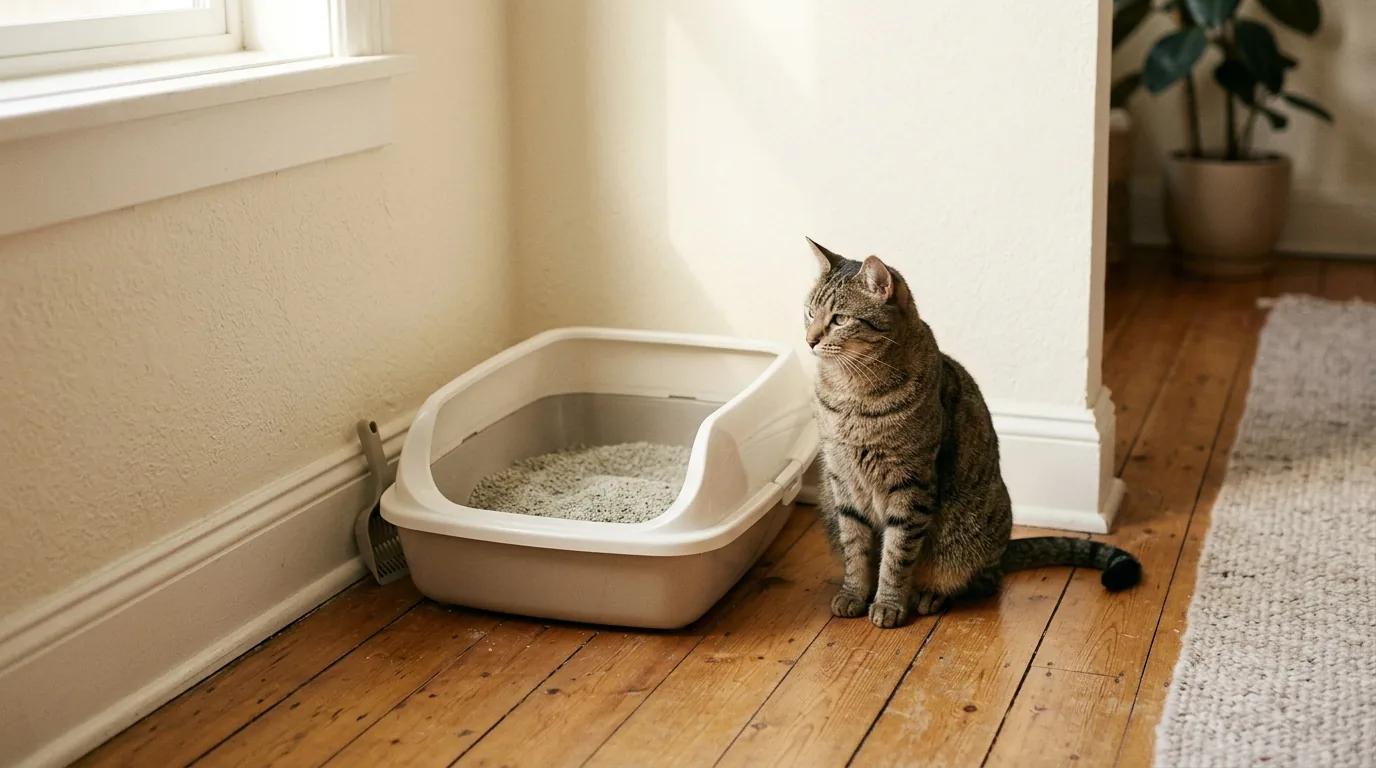
A cat urinating outside the box is the single most common reason cats are surrendered to shelters in the United States. It's also one of the most under-diagnosed problems in feline medicine, because owners reach for behavioral fixes — a new litter, a covered box, a stern voice — when somewhere between half and two-thirds of these cases have a medical cause underneath. The order of operations matters. Vet first, environment second, behavior third. Skip the vet step and most household fixes will fail, because the cat isn't choosing the rug — they're flinching from pain or showing the first visible sign of internal disease.
This guide walks through the same triage a board-certified veterinary behaviorist would use, in the order they'd use it. It's the framework PetTranslator.ai applies when an owner uploads a litter-box photo and a description.
The vet-first rule (and why most owners skip it)
The veterinary literature on this is unusually clear. Neilson's "Thinking outside the box" review in the Journal of Feline Medicine and Surgery puts the rule plainly — house-soiling in cats is a medical problem until proven otherwise. The AAFP and ISFM Feline Environmental Needs Guidelines say the same thing, in similar language. The reason most owners skip the vet visit isn't denial. It's that the cat looks fine. They eat. They groom. They sit in the window. So the owner reaches for the obvious explanation — the cat is mad, the cat is bored, the cat doesn't like the new litter — and starts swapping environmental variables.
The problem is that cats are evolved to hide illness. By the time a cat is peeing on the bathmat, the underlying medical issue has often progressed past the point where it would have been caught at a routine visit. A urinalysis and a basic blood panel cost less than three weeks of replacement carpet. They also rule out the largest single category of cause before any behavioral plan is built.
The vet visit is not optional. It is the first step.
Medical causes — what your vet will rule out
A general practice vet working through feline house-soiling will typically run a urinalysis, a urine culture if indicated, basic bloodwork, and — depending on age and presentation — imaging. They're ruling out a defined list.
Urinary tract infection. True bacterial UTIs are less common in young cats than owners assume but become more common with age, kidney disease, and diabetes. The cat will often urinate small volumes frequently, sometimes with visible blood, sometimes with vocalization in the box.
Feline Idiopathic Cystitis (FIC). This is the most under-recognized diagnosis on this list. FIC is a sterile inflammation of the bladder wall, strongly linked to stress, that mimics a UTI without bacteria present on culture. Buffington's work at Ohio State established FIC as the dominant cause of lower urinary tract signs in cats under ten — roughly two-thirds of cases by some estimates. The cat hurts when they urinate, associates the box with the pain, and starts eliminating elsewhere. FIC is treated by reducing environmental stress, increasing water intake, and addressing pain — not by antibiotics.
Crystals or stones. Struvite or calcium oxalate crystals in the urine can scratch the bladder lining or, in male cats, cause partial or complete urethral obstruction. A blocked male cat is a medical emergency. Signs include straining in the box with no production, vocalization, and lethargy.
Kidney disease. Chronic kidney disease causes increased urine volume because the kidneys can no longer concentrate urine effectively. The cat may simply not make it to the box in time, or may produce more than the existing box capacity can absorb between scoops.
Diabetes mellitus. Same mechanism — increased water intake and increased urine output. A cat who was reliably box-trained for years and suddenly isn't, especially paired with weight loss or increased appetite, should have a glucose check.
Hyperthyroidism. Common in cats over ten. Drives increased thirst, increased urine output, weight loss despite a strong appetite, and behavioral restlessness. A T4 test rules it in or out.
Arthritis. Older cats with degenerative joint disease often cannot comfortably climb into a high-sided box, especially a top-entry one. They aren't refusing the box. The act of stepping into it hurts. The cat starts eliminating on a flat surface nearby. Owners read this as spite. It's mechanical pain.
Cognitive dysfunction. Senior cats — typically over twelve — can develop the feline equivalent of dementia. They become disoriented, vocalize at night, sleep through normal cues, and sometimes lose their association with the box entirely. This is covered in more depth in our piece on behavior change in senior cats.
A vet will work through this list with diagnostics. If everything comes back clean, the case becomes environmental and behavioral. Not before.
Environmental causes — the "litter box audit"
Once medical is ruled out, the next step is what veterinary behaviorists call a litter box audit. The AAFP/ISFM Feline Environmental Needs Guidelines define the parameters. Most households fail one or more of them.
Number. The N+1 rule. One box per cat plus one extra. A single-cat home needs two boxes. A two-cat home needs three. Cats don't share litter boxes the way human roommates share a bathroom. They share resources only when forced to, and a forced share is a common stressor.
Size. The interior dimension of the box should be at least 1.5 times the length of the cat from nose to tail base. Most commercial cat boxes are too small for an adult cat. Storage tubs from a hardware store make better boxes than most products marketed as cat boxes.
Location. Away from food and water, away from high-traffic areas, away from loud appliances (washing machines, furnaces), with at least two clear escape routes. A box wedged in a corner with a single exit makes a cat vulnerable. Predator-prey wiring runs deep in cats — they will not eliminate in a place that feels like an ambush point.
Type. Most cats prefer an open box to a covered one, despite the human preference for the opposite. Covers trap odor, restrict visibility, and limit escape options. If a household has covered boxes, the audit step is to add at least one open box and watch which gets used.
Litter substrate. The research is consistent — unscented clumping clay is the most preferred substrate across populations of cats studied. Scented litters often deter cats because the additive is for human noses. Pellet litters, crystal litters, and pine-based litters work for some individuals but fail for many. If you're changing litter brands, do it gradually and offer the original in a parallel box.
Cleanliness. Scoop daily. Empty and wash the box itself weekly minimum. Cats have an olfactory threshold for box hygiene that's well below most owners' threshold. The litter that smells "fine" to a human can smell like a used port-a-potty to a cat.
A litter box audit failing on three or four of these criteria can produce house-soiling in a cat with no medical or social issues at all. Fixing the audit is sometimes the entire treatment plan.
Stress and territorial causes
If the box passes the audit, the next layer is stress. Cats are territorial animals with strong attachments to environmental stability. House-soiling — particularly the form veterinarians call urine marking — is a documented stress response.
Common triggers, in roughly the order they show up clinically:
- A new cat added to the home, especially without a structured introduction process.
- A new baby. The change in the resident cat's available space, schedule, and human attention is substantial.
- A move to a new home, or a major renovation in the existing one.
- An outdoor cat visible from a window the resident cat uses. A cat the resident cannot reach but can see is a chronic stressor.
- Latent conflict with another resident cat that the owner has not noticed — see the body language piece on cat communication for what subclinical conflict looks like.
- Changes in the human household — a partner moving in or out, a household member returning from a long trip, a death.
Buffington's FIC work links many of these stressors directly to bladder inflammation, which loops the medical and behavioral categories together. The cat experiencing chronic environmental stress isn't only "acting out" — they may be developing the inflammation that drives the pain that drives the avoidance of the box. Stress and disease are coupled in this species.
Marking vs inappropriate elimination — the diagnostic difference
Veterinary behaviorists draw a sharp line between two patterns that look similar to owners but are not the same problem.
Urine marking. The cat sprays a small volume of urine onto a vertical surface — a wall, a door frame, a piece of furniture — usually while standing, with the tail held up and quivering. Marking is a communication behavior. It's most common in intact males, but spayed and neutered cats of both sexes also mark under territorial pressure. The treatment plan focuses on stress reduction, social conflict resolution, and pheromone support.
Inappropriate elimination. The cat squats and urinates a normal volume on a horizontal surface — a rug, a bed, a pile of laundry, the floor near the box. This is usually an aversion to the existing box, a medical issue making the box painful, or an inability to reach the box in time. The treatment plan focuses on medical workup, the litter box audit, and re-establishing positive box association.
The volume and the surface are the fast diagnostic. Small volume, vertical surface, tail-up posture is marking. Normal volume, horizontal surface, squatting posture is inappropriate elimination. The plans diverge from there.
What does not work
A number of "fixes" circulate in online cat advice that the veterinary behavior literature has either disproven or actively warned against. They are worth naming.
Punishment. Rubbing the cat's nose in urine, yelling, swatting, spraying with water. None of this works, and all of it makes the underlying problem worse. The cat does not connect the punishment with the earlier act. What they learn is that the human is an unpredictable threat, which adds to the stress load and often increases the elimination behavior. Karen Overall's Manual of Clinical Behavioral Medicine is explicit on this point.
"They're doing it for revenge." Cats do not have the kind of theory-of-mind required to plan a revenge act. They don't think "the human left me for a weekend, so I will urinate on their pillow." The pillow is being urinated on because it smells strongly of the absent human, because the cat is stressed, and because the pillow is soft and absorbent. The behavior is signal, not retaliation.
Adding more boxes without addressing the underlying cause. More boxes can be part of a fix, but more boxes in a house where the existing boxes are dirty, too small, badly located, or in a house with an undiagnosed UTI will not solve the problem. The audit must come first.
Ammonia-based cleaners. Ammonia is a primary component of cat urine. Cleaning a soiled spot with an ammonia-based product makes the spot smell, to the cat, like a fresh marking site. The cat re-marks. Enzymatic cleaners are the correct tool — they break down the uric acid that ammonia-based cleaners leave behind.
What works — the systematic approach
The treatment plan, in order:
Vet visit first, always. Urinalysis, urine culture if indicated, basic bloodwork. In older cats, add T4 and imaging.
Litter box audit. Number (N+1), size (1.5x cat length), location (low-traffic, escape routes), type (open before covered), substrate (unscented clumping clay first), cleanliness (daily scooping).
Address environmental stressors. A new cat needs a slow structured introduction. An outdoor cat at the window may need window film or a closed blind. A multi-cat home with subclinical conflict needs more vertical territory, more food stations, and possibly more isolated retreat spaces.
Pheromone support. Feliway Classic (the F3 fraction of feline facial pheromone) has reasonable evidence for reducing marking and stress-related elimination in multi-cat homes. It's not a standalone fix, but it pairs well with environmental changes.
Enzymatic cleaner on all soiled spots. Not ammonia. The full removal of the urine signal matters as much as the absence of new urine — cats return to spots that still smell like a toilet to them.
Re-establish positive box association. Some cases benefit from temporary confinement to a small room with a clean box, food and water on the opposite side of the room, and quiet rest. Once the cat is reliably using the box in the small space, the territory expands gradually.
Pain management. If the workup identified arthritis, FIC, or any other source of physical discomfort, a vet-supervised pain plan is part of the protocol. A cat in pain will not reliably use a box, regardless of environmental fix.
When to call a professional
A general practice vet can handle most of the medical workup and many of the environmental and stress cases. The cases that warrant a board-certified veterinary behaviorist or a credentialed cat behavior consultant include marking that doesn't resolve after medical workup and environmental change, multi-cat households with persistent conflict, and cases involving fear-based or anxiety-based co-morbidities.
Look for one of these credentials: Dip. ACVB (Diplomate of the American College of Veterinary Behaviorists — a board-certified veterinarian), CCBC (Certified Cat Behavior Consultant through IAABC), or CAAB (Certified Applied Animal Behaviorist). All three signal force-free, evidence-based methodology. The AAFP cat-friendly practice directory lists vets with additional feline behavior training. The full credential framework is covered in our piece on how to find a credentialed behaviorist.
Try it on your own cat
Reading the triage is one thing. Applying it to a specific cat in a specific house is another. PetTranslator.ai takes a photo of the cat, a description of the soiling pattern (volume, surface, location, frequency), and the household context, and returns a structured report — likely category (medical / environmental / stress / marking), the next diagnostic step, and an environmental audit checklist tailored to the setup. It won't replace a vet visit. It will tell you what to ask the vet about, and which environmental variables to change first.
Sources
The framework in this guide is drawn from:
- John Bradshaw, Cat Sense (Basic Books, 2013) — for the species-level behavioral and territorial framework.
- Karen Overall, Manual of Clinical Behavioral Medicine for Dogs and Cats (2nd edition, Elsevier 2013) — the clinical reference on feline elimination disorders, marking, and the rejection of punishment-based methods.
- C.A.T. Buffington et al. — the body of work establishing Feline Idiopathic Cystitis as the dominant lower urinary tract diagnosis in cats under ten, and its link to environmental stress.
- AAFP/ISFM Feline Environmental Needs Guidelines (Ellis et al., Journal of Feline Medicine and Surgery, 2013) — the source for the litter box audit parameters used here.
- J. Neilson, "Thinking outside the box: feline elimination" (Journal of Feline Medicine and Surgery) — the standard clinical review on triaging feline house-soiling.
For owners working with a specific case, the ACVB and IAABC websites both maintain searchable directories of credentialed feline behavior professionals by region.
Khabir Mughal is the founder of PetTranslator.ai. This article was reviewed against the AAFP/ISFM Feline Environmental Needs Guidelines and Karen Overall's Manual of Clinical Behavioral Medicine before publication.