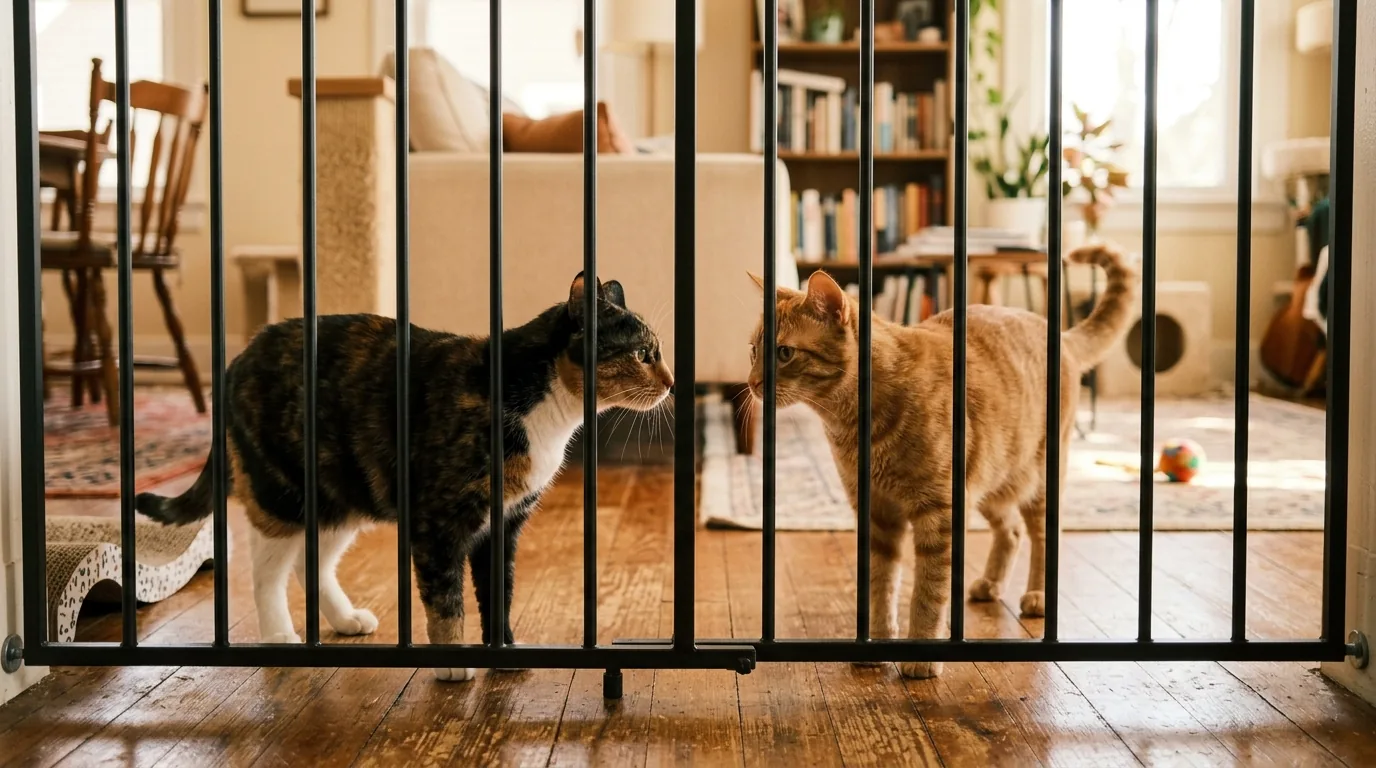
TL;DR. Cat introductions go wrong when rushed. Cats are solitary by nature — they have to learn to share territory rather than negotiating their way into it the way dogs do. The slow-method protocol takes two to six weeks and runs in four phases: scent first, then visual through a barrier, then short supervised same-room sessions, then full integration. Skipping steps creates lasting territorial conflict that is hard to undo, and the resident cat almost always shows the earliest stress signs.
Why cat introductions are different from dog introductions
A lot of multi-cat conflict is explained by one fact most owners don't apply when they bring a new cat home: cats evolved as solitary hunters. Dogs evolved in social groups. Those two natural histories produce two completely different ways of meeting strangers, and applying dog logic to cats is where most introductions break.
Dogs come pre-wired to read another dog's social signals, negotiate hierarchy, and form a working group. Cats come pre-wired to establish and defend an individual territory. When a dog meets a strange dog, the default question their nervous system is asking is "where do you fit in the group?" When a cat meets a strange cat, the default question is "is this my space or yours?" Those are not the same problem.
This is also why the common advice "let them work it out" is wrong for cats. Two dogs may scuff briefly and then settle into a working relationship. Two cats may scuff briefly and form a lasting grudge — the loser becomes a permanent stressed party in their own home, and the conflict shows up later as urine marking, blocked access to litter boxes, redirected aggression, or chronic appetite loss. Cats are slow forgivers. First impressions matter enormously, and there is no make-up phase.
If one cat starts controlling food, a safe room or the route through a doorway, use the cat resource-guarding guide alongside the introduction plan.
The slow-method protocol that follows is built around that biology. It is the same staged approach Sarah Ellis and John Bradshaw outline in The Trainable Cat and that Karen Overall describes in the Manual of Clinical Behavioral Medicine for Dogs and Cats. It works because it lets the cats build positive associations before they ever meet face-to-face.
Setting up before the new cat arrives
The work starts before the new cat is in the house. The single most common preventable mistake is bringing the new cat in without a separated room and a stocked territory for them to occupy on day one.
The setup checklist:
- A separate room with a door that closes — a bedroom, office, or large bathroom. Not a crate.
- Inside that room: food, water, a litter box, multiple hiding spots, a scratching post, vertical space if possible.
- The resident cat's existing territory is left unchanged. No moving furniture, no rearranging food stations, no rotating litter boxes during the introduction window.
- One litter box per cat, plus one extra. This is the n+1 rule and it is non-negotiable. Two cats means three boxes, placed in separate rooms.
- A synthetic feline pheromone diffuser (Feliway MultiCat or equivalent) running in shared spaces for two weeks before the new cat arrives. The pheromone analogue mimics the cheek-gland marker cats use to flag familiar territory, and the head start matters.
Plug into a veterinary check first. The new cat should arrive with a recent fecal test, FeLV/FIV testing, and current vaccinations. A new cat with an undiagnosed upper respiratory infection or intestinal parasites will derail the introduction and put the resident cat at risk. This is not a step to compress.
Phase 1 — Scent introduction (Days 1-7)
The new cat moves into the separate room. The door stays closed. The resident cat keeps free access to the rest of the home.
For the first week, the two cats never see each other. What they do is exchange scent.
The standard technique: take a clean soft cloth or sock and gently rub it along each cat's cheek glands (the area in front of the ears and at the corners of the mouth). Leave that cloth in the other cat's space. Switch daily. The goal is gradual desensitization to each other's chemical signature before any visual contact happens.
Feed both cats at the same time on opposite sides of the closed door, far enough apart that neither cat is too stressed to eat. Each cat gets a positive experience (food) paired with a faint scent of the other cat. Over several days, move the food bowls slightly closer to the door — slowly. Both cats should be able to eat calmly within a few feet of the door before moving forward.
What to watch for: hissing, growling, swatting at the door, refusing food near the door, urine marking, or hiding by the resident cat. Any of these means slow down, not stop. The phase isn't over until both cats can eat near the door without obvious tension.
This phase is the foundation, and it is the one most commonly skipped. Skipping it does not save time. It almost always costs more time on the back end when the introduction stalls.
Phase 2 — Visual through a barrier (Days 7-14)
Once the scent phase is solid, introduce a visual barrier. A baby gate stacked two-high, a screen door, or a tall pet gate works. Mesh laundry hampers and clear plexiglass barriers also work in smaller spaces. The cats can see each other but cannot reach each other.
Sessions start short — five to ten minutes — and end on a positive note before either cat shows tension. Continue the positive associations: feed both cats within sight of the barrier, offer treats, run play sessions on each side.
The pacing rule: end the session before, not after, either cat starts showing stress signals. Pinned ears, low body posture, freezing, tail lashing, vocalizing, or breaking off food are all reasons to end the session and try again later with more distance.
Over the week, gradually increase session length. By the end of phase two, both cats should be able to spend extended time in view of each other without flinching, breaking off food, or fixating.
A common failure mode here is leaving the barrier up too short. A barrier session that ends in a hiss is not a failed session — it's information that the next session should be shorter and farther apart. Owners who push through a hiss because the barrier was up "long enough" lose more time than owners who back off.
Phase 3 — Supervised same-room sessions (Days 14-28)
Now the barrier comes down for short, supervised periods, with both cats occupied by something positive — a meal, a play session, treats spread across the floor.
The setup for the first session: both cats in the same room, multiple escape routes available, vertical space accessible, no cornered geometry. A few feet of distance, food or toys between them, and a clear path to leave for both cats. The supervising human stays calm and present. If either cat begins to fixate, stalk, freeze, or stare, the session ends — calmly, before the situation escalates.
Thirty minutes is a long first session. By week three, an hour is plenty. The goal is not to maximize duration but to stack repeated positive same-room experiences. Each session that ends on a positive note compounds.
Watch for fixation, in particular. A cat who has stopped exploring and is staring at the other cat is not ready for more time. Break the fixation with food or a toy and end the session before the fixation turns into a stalk.
Phase 4 — Full integration (Day 28+)
By day twenty-eight, most introductions are ready to expand into unsupervised time, starting in short blocks during the day when someone is home and able to intervene if needed.
Keep the separate feeding stations. Keep the separate resting spots if either cat prefers them. The goal of integration is not forced sharing — it is peaceful co-existence, with each cat able to access food, water, litter, rest, and vertical territory without conflict.
Continued monitoring matters here. Low-grade conflict shows up in subtle ways: one cat consistently using only one of three litter boxes, one cat blocking the doorway when the other wants to pass, one cat eating less or losing weight, one cat hiding more. These are early warning signs, not stable equilibria. Address them by adding resources (more boxes, more food stations, more vertical paths) before the situation escalates into open conflict.
Reading the signals during introductions
Behaviorists watch for two parallel streams during an introduction: signals that say slow down, and signals that say keep going.
Slow down. Hissing, growling, swatting, hiding for extended periods, appetite drop, urine marking outside the litter box, excessive vocalization, dilated pupils held over time, piloerection (puffed fur), and a low ground-hugging stance with backward-rotating ears.
Keep going. Parallel resting (in the same room without contact), mutual grooming (allogrooming), play behavior, eating in proximity, sleeping in proximity, rubbing on the same furniture, calm tail carriage when the other cat enters the room.
A note on expectations: many cats never become close friends. Mutual tolerance — sharing the same home without active conflict — is a fully successful outcome. The cultural image of two cats curled up together is real for some pairs and not for others. The protocol succeeds when both cats can access their resources, rest without vigilance, and exist in the same space without showing chronic stress. Bonded companionship is a bonus, not the target.
For finer-grained signal reading during the introduction, the cat body language guide walks through ears, eyes, tail, and posture for both cats in detail.
Common mistakes
The introduction-derailing mistakes show up in roughly the same order in most cases:
- Skipping the scent phase. The most common error. Owners read about visual barriers and forget the chemical signature has to come first.
- Forcing face-to-face on day one. Pulling the new cat out of the carrier into the same room as the resident cat is the classic worst-case start. First impressions are sticky.
- Letting them work it out. Cats don't work it out. They form lasting grudges and develop chronic territorial stress.
- Insufficient litter boxes. Two cats sharing one box is a recipe for blocked-access disputes and house soiling. The n+1 rule is a baseline, not an aspiration.
- Single feeding station. Forcing both cats to eat in the same spot creates resource competition that bleeds into every other interaction. Separate stations from the start.
- Missing the resident cat's stress signs. The new cat is the visible problem — they're the new variable in the household — but the resident cat almost always shows earlier signs. A resident cat who starts hiding under the bed, urine marking, or going off food is telling you the integration is moving too fast.
When the introduction isn't working
A protocol that has plateaued for four weeks with no forward progress is not on track. The first move is to step back a full phase — return to the barrier, or return to scent-only — and rebuild the positive associations from there.
Repeated altercations that draw blood, persistent appetite loss in either cat, or a resident cat who is hiding constantly are reasons to bring in a credentialed feline behaviorist rather than continuing to troubleshoot alone. Look for IAABC Cat Division credentialing (Certified Cat Behavior Consultant), Fear Free certification, or a board-certified veterinary behaviorist (DACVB) — see the credentialed behaviorist guide for details on what each credential means and how to find one. Avoid trainers who use "dominance" or "alpha" framing, which has no basis in feline social behavior.
A medical workup matters too. Sudden behavior change in either cat — particularly appetite loss, urine marking, or hiding — should be evaluated by a veterinarian before being attributed to the introduction. Pain and illness mimic and amplify behavioral stress.
Special situations
A few variations on the standard protocol:
- Adult cat with a kitten. Generally the easiest case. Kittens are less territorial and most adults tolerate them well after a slow introduction. Still run the protocol — don't shortcut on the assumption that "it'll be fine."
- Two adult cats of the same sex. Generally the hardest case, particularly two adult males. Plan for three to six weeks of staged work, sometimes longer.
- Two adult cats of opposite sex. Typically smoother than same-sex pairs. Still run the protocol.
- Senior resident cat with a new arrival. Prioritize the senior's stress reduction. Senior cats handle environmental disruption poorly and the introduction window should be extended and pacing relaxed. Watch closely for hiding behavior in the senior, which often precedes appetite loss.
Try it on your own cats
Reading subtle stress in either cat during an introduction is the highest-use skill in the process. Most failed introductions failed because an early warning sign was missed and the session was pushed past the point where the cats were learning positive associations.
PetTranslator.ai is built around the same framework a behaviorist uses to read cats. Upload a clear photo of either cat during a session and the AI returns a structured read — ears, eyes, tail, posture, and what the combination typically signals. It won't replace working with a feline behaviorist on a complex case. For week-by-week reading practice during an introduction, it's a useful instrument.
Sources
- John Bradshaw, Cat Sense (Basic Books, 2013) — the natural-history framework for understanding cats as solitary hunters rather than social pack animals.
- Sarah Ellis & John Bradshaw, The Trainable Cat (Penguin, 2016) — the staged-introduction protocol drawn from applied feline ethology.
- Karen Overall, Manual of Clinical Behavioral Medicine for Dogs and Cats (Elsevier, 2013) — the clinical reference for feline behavioral diagnosis and intervention.
- AAFP/AFM Feline Environmental Needs Guidelines — resource requirements and environmental enrichment standards for multi-cat households.
- Sarah Heath, "Aggression in cats" in the BSAVA Manual of Canine and Feline Behavioural Medicine (2nd edition, 2009) — clinical framing of inter-cat aggression and territorial conflict.
For owners working with a specific multi-cat concern, the IAABC Cat Division maintains a searchable directory of credentialed feline behavior consultants by region.
Khabir Mughal is the founder of PetTranslator.ai. This article was reviewed against the AAFP/AFM Feline Environmental Needs Guidelines and Karen Overall's Manual of Clinical Behavioral Medicine before publication.