TL;DR
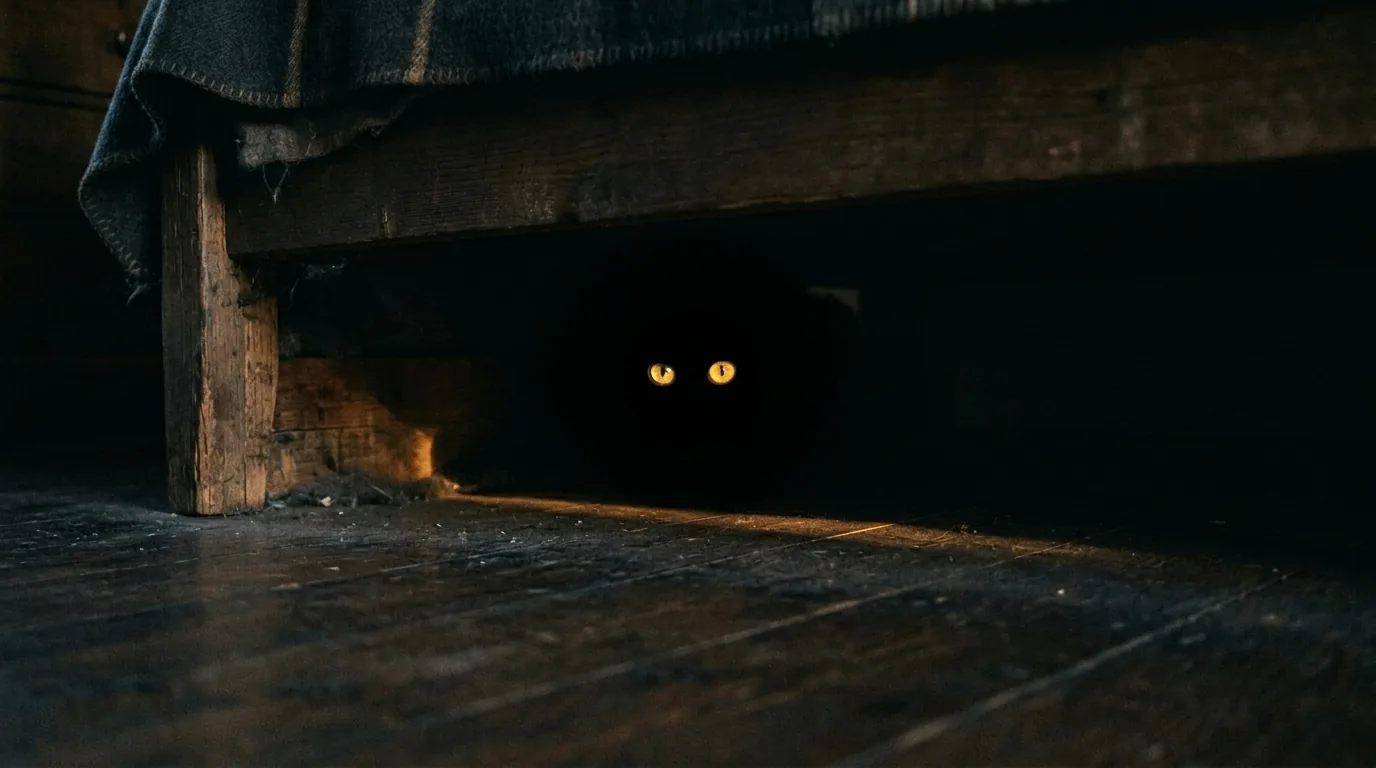
Cats hide for two distinct reasons, and they look identical from the hallway. The first is normal solitary-species behavior — the bed is a quiet base, a thermoregulated cave, an observation post. The second is a stress response — something has spiked the cat's arousal and they've gone to ground. What separates them is duration, context, and the signs riding alongside the hiding. Brief retreat after a stressor is normal. Persistent hiding paired with appetite change is a vet visit.
If this started with a relocation, use the move-specific safe-room plan for a cat hiding after moving house. It covers territory expansion, familiar scent, escape prevention and recovery checkpoints.
Why hiding is normal for cats (most of the time)
Domestic cats sit at an evolutionary crossroads that almost no other companion animal occupies. They're solitary hunters by descent — Felis silvestris lybica, the North African wildcat from which the housecat is descended, lives and hunts alone — and that origin shapes everything about how they regulate themselves indoors. Hiding isn't a quirk in this species. It's part of the species-typical behavior repertoire.
There's also a predator-prey paradox at work. Cats are predators, but at four to five kilograms they're also prey to anything larger than a raccoon. That two-sided pressure built an animal that hunts from concealment and rests from concealment. A cat under the bed isn't hiding from you in most cases. They're using the bed the way their wild cousins use a thicket — as a base.
John Bradshaw makes this point throughout Cat Sense: the behaviors that look pathological in cats, viewed through a dog-shaped lens, are usually species-typical when viewed on their own terms. Hiding is at the top of that list.
Concealed rest spaces also do practical work. They're thermoregulated — the air under a bed is more stable than the open floor. They block visual input, which lowers arousal in a species that processes a lot through vision. They give a cat the option to watch the room without being watched back. None of this requires a stressor to explain it.
When hiding is just a personality preference
Some cats are quiet by temperament. They were quiet kittens, they're quiet adults, and they'll spend large portions of any given day in a cave-shaped space whether or not anything is wrong. If your cat has always retreated to the bed in the late afternoon and emerged at dusk, the bed isn't a stress marker — it's a schedule.
Recently adopted cats follow a different pattern. The shelter and rescue community uses what's called the 3-3-3 rule: roughly three days to decompress, three weeks to start showing real personality, three months to fully settle. During the first three days, hiding is the expected baseline. A new cat who emerges immediately is the exception, not the rule. Sarah Ellis and John Bradshaw cover the decompression window in The Trainable Cat — the recommendation is to set up the environment (food, water, litter, a hiding option) and let the cat dictate the pace.
Households with frequent visitors, children at play volume, or multiple other animals also produce more daytime hiding even in cats who've lived there for years. That isn't a problem to solve — it's the cat using the resources available to manage their own arousal. The AAFP/AFM Feline Environmental Needs Guidelines (Ellis et al., 2013) list "provide an environment that respects the cat's need for privacy" as one of the five core pillars. The bed is privacy.
When hiding signals stress
The shift from baseline hiding to stress hiding shows up in three patterns.
Sudden onset. Yesterday the cat was on the couch by 7pm. Today they're under the bed and haven't come out. The change itself is the signal — a cat whose baseline shifts overnight is responding to something, even if the something isn't visible to you.
Persistent duration. A cat who retreats for two hours after a vacuum runs is regulating themselves. A cat who refuses to emerge for more than twenty-four hours is no longer regulating — they're stuck in the elevated arousal that drove them under the bed in the first place.
Co-occurring signs. Hiding on its own carries less weight than hiding combined with: not eating, not using the litter box, vocalizing in a register the cat doesn't normally use (low yowls, persistent meowing, silence in a normally vocal cat), or visible body posture changes when you do see them — crouched, low-tucked tail, dilated pupils, ears rotated sideways or flattened.
Hiding that begins after a household change carries more weight than hiding with no apparent trigger. A move, a new pet, a new person in the household, a renovation with strange smells and persistent noise — Karen Overall's Manual of Clinical Behavioral Medicine for Dogs and Cats documents environmental change as one of the most consistent triggers for feline anxiety responses. The hiding in those cases isn't the problem. It's the visible signal of the underlying stress.
When hiding signals medical illness
This is the section most owners miss, and it matters more than the rest combined.
Cats hide pain and illness. It's a survival adaptation, and it's almost certainly the most important fact about feline behavior an owner can learn. In a wild population, a cat showing weakness is a cat being targeted by larger predators. The animals who survived to reproduce were the ones who concealed illness reflexively. That trait is still in the housecat sitting on your couch.
The practical consequence: sudden behavioral hiding can be the first observable sign of a medical problem. Urinary obstruction, dental pain, arthritis flare, gastrointestinal illness, cardiac issues — any of these can present as a cat who's suddenly under the bed and won't come out. The cat isn't avoiding you. They're concealing illness in the way their species evolved to conceal it.
This is why every behavior protocol for sudden-onset hiding starts with the same instruction: rule out medical first. A behaviorist won't begin a workup until a veterinarian has confirmed there isn't a pain source or an internal illness driving the behavior. Karen Overall is explicit on this point throughout her manual — for feline cases especially, the medical workup is non-negotiable before behavioral intervention.
The 24-hour rule
The simplest decision tool for most owners is a time-and-food rule.
Give the cat twenty-four hours with food, water, and a clean litter box accessible from their hiding space. They don't have to come out. They have to be able to eat, drink, and eliminate if they choose to. Check those resources at the end of the twenty-four-hour window.
If the food is being eaten — even partially — and the litter box shows use, the cat is regulating. They're using the bed as a base. Give them more time.
If the food is untouched after twenty-four hours, that's a vet visit. Not a wait-and-see. Cats who fast for even short periods are at risk for hepatic lipidosis, a serious metabolic condition where the liver gets overwhelmed processing fat stores during food restriction. Overweight cats are at higher risk. The window between "concerning" and "emergency" in a cat who has stopped eating is shorter than most owners assume — measured in days, not weeks.
The twenty-four-hour rule is a floor, not a ceiling. If something else is obviously wrong — visible distress, vocalizing in pain, bleeding, vomiting, difficulty urinating — skip the wait. Go now.
What not to assume
A few patterns get misread often enough that they're worth naming.
"They're being dramatic." Cats don't perform emotion for an audience. A cat who has gone to ground is responding to something internal — either an external trigger you didn't notice or a physical state you can't see. Anthropomorphizing the hiding as personality drama delays the medical question.
"They'll come out when they're hungry." Sometimes. Not always. A cat who is genuinely ill won't come out when they're hungry, because the illness is overriding the hunger drive. Waiting for hunger to solve the problem is the path to a delayed vet visit.
"They hated the vet last time, that's why they're hiding." A cat who hid for two hours after a vet visit and then resumed normal life was processing the stress. A cat who is still hiding two days later isn't processing the vet visit — they're showing you something else, and "the vet visit was the trigger" stops being a useful explanation once the duration extends.
"Hiding always means stress." Read the rest of the picture. Baseline hiding in a quiet cat with normal appetite, normal litter box use, and normal interaction during their active hours isn't a problem to solve.
What to do
A short action list for the moment you notice your cat hiding more than usual.
DO give space initially. The single most common owner mistake is reaching under the bed to "comfort" the cat. From the cat's perspective this is the predator following them into the den. Sit on the floor near the bed if you want to be near them. Don't reach in.
DO provide food, water, and litter where they can reach without crossing the stressor. If the cat is hiding because the new dog is in the living room, the food bowl in the living room isn't accessible. Move resources closer to the hiding space.
DO apply the 24-hour rule. Track whether food is being eaten and the litter box is being used. That data tells you whether to wait or to call.
AVOID dragging them out from under the bed. This is a trust break that can take weeks or months to repair, and it doesn't solve whatever drove the cat under the bed in the first place. If a cat must be moved (for a vet visit), use a carrier and a towel, not a grab.
AVOID forcing interaction. No reaching, no chasing, no extracting. Let the cat choose the pace of re-engagement.
AVOID ignoring it if it persists. The flip side of "give space" is that giving space indefinitely turns into missing a medical signal. The 24-hour rule exists so that "give space" has a stop point.
When to call a professional
The decision tree is short.
Call a veterinarian first if the hiding is sudden, persistent past twenty-four hours, or paired with appetite change, litter box change, or visible distress. The medical question gets answered before anything else. Look for a Fear Free certified veterinary practice if one is available in your area — Fear Free clinics use low-stress handling protocols that reduce the trauma of the visit itself, which matters more for cats than for almost any other species.
Call a credentialed behaviorist if the veterinary workup has cleared medical causes and the hiding still persists. Look for credentials: CCAB (Certified Clinical Animal Behaviorist), CAAB (Certified Applied Animal Behaviorist), IAABC-CCBC (Certified Cat Behavior Consultant), or DACVB (Diplomate of the American College of Veterinary Behaviorists). All of these signal evidence-based, force-free methodology. Avoid anyone who frames cat behavior in terms of "dominance" or "punishment" — neither concept applies meaningfully to feline behavior, and using them will make a stress-driven case worse.
Try it on your own cat
The fastest way to develop the read is to do it on your own cat during their normal day — when they're at rest, when they're hunting a toy, when they're greeting you at the door, when they retreat to the bed in the late afternoon. The patterns become recognizable with deliberate practice.
PetTranslator.ai uses the same framework as this guide. Upload one clear photo of your cat and the AI returns a structured report — the observable markers, a behavioral interpretation, and an action plan grounded in AVSAB-aligned, force-free methodology. It won't replace a veterinary workup on a sudden-onset hiding case. For daily reading practice on the cat you already live with, it's a useful instrument.
Sources
The framework in this article is drawn from:
- John Bradshaw, Cat Sense (Basic Books, 2013) — the foundational work on housecat behavior viewed through the lens of feline evolution rather than dog-shaped assumptions.
- Karen Overall, Manual of Clinical Behavioral Medicine for Dogs and Cats (2nd edition, Elsevier 2013) — the clinical reference for behavioral observation, the role of medical workup, and feline anxiety presentations.
- Sarah Ellis & John Bradshaw, The Trainable Cat (Penguin, 2016) — the decompression framework and the practical detail on adoption and household-change transitions.
- AAFP/AFM Feline Environmental Needs Guidelines (Ellis et al., Journal of Feline Medicine and Surgery, 2013) — the five-pillar standard for indoor cat environments, including the privacy requirement.
For owners working through a confirmed-not-medical hiding case, the IAABC and ACVB websites both maintain searchable directories of credentialed feline behavior professionals.
Khabir Mughal is the founder of PetTranslator.ai. This article was reviewed against the AAFP/AFM Feline Environmental Needs Guidelines and Karen Overall's Manual of Clinical Behavioral Medicine before publication.