TL;DR
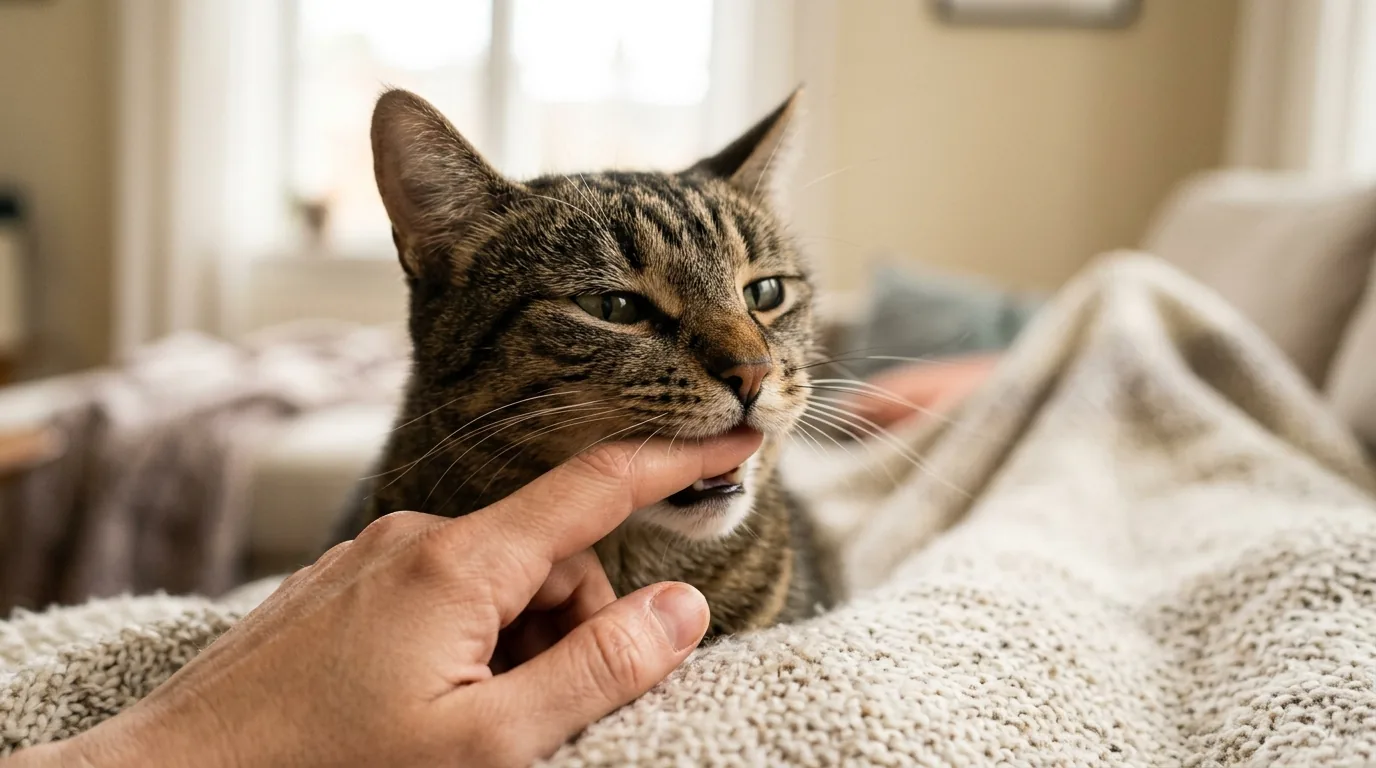
"Love bites" is owner shorthand for the gentle nibbles cats give during petting or play. The behavior has multiple causes — petting-induced overstimulation, social grooming gestures, predatory practice, or low-grade boundary-setting. It's rarely literal "affection." Reading the body context separates them, and recognizing overstimulation prevents the bites from escalating to skin-breaking ones.
The label is the problem. Calling it a love bite frames a communication signal as a romantic gesture, which is the surest way to keep missing what the cat is actually doing. The behavior is real. The interpretation usually isn't.
If the bite follows petting, compare the whole sequence with the early signs of cat overstimulation. A rippling back can be part of that sequence, but skin twitching during petting also has medical differentials worth knowing.
What "love bites" actually are
The behavior most owners file under this label has a consistent profile.
- Light pressure. Teeth make contact but skin isn't broken.
- Often delivered during petting or close interaction.
- Sometimes during play.
- Almost never aggressive in intent.
A cat who wanted to do damage could. House cat bite pressure can puncture skin and reach bone. The fact that a love bite doesn't is itself the signal — the cat is communicating something with a deliberately inhibited bite, not attacking. The next question is what the communication is.
There are four common answers, and they look more similar than they are.
The four common causes
Petting-induced aggression. The most common cause in adult cats with affectionate owners. Sustained petting raises arousal past the cat's tolerance threshold and the bite is the signal that the threshold has been crossed. This isn't aggression in the colloquial sense — it's a communication failure on the owner's part. Most cats give three to six warning signals before they bite, and most owners miss all of them.
Social grooming gestures. Mother cats nibble kittens during grooming, and adult cats raised in social groups continue to use light nibbling as part of allogrooming — the mutual grooming behavior between socially bonded cats. A cat who licks your hand and follows it with a light nip is often running this program. The bite in this case is closer to a grooming gesture than a warning. It still doesn't mean what owners call "affection" in a human sense, but it's the closest of the four to it.
Predatory practice. Young cats and adolescents — usually under two years — practice the killing bite on whatever's available. The bite to the back of the neck is the species-typical kill stroke, and kittens rehearse it on littermates, toys, and the hands of humans who play with them. An adult cat who never had appropriate play targets as a kitten often continues this into maturity. The pressure is light, the body is engaged but not stiff, and the cat is essentially treating the hand as prey.
Boundary-setting. A low-grade "stop petting me now" signal that hasn't escalated to a full warning bite. The cat is asking for the interaction to end and using the lowest-pressure tool that works.
These four overlap. Petting that's been ongoing too long can shift from grooming gestures to boundary-setting to a real warning bite in under thirty seconds, and the only way to tell which phase the cat is in is by reading the body that the mouth is attached to.
Petting-induced overstimulation — the most owner-relevant cause
This is the cause worth understanding in detail, because it's the one that causes most of the bites that send owners to search engines.
Cats have a lower tolerance for sustained petting than dogs. The neurology behind this is reasonably well documented — repeated tactile input on certain regions of the cat's body produces increasing autonomic arousal, and at a species level cats are wired to terminate sustained contact faster than canids are. Bradshaw covers this in Cat Sense and Karen Overall's clinical work treats petting-induced aggression as a discrete diagnostic category.
The escalation in cats is fast. A dog who reaches their petting threshold will usually show several seconds of stress signaling before they bite. A cat will often show the same number of signals compressed into one or two seconds. The tail flick to twitch to swish to bite progression can happen faster than most owners can disengage.
This is why most owners miss it. The signals are present. The window to act on them is short.
Body signals that warn of overstimulation
The pre-bite escalation has a recognizable shape. These signals appear in roughly this order, though the order varies and not every cat shows every signal.
Tail tip twitching while being petted. The first signal in most cats. A relaxed cat's tail at rest is still. A tail tip that starts to flick during petting — even a small movement — is the earliest sign that arousal is climbing.
Ear position shifting back. The ears rotate slightly backward or sideways. This isn't the full "airplane" flare that signals defensive arousal, but it's the early version of it. Forward-set relaxed ears mean the cat is receiving the interaction. Ears that start to swivel away mean the cat is reconsidering.
Skin twitching on the back. Often called rippling. The skin along the cat's lower back twitches involuntarily, like a fly is on it. This is the autonomic nervous system reaching a level of arousal that crosses into discharge. It's a high-grade signal and a clear instruction to stop.
Hard look toward your hand. The cat turns and stares at the petting hand. This is the cat's last verbal warning, except cats don't have verbal warnings, so they use the visual equivalent. Hard staring at the source of the contact means the cat has identified your hand as the problem.
Body stiffening. The cat's posture freezes. A cat who was loose and curled becomes locked. This is the moment immediately before the bite in many cases.
The signals are graded. Stopping at the tail flick prevents the rest of the sequence. Stopping at the body stiffening is usually too late.
How to pet a cat without triggering overstimulation
The protocol is short and well-supported in the behavior literature, particularly in Ellis and Bradshaw's The Trainable Cat.
Short sessions. Ten to thirty seconds. Cats are not designed for the prolonged petting sessions dogs tolerate. A short interaction that ends before the threshold is reached builds positive association. A long one that ends in a bite teaches the cat that human contact ends in autonomic discharge.
Consent-test before continuing. After a short petting bout, stop. Move your hand away. A cat who wants more contact will move toward the hand or head-butt it. A cat who's done will not. This is the standard consent-test protocol used in shelter behavior work, and it transfers directly to home use.
Stick to the safe zones. The chin, cheeks, and top of the head are the regions most cats tolerate longest. These are also the regions cats rub against objects and people when they're scent-marking — the tactile input there is familiar. The belly and lower back are the regions most cats tolerate least, regardless of how often the cat exposes them. Exposed belly is rarely an invitation to touch the belly. Each cat sets their own preferred zones, and the only way to find them is by watching what each cat invites.
Watch the tail. The tail is the earliest and most reliable signal. A cat whose tail is still and loose is receiving the contact. A cat whose tail starts to flick is exiting.
What to do when a love bite happens
Stop petting immediately. The bite is the communication. Continuing through it teaches the cat that the bite isn't sufficient and the next one needs more pressure.
Don't react with sound or movement. A loud reaction — a yelp, a fast hand withdrawal, a startled noise — can reinforce the behavior in two directions. Some cats find the reaction exciting and escalate. Others learn that the bite produces a dramatic response from the human and repeat it. The cleanest response is to go still, withdraw the hand calmly, and stop the interaction.
Wait for the cat to disengage or re-engage. Let the cat make the next move. A cat who walks away has communicated successfully. A cat who stays in place and head-butts the hand a moment later has reset the interaction and is asking for a different kind of contact. Either outcome is fine.
What not to do
Punish. Punishment damages the trust relationship and doesn't address the underlying overstimulation threshold. The cat doesn't learn "biting is wrong." The cat learns "this human is unpredictable around my body," which makes future bites more likely, not fewer.
Continue petting through warning signals. The most common owner error. The cat flicks their tail, the owner notices but assumes one more pet is fine, the cat bites, the owner is surprised. The tail flick was the signal. There is no one-more-pet allowance.
Spray water. Creates fear without changing the arousal threshold. The cat learns to fear hands and water bottles, not to tolerate longer petting sessions.
Yelp dramatically. Cats interpret human distress sounds variably. Some cats find the yelp exciting and escalate. Others find it aversive and become avoidant of contact in general. Neither outcome is desirable.
When love bites are not okay
Three patterns warrant a closer look.
Skin-breaking pressure. Once a bite breaks skin, the inhibition that defines a love bite is gone, and the behavior has crossed into a category that needs intervention rather than tolerance.
Sudden onset in a previously gentle cat. A cat who has never bitten and suddenly starts is communicating that something has changed. Pain is the first thing to rule out — arthritis, dental disease, abdominal discomfort, and skin sensitivities can all turn a previously tolerant cat into one who bites during petting. A vet exam is the right next step before behavioral intervention.
Targeted at specific people only. A cat who bites one household member and not others is often signaling something specific about that person's handling — fast movements, heavy petting pressure, a startling history. This is closer to fear-based behavior than overstimulation, and it usually responds to a structured desensitization program rather than to a change in petting style alone.
Try it on your own cat
Reading cat body language is a skill that develops with attention. The fastest way to build it is to read your own cat at rest, during play, and during petting — moments where the body signals are clearest and the stakes are lowest.
PetTranslator.ai uses the same framework as this guide. Upload a clear photo of your cat and the AI returns a structured read — what biometric markers are visible, what the body context likely indicates, what the next handling step would be. For deeper context on the signals discussed here, see the guide to cat body language, the breakdown of cat tail meanings, and the post on cat airplane ears — the defensive arousal signal that often follows an unheeded overstimulation warning.
Sources
The framework in this guide is drawn from:
- John Bradshaw, Cat Sense (Basic Books, 2013) — the species-level reference on cat behavior and the neurology of petting tolerance.
- Karen Overall, Manual of Clinical Behavioral Medicine for Dogs and Cats (2nd edition, Elsevier 2013) — the clinical reference for petting-induced aggression as a diagnostic category.
- Sarah Ellis and John Bradshaw, The Trainable Cat (Penguin, 2016) — the standard reference for consent-tested handling and force-free cat training protocols.
- AAFP/AFM Feline Behavior Guidelines — the American Association of Feline Practitioners' professional guidelines on feline behavior, including handling and overstimulation.
Khabir Mughal is the founder of PetTranslator.ai. This article was reviewed against the AAFP Feline Behavior Guidelines and Karen Overall's Manual of Clinical Behavioral Medicine before publication.