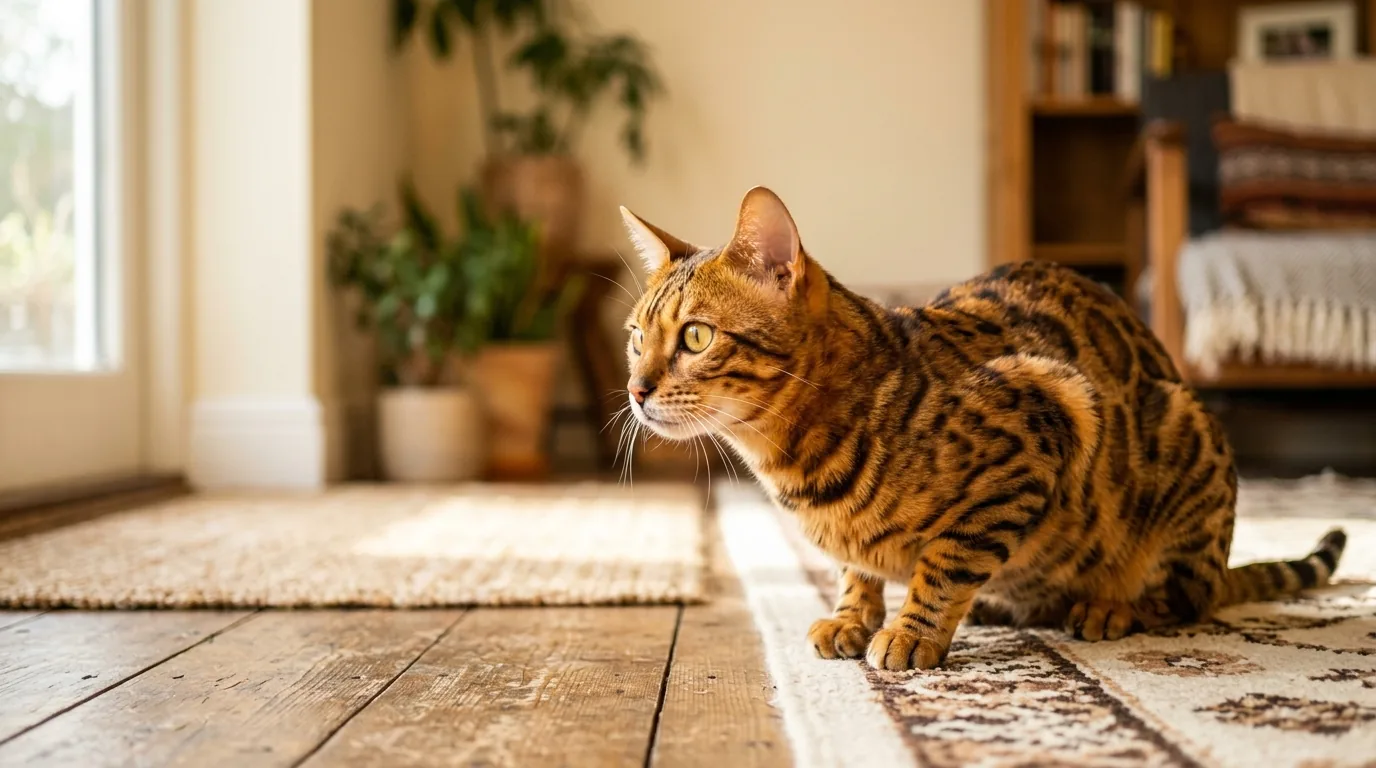
A Bengal is not a regular cat with prettier markings. The breed exists because someone, in the 1960s, crossed a domestic cat with a small wild felid called the Asian Leopard Cat, and most of the temperament that owners eventually complain about traces back to that decision. Bengals are high-drive, vocal, intelligent, water-curious animals that need substantially more enrichment than the average house cat — and a meaningful share of the ones placed in homes end up in rescue when the owner finds that out the hard way.
This guide is for owners who want the honest version before they commit, and for current Bengal owners who want to know whether what they're seeing is normal for the breed or a behavior problem to address.
TL;DR
Bengals are an active, intelligent, hybrid-origin breed with a strong prey drive, a high baseline arousal level, and substantial environmental needs. The earliest generations (F1 through F4) are filial hybrids with varying Asian Leopard Cat content — and varying legal status depending on jurisdiction. Most Bengals available as pets are F5 or later, classified as fully domestic, but they still carry the temperament traits that made the breed distinctive. They are not a starter cat. They do well in multi-cat households more often than as solo pets. Single-cat, low-enrichment homes are where most behavior problems start.
The hybrid origin — what it actually means
The Bengal's recent ancestry separates it from every other commonly registered cat breed. The cross that created the line was between Prionailurus bengalensis, the Asian Leopard Cat (ALC), and Felis catus, the domestic cat. Jean Mill started the program in the 1960s; TICA recognized the breed in the 1980s.
Filial generations are notated F1, F2, F3, F4 — each describing how many generations removed an animal is from the original ALC parent. An F1 has one ALC parent and is roughly fifty percent wild. An F2 is the offspring of an F1 bred back to a domestic, and so on. By F4, ALC content is generally low, and by F5 most registries classify the cat as fully domestic, eligible for show and pet placement.
The legal picture matters here. F1 through F3 Bengals are restricted or prohibited in a meaningful number of jurisdictions. New York City prohibits hybrid cats outright. Hawaii, Connecticut, and parts of New York State require permits or prohibit ownership entirely. Several other states require permits for the earliest filial generations. None of this applies to F5+ Bengals in most places, but a prospective owner who finds a "Bengal kitten" listed for sale needs to know which generation they're being offered and what their local law says.
Temperament — what owners actually live with
Bengals are not subtle. The temperament traits that show up consistently across the breed:
High energy across the day. Most domestic cats sleep sixteen hours. Bengals do too, but the waking hours are intense. They run, climb, vocalize, and engage with their environment at a level closer to a working dog than to a typical housecat.
Above-average intelligence. Bengals open cabinets, lever latches, turn handles, and learn to operate household objects. They observe what their owner does and try to replicate it. This sounds charming until they figure out how to open the refrigerator at 3am.
Vocal range. The Bengal vocal repertoire is wider than most breeds. Owners describe chirps, trills, yowls, chatters, and a specific demanding meow that does not stop until the cat is satisfied.
Water curiosity. A meaningful share of Bengals will play in water — paw at a running tap, walk into the shower, fish toys out of a water bowl. This is a real breed trait, not a myth, though it isn't universal.
Dog-adjacent trainability. Bengals respond well to clicker training, learn names, can be taught to walk on a harness, and often retrieve. Sarah Ellis and John Bradshaw cover this trainability ceiling in The Trainable Cat — cats as a species are more trainable than most owners realize, and Bengals sit near the top of the curve.
Strong prey drive. This is the trait that traces most directly to the ALC heritage. Bengals stalk, pounce, and hunt with focus and intensity. Indoor toys help, but a Bengal denied any outlet for prey behavior usually invents one — chasing the family dog, ambushing feet, hunting houseflies obsessively.
Body language — same vocabulary, higher intensity
Bengals communicate using the same body-language framework as any domestic cat — ear position, eye state, tail carriage, body tension, vocalization. The framework in the cat body language guide applies. What changes is the intensity.
A Bengal's alert orient — forward ears, locked eye contact, weight shifted forward, mid-to-high tail — is more pronounced than the same signal in a Domestic Shorthair. Bengals stay in alert state longer and transition into stalking faster. The prey-drive escalation, when it kicks in, runs all the way to the predatory bite-and-shake sequence on toys.
Tail signals carry the same meaning across breeds, but Bengals use them more visibly. The lashing tail of an overstimulated Bengal is hard to miss. The puffed tail of a startled Bengal is theatrical. Owners who learn the standard cat-tail vocabulary read their Bengal accurately; the signals are bigger, not different.
Two patterns are worth flagging specifically:
The chatter. The mouth-vibration vocalization Bengals make at birds through windows is a prey-frustration signal. It isn't a stress sign. It is, however, an indicator that the cat's prey drive is engaged with nothing to discharge against — useful information when planning enrichment.
The post-play stillness. A Bengal who has just hunted an interactive toy to completion will often stop, sit, and stare at the toy or the owner for several seconds. This is consummatory behavior — the cat is processing the predatory sequence. Don't interrupt it. Let the cycle finish.
Common owner questions
The questions that show up most often from Bengal owners, with the behavioral read:
"My Bengal opens cabinets and steals food." Normal for the breed. Counter-surfing and cabinet exploration are extensions of foraging behavior in an intelligent, high-drive cat. Childproof latches solve the access problem. Puzzle feeders and increased enrichment solve the underlying drive.
"My Bengal plays in the toilet." Water-curiosity behavior. Keep the lid closed. Provide alternative water play — a recirculating fountain, a shallow tray with floating toys.
"My Bengal demands attention constantly and won't stop yowling." Two reads possible. If the cat is in an under-enriched single-cat household, the demand vocalizations are usually a behavioral symptom of under-stimulation. Add structured play sessions, foraging puzzles, vertical territory, and a second cat if compatible. If the cat is already in a well-enriched home, rule out medical causes — hyperthyroidism, pain, sensory decline — before treating it as behavioral.
"My Bengal stalks and attacks my ankles." Predatory behavior with no other outlet. Schedule structured play sessions with wand toys twice daily, end each session with a "kill" the cat can grasp and chew, and feed immediately after. This routes the predatory sequence through legitimate channels.
"My Bengal is destroying furniture." Provide vertical scratching posts at least as tall as the cat at full stretch, in multiple materials (sisal, cardboard, wood). The destructive scratching in most Bengals isn't unusual scratching — it's normal scratching with nothing acceptable to scratch on. See the furniture scratching guide for the full protocol.
Health — the genetic picture
Bengals carry breed-specific health considerations that prospective owners need to ask breeders about directly.
Bengal PRA-b (progressive retinal atrophy, Bengal-specific). An autosomal recessive form of retinal degeneration. A DNA test exists. Reputable breeders test breeding cats and avoid pairing two carriers. Ask for documentation.
Hypertrophic cardiomyopathy (HCM). The most common heart disease in cats overall, and present in some Bengal lines. Cannot be ruled out by DNA test alone — breeding cats should also be echocardiogram-screened annually by a board-certified veterinary cardiologist.
Polycystic kidney disease (PKD). Less common in Bengals than in Persians but documented in some lines. DNA testing available.
Erythrocyte pyruvate kinase deficiency (PK-Def). A hemolytic anemia that can be DNA-tested for and bred against.
A Bengal breeder who can't produce documentation of these health screens for the parents is selling a kitten with unknown medical risk. The questions to ask are the same ones a board-certified veterinary internist would ask — and a breeder who reacts defensively to being asked is the wrong breeder.
Enrichment — the topic that decides everything
If there is one section of this guide to read twice, it's this one. Most Bengal behavior problems are enrichment failures. Get the enrichment right and most of the rest sorts itself out.
The AAFP/ISFM Feline Environmental Needs Guidelines lay out five pillars of feline welfare: safe space, multiple separated key resources, opportunity for play and predatory behavior, positive consistent human interaction, and respect for the cat's sense of smell. Bengals need every one of these at higher volume than the average cat.
Vertical territory. Cat trees, wall shelves, window perches, accessible high spots. Bengals are climbers. A home with no vertical access is, to a Bengal, a third of a home.
Structured play. Two daily sessions of interactive wand-toy play, ten to fifteen minutes each, taking the cat through the full predatory sequence: stalk, chase, pounce, grab, bite, kill. End with the cat catching the toy. Feed immediately after. This routes predatory drive through a legitimate channel and discharges it.
Foraging enrichment. Puzzle feeders, food balls, lick mats, food hidden in cardboard boxes. A Bengal who gets all their food from a bowl is missing the cognitive engagement the breed needs.
Cognitive work. Clicker training. Teach a sit, a target, a high-five, a station behavior. Five-minute sessions, multiple times a day. Bengals work willingly for food rewards and visibly settle after cognitive sessions.
Social structure. Many Bengals do better with a second cat — ideally another active breed of similar age, introduced properly. A single Bengal in a low-traffic adult household is the configuration most associated with behavior complaints. The new-cat introduction protocol applies.
The welfare conversation
Bengals appear in rescue at a rate disproportionate to their breed population. Bengal-specific rescues exist in most regions of the United States precisely because owners adopt without understanding the temperament, struggle to manage the energy and the vocalization and the destruction, and surrender. This is not the rescue's fault, and it is rarely the cat's fault. It is a mismatch problem at the point of adoption.
The hybrid-generation issue compounds this. Owners of F1 through F3 Bengals occasionally find themselves in violation of state or city law when they move and have to surrender the cat with limited placement options. Sanctuary placement for the earliest filial generations is hard to find.
The honest framing: every Bengal in rescue exists because a previous owner didn't have the information you're reading now. If you adopt a Bengal, plan to keep it for its full lifespan and resource the household accordingly.
Common owner mistakes
Six patterns show up repeatedly with under-prepared Bengal households:
- Treating the breed as cosmetic. Adopting because the markings are striking, without budgeting for the temperament.
- No vertical territory. A Bengal in a flat one-story space with no climbing opportunity will create vertical territory by climbing furniture, curtains, and people.
- Single-cat household with one adult who works full-time. The mismatch with the breed's social and activity needs is severe.
- Free-feeding from a bowl. Bypasses the foraging-and-hunting cognitive load the breed evolved to handle.
- Reactive training to "correct" the energy. Punishment-based responses to Bengal behavior do not reduce the underlying drive; they teach the cat to discharge it differently or to mistrust the handler. The AVSAB position on humane training applies to cats too.
- Not screening the breeder. Buying from a pet store, an Instagram listing, or a breeder who can't produce health documentation. The downstream costs — medical, behavioral, ethical — are substantial.
Is a Bengal right for you?
The honest checklist:
- You have time for two structured play sessions a day, every day, for fifteen-plus years.
- You have vertical space and are willing to install cat shelves, trees, and perches.
- You are prepared to do clicker training and puzzle-feeder enrichment as routine, not novelty.
- You can afford the genetic testing and cardiac screening of a reputable breeder, or you are adopting from a Bengal-specific rescue with realistic expectations.
- You are not buying the breed for its appearance alone.
- Your household can absorb a vocal, active, opinionated cat without that becoming a source of conflict.
- You have checked your local hybrid-cat laws and confirmed the filial generation of the cat you're acquiring.
If most of those land as honest yeses, a Bengal can be one of the most engaging cats a person ever lives with. If most of them land as maybes, the breed isn't the right match — and the right match for the household is a more typical domestic cat from local rescue, with no welfare cost to either party.
Try it on your own Bengal
Reading a Bengal's body language is a daily practice. The signals are the same as in any cat — they're just louder. Practice with a few photos a day, in moments where you already know what your cat is feeling: post-play, in the window watching birds, at rest, mid-stalk.
PetTranslator.ai uses the AAFP-informed body-language framework on uploaded photos and returns a structured behavioral read — what the AI can see, what it likely means, and what to do next. It won't replace working with a credentialed behaviorist on a complex case, and for [serious behavior work an IAABC or CCBC consultant is the right path](/blog/how-to-find-credentialed-behaviorist). For everyday reading practice, it's a useful instrument.
Sources
- John Bradshaw, Cat Sense (Basic Books, 2013) — the trade reference on feline behavior, evolution, and domestication.
- Karen Overall, Manual of Clinical Behavioral Medicine for Dogs and Cats (Elsevier, 2013) — clinical reference for behavioral observation and intervention.
- Sarah Ellis and John Bradshaw, The Trainable Cat (Penguin, 2016) — for the trainability framework that underpins Bengal-appropriate enrichment.
- AAFP/ISFM Feline Environmental Needs Guidelines (Ellis et al., Journal of Feline Medicine and Surgery, 2013) — the five-pillar framework for feline welfare.
- TICA Bengal Breed Standard and Filial Generation Registration Policies — for the F1–F5 classification and registry standards.
- AVSAB Position Statement on Humane Dog Training (2021) — the methodology applies to cats too; force-free, evidence-based, with positive reinforcement as the operative tool.
Related guides on PetTranslator.ai: cat body language, Persian cat behavior guide, Maine Coon behavior guide, and how to find a credentialed behaviorist.
Khabir Mughal is the founder of PetTranslator.ai. This article was reviewed against the AAFP/ISFM Feline Environmental Needs Guidelines and the TICA Bengal Breed Standard before publication.