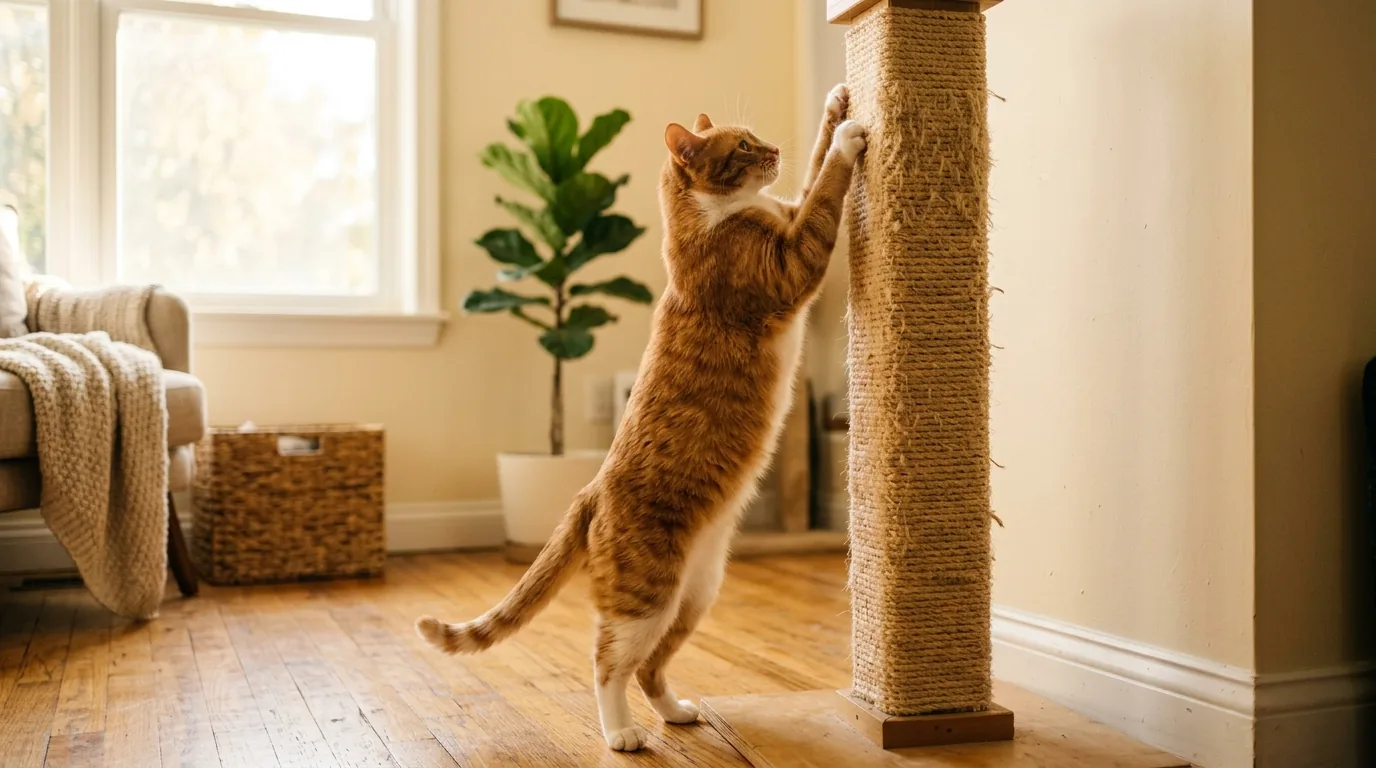
TL;DR. Cats scratch because they're biologically wired to. The behavior is communication, claw maintenance, stretching, and territory marking happening at the same time. Stopping a cat from scratching is impossible. Redirecting where they scratch is achievable, often within a few weeks of consistent management. Declawing is amputation of the last bone of each toe, not nail removal, and the underlying drive to scratch survives the surgery. What follows is what actually works.
A cat scratching the side of a sofa is doing several things at once, and none of them are spite. The owner who walks in on the act tends to read it as defiance because the cat usually freezes, looks at them, and then keeps scratching. That isn't defiance. That's a cat finishing a multi-function behavior they've been performing since they were three weeks old.
The clinical question isn't "how do I stop this." It's "how do I get the cat to do this somewhere else." Those are different problems with very different answers.
Why cats scratch — the four functions
Scratching is one of the few behaviors in the feline ethogram that serves four distinct functions simultaneously. This matters because solutions that address only one function tend to fail. Mengoli and colleagues documented the multi-function nature of scratching in a 2013 questionnaire-based study in the Journal of Feline Medicine and Surgery — cats in homes with appropriate scratching infrastructure still scratched daily, because each function was being served.
Claw maintenance. The outer sheath of a cat's claw sheds in layers. Scratching against a textured surface peels away the worn outer layer and exposes the sharp underlying claw. This is why pieces of shed claw sheath sometimes appear next to a well-used scratching post. The cat isn't damaging the post — they're grooming the claw against it.
Stretching. A cat extending into a full vertical scratch is engaging the muscles along the back, the shoulders, the front legs, and the toes. This is a stretch the cat cannot replicate any other way. A horizontal scratch engages a different set of muscles. The behavior overlaps with the morning stretch most cats perform after sleep, which is why scratching often happens immediately after waking.
Scent marking. The paw pads contain interdigital scent glands. When a cat scratches a surface, those glands deposit a chemical signature alongside the visible mark. This is one reason cats often scratch in heavily trafficked locations rather than in quiet corners. They're marking the route, not hiding the behavior.
Visual marking. The claw marks themselves are signal. A cat passing the scratched surface later — whether the same cat or a different one — reads the marks as territorial information. This is why hiding a scratching post in a closet rarely works. The cat needs the marks to be seen.
Reading these together, the picture clarifies. Scratching isn't a habit. It's four overlapping biological functions expressed through one behavior. An owner who removes the outlet without providing alternatives is asking the cat to abandon four needs at once.
Why declawing isn't an answer (and why most countries have banned it)
Declawing is not a manicure. The procedure — onychectomy — removes the last bone of each toe, the distal phalanx, because the claw grows from inside that bone and cannot be removed otherwise. The functional equivalent in a human would be amputation at the last joint of every finger.
Martell-Moran, Solano, and Townsend published a 2017 study in the Journal of Feline Medicine and Surgery comparing 137 non-declawed and 137 declawed cats. Declawed cats showed significantly higher rates of back pain, biting, barbering, and inappropriate elimination. The researchers also found bone fragments left in the paws of a meaningful percentage of declawed cats — incomplete surgical removal that produced lifelong pain.
The behavioral side effects are the part owners rarely hear before the surgery. A cat whose first line of defense has been amputated tends to escalate to the second line. Biting frequency increases. Litter box aversion increases — many declawed cats associate the litter substrate with the pain of healing paws and never recover the association with the box. Some develop chronic fear or aggression patterns that weren't present pre-surgery.
The professional consensus is unambiguous. The AAFP (American Association of Feline Practitioners), the AVMA (American Veterinary Medical Association), ICatCare, and the AVSAB (American Veterinary Society of Animal Behavior) all oppose declawing as a routine procedure. The AAFP's position statement describes it as ethically controversial and recommends it only as a last resort when the alternative is euthanasia or relinquishment. Most veterinary teaching hospitals no longer teach the procedure.
The legal picture is moving the same direction. Declawing is banned outright in over 40 countries including the UK, most of the EU, Australia, New Zealand, Israel, and Brazil. In the United States, New York State banned it in 2019, Maryland in 2022, and over a dozen California municipalities including Los Angeles and San Francisco. Denver banned it citywide. The American Veterinary Medical Association's own 2024 policy update strengthened the language opposing the practice.
A cat scratching furniture is not a medical problem. Declawing treats it as one and produces a different, more durable problem in exchange.
What actually works — the redirect approach
The redirect framework rests on a single premise: the cat is going to scratch. The only variable is the surface. An owner who provides the right surface, in the right orientation, in the right location, and rewards its use, will usually see the targeted furniture stop being a target within four to six weeks.
Five elements move the needle.
- Provide multiple acceptable surfaces. One scratcher in a home is often the failure mode. A multi-cat home or a multi-room home needs scratchers in several locations.
- Match the surface preference. Different cats prefer different textures — sisal, cardboard, carpet, wood. The cat already has a preference. Read it from what they're scratching now.
- Match the orientation preference. Vertical, horizontal, and angled scratchers engage different muscle groups. Most cats have a strong preference.
- Place scratchers near the targeted furniture. Hiding the new scratcher in a back room while the cat continues scratching the sofa in the living room is asking the cat to walk past their preferred outlet to find a less convenient one.
- Reward use. A treat or a piece of high-value food delivered when the cat uses the new scratcher builds the association faster than any deterrent on the targeted furniture.
The redirect approach is not a trick. It's a translation of what the cat is already trying to do into a context that doesn't damage the furniture.
Surface preferences — by cat type
Surface preference is individual. The reliable approach is to test more than one and let the cat pick.
Sisal rope. Tightly wound rough fiber wrapped around a vertical post. Many cats prefer sisal because the texture catches the claw and resists shredding, which makes the scratching motion feel productive. Sisal fabric — a flat woven version — is sometimes a separate preference. A cat who likes one doesn't always like the other.
Cardboard. Corrugated cardboard scratchers, usually horizontal or angled, are the most commonly chosen surface in surveys of cat-household preferences. The corrugation gives way under the claw, which produces a satisfying physical feedback. Cardboard scratchers are inexpensive enough that several can be placed throughout a home.
Carpet. Some cats prefer carpet-style scratchers, which is often the same preference that drives them toward upholstered furniture. If a cat is scratching the side of a carpeted sofa, a carpet-surfaced scratcher placed against it will often redirect the behavior within days.
Wood. A smaller subset of cats prefers bare wood — tree bark, untreated logs, or wood-surfaced cat trees. This preference correlates with cats who had outdoor access early in life.
The test is empirical. Place two or three surface types in the same area and observe which one the cat uses repeatedly across a week. That's the preference.
Orientation preferences
Surface and orientation are independent variables.
Vertical. A vertical scratcher tall enough for the cat to stretch into a full extension simulates a tree trunk. The cat stands on the back legs, reaches up with the front legs, and pulls down with the claws. A vertical post shorter than the cat's full stretch length is not a vertical scratcher — it's an undersized one, and most cats will reject it.
Horizontal. A horizontal scratcher lets the cat scratch at floor level, engaging the shoulders and front legs without the back extension. Many cats use both vertical and horizontal scratchers for different needs, often horizontal after waking and vertical after eating.
Angled. Angled cardboard scratchers — the kind shaped like a ramp — combine elements of both. They are widely preferred by cats who don't strongly favor either pure orientation, and they're often the highest-conversion option in homes where one scratcher has to do most of the work.
A cat who scratches the floor is signaling horizontal preference. A cat who scratches the back of a chair is signaling vertical preference. The behavior is the assessment.
Placement matters more than owners realize
The most common failure point in the redirect approach is placement. A correctly chosen scratcher in the wrong location performs about as well as no scratcher at all.
Three placement rules cover most cases.
Near sleeping areas. Cats stretch and scratch immediately after waking. A scratcher placed within a few feet of where the cat sleeps will catch that post-nap behavior most reliably.
Near targeted furniture. If the cat is scratching the side of the sofa, the new scratcher belongs next to the sofa — not in another room. The intercept location is the targeted location. Once the cat consistently uses the new scratcher (typically two to four weeks), it can be moved gradually, a few inches per day, to a location the owner prefers.
In visible, central locations. Scratching is communication. A scratcher tucked behind a door or hidden in a closet defeats one of the four functions. Cats use central, high-traffic locations because the visual and scent marks are part of the point. A scratcher in the middle of a living room is more effective than a nicer scratcher in a guest bedroom.
Other tools that help
A handful of tools complement the redirect framework. None of them are substitutes for it.
Soft Paws / Soft Claws. Vinyl nail caps glued over the cat's existing claws. They blunt the scratching impact without removing function. They last four to six weeks before shedding with the natural claw cycle and need to be reapplied. They are a useful bridge tool while a cat is being redirected, particularly in homes with antique furniture or leather upholstery.
Nail trimming. Trimming the sharp tip of the claw every two to three weeks reduces the visible damage from scratching dramatically. The cat keeps the claw and the function; the furniture keeps most of its surface. Most cats accept nail trimming with progressive desensitization — Fear Free and the AAFP both publish handling protocols.
Pheromone products. Feliscratch by Feliway is a pheromone analog designed to be applied to a scratching post. The product mimics the interdigital marking signal and directs the cat's scratching toward the treated surface. Independent studies have shown modest but real effects in directing scratching location.
Double-sided tape on targeted furniture. Cats dislike the tacky sensation on their paws. A temporary application of double-sided tape (or a commercial product like Sticky Paws) on the targeted area, paired with an appealing scratcher placed adjacent, accelerates the redirect.
What does not work
A short list, because owners are commonly told to try these and they consistently fail.
Spray bottles. A spray of water from the owner doesn't stop the underlying drive. It teaches the cat that the owner is unpredictable. Trust degrades. The cat may scratch when the owner isn't present and continue scratching the same furniture. This is consistent across the welfare literature.
Punishment after the fact. Cats do not connect a punishment to a behavior performed minutes or hours earlier. The cat who is scolded for a scratched chair while sitting on the windowsill is learning that the owner is sometimes scary at the windowsill. That is the entire lesson.
Yelling. Same mechanism as punishment. Stress increases, behavior doesn't change, the cat may begin avoiding the owner.
Vinegar or citrus sprays. Sometimes effective for a few days while the scent is fresh. Usually the cat adapts and resumes the behavior, often in a new location.
Removing all scratching surfaces. The drive to scratch is intrinsic. A cat with no acceptable surfaces will scratch whatever is available, often expanding the targeted area rather than reducing it.
When to call a professional
The redirect framework above resolves most cases of furniture scratching within four to six weeks of consistent application. If a cat continues to target furniture after that window — with appropriate scratchers in appropriate locations, with rewards in place, with nail trimming or caps as a bridge — the underlying picture is usually more complex than scratching alone.
Look for credentialed professionals: IAABC CCBC (Certified Cat Behavior Consultant), Fear Free Certified Veterinary Professional, or a veterinarian board-certified in behavior (DACVB). Avoid anyone who recommends declawing as a behavioral solution. The IAABC and Fear Free directories both let owners search by region and species.
Persistent scratching at a new location — particularly horizontal scratching at door frames, walls, or windows — can also signal a marking response to outdoor cats, conflict with another cat in the home, or medical discomfort. A behavior consultation will read the whole picture, not just the surface.
For reading the cat's body language alongside the behavior — what the ears, eyes, tail, and posture are signaling in the moments around the scratch — see the companion field guide on cat body language. Reading the affective state often clarifies whether the scratching is routine, displacement, or marking. For guidance on what credentials to look for, see how to find a credentialed behaviorist.
Try it on your own cat
The redirect framework works because it treats scratching as the multi-function behavior it actually is. The first step is reading the cat's existing preferences — surface, orientation, location — from the behavior they're already producing.
PetTranslator.ai uses the same observational framework. Upload one clear photo of the cat (ideally mid-scratch, but resting works too) and the AI returns a structured report — biometric markers, behavioral interpretation, and recommended next steps — drawn from the AVSAB and AAFP positions and the clinical reading framework above.
Sources
- Martell-Moran, N. K., Solano, M., & Townsend, H. G. (2017). "Pain and adverse behavior in declawed cats." Journal of Feline Medicine and Surgery, 20(4), 280–288. The reference study on welfare outcomes of onychectomy.
- Mengoli, M., Mariti, C., Cozzi, A., et al. (2013). "Scratching behaviour and its features: a questionnaire-based study in an Italian sample of domestic cats." Journal of Feline Medicine and Surgery, 15(10), 886–892. The reference study on scratching as a multi-function behavior.
- AAFP Position Statement on Declawing. American Association of Feline Practitioners, current edition.
- AVMA Position Statement on Declawing of Domestic Cats. American Veterinary Medical Association, 2024 update.
- ICatCare Position on Declawing. International Cat Care.
- AVSAB Position Statement on Declawing. American Veterinary Society of Animal Behavior.
- John Bradshaw, Cat Sense: How the New Feline Science Can Make You a Better Friend to Your Pet (Basic Books, 2013). The reference work on domestic cat behavior and the gap between feline cognition and owner expectation.
Khabir Mughal is the founder of PetTranslator.ai. This article was reviewed against the AAFP and AVSAB position statements on declawing and the Mengoli et al. 2013 scratching study before publication.