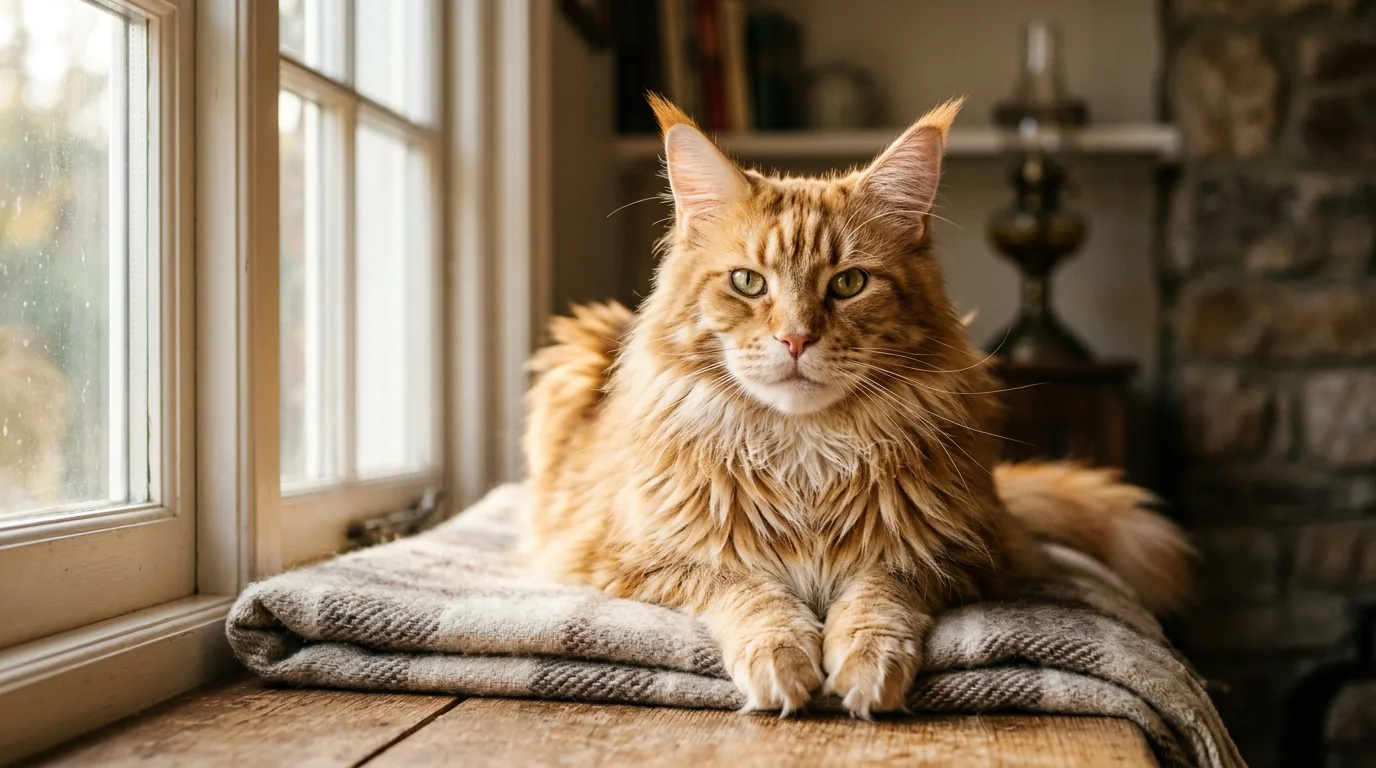
TL;DR. Maine Coons are the gentle giants of the cat world — highly social, dog-like in many of their behaviors, and vocal in an unusual way. They trill, chirp, and chatter far more than they meow. They mature slowly, often not reaching full adult size and temperament until four years old, and they carry a specific set of breed-related health concerns including hypertrophic cardiomyopathy, hip dysplasia, and spinal muscular atrophy. The body-language framework is the same as any other cat. The size, the vocalization pattern, and the heart-screening reality are what change.
Maine Coon temperament — what the breed actually looks like
The Maine Coon is one of the larger domestic cat breeds and one of the most consistently social. Adult males commonly reach 15 to 25 pounds at a healthy weight, with females in the 10 to 15 pound range. The size is real and it changes household logistics — litter boxes, cat trees, carriers, and door gaps all need to accommodate a cat closer in mass to a small dog than to a typical domestic shorthair.
The temperament profile holds up well across breed research and veterinary reference works. Maine Coons are described as confident, affiliative, and people-oriented across multiple feline behavior sources. They greet at the door, follow household members between rooms, and settle near people rather than away from them. The breed is often labeled "dog-like," and the label is more accurate than most breed shorthand.
They are slow to mature. A Maine Coon kitten looks like an oversized kitten well into the second year and behaves like one for longer than that. Full adult body size and full adult temperament typically arrive between three and four years. An owner expecting the calm settled adult cat at twelve months is going to be reading a still-juvenile animal.
They are playful into adulthood. Where many breeds taper their play interest after the kitten phase, Maine Coons retain a working interest in toys, puzzles, and interactive games for years longer. This is the breed's most reliable enrichment signal — a Maine Coon who has stopped playing is rarely just "growing up."
Behavior differences from a typical cat
The same framework that reads any cat reads a Maine Coon. A handful of breed-typical patterns shift the baseline.
Dog-like attachment behavior. Maine Coons follow people between rooms more consistently than most breeds. They sit in the bathroom, they wait at the door, they choose proximity over solitude. The pattern reads as friendliness; what it actually reflects is a high social-attachment score that maps better onto the canine literature than the typical feline one.
Water interest. Many Maine Coons are unusually drawn to water — drinking from running taps, pawing at filled glasses, occasionally getting into the shower. The behavior is breed-typical and not pathological. A water fountain often gets used heavily by this breed. The interest is worth noting but is not a stress signal.
Trill and chirp instead of meow. This is the most distinctive vocalization profile in the breed. Maine Coons produce a rolling trill, a short chirp, and a quieter chatter far more often than the loud meow common to other breeds. Repeated quiet trilling around a person is affiliative communication. A sudden shift to loud, repeated meowing in a cat who normally trills is a meaningful change — it warrants attention, often medical.
Leash and harness tolerance. Maine Coons accept leash training more readily than most breeds when introduced gradually. They are not exempt from the standard introduction protocol — harness inside, then movement inside, then short outdoor sessions — but the ceiling is higher. Many adult Maine Coons walk reliably on a harness if the training was done in the first eighteen months.
Higher exercise need. The size and the retained kitten-like play drive combine into a meaningfully higher daily exercise need than most breeds. A Maine Coon left without enrichment for long stretches is more likely to redirect into destructive scratching, food anxiety, or attention-seeking vocalization than a less active breed would be.
Body language considerations
The signals are the same as in any other cat. Three breed-specific factors shift how they read on a Maine Coon.
Size compresses signal urgency. A small posture change in a 22-pound cat is more displacement of body mass than the same percentage change in a 9-pound cat. Owners often miss the early signal because the cat is large enough to look "still" while subtly bracing. Calibrate against the individual cat's resting baseline rather than against an absolute scale.
Tufted ears change the visual frame. The lynx-like ear tufts that are part of the breed standard make the top of the ear less informative than the base. Read ear position by the base orientation — forward, neutral, sideways, pinned — not by the silhouette the tufts create. The tufts move with the ear but they exaggerate the apparent shape, and that can mislead.
Coat length hides body tension. The long double coat softens the visible outline of the body. Tension across the shoulders, slight piloerection along the spine, or a half-tucked tail can all be partially hidden under the coat. Reading a Maine Coon often requires watching motion — how the cat moves to a stimulus — rather than relying on the still-frame outline.
Tail signals remain reliable. The breed's long, plumed tail carries the same signals as any other cat's tail. Tail-up greeting, twitching tip, lashing tail, and tucked tail all read the same. The plume amplifies the signal rather than masking it, which makes the tail the most reliable single channel on a Maine Coon.
Vocal range carries signal. Because trilling is the breed's baseline, a Maine Coon who stops trilling, or who switches to a louder, harsher vocalization, is showing a change worth investigating. The shift is the signal, not the sound in isolation.
Common behavior questions specific to Maine Coons
"Why does my Maine Coon follow me everywhere?" Breed-typical attachment behavior. Maine Coons are among the most consistently people-oriented cat breeds, and following from room to room reflects the breed's social drive rather than separation distress. The concern is a change — a cat who used to follow and now hides, or a cat who paces and vocalizes when you leave, is showing a different signal that warrants reading more carefully.
"Why is my Maine Coon trilling so much?" Usually breed-typical. Trills, chirps, and chatter are the breed's normal vocal range and most of it is affiliative or attention-seeking. The frequency shouldn't worry an owner. The exception is a sudden shift in pitch, intensity, or pattern, particularly if it appears alongside changes in eating or activity. See the framework for reading cat body language.
"Why is my Maine Coon still acting like a kitten at two?" Because the breed is slow to mature. The full adult temperament typically arrives between three and four years. Continued play drive, jumpy curiosity, and high social demand at two are not behavioral problems — they are breed-typical developmental pacing.
"Why is my Maine Coon obsessed with water?" Breed-typical. The interest in running water, pawing at glasses, and pawing in water bowls appears more often in Maine Coons than in most breeds. A pet water fountain often resolves the behavior by giving the cat a stable target. The interest is not pathological unless the cat is also drinking far more than usual, which is a different signal and a vet visit.
"Why did my Maine Coon suddenly stop playing?" This is the breed's most useful early-warning signal. A Maine Coon who has lost interest in play, particularly before age eight, warrants a veterinary check. The breed retains play drive longer than most. Loss of it is medical until proven otherwise — often the first visible sign of cardiomyopathy, joint pain, or another condition. See the framework for behavior change in senior cats.
Health concerns and the screening that actually matters
Behavior change in a Maine Coon is medical until proven otherwise. The breed carries a specific genetic load that owners need to know about before adoption, and that breeders need to be testing for before pairing.
Hypertrophic cardiomyopathy (HCM). The most significant inherited condition in the breed. Maine Coons carry a known mutation in the MYBPC3 gene that is associated with HCM — first identified by Meurs and colleagues at Ohio State and published in Human Molecular Genetics in 2005. The mutation is testable through a simple cheek swab. Responsible breeders test the gene and also screen breeding cats with echocardiography by a board-certified veterinary cardiologist, because the genetic test alone doesn't catch every case. For an adult Maine Coon, annual or every-other-year cardiac ultrasound is the standard recommendation in the breed, particularly past age five. Pawpeds and OptiGen are commonly used as testing references in pedigree contexts. Signs of HCM are often subtle until the disease is advanced — reduced activity, faster breathing at rest, occasional hind-limb weakness. The behavioral signal often arrives before the owner notices the breathing change.
Hip dysplasia. Maine Coons are over-represented for hip dysplasia compared to most cat breeds — a consequence of the breed's size. Screening through PennHIP or OFA radiographs is standard in breeding programs. Affected cats may show reduced jumping, a "bunny hop" gait at higher speeds, or reluctance to use stairs. Pain often goes underreported because cats don't show joint pain visibly the way dogs do.
Spinal muscular atrophy (SMA). A recessive neurological condition that causes muscle weakness in affected kittens. Genetic testing for SMA is available and reliable, and responsible breeders test both parents before pairing. The mutation is recessive, so two carriers can produce affected kittens. Asking a breeder for the SMA test result on both parents is a basic adoption-due-diligence step in this breed.
Polycystic kidney disease (PKD). Less prevalent in Maine Coons than in Persians but present at low population rates. Screening is straightforward through ultrasound or genetic testing.
Obesity. Worth naming as a behavioral and health concern in its own right. The breed's size makes weight gain harder to spot — a Maine Coon can be ten or fifteen percent over ideal weight and still look proportional. The cardiac and joint consequences are real. Weight should be measured against breed-and-individual baseline rather than against a generalized cat chart.
The screening cost adds up. Cardiac ultrasound, genetic panel, and hip radiographs over the life of one cat run in the high three figures or low four figures depending on geography. This is a real adoption cost, not an optional add-on. It is also the single best protection against expensive end-of-life conditions arriving without warning.
Exercise and mental needs
A Maine Coon at adult size with retained kitten-like play drive needs more daily enrichment than most breeds. The baseline:
Two play sessions a day, ten to fifteen minutes each. Interactive play with a wand toy or fishing-rod toy. Laser pointers are useful as a warm-up but should always end on a physical toy the cat can catch — chasing a target the cat can never capture builds frustration over time.
Vertical territory. Maine Coons climb. A cat tree rated for the breed's weight, window perches, and shelving routes around the home use the vertical dimension that the cat is going to use whether you provide it or not.
Food puzzles. Treat balls, snuffle mats, and puzzle feeders engage the breed's foraging drive and slow down eating in cats prone to gulping food.
Leash work. As covered above, Maine Coons train to a harness more readily than most breeds. Outdoor leashed sessions in a quiet area extend the enrichment options significantly, particularly for cats kept strictly indoors.
A second cat. Maine Coons are among the breeds most likely to do well with a feline companion. Pairing is not automatic — introductions still need to follow the standard protocol of scent exchange, controlled visual contact, and gradual integration — but the success rate is higher in this breed than in many.
A Maine Coon without enrichment redirects. The breed's size and intelligence mean the redirected behavior can be more disruptive than the same pattern in a smaller cat. The enrichment is a baseline care decision, not an optional enhancement.
Common owner mistakes
A handful of patterns appear repeatedly in Maine Coon households, particularly first-time owners.
Treating the size as decorative rather than functional. A 20-pound cat needs proportional resources. The standard cat carrier is too small. The standard cat tree is undersized and often unstable under the breed's weight. The standard litter box requires the cat to fold in on itself. Upsizing all of these is part of caring for the breed, not luxury.
Missing the slow maturation. Expecting adult-cat calm at one year and reading the still-juvenile behavior as a problem. The cat isn't misbehaving. The cat is still developing.
Skipping cardiac screening. Annual cardiologist-performed echocardiography is the standard recommendation in this breed past age three. Many owners skip it until a clinical sign appears, by which point the disease is often advanced.
Confusing breed-typical attachment for separation distress. A Maine Coon who follows you from room to room and waits at the door is showing breed-typical social behavior. A Maine Coon who paces, vocalizes loudly when alone, or destroys property when left is showing actual distress. The two can look similar to a new owner; the difference is what happens when you're not home.
Underestimating grooming. The double coat needs brushing two or three times a week minimum, more in shedding seasons. Mats form behind the ears, on the belly, and in the "britches" of the rear legs if left alone. Less frequent than a Persian, more frequent than a shorthair.
Is a Maine Coon right for you?
Yes, if you want a highly social, people-oriented cat who will participate in household life rather than observe it from a distance, you have the space for a large cat with vertical territory, you can budget for ongoing cardiac and joint screening, and you find the breed's slow maturation and retained playfulness appealing rather than tedious.
No, if you want a low-engagement cat who keeps to themselves, you can't realistically commit to twice-daily play sessions and proportionally sized resources, the screening costs are out of budget, or you wanted a small adult cat — the breed's size is non-negotiable.
There is no wrong answer to that question. There are wrong answers to "the size will work out" and "the heart thing is probably overblown" — neither is a workable plan for this breed.
Try it on your own Maine Coon
Reading a Maine Coon takes calibration. The signals are the same as any other cat — soft eyes, slow blink, tail position, ear set, posture — but the size, the long coat, the tufted ears, and the trilling vocal range all change the baseline. Build the calibration by watching your own cat in moments where you already know the answer. Compare those moments against the uncertain ones.
PetTranslator.ai is built around the same body-language framework board-certified behaviorists use, with breed-specific calibration including the Maine Coon's vocal range and size considerations. Upload one clear photo of your cat and the AI returns a structured report — biometric markers, behavioral interpretation, action plan — calibrated to the breed rather than treating a 20-pound gentle giant as a typical 9-pound shorthair. For day-to-day reading practice, and for catching the early shifts that the breed's coat and stoic posture can hide, it's a useful instrument.
For broader reference on reading any cat, see the cat body language guide. For owners considering a different long-coated breed, the Persian cat behavior guide covers an adjacent profile.
If a specific behavior concern is escalating — aggression, severe separation distress, stereotypic patterns, sudden change in a stable adult — work with a credentialed behaviorist rather than trying to handle it alone.
Sources
The framework in this guide is drawn from:
- John Bradshaw, Cat Sense (Basic Books, 2013) — for breed temperament profiles and the social behavior framework.
- Meurs et al., "A cardiac myosin binding protein C mutation in the Maine Coon cat with familial hypertrophic cardiomyopathy" (Human Molecular Genetics, 2005) — the foundational study identifying the MYBPC3 mutation associated with HCM in the breed.
- Karen Overall, Manual of Clinical Behavioral Medicine for Dogs and Cats (2nd edition, Elsevier 2013) — the clinical reference for behavioral observation, including breed-specific considerations.
- Sarah Ellis and John Bradshaw, The Trainable Cat (Penguin, 2016) — for the harness-training and enrichment framework applied to higher-engagement cat breeds.
- AAFP/AFM Senior Care Guidelines — the American Association of Feline Practitioners' professional guidance on monitoring behavior change as a clinical marker.
For Maine Coon owners working through a screening decision, the Pawpeds and OptiGen testing pipelines are commonly referenced in pedigree contexts, and a board-certified veterinary cardiologist (located through the ACVIM directory) is the standard route for echocardiography. The IAABC lists credentialed cat behavior consultants by region for behavioral concerns.
Khabir Mughal is the founder of PetTranslator.ai. This article was reviewed against Meurs et al. (2005) on MYBPC3 in Maine Coons and Karen Overall's Manual of Clinical Behavioral Medicine before publication.