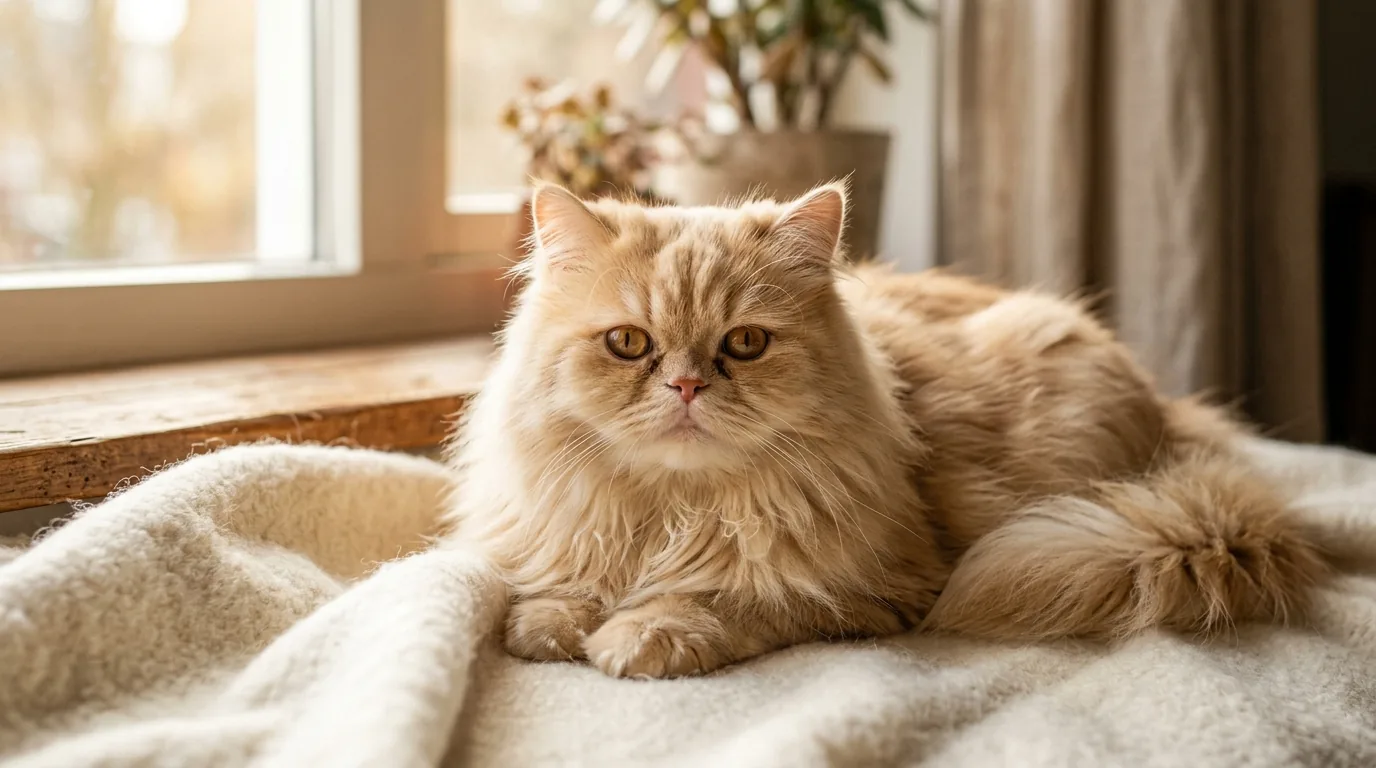
TL;DR. Persian cats are calm, low-activity, indoor-affiliative companions with specific care requirements and significant breed-related health concerns. The flat-faced (brachycephalic) anatomy that defines the breed creates breathing, dental, and tear-duct problems that shape daily behavior. Reading a Persian's body language requires accounting for a reduced facial expression range — the "neutral" mask isn't the same as it is in a domestic shorthair. This guide covers the behavioral science alongside the genuine welfare considerations a Persian owner needs to know.
Persian cat personality — what the breed actually looks like
Persians are one of the most consistently described breeds in feline behavior research. The temperament profile holds up well across multiple sources.
They are sedentary by breed standard. A Persian in good health spends most of the day at rest, with short bursts of low-intensity activity around food, grooming, and quiet exploration. They are affiliative but selective — most Persians bond strongly with one or two people in the household and tolerate others with polite reserve.
Vocalization is limited. Persians use far less meowing than Oriental breeds, and the meow itself is typically soft, short, and infrequent. A loud, repeated Persian meow is more often a signal of distress than conversation.
They are slow to warm up. New people, new rooms, and new objects are met with observation from a distance before approach. This isn't fear — it's breed-typical caution. The same cat who hides for the first hour of a visit may settle onto the guest's lap by the third.
The popular description of Persians as "decorative cats" is accurate about activity level and dramatically undersells their emotional life. They are quiet, but they are not blank.
How brachycephaly affects behavior reading
A Persian's face is not built for the same range of expression as a domestic shorthair's. The selective breeding that produced the modern Persian shortened the muzzle, flattened the skull, and reduced the distance between eye, nose, and mouth. The visible result is the characteristic Persian face. The behavioral result is more subtle and more important.
Facial expression range is reduced. The muscles that pull a cat's ears, eyes, and mouth into coordinated signals still work in a Persian, but the framing skull shape compresses the visible movement. What reads as a clear stress signal in an Egyptian Mau can look like a neutral face on a Persian.
Breathing is often partially obstructed. Brachycephalic Obstructive Airway Syndrome (BOAS) affects roughly one in three Persians on primary veterinary care (O'Neill et al., Journal of Feline Medicine and Surgery, 2019). Snoring during sleep is common in the breed. Snoring while awake, open-mouth breathing at rest, and exercise intolerance are not. Owners often normalize labored breathing as "how Persians sound."
Tear ducts are often obstructed. The flattened skull bends and shortens the nasolacrimal duct, so tears pool on the face rather than draining. The wet face that the Persian can't groom away is a daily anatomical reality, not a behavioral cue.
Dental crowding is the rule. A Persian's jaw is shorter, but the teeth aren't. By middle age most Persians have visible dental disease, and the pain is real even when the cat hides it.
The reputation for a uniformly "calm" temperament is partly genuine breed-typical low arousal and partly a limited ability to express discomfort visibly. Both pieces matter when reading a Persian.
Body language differences in Persians
The signals are the same as in any other cat. The baselines are different.
Slow blink. Persians slow-blink the same way other cats do, but the pacing is slower and the eyelid movement is less pronounced. Read it by duration, not by speed.
Ear position. Forward, neutral, sideways (airplane), and pinned all carry their usual meanings. The Persian's domed skull changes the framing of the "neutral" position, so calibrate against the individual cat at rest before judging a particular moment.
Tail signals. Identical to other cats. Tail-up greeting, twitching tip, lashing tail, and tail tucked all read the same. The tail is the most reliable single signal on a Persian for exactly this reason.
Vocalization. Persians often express through proximity rather than sound. A cat who moves to sit next to you instead of meowing for attention is using the breed's preferred channel. Sudden new vocalization is significant.
The "sad face" appearance. The downturned mouth, the wet face, the heavy brow — these are anatomical features of the breed, not emotional signals. A Persian with a soft body, relaxed ears, and a slow blink is content, regardless of what their resting face looks like to a human eye.
Common behavior questions specific to Persians
"Why is my Persian so quiet?" Usually breed-typical. Persians are low-vocalization cats by design. The concern is breathing, not silence — listen for labored or open-mouth breathing at rest, which is a veterinary issue regardless of the meow rate.
"Why does my Persian hide so much?" Some Persians genuinely prefer solitude and rest in quiet rooms by choice. Others are responding to stress — a new home, a household change, an unaddressed pain source. The framework for distinguishing the two is covered in the guide to cat hiding behavior. A Persian who hides in a new spot, eats less, or stops grooming is signaling that something has changed.
"Why doesn't my Persian play much?" Persians do play. The intensity is lower than in active breeds — short sessions, slow batting motions, often from a seated position. A wand toy at low speed gets more engagement than a laser pointer at full speed. A Persian who shows no interest in any play, ever, is worth a veterinary check.
"Why is my Persian eating slowly?" A flat-faced cat can struggle mechanically to pick up kibble, and dental pain is common in middle-aged and older Persians. Slow eating that's new, dropping food while eating, or chewing on one side of the mouth are dental signs and warrant a vet visit. See also the framework for behavior change in senior cats.
Persian-specific health and behavior overlaps
Behavior change in a Persian is medical until proven otherwise. The breed carries enough overlapping conditions that ruling out pain and disease comes before behavioral interpretation.
BOAS — Brachycephalic Obstructive Airway Syndrome. Affects roughly one in three Persians. Signs include open-mouth breathing at rest, exercise intolerance, snoring while awake, and labored breathing after mild activity. Cats with BOAS often appear unusually quiet because moving is uncomfortable.
Polycystic Kidney Disease (PKD). Up to 40% of Persians carry the PKD1 mutation (Lyons et al., earlier prevalence studies; modern breeding programs are reducing this through screening). Early signs are subtle: increased water intake, more frequent urination, gradual weight loss. A Persian drinking notably more water is worth a vet visit even if every other behavior looks normal.
Eye problems. Entropion (lid rolling inward) and keratoconjunctivitis sicca (dry eye) are over-represented in the breed. Both cause constant low-grade discomfort that affects mood and tolerance for handling.
Dental disease. The shortened jaw crowds teeth that are the same size as any other cat's. Periodontal disease, tooth resorption, and chronic gingivitis are common. Pain often goes undetected for years because cats don't show oral pain visibly — they simply eat differently.
A Persian who has slowed down, become more withdrawn, or changed their eating pattern needs a veterinary workup before any behavioral interpretation. The behavior is downstream of the body.
Diet considerations
Wet food is often preferred by Persians for mechanical reasons — the flat face makes picking up kibble harder than it looks. Many breeders and feline veterinarians recommend wet food as the primary diet for the breed, with kibble as a supplement.
Specialized "Persian" dry kibble exists and is shaped to be easier for a brachycephalic mouth to pick up — almond-shaped or scoop-shaped pieces that the cat can scoop with the tongue rather than grip with the front teeth. Whether the branded versions are worth the price is a judgment call; the shape principle is real.
Slow-feed bowls help with cats who gulp food without chewing — a pattern that's more common when chewing is uncomfortable, which is most older Persians.
Hydration matters more in this breed than in most. With a 40% population-level risk of PKD, supporting kidney function through high-moisture food, multiple water stations, and water fountains is a baseline care decision, not an optional enhancement.
Grooming — the daily commitment
The Persian coat is the most labor-intensive feature of the breed, and the grooming reality is the single most common reason adult Persians are surrendered to rescue.
Daily brushing is required. The undercoat mats within 24 hours if left alone. A matted Persian becomes a vet visit — mats pull on the skin, trap moisture, and cause sores that are usually only discovered when the coat is shaved off.
Eye cleaning twice daily. Most Persians have visible tear staining and a wet face throughout the day. A soft damp cloth, or a vet-recommended eye wipe, used twice a day, keeps the area healthy.
Sanitary trim is often needed. Some Persians cannot effectively clean their own hindquarters because the facial structure makes the reach difficult and the coat traps debris. A regular sanitary trim (clipped fur around the rear) is part of routine care.
Bath every 4–6 weeks. Persians don't keep themselves clean the way a domestic shorthair does. Bathing with a mild cat-safe shampoo, careful drying, and brushing afterward is normal Persian care.
Professional grooming every 6–8 weeks. A "lion cut" or shorter trim, depending on the cat, keeps the coat manageable between full grooms.
The total commitment is fifteen to thirty minutes of brushing daily, plus eye care, plus periodic baths, plus professional grooming. This is the baseline. It is not optional, and skipping it for even a week creates problems that take weeks to undo.
Is a Persian right for you?
Yes, if you want a calm, indoor-affiliative companion who will sit near you for hours, you can commit to daily grooming and twice-daily eye care, you can budget for frequent veterinary visits including dental work, and you have the patience for a cat who warms up slowly to new people.
No, if you want an active, playful, high-engagement cat, you can't realistically commit to daily coat care, you're not in a position to budget for ongoing veterinary costs that exceed those of an average-health domestic shorthair, or you find the welfare concerns of extreme brachycephalic breeding troubling.
There is no wrong answer to that question. There are wrong answers to "I'll figure the grooming out later" and "the breathing thing seems mild" — those are not workable plans for this breed.
The honest welfare conversation
Several welfare organizations have raised formal concerns about extreme-brachycephalic breeding in cats, including the RSPCA, the British Veterinary Association, and the International Society of Feline Medicine. The concerns are not about Persians as a breed — they are about the extreme end of the modern show standard, where the face is pushed flatter and the health consequences are worse.
"Doll-faced" or "traditional" Persians (with a more moderate face structure, closer to the breed standard from the mid-twentieth century) have meaningfully fewer of the breed-typical health issues. BOAS rates are lower, tear duct problems are less severe, dental crowding is reduced. The cats look more like cats and less like the show-line ideal, and they live longer with less veterinary intervention.
If a Persian is the right cat for the household, considering a doll-faced line or an adult Persian from rescue is worth thinking about. Many adult Persians need new homes specifically because the grooming reality didn't match the buyer's expectations, and these cats are often already past the kitten energy phase that some new owners find difficult to manage in the breed.
Try it on your own Persian
Reading a Persian takes calibration. The signals are the same as any other cat — soft eyes, slow blink, tail position, ear set, posture — but the resting face is different and the breed-typical low activity changes the baseline. Build the calibration by watching your own cat in moments where you already know the answer. Compare those moments against the uncertain ones.
PetTranslator.ai is built around the same body-language framework board-certified behaviorists use, with breed-specific calibration including the brachycephalic baseline. Upload one clear photo of your Persian and the AI returns a structured report — biometric markers, behavioral interpretation, action plan — accounting for the breed's face structure rather than treating it as a domestic shorthair. For day-to-day reading practice, and for catching the subtle signals that a flat-faced cat compresses, it's a useful instrument.
For broader reference on reading any cat, see the cat body language guide.
Sources
The framework in this guide is drawn from:
- John Bradshaw, Cat Sense (Basic Books, 2013) — for breed temperament profiles and the social behavior framework.
- O'Neill et al., "Persian cats under primary veterinary care in the UK: a clinical audit of demography, mortality and disorders" (Journal of Feline Medicine and Surgery, 2019) — for prevalence figures on BOAS, dental disease, and ocular conditions in the modern Persian population.
- International Society of Feline Medicine (iCatCare) — breed welfare position statements — for the formal welfare framework on brachycephalic breeding.
- Karen Overall, Manual of Clinical Behavioral Medicine for Dogs and Cats (2nd edition, Elsevier 2013) — the clinical reference for behavioral observation in cats, including breed-specific considerations.
- AAFP/AFM Feline Behavior Guidelines — the American Association of Feline Practitioners' professional guidance on feline behavior assessment in clinical practice.
For Persian owners working through a specific behavior or health concern, the AAFP website maintains a directory of feline-specialist veterinarians, and the IAABC lists credentialed cat behavior consultants by region.
Khabir Mughal is the founder of PetTranslator.ai. This article was reviewed against the O'Neill et al. (2019) Persian primary-care study and the International Society of Feline Medicine's brachycephalic breeding position before publication.