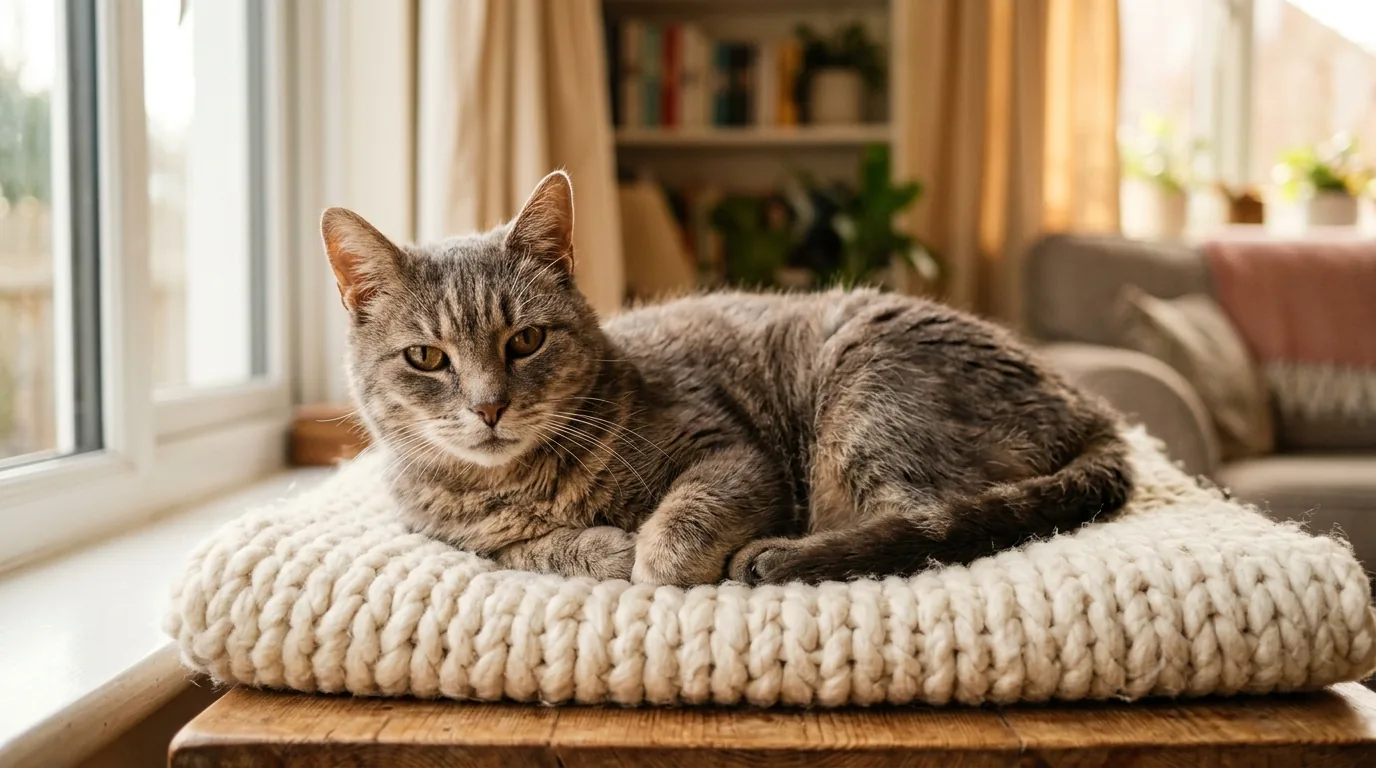
A cat over ten who suddenly vocalizes at night, hides under the bed, stops grooming her back end, or pees outside the box is not "just being old." She's almost certainly telling you something has changed inside her body — and that change is usually treatable. The category of senior cat behavior changes that owners write off as aging is the same category veterinary internists open a workup on. The two reads sit on opposite sides of a decision that matters.
This guide walks through which behavior changes carry the highest medical signal in cats over eight, the specific conditions that present that way, and the workup a credentialed feline vet runs to find them.
TL;DR
Behavior change in a senior cat is almost always medical. Hyperthyroidism affects roughly 10% of cats over ten (Peterson 2012). Chronic kidney disease affects 30 to 50% of cats over fifteen. Radiographic osteoarthritis is present in around 90% of cats over twelve (Hardie, Roe, Martin 2002). "Just aging" is rarely the right read. Sudden behavior change in a cat over eight is a vet visit, not a training problem — and the workup catches conditions that are highly treatable when caught early.
When "senior" actually starts for cats
The AAFP life-stage framework draws cleaner lines than most owners use day to day:
- Mature. Seven to ten years. Outwardly healthy but starting to accumulate subclinical changes.
- Senior. Eleven to fourteen years. The decade where hyperthyroidism, CKD, and arthritis become common findings.
- Geriatric. Fifteen plus. Multi-condition management becomes the norm.
Behavioral changes can begin as early as eight and become more common at ten and above. The cat doesn't read the chart — what the chart provides is a threshold for screening. After eight, behavior shifts deserve a vet workup before a behavioral interpretation.
Behavior changes that are usually medical
The signals below have medical causes more often than behavioral ones in a cat past mid-life. None of them prove a diagnosis on their own. All of them justify a vet visit.
Increased vocalization, especially at night. Loud, repetitive, often non-directed yowling in a cat over ten is one of the most reliable presentations of hyperthyroidism or cognitive dysfunction syndrome. Hearing loss can also drive it — cats who can't hear themselves vocalize louder. A separate guide covers cat meowing at night in more depth.
Increased thirst and urination. Owners notice an empty water bowl or a heavier litter box before they notice anything else. Polyuria and polydipsia together are the cardinal sign of CKD, diabetes, and hyperthyroidism in cats. This isn't a behavior problem. It's an internal-medicine workup.
Do not dismiss new time at the bowl as play; the cat water-play guide separates ordinary pawing and splashing from a genuine rise in thirst.
Hiding more often. A cat who used to sit on the couch and now lives under the bed is almost certainly in discomfort. Hiding is a default coping behavior for feline pain and illness, and it's easy to miss because the cat looks "quiet" rather than distressed. See cat hiding under the bed for the full read.
Loss of litter box habits. Periuria — urinating outside the box — in a senior cat is medical until proven otherwise. CKD makes urine more dilute and more frequent. UTIs cause urgency. Arthritis makes the box itself painful to climb into and squat over. Cognitive changes can disorient the cat away from the box she's used for years.
Sudden aggression when touched. A cat who has tolerated handling for a decade and now bites when picked up or stroked along the spine is reporting pain. The behavior didn't change. The body underneath the behavior changed.
Loss of appetite. Many conditions present this way — dental disease, CKD advancing, nausea from hyperthyroidism, pain. A cat who skips meals for more than 24 hours, particularly an overweight cat, is at risk of hepatic lipidosis. This is a same-week vet call.
Increased irritability. A cat who used to tolerate the other cat in the household and now hisses across the room is more likely showing pain or thyroid-driven restlessness than a personality shift.
Weight loss with a normal or increased appetite. This pattern is so characteristic of hyperthyroidism that internists often suspect it before any bloodwork is drawn. The cat eats the same amount or more and visibly thins.
Confused vocalization. Calling out into an empty room, getting stuck in a corner and yowling, vocalizing at three in the morning for no apparent trigger. This pattern fits cognitive dysfunction syndrome, vision loss, or hearing loss — sometimes all three at once.
The top medical conditions that present as behavior change
Five conditions account for most of what owners initially perceive as senior cat behavior changes.
Hyperthyroidism. A benign tumor of the thyroid gland over-produces thyroid hormone, accelerating metabolism. Peterson's 2012 review summarized two decades of clinical experience: cats present with weight loss despite a normal or ravenous appetite, increased vocalization, restlessness, increased thirst, sometimes irritability or vomiting. Bloodwork (T4, with a full thyroid panel if equivocal) confirms it. Treatment options include daily methimazole, prescription Y/D diet, surgical thyroidectomy, or radioactive iodine (I-131) therapy, which is curative.
Chronic kidney disease. Kidney function declines slowly in cats and is often advanced by the time owners notice anything. Increased thirst, increased urination, decreased appetite, weight loss, lethargy, a change in breath odor (uremic). Bloodwork (creatinine, SDMA, BUN, phosphorus) plus urinalysis stages the disease. Earlier-stage CKD is highly manageable with subcutaneous fluids, phosphate binders, kidney-support diets, and treatment of secondary hypertension.
Hypertension. Secondary high blood pressure is common in cats with CKD or hyperthyroidism and frequently goes undiagnosed because most owners don't think to ask for blood pressure measurement. Presentation can include disorientation, vocalization, and acute retinal detachment that shows up as sudden blindness — the cat walks into furniture or stops jumping. Amlodipine is highly effective.
Diabetes mellitus. Increased thirst, increased urination, weight loss with a normal or increased appetite, eventual weakness in the hind end (diabetic neuropathy). Common in middle-aged and senior overweight cats. Insulin therapy paired with a low-carbohydrate diet allows some cats to enter remission.
Osteoarthritis. Hardie, Roe, and Martin (2002) reviewed radiographs of 100 cats and found osteoarthritic changes in 90% of cats over twelve. Most of those cats had no diagnosis. Arthritis in cats almost never looks like the limping owners expect from dogs — it looks like decreased grooming, hesitation to jump, less play, more loafing, and litter box avoidance because squatting hurts.
Dental disease. Resorptive lesions, periodontal disease, and stomatitis are extremely common in senior cats and routinely missed. Drooling, chewing on one side, dropping food, pawing at the mouth, eating less, or eating only soft food. A full oral exam under anesthesia is part of senior wellness.
Cognitive dysfunction syndrome (feline CDS). Gunn-Moore's clinical reviews describe the pattern as DISH-A: Disorientation, altered Interactions with people or other pets, Sleep-wake cycle disruption, House-soiling, and altered Activity. Cats stare at walls, get stuck in corners, vocalize at night, stop using the litter box reliably, and lose interest in play. Diagnosis is clinical and requires ruling out everything above first, because most CDS-like signs have a medical mimic.
Behavior changes that often signal pain specifically in cats
Cats hide pain. They evolved to. The signals below are how pain leaks through anyway:
- Decreased grooming, especially the back end. A cat with spinal or hip pain can't reach behind. A formerly fastidious cat with mats over the rump is in pain until proven otherwise.
- Hesitation jumping up or down. Pausing before a jump, missing landings, choosing the chair instead of the counter, sleeping on the floor instead of the bed.
- Litter box avoidance. Climbing into a high-walled box and squatting requires intact hips, stifles, and elbows. A cat who pees on the rug next to the box is often telling you the box itself hurts.
- Hiding more. Pain drives concealment in cats more reliably than vocalization.
- Reduced kneading. "Biscuit-making" requires pain-free front limbs. A cat who stops kneading on the blanket may have early carpal or elbow arthritis.
- Reluctance to be petted in specific areas. A cat who used to enjoy a stroke down the spine and now flinches, ear-flicks, or bites at that location is reporting pain at the spot you just touched.
- Loafing more than usual. The loaf position — feet tucked under, weight on the chest — protects sore joints from contact with the floor. Excessive loafing in a cat who used to sprawl is a soft pain signal.
Cat-specific challenges in detecting illness
Several factors make feline disease harder to catch than canine disease:
- Cats hide pain even more than dogs. Evolved as both predator and prey, cats default to concealment rather than vocalization.
- Many senior cats are stoic to a fault. Owners don't see the limp because there isn't one — the cat compensates by moving less.
- Vet visits are stressful, which masks chronic signs. A cat in a carrier in a clinic is in survival mode. Hypertension, low-grade pain, and behavioral signs can all disappear in the exam room.
- You see daily behavior; your vet sees a snapshot. Owner observations — video, notes, water-bowl tracking — carry real diagnostic weight. They aren't anecdotes. They're the longitudinal data the clinical snapshot can't provide.
The vet workup for senior cats
The AAFP Senior Care Guidelines recommend a baseline workup that catches most of the conditions above before they're clinically obvious:
- Senior wellness exam annually for cats seven to ten, every six months for cats eleven and up.
- Full blood panel including thyroid (T4, with reflex to free T4 if borderline).
- Urinalysis with specific gravity — concentrating ability is one of the earliest indicators of CKD.
- Blood pressure measurement — non-invasive, takes minutes, frequently skipped.
- Body condition score and muscle condition score — muscle loss can outpace weight loss in older cats.
- Pain assessment — many clinics use the Feline Musculoskeletal Pain Index or a similar validated tool.
- Dental exam, with anesthetized oral exam and dental radiographs at intervals.
What to do before the vet visit to make it more accurate
Owner-collected data turns a fifteen-minute appointment into a diagnostic conversation:
- Track water intake by measuring how much you put in the bowl and how much is left after twenty-four hours. Sustained intake above roughly 60 ml per kg per day is suspicious.
- Track urination frequency by counting clumps in the box, or weighing the box morning and evening.
- Note appetite changes — meals skipped, food preferences shifted, time-to-finish.
- Video any unusual behaviors — vocalization episodes, the moment of jumping hesitation, the litter box approach. Vets can read these in seconds.
- Time how long the cat takes to eat. A cat who used to finish in two minutes and now takes ten is often telling you about her mouth.
Treatments that genuinely help
The conditions on this list are treatable. That's the point of catching them.
- Hyperthyroidism. Methimazole (oral or transdermal) controls the disease. I-131 radioactive iodine therapy is curative and is the gold standard where available. Prescription Y/D (iodine-restricted) diet works for cats who eat nothing else.
- CKD. Subcutaneous fluids at home (most owners learn this quickly), phosphate binders, kidney-support diets, appetite stimulants (mirtazapine, capromorelin), and aggressive treatment of secondary hypertension.
- Hypertension. Amlodipine, sometimes with telmisartan in CKD cats.
- Diabetes. Long-acting insulin (glargine, ProZinc) paired with a low-carbohydrate canned diet. Remission is possible when caught early.
- Arthritis. Gabapentin for chronic pain. FDA-approved frunevetmab (Solensia), a monthly monoclonal antibody injection, is the first feline-specific arthritis medication and is widely well-tolerated. Environmental modifications (below) carry real weight. NSAIDs in cats require a vet's hand — feline NSAID metabolism is narrow and the wrong drug at the wrong dose causes kidney injury.
- Cognitive dysfunction. SAMe-based supplements, prescription cognitive-support diets (Hill's b/d for dogs is occasionally extrapolated; feline-specific options are emerging), and environmental enrichment. Sleep-wake disruption sometimes responds to nighttime food and a low night light.
- Pain in general. Gabapentin is the workhorse. Buprenorphine for acute flares. Always vet-prescribed at vet-set doses.
Environmental modifications for senior cats
Most senior cats benefit from a quiet retrofit of the spaces they use:
- Litter box. At least one box with a very low entry (a cut-down storage tote works well). Multiple boxes on each floor of the home. Larger surface area than a standard box — older cats need room to position.
- Food and water. Separate locations. Raised dishes for cats with cervical or elbow arthritis. Water in more than one room — cats with CKD or hyperthyroidism drink more, and they drink more if the water is easier to reach.
- Resting spots. Orthopedic, heated, and at multiple heights. Some senior cats want to stay high (their preference doesn't change just because the jump got harder), so build the path up there with ramps or steps.
- Ramps and stairs to favorite high spots — window sills, the bed, the back of the couch.
- Night lights for cats with cognitive changes or vision loss. A small amount of ambient light reduces nighttime disorientation.
- Reduced household stressors. Senior cats tolerate change less well. A predictable routine, quiet handling, and slow introductions to new pets or people lower the cognitive load.
When to consult a professional
A senior cat with new behavior signs needs a vet first, not a behaviorist first. The order matters. Most behavior changes in cats over eight resolve when the underlying medical condition is treated. A behaviorist working without a clean medical workup is treating the wrong problem.
After the medical workup is clean — or once medical conditions are well-controlled and behavior signs persist — a credentialed feline behavior professional is the right next step. Look for CDBC (Certified Dog and Cat Behavior Consultant) through IAABC, Diplomate ACVB (board-certified veterinary behaviorist), or Fear Free Certified Professional. The guide on how to find a credentialed behaviorist walks through the credential landscape.
Avoid anyone who frames feline behavior in dominance terms. Cats don't have a dominance hierarchy in the canid sense, and the framework doesn't fit them.
Try it on your own cat
Senior cat behavior changes are the category of pet behavior where deliberate reading matters most, because the cat won't tell you in any other way. Photograph her in her normal resting position, her current jumping pattern, her grooming state, her body condition.
PetTranslator.ai is built on the same observational framework used in feline clinical behavior medicine. Upload a clear photo and the AI returns a structured report — biometric markers, behavioral interpretation, and a flag when patterns are consistent with medical concerns that warrant a vet visit. It is not a substitute for senior wellness bloodwork. For reading the early signs that send you to the vet sooner, it's a useful instrument. The cat body language guide pairs with it.
Sources
The framework in this guide is drawn from:
- Peterson, M. "Hyperthyroidism in Cats: What's Causing This Epidemic of Thyroid Disease and Can We Prevent It?" Journal of Feline Medicine and Surgery 14, no. 11 (2012): 804–818.
- Hardie, E. M., Roe, S. C., and Martin, F. R. "Radiographic Evidence of Degenerative Joint Disease in Geriatric Cats: 100 Cases (1994–1997)." Journal of the American Veterinary Medical Association 220, no. 5 (2002): 628–632.
- AAFP Senior Care Guidelines — Quimby, J., et al. "2021 AAFP/AAHA Feline Life Stage Guidelines." Journal of Feline Medicine and Surgery 23, no. 3 (2021): 211–233.
- Karen Overall, Manual of Clinical Behavioral Medicine for Dogs and Cats. 2nd edition. Elsevier, 2013 — the clinical reference for behavioral observation and diagnosis in companion animals.
- Gunn-Moore, D. "Cognitive Dysfunction in Cats: Clinical Assessment and Management." Topics in Companion Animal Medicine 26, no. 1 (2011): 17–24.
- AVSAB Position Statements — American Veterinary Society of Animal Behavior, for the professional standard on force-free, evidence-based behavior work.
For owners working with a senior cat showing behavior change, the right professional path is a credentialed feline veterinarian first, followed by a Diplomate ACVB or IAABC-CDBC behaviorist if behavior signs persist after medical conditions are controlled.
Khabir Mughal is the founder of PetTranslator.ai. This article was reviewed against the AAFP Senior Care Guidelines and Karen Overall's Manual of Clinical Behavioral Medicine before publication. It is not a substitute for veterinary care.