TL;DR
Adult cats meow primarily at humans, rarely at each other. Cat-to-cat communication is built from body language, scent, and a narrow band of vocalization that's mostly conflict-related. Nighttime meowing is a human-directed behavior with seven distinct causes — hunger, boredom, attention-seeking, intact sexual behavior, cognitive dysfunction syndrome, hyperthyroidism, and pain. Reading which one applies requires looking at age, recent changes, and accompanying behaviors. Reflexively ignoring a night meow can mask a medical issue, especially in cats over 8.
Why cats meow at humans (and rarely each other)
The meow is, for the most part, a domestication artifact. John Bradshaw's Cat Sense lays out the evidence directly: adult feral cats living in colonies almost never meow at each other. They communicate through body posture, tail position, ear set, and scent marking. The vocalizations that do appear between adult cats are mostly hisses, growls, and yowls — and those almost always signal conflict, not conversation.
What domestic cats figured out is different. Somewhere across the ten-thousand-year arc of living alongside humans, cats learned that a particular vocal pattern reliably gets a human response. The meow became a tool aimed at a specific audience — us. Each cat develops their own meow vocabulary in response to which sounds work on the humans they live with. Two cats in the same household often meow differently because their humans reinforce different sounds.
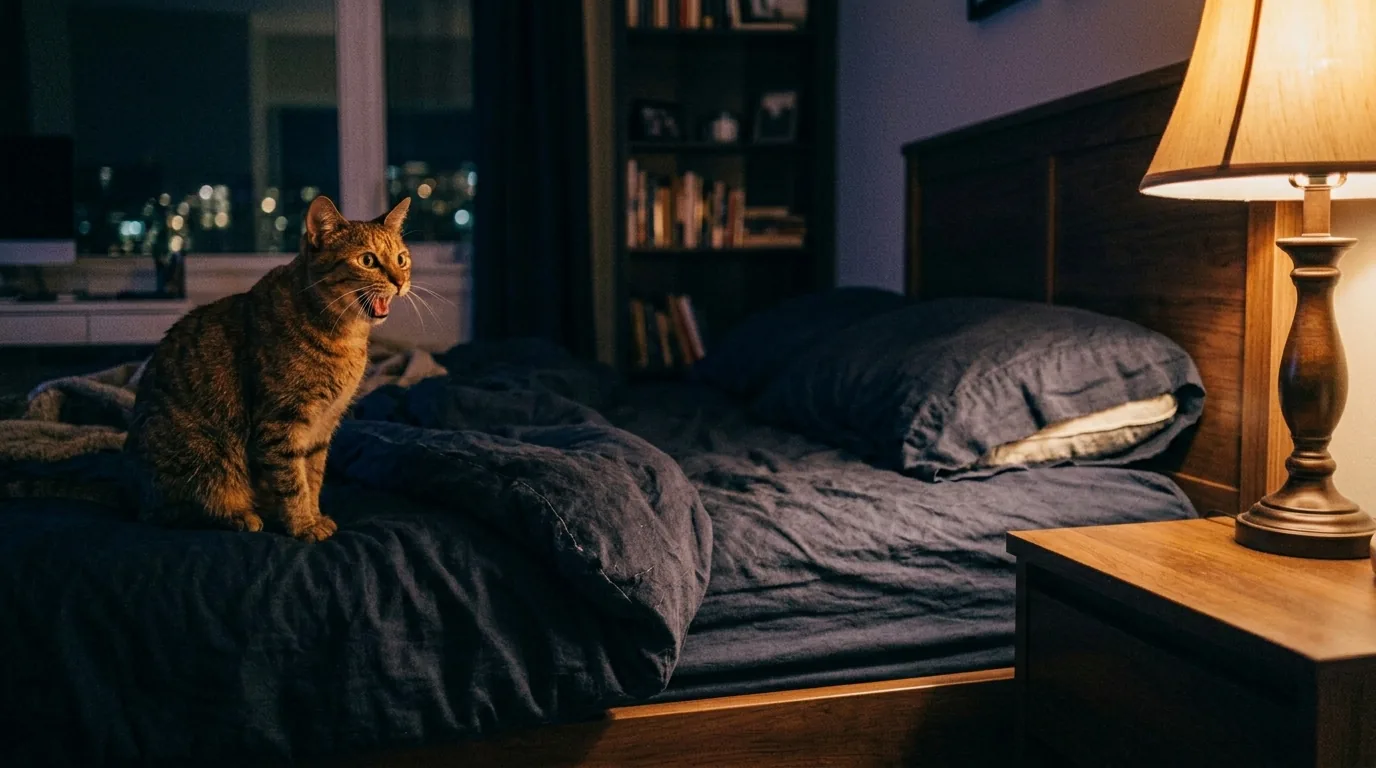
This matters for the nighttime question for one reason. If a cat is meowing at 3 a.m., they aren't talking to the other cat in the house. They're addressing a human. Whatever the underlying cause, the meow itself is a learned communication aimed at you.
The 7 causes — how to identify which one
The cause matters more than the meow. Treating a hunger meow and a hyperthyroidism meow the same way leaves one cat reinforced and one cat sick.
1. Hunger and scheduled feeding association
The most common cause in young, healthy cats. A cat fed at consistent times learns that vocalization in proximity to feeding time produces food. If the cat is fed at 6 a.m. and starts meowing at 5:30 a.m., the feeding window has trained that vocalization. The pattern usually escalates if the human responds at any earlier time — the cat updates the schedule.
How to tell it's this one. The meowing is timed to the feeding window. It stops or drops sharply after the meal. The cat is otherwise healthy, under 8, and the behavior is not new.
2. Boredom and under-stimulation
Indoor-only cats are particularly susceptible. The natural feline activity pattern is crepuscular — peak alertness at dawn and dusk — with bursts of predatory behavior scattered through the night. A cat with no outlet for that energy often vocalizes for engagement at the hours their biology pushes them toward activity.
How to tell it's this one. Indoor-only cat, no environmental enrichment, single-cat household or sleeping arrangement that isolates the cat at night, and the meowing is paired with other under-stimulated behaviors — pacing, knocking things off counters, attention-soliciting during the day.
3. Attention-seeking (learned)
The closest first cousin of the boredom meow. A cat who has learned, through repetition, that meowing at night produces a human reaction — any reaction — will continue to meow. Yelling counts as a reaction. Getting up to check counts. Letting the cat into the bedroom counts. The behavior is reinforced even by responses meant to stop it.
How to tell it's this one. The meowing escalates when ignored, then briefly resolves when the human responds, then recurs. The cat is healthy and engaged during the day, and the meowing is loudest near the bedroom door.
4. Intact sexual behavior
A cat in heat yowls. An intact male responding to a female in heat yowls. This is unmistakable once you've heard it — a long, modulated, almost mournful vocalization that doesn't sound like the household meow at all. The obvious solution is the only one that actually works: spay or neuter the cat.
How to tell it's this one. Intact reproductive status, the vocalization pattern doesn't match the cat's normal meow, often accompanied by restlessness, rolling, and increased affection-seeking in females or territorial spraying in males.
5. Cognitive dysfunction syndrome
The American Association of Feline Practitioners' Senior Care Guidelines describe cognitive dysfunction syndrome as a recognized clinical condition in geriatric cats, with disorientation and altered vocalization among the cardinal signs. A cat with CDS may wander the house at night, get stuck in corners they used to navigate easily, fail to recognize familiar people for a moment, and vocalize with a quality their owners describe as plaintive or confused.
How to tell it's this one. Cat over 11, new or worsening behavior, the meowing has a disoriented quality — often from a different room than where the cat fell asleep — and accompanies other changes like altered sleep cycles, reduced grooming, or house-soiling.
6. Hyperthyroidism
The most common endocrine disorder in older cats. Increased vocalization is a classic symptom, alongside weight loss with preserved or increased appetite, increased thirst, restlessness, and an unkempt coat. Karen Overall's Manual of Clinical Behavioral Medicine lists hyperthyroidism among the medical conditions that must be ruled out before a behavioral diagnosis is made for excessive vocalization in any cat over 8.
How to tell it's this one. Cat over 8, new or escalating vocalization, paired with weight loss, increased appetite, increased water consumption, or restlessness. This is diagnosed with a blood test. Don't guess.
7. Pain or illness
Sudden onset of nighttime meowing in a cat that previously slept through the night — especially a middle-aged cat — is a medical signal until proven otherwise. Cats hide pain. The vocalization may be the only outward sign of an underlying issue. Urinary tract problems, dental pain, arthritis in older cats, and gastrointestinal discomfort can all surface as overnight vocalization before any other symptom is obvious.
How to tell it's this one. Sudden onset. The cat is not following a predictable pattern (not at feeding time, not at the bedroom door). The vocalization sounds different from the cat's normal meow. Often accompanied by changes in litter box behavior, appetite, or activity.
How to triage
Three questions, in order, narrow the cause faster than anything else.
1. Is the cat over 8, and is this new behavior? If yes — book a vet visit before changing anything at home. Hyperthyroidism, kidney disease, hypertension, dental pain, and cognitive dysfunction syndrome all present with vocalization in older cats. Treating the meow as a behavioral problem in a senior cat with new vocalization is how medical issues get missed.
2. Is the cat intact? If yes — the answer is spay or neuter. Heat-related yowling and intact-male territorial behavior won't resolve through environmental changes. This isn't a behavioral problem; it's a hormonal one.
3. Indoor-only, under 8, healthy on exam? Then the cause is likely a combination of boredom, hunger conditioning, and learned attention-seeking — usually all three at once. The fix is environmental and routine-based, not punitive.
What does NOT help
Three responses appear constantly in owner forums and almost universally make the situation worse.
Yelling or spray bottles. Both add stress without addressing the cause. A scared cat doesn't stop meowing — they learn to meow when you're not in a position to react, and they develop a generalized anxiety response to your presence at night. For a cat with an underlying medical issue, punishment compounds the problem with stress.
Locking the cat out of the bedroom. Sometimes effective for the attention-seeking subset, often counterproductive. A cat who has learned that meowing produces a response often escalates when the response is removed before they extinguish — louder meowing, scratching at the door, knocking things off surfaces. If you go this route, you have to hold the line through the escalation, and the escalation can last weeks. For a medical cause, locking the cat out delays diagnosis.
Just feeding them. Reinforces the meowing-for-food association, doesn't address the other six causes, and in a hyperthyroid cat, masks the weight-loss-with-increased-appetite signal that should have triggered a vet visit.
What helps for the behavioral causes
Once medical causes have been ruled out, the behavioral cluster — boredom, hunger conditioning, attention-seeking — responds to a small set of evidence-based interventions. The AAFP/ISFM Feline Environmental Needs Guidelines (Ellis et al.) frame these around the cat's natural behavioral repertoire.
Pre-bedtime play session. Fifteen to twenty minutes of structured wand toy play, with the goal of triggering the full predatory cycle — stalk, chase, pounce, capture. The cat should be visibly winded at the end. This isn't laser pointer play; lasers don't allow capture and tend to leave cats more aroused, not less.
Final meal after the play session. The natural feline cycle is hunt, eat, groom, sleep. Replicate it. Play first, then a small meal. The cat's behavior often shifts within a week — the post-meal grooming and sleep response is wired in.
Environmental enrichment. Vertical space (cat trees, shelves), window access, food puzzles for breakfast, rotating toy access so the cat doesn't habituate. The Ellis guidelines list five pillars of feline environmental need; the practical translation for nighttime vocalization is that the cat needs more daytime stimulation than most indoor-only setups provide.
Consistent feeding schedule, with interactive feeders for the morning meal. A timed automatic feeder breaks the human-meow-food association by removing the human from the equation entirely. The cat learns the feeder produces food, not the meow.
These changes work over weeks, not nights. The boredom-and-conditioning cluster takes consistency to extinguish, and the first few nights of a routine change often see louder meowing before quieter ones — the extinction burst before the behavior drops.
When to call a professional
A veterinarian comes first for any older cat, any cat with sudden behavior change, and any case where medical causes haven't been ruled out. Bloodwork for senior cats is the standard starting point — thyroid, kidney, glucose, and a complete blood count.
For persistent behavioral cases in an otherwise healthy cat, a credentialed cat behaviorist is the right next step. The IAABC (International Association of Animal Behavior Consultants) maintains a searchable directory of certified cat behavior consultants. Look for CCBC (Certified Cat Behavior Consultant) or veterinary behaviorists (DACVB). Avoid anyone who frames cat behavior in dominance terms — that framework was never well-supported in dogs and is even less applicable to cats.
Related reading for cat owners working through other behavior questions: the cat body language guide, the cat tail meanings reference, and a deeper look at cat hiding under the bed for stress-related behaviors that often coexist with vocalization.
Try it on your own cat
The 7 causes above narrow to one or two with a clear photo of the cat, age, and a short description of when the meowing happens. PetTranslator.ai is built around the same triage framework — upload a photo and a short context note, and the AI returns a structured report with behavioral interpretation, medical flags worth raising with a vet, and an action plan. It doesn't replace a vet visit for a senior cat with new vocalization. For sorting out which of the 7 causes is in play, it's a useful first instrument.
Sources
- John Bradshaw, Cat Sense (Basic Books, 2013) — for the cat-to-cat versus cat-to-human vocalization framework and the domestication-artifact origin of the meow.
- Karen Overall, Manual of Clinical Behavioral Medicine for Dogs and Cats (Elsevier, 2013) — for the differential diagnosis of excessive feline vocalization, including the medical rule-outs required for any cat over 8.
- AAFP Senior Care Guidelines (latest version, American Association of Feline Practitioners) — for cognitive dysfunction syndrome diagnostic criteria and the medical workup for senior cats with behavior change.
- Sarah Ellis et al., AAFP/ISFM Feline Environmental Needs Guidelines — for the five-pillar framework that grounds the environmental enrichment recommendations.
For owners working with a specific behavior concern, the IAABC website maintains a searchable directory of certified cat behavior consultants by region.
Khabir Mughal is the founder of PetTranslator.ai. This article was reviewed against Karen Overall's Manual of Clinical Behavioral Medicine and the AAFP Senior Care Guidelines before publication.