TL;DR
A cat's tail carries more positional signal than motion signal, which inverts the rule most owners learned from dogs. An upright tail is a greeting. A question-mark hook is a friendly invitation. A puffed tail is defensive arousal, not playfulness. A flicking tip is irritation or predatory focus, not affection. The eight positions below cover almost everything a healthy cat will show you in a normal week — read them against the rest of the body, against your cat's own baseline, and the misreads largely stop happening.
Why tail position matters more than tail motion in cats
In dogs, tail motion does most of the communicative work — the wag, the helicopter, the slow sweep. In cats it's the reverse. Position carries the bulk of the signal, and motion mostly modulates intensity. A cat with a still upright tail is friendlier than a cat with a moving upright tail. A still tail in a relaxed body is closer to "comfortable" than any tail in motion.
The reason traces to how the signaling system evolved. Dogs descended from group-living canids whose communication had to broadcast state across distance. Cats descended from Felis silvestris lybica, a solitary territorial predator whose signaling evolved primarily to regulate distance between individuals. The signals are low-amplitude by design, and motion in a cat tail is more often a marker of escalating arousal than of friendly engagement.
Movement directed at the tail itself is a separate question. Brief tail chasing can be play, while repeated biting with skin rippling, pain or hair loss needs veterinary assessment.
John Bradshaw, in Cat Sense (Basic Books, 2013), notes that the tail-up greeting in adult cats is one of the very few unambiguously affiliative signals in the species. Most other tail signals lean neutral or distance-increasing. Owners who read cat tails as if they were dog tails get the valence backward more often than they get it right.
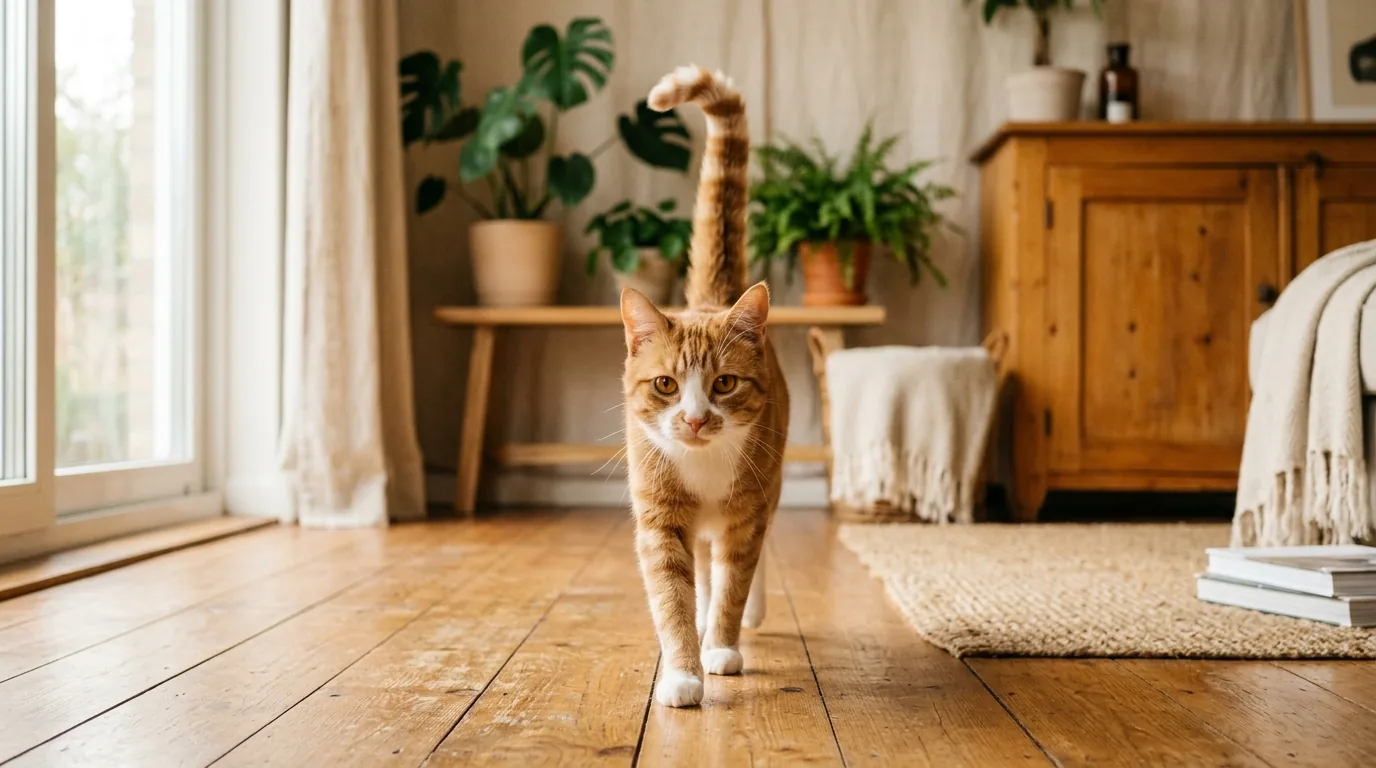
Tail position 1: Upright (tail-up)
The tail rises vertically from the base, held straight or with a slight forward lean. Hair lies flat — this isn't piloerection. The cat usually approaches as they show this signal, sometimes with a soft trill, sometimes silently.
This is the closest thing the species has to "hello." Cameron-Beaumont's work at the University of Southampton, cited in Bradshaw's Cat Sense, identified the upright tail as the primary feline affiliative greeting between bonded conspecifics and between cats and familiar humans. Kittens display it toward their mother from about a month old, and adult cats carry the behavior forward into their human relationships.
A cat coming to the door tail-up when you arrive home is greeting you. Two cats greeting each other tail-up in a multi-cat home is a reliable sign the relationship is in functional territory.
One nuance: the upright tail is friendly, but it doesn't automatically mean petting is welcome. A cat who tail-ups, slow-blinks, and head-bunts your hand is asking for contact. A cat who tail-ups and walks past toward the food bowl wanted the acknowledgment, not the touch.
Tail position 2: Question mark (curled tip)
The tail goes upright with a distinct hook or curl at the very tip, forming a shape like a question mark.
This is a refinement of the tail-up signal — affiliative, sociable, with an added quality of playful curiosity or invitation. The question-mark tail often appears when a cat is asking for something specific: come over, play with me, follow me to the bowl, sit on the couch I just jumped on. It's one of the most reliable positive-affect signals adult cats produce.
A straight upright tail is the greeting; the hook adds a request. Owners who learn to recognize the difference start catching their cat's actual ask earlier — and cats whose asks are answered tend to escalate to demand-meows and door-pawing less often, because the soft signal worked.
Tail position 3: Neutral horizontal
The tail extends roughly horizontally from the spine, neither raised nor lowered, with a relaxed line and no tension in the base.
Neutral horizontal is observation without commitment. The cat is taking in the room, tracking what's happening, but not signaling either affiliation or caution. It's the resting transit position when a cat is moving through their territory unconcerned.
Mostly useful as a baseline read. A cat who normally carries their tail at neutral horizontal during routine movement, and then starts carrying it lower during the same activity, is showing a change against their own baseline. Karen Overall, in Manual of Clinical Behavioral Medicine for Dogs and Cats (Elsevier, 2013), emphasizes establishing each cat's individual baseline before reading any signal as diagnostic.
Tail position 4: Low (below horizontal)
The tail drops below the line of the spine, held down toward the back legs but not actively tucked. The base may show slight tension.
A low tail is uncertain or cautious — a notch up from neutral toward stress, but not full appeasement. The cat is processing something: new furniture, an unfamiliar smell, a slight noise from a neighboring apartment. They haven't committed to retreat, but they're no longer in casual transit mode.
A cat investigating a new carrier with a low tail will usually return to neutral within minutes. A cat carrying their tail low for hours after a household change — a visitor, a new pet — is showing a more persistent stress response that deserves environmental management.
Breed nuance: some cats naturally carry their tails lower than others. Read against your own cat's resting tail, not against an ideal.
Tail position 5: Tucked under body
The tail drops further and curls under the cat's body, sometimes wrapping toward the belly, often paired with a crouched body and lowered head. Hair stays flat — this is postural, not piloerection.
The tucked tail is a high-grade fear or appeasement signal. The cat is reducing their visible profile and signaling no threat. It's one of the most reliable distress markers a cat shows and almost never appears in a comfortable, regulated animal in a familiar environment.
The 2022 Feline-friendly veterinary interaction guidelines from the AAFP/ISFM list the tucked tail among the consistent observable indicators of stress in feline patients during veterinary handling. In a clinic setting it's an instruction to slow down. In a home setting it's the same instruction: identify the trigger and reduce it.
A persistently tucked tail across more than one context warrants attention. Chronic stress in cats manifests in subtle postural changes long before it shows up in eating, litter, or sleep.
Tail position 6: Puffed (piloerection, "Halloween cat")
The tail thickens as the hair stands on end, often paired with an arched back, sideways body orientation, pinned ears, and dilated pupils. The whole cat appears to double in size.
This is defensive arousal. The cat has registered a perceived threat and is making themselves look larger to deter it. The puffed tail is one component of a coordinated display — a puffed tail with a sideways-arched body is not the same as a puffed tail in mid-leap during play.
Reaching toward a cat in full Halloween-cat posture is one of the most reliable bite scenarios in the home. Honor the distance request — back away, give them an exit path, let the arousal settle before any approach. Several minutes is usually the minimum.
A note on play: kittens and some adult cats will briefly puff and side-bounce during play sequences. This is the defensive motor pattern rehearsed in a low-stakes setting. Brief puff during clear play is normal. Sustained puff outside of play is not.
Tail position 7: Wrapped around body or self
A sitting or lying cat curls the tail around their own body, wrapping it across the front paws or along the flank. The line of the tail is soft, not tense.
Tail-wrap is self-contained behavior — the cat is using their own tail as a small enclosure. In a familiar environment, this is often associated with calm and self-regulation: settled and slightly inward. It's a common posture during loafing, light dozing, and observation from a perch.
In a less familiar environment, the same wrap can read as mild self-soothing. A cat in a new home with their tail wrapped tightly across the paws, paired with slightly half-closed eyes, is regulating their own arousal. It's not high-grade stress, but it's a notch above pure relaxation.
Distinguish tail-wrap from tail-tuck. Wrap is soft and incorporated into a settled posture. Tuck is held under the body with tension, paired with a crouched body.
Tail position 8: Flicking/swishing tip
The last inch or two of the tail flicks back and forth, sometimes rhythmically, sometimes intermittently. The base stays relatively still.
This is the single most misread cat tail signal. Owners frequently read a flicking tip the way they'd read a dog wag — as happiness. It almost never is.
Tip-flick indicates one of two things. First: focused predatory or observational attention. A cat watching a bird through the window with a flicking tip is locked on — the visible expression of arousal building during the stalk phase. Second: low-grade irritation. A cat being petted with a flicking tip is registering that the interaction has gone past their threshold. The flick is earlier than a thump, swish, or lash — but it's a signal the interaction is moving past comfortable.
Context decides which. If the cat is watching prey through a window, the flick is normal predatory attention. If the cat is in interaction with you, the flick is a request to ease off — slow the petting, change location (most cats prefer cheek and head over flank and tail-base), or stop. Owners who catch the tip-flick during petting stop accumulating petting-induced aggression incidents, because they exit before the cat needs to escalate.
Common combinations of position + motion
Cat tail signals rarely appear in isolation. A few combinations come up often enough to recognize at a glance.
- Upright + still. Affiliative greeting. Soft voice, available hand for head-bunt. Don't reach for the belly even if it's offered.
- Upright + question-mark hook + approach. Sociable invitation. The moment they're most likely to accept light interaction.
- Neutral horizontal + still. Routine transit. Nothing required of you.
- Low + tense + still. Uncertain, processing. Give space and let the cat make the next move.
- Tucked + crouched body + pinned ears. High-grade fear cluster. Stop, back away, reduce the trigger.
- Puffed + arched body + hiss. Defensive arousal. Honor the distance request.
- Wrapped + half-closed eyes + soft body. Settled self-regulation. Don't disturb.
- Tip-flick + body engaged in petting. Tolerance exceeded. Ease off before it becomes a swish or a swat.
What not to read into
Three patterns are commonly misread, even by experienced owners.
A flicking tail isn't affection. This is the single most consistent cat tail misread. A flicking tip during petting is the early form of "ease off," not the cat's version of a happy dog wag. The vocabulary doesn't cross species.
An upright tail isn't 100% positive — read the rest of the body. The tail-up greeting is friendly, but a cat who tail-ups and then shifts into a fixed stare, flattened whiskers, or a stiff body is showing arousal that has tipped past simple greeting. Most upright tails are friendly. Read the cluster anyway.
Puffed tails happen in play sometimes. A kitten or young adult cat briefly puffing during a play sequence is rehearsing the defensive motor pattern in a low-stakes context, not signaling actual threat response. Brief, contextual puff in clear play is normal. Sustained puff outside of play, with the rest of the defensive cluster, is not.
What to do
Do:
- Establish your cat's resting baseline before reading any single signal as meaningful.
- Read position before motion — position carries more signal weight in cats than motion does.
- Pair the tail read with ears, whiskers, eyes, and posture. Behaviorists read at least four signals before drawing a conclusion.
- Watch for the tip-flick during petting and end the interaction before it escalates.
- Offer light contact when the tail is upright or question-mark. Most cats accept it in this state.
Avoid:
- Reading any cat tail signal the way you'd read a dog tail. The vocabularies don't translate.
- Reaching toward a cat with a puffed, tucked, or thumping tail. Honor the distance request.
- Punishing warning signals (thump, hiss, growl). Punishment removes the warning and leaves the underlying state intact — the next signal up the ladder is the swat or bite.
- Treating one tail position as the whole story. Cluster reading is the standard.
When to call a professional
A persistent change in tail carriage that doesn't trace to an obvious environmental trigger is worth investigating. If the change pairs with any of the following, work with a credentialed positive-reinforcement professional or a veterinary behaviorist:
- Sudden onset of a routinely tucked or lashing tail with no clear trigger
- Tail-related self-directed behavior — chewing, repetitive chasing, overgrooming the tail base
- Defensive arousal (Halloween-cat posture) directed at familiar household members
- Tail carriage change after handling, a fall, or a startle that doesn't resolve in 24 to 48 hours — rule out medical first with a vet visit
- Petting-induced aggression that's escalated past the tip-flick stage
Look for credentials: CCBC (Certified Cat Behavior Consultant), CFBC (Certified Feline Behaviorist), IAABC Cat Division, Fear Free Certified Professional, DACVB (Diplomate of the American College of Veterinary Behaviorists). All of these signal force-free, evidence-based methodology aligned with the AVSAB position on humane behavior work.
Try it on your own cat
Tail position is one of the fastest body-language signals to learn, because the tail is large and consistently visible. Spend a week noticing your cat's tail at five recurring moments: when you walk in the door, when they hear the food bag, on a window perch, during a normal petting session, and at rest on the couch. Note position first, then motion, then the rest of the body. By day three or four, deviations from baseline will start to look obvious.
PetTranslator.ai is built around the same framework certified feline behaviorists use. Upload one clear photo of your cat and the analysis returns a structured report — biometric markers it can see, a behavioral interpretation, an action plan. The tail read is one component of a cluster.
For the full body-language framework, see cat body language. For the related ear signal, see airplane ears.
Sources
The framework in this guide is drawn from:
- John Bradshaw, Cat Sense: How the New Feline Science Can Make You a Better Friend to Your Pet (Basic Books, 2013) — the most comprehensive trade reference for the evolution and signaling repertoire of the domestic cat, including the upright-tail greeting work.
- Karen Overall, Manual of Clinical Behavioral Medicine for Dogs and Cats (2nd edition, Elsevier, 2013) — the clinical reference for behavioral observation and individual-baseline diagnosis.
- Ellis, S. L. H., Carney, H. C., Halls, V., et al. (2022). AAFP and ISFM Feline-Friendly Veterinary Interaction Guidelines: Approach and Handling Techniques. Journal of Feline Medicine and Surgery, 24(11), 1093–1132 — for the cat stress-signal cluster used in clinical and home settings.
- AVSAB Position Statement on Humane Dog Training (2021) — American Veterinary Society of Animal Behavior. The position applies to cats as well as dogs and is the professional standard for force-free behavior work.
For owners working with a specific behavior concern, the IAABC, AVSAB, and American College of Veterinary Behaviorists websites all maintain searchable directories of credentialed positive-reinforcement professionals by region.
Khabir Mughal is the founder of PetTranslator.ai. This article was reviewed against the AVSAB Position Statement on Humane Dog Training, Karen Overall's Manual of Clinical Behavioral Medicine, John Bradshaw's Cat Sense, and the 2022 AAFP/ISFM Feline-Friendly Interaction Guidelines before publication.