TL;DR
The cat slow-blink is a documented friendly communication signal between cats and humans. A 2020 peer-reviewed study in Scientific Reports (Humphrey et al.) found that cats narrow their eyes more often when their owner does the same, and that unfamiliar humans who slow-blink at a cat get warmer approach behavior back. It's the closest thing science has to a verified positive cue from cats to humans — and one of the few signals you can return.
What a slow blink actually looks like
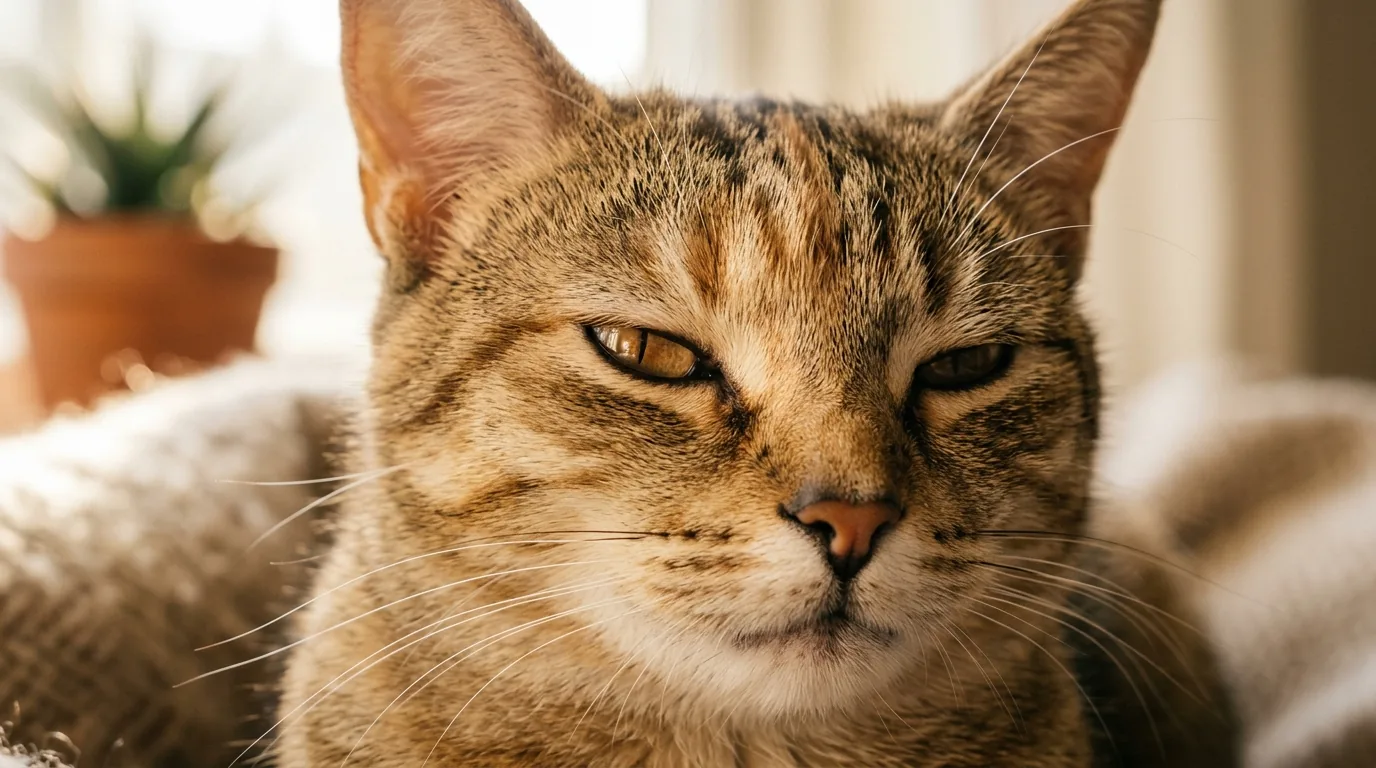
A real slow blink isn't a blink the way humans use the word. It's a gradual eyelid closure that doesn't fully close — the eye narrows over roughly one to two seconds until the lids meet softly, often held at a half-closed position for several seconds after, before opening again at the same unhurried pace.
That last detail matters. A normal cat blink takes a fraction of a second and carries no social weight. The slow blink is the same motion done at quarter-speed, with the eye spending real time in a partially closed state. Sarah Ellis and John Bradshaw, in The Trainable Cat (2016), describe it as "narrowing of the eyes" rather than blinking per se — half-blink might be the more accurate term, and it's what the research literature calls a "eye narrowing movement."
A few visual markers that distinguish it from a regular blink:
- The lids meet slowly enough that you can see the motion, not in a snap.
- The eye often holds at half-mast for two to four seconds after the initial closure.
- The body around the eye is soft — no tension in the brow, no flattened ears, no head pulled back.
- It's frequently delivered after the cat has looked away briefly, as if the cat is voluntarily lowering visual engagement.
If you've ever watched a relaxed cat across the room and noticed their eyes seem to be drifting closed in slow motion, you've seen it.
What the science says
The anchor study is Humphrey, Mansfield, Mills, and Ellis (2020), "The role of cat eye narrowing movements in cat-human communication," published in Scientific Reports. It's the first controlled experimental work to test whether the slow blink functions as a communication signal between cats and humans, and it answered the question in two experiments.
Experiment 1. Twenty-one cats from fourteen households were observed in their home environments. Owners sat at a fixed distance from their cat and either slow-blinked at them or kept a neutral face. Cats slow-blinked back significantly more often when their owner had slow-blinked first than during the neutral-face condition.
Experiment 2. Twenty-four cats from eight households were approached by an unfamiliar experimenter — someone the cat had never met. The experimenter either slow-blinked at the cat or held a neutral face. Cats were more likely to slow-blink back at the stranger after being slow-blinked at, and were also more likely to approach an outstretched hand from the slow-blinking stranger than from the neutral one.
The second experiment is the more striking finding. Slow-blinking doesn't only work between bonded cats and owners — it functions as a positive social cue from human strangers as well. The cats appeared to read the human's slow blink as a non-threat signal and reciprocated.
The authors are careful about what the data does and doesn't show. The study documents that the behavior is reciprocal and that it shifts approach behavior in cats. It doesn't prove the cat is consciously communicating affection in the way a human might. What it does prove is that this specific motion — drawn-out eye narrowing — is a real, measurable cat-human signal.
What it likely means
The functional interpretation comes from feline ethology. In free-ranging and feral cat colonies, cats avoid direct staring at one another. A hard, fixed stare between cats almost always precedes aggression. John Bradshaw, in Cat Sense (2013), notes that mutual sustained eye contact is a high-stakes social act in cats — it's something done between rivals, not between friends.
Slow eye narrowing is the social opposite. By lowering the visual surface of the eye and softening the gaze, a cat is broadcasting "I am not staring at you in a threatening way." It's an appeasement signal in the technical sense — a signal that lowers the social temperature of an interaction.
When a domestic cat extends that signal to a human, the most defensible reading is something like: I'm comfortable enough in your presence to drop my visual defenses. It's a statement about felt safety, not a declaration of love. Karen Overall's Manual of Clinical Behavioral Medicine for Dogs and Cats (2013) classes this kind of slow facial movement among feline calming and affiliative signals — the same category as a cat's slow tail tip flick or a chin rub against your hand.
That's a more interesting interpretation than "my cat is saying I love you," because it's actually verifiable. A cat who slow-blinks at you is a cat whose autonomic state allows them to relax around you. Cats in pain, fear, or chronic stress almost never slow-blink. The signal is doing real work.
How to slow-blink back (and why most people get it wrong)
The motion is easy. The mistakes are common.
The motion, step by step.
- Soften your eyes first. Drop any focused or fixed gaze. Relax the muscles around your brow.
- Let your eyelids close gradually. Take roughly one to two seconds — slower than feels natural. Don't squeeze them shut.
- Hold them half-closed. Pause for two to three seconds with your eyes mostly closed but not fully shut. This is the load-bearing part of the signal.
- Open slowly. Don't snap back to alert eye contact. Open as gradually as you closed.
- Look slightly away after. Breaking visual focus reinforces the non-threat read.
The mistakes.
- Staring intensely at the cat right before the blink. This is the most common one. People lock eye contact, then slow-blink, then lock eye contact again. From the cat's perspective the slow blink is bracketed by the very thing the slow blink is meant to undo. Soften the gaze first.
- Blinking too fast. A regular speed blink reads as a regular blink. Cats won't return it. The signal lives in the duration — it has to be visibly slow.
- Holding eye contact after the blink. Returning straight to a fixed stare undoes the appeasement. The slow blink should resolve into a softer, less direct gaze, not a re-locked one.
- Doing it from too close. A novel slow blink from six inches away with your face hovering over the cat doesn't translate. Give the cat space. The Humphrey experiments were conducted at roughly a meter's distance.
- Expecting reciprocation every time. The 2020 study found a statistical effect, not a guarantee. Plenty of slow blinks go unanswered. A cat that's distracted, drowsy, or focused on something else may not return it. The signal is real; the rate isn't 100%.
What NOT to read into it
The slow blink is one of the few cat signals with peer-reviewed support, and it's tempting to overload it with meaning. Three over-reads to avoid:
Slow-blink does not mean "I love you." The data supports an affiliative reading — a signal of social comfort and non-threat. Mapping it onto a human emotion word loses information. A cat who slow-blinks at you isn't necessarily attached to you in a deep emotional sense; they're signaling that the interaction is safe.
Absence of slow-blinking doesn't mean dislike. A cat who never slow-blinks at you might be a cat who isn't in a state where slow blinks happen — high-arousal cats, cats in unfamiliar environments, and cats with chronic stress all show fewer slow blinks regardless of how they "feel" about you.
A cat slow-blinking at one person and not another isn't ranked preference. Context drives the behavior heavily. The same cat may slow-blink at a houseguest on a calm afternoon and ignore the primary owner during a thunderstorm. Read the situation before reading the relationship.
The signal is useful precisely because it's narrow. Treat it as narrow.
When the slow-blink isn't there
The more diagnostically interesting question is often what a cat is doing instead of slow-blinking. A cat who's uncomfortable in a social moment usually shows:
- Hard, fixed eye. Eyelids wide, no blinking, gaze locked on the source of concern.
- Dilated pupils even in normal indoor lighting.
- Ears rotated sideways or back — the "airplane" position in cats often precedes defensive arousal.
- Body tension. Crouched posture, weight shifted backward, tail tucked or wrapped tight against the body.
- Whiskers pulled back flat against the cheeks.
A cat showing those signals is not in a state where a slow blink is going to happen, and trying to elicit one by leaning in or making prolonged eye contact will usually make things worse. The correct move with a tense cat is to look away, soften your own body, and let them choose the distance.
For the full framework on reading cat body posture across the whole body, see cat body language.
When to call a professional
The slow blink itself almost never warrants a vet visit. The disappearance of it sometimes does.
A cat who used to slow-blink reliably and has stopped — especially in combination with other changes like reduced grooming, hiding more, eating less, or any new resource-guarding behavior — is worth a veterinary visit before anything else. Behavioral changes in cats are very often the visible edge of an underlying medical issue: dental pain, hyperthyroidism, arthritis, urinary tract conditions, or chronic kidney disease can all present first as a withdrawn cat who no longer engages socially.
Karen Overall is firm on this point in the Manual of Clinical Behavioral Medicine: rule out medical causes before pursuing behavioral interpretations of a cat who has changed. A previously-affiliative cat going quiet is data worth acting on.
For ongoing behavioral concerns in cats — aggression, severe fear, compulsive behaviors, or relational changes that persist after medical clearance — look for credentials: IAABC-CCBC (Certified Cat Behavior Consultant), CCBC (Certified Cat Behavior Consultant via ACAAB), Fear Free Certified Professional, or a Diplomate of the American College of Veterinary Behaviorists (DACVB).
Try it on your own cat
The slow blink is one of the few cat behaviors you can practice on directly and see results. Try it tonight on a relaxed cat across the room. Soften your eyes. Close them slowly. Hold half-closed. Open slowly. Look slightly away. Watch what happens over the next thirty seconds.
If you want to go further on reading the rest of the signals — the ones around the slow blink that shape what it means in context — PetTranslator.ai analyzes a single uploaded photo of your cat against the same behavioral framework that informs this article. It returns structured observations on eye, ear, whisker, tail, and posture signals, along with a likely interpretation and what the research base says about that pattern. Useful for daily reading practice, not a substitute for working with a credentialed professional on a serious concern.
Sources
- Humphrey, T., Proops, L., Forman, J., Spooner, R., McComb, K. (2020). "The role of cat eye narrowing movements in cat-human communication." Scientific Reports 10, 16503. The peer-reviewed anchor study. Two experiments demonstrating that cats slow-blink more when humans do, and that slow-blinking strangers get warmer approach behavior from unfamiliar cats.
- John Bradshaw, Cat Sense: How the New Feline Science Can Make You a Better Friend to Your Pet (Basic Books, 2013). Background on feline social signaling, including the role of sustained eye contact in cat-to-cat aggression.
- Sarah Ellis & John Bradshaw, The Trainable Cat (Penguin, 2016). Ellis was a co-author on the Humphrey paper. The book includes practical guidance on slow-blink communication grounded in the same research program.
- Karen Overall, Manual of Clinical Behavioral Medicine for Dogs and Cats (Elsevier, 2013). Clinical reference for feline behavioral observation, including the role of facial signals in affiliative communication and the medical-first rule for behavioral change.
For owners working through persistent behavioral concerns in a cat, the IAABC website maintains a searchable directory of credentialed feline behavior consultants by region.
Khabir Mughal is the founder of PetTranslator.ai. This article was reviewed against Humphrey et al. (2020) in Scientific Reports and Karen Overall's Manual of Clinical Behavioral Medicine before publication.