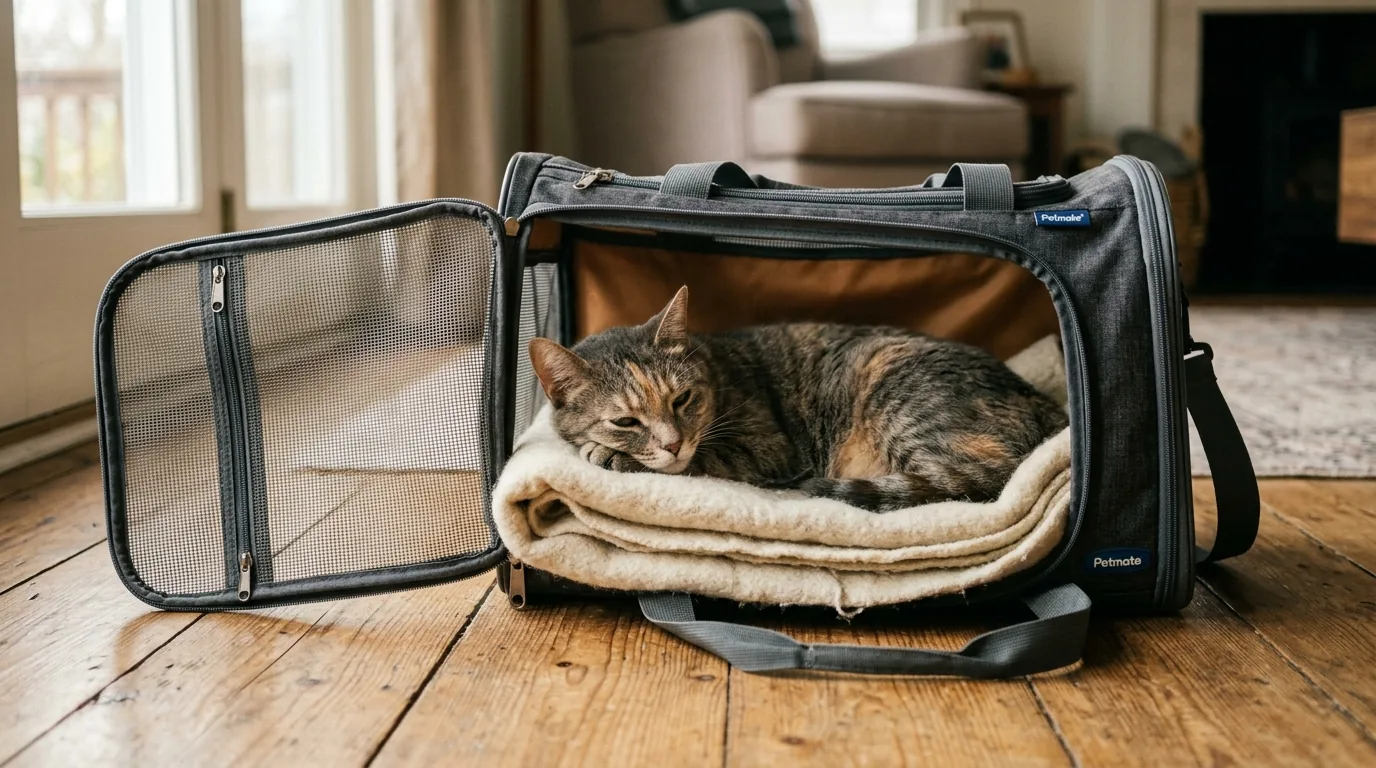
Most cats panic at carriers because they only see them before vet visits — a textbook Pavlovian negative association. The behaviorist fix is to make the carrier a neutral, then positive, object year-round. The protocol takes two to four weeks of low-effort daily exposure. The reward is a cat who walks into the carrier voluntarily instead of being chased, cornered, and force-loaded twenty minutes before an appointment.
Why most cats hate carriers
The carrier comes out of the closet. The cat disappears under the bed. The owner spends ten minutes on their stomach with a broom. Eventually the cat is wrestled into the box. Then comes a car ride, a waiting room full of dogs, an exam table, a thermometer, and a needle. The carrier goes back into the closet for six months.
That sequence runs reliably twice a year for most indoor cats. From the cat's perspective, the appearance of the carrier is a near-perfect predictor of every aversive event in their year. By the third or fourth iteration, the carrier itself has become the trigger. Cats start hiding at the sound of it being pulled from the closet — not at the vet, not in the car, but at the rattle of plastic on a shelf two hours before anything happens.
This is conditioning, not stubbornness. It also compounds. A cat with a strongly conditioned aversion to one carrier will often generalize the response to any carrier of similar shape, and the force-loading techniques most owners default to — pulling them out from under furniture, wrapping them in a towel without warning, shoving them in head-first — sharpen the association rather than weakening it.
The good news: the same conditioning mechanism that built the problem dismantles it.
The principle: classical conditioning
Right now, for most cats, the carrier sits at one end of a long chain of negative associations. The goal is to break that chain by introducing the carrier in contexts that have nothing to do with vet visits, often enough that the association weakens. This is counter-conditioning — pairing a previously aversive cue with neutral or positive outcomes until the cue itself stops predicting threat.
Two principles drive the protocol:
- The carrier must appear outside of vet contexts. As long as it only emerges before bad things, the cat will keep predicting bad things.
- No forcing. Every step of the protocol depends on the cat choosing to interact with the carrier. The moment force enters, the conditioning runs backward.
Everything below is the operational version of those two principles.
Choose the right carrier (this matters more than owners think)
Carrier design is a quiet variable that owners underweight. The wrong carrier can make the training nearly impossible; the right one makes it routine.
Hard-sided is non-negotiable for most cats. Soft mesh carriers feel less restrictive to humans but are worse for fearful cats. A panicking cat can claw the mesh, get a paw stuck, or chew through the fabric. The structural rigidity of a hard-sided carrier is also calming — it feels like a den, not a bag.
Top-opening is the feature that matters most. A front-only door forces a sideways approach, which is exactly the position a stressed cat resists. A top-opening carrier lets you lower the cat in from above — far easier for emergency loading and far less aversive for the cat. Two-door carriers (front and top) give the most flexibility.
Size matters less than owners think. The carrier should be roughly 1.5x the cat's length — enough room to turn around and lie down, not so much that they slide around in transit. Oversized carriers are not kinder. They make the cat feel less secure.
Avoid carriers with metal grate doors that rattle. The auditory signature of a rattling door is often part of what the cat learns to fear.
The protocol — weeks 1 through 4
The protocol is structured as four roughly weekly stages. Most cats move through it on this schedule; some go faster, some slower. The pace is set by the cat, not the calendar.
Week 1 — Carrier becomes furniture
Place the carrier in a regular room the cat already uses — the living room, a bedroom. Not the closet, not the garage, not a hallway they avoid. Take the door off if it's removable, or fix it in the fully open position. Put a soft blanket inside, ideally one that already smells like the cat or the household.
That familiar open carrier can also become a useful hide in the safe room after a house move, provided the cat can enter and leave freely.
Do nothing else. Don't lure the cat in. Don't talk about it. Don't move it. The goal of week one is for the carrier to lose its novelty and stop functioning as a predictor of anything at all. It is now just a piece of furniture the cat walks past.
Some cats will start sleeping in it within the first few days. Others will avoid it for a week. Both are fine.
Week 2 — Carrier becomes valuable
Once the cat ignores the carrier without visible tension, start dropping treats inside. Begin near the entrance, then progressively further in. Use treats the cat already loves — freeze-dried chicken, lickable tubes, whatever consistently gets a response.
Within a few days, start feeding regular meals near the carrier, then at the entrance, then inside it. The cat should be eating voluntarily inside the carrier by the end of the week. Still no door, still no movement.
This stage is doing real work even when it looks like nothing. The cat's brain is updating the carrier's predictive value — from "vet visit incoming" toward "neutral, possibly good."
Week 3 — The door closes briefly
When the cat is eating meals inside the carrier without tension, close the door for a few seconds while they're eating, then open it again before they finish. Keep the duration short — three to five seconds at first, then longer over several sessions. Don't move the carrier. Don't react if they react.
If the cat freezes or stops eating when the door closes, you've moved too fast. Go back to week two for several more days and try again with shorter closures.
Week 4 — Movement, then transport
Lift the carrier a few inches off the floor with the cat inside and set it back down. Walk a few steps. Then a slow lap of the house. Then place the carrier in the car without starting the engine. Then a short drive — around the block, not to the vet.
End every session with the cat exiting voluntarily and finding a treat outside. The carrier should never end a session with a needle.
By the end of week four, most cats will walk into the carrier on their own when it appears, because it now predicts food, blanket, and a return to baseline rather than the vet.
What does NOT work
Several common approaches actively make the conditioning worse:
- Chasing the cat with the carrier in hand. This creates an additional association: the carrier is a thing that pursues you. The next time it appears, the cat hides earlier.
- Wrapping in a towel and stuffing them in. Without prior burrito-wrap training as a positive experience, this is an ambush. The cat now also fears towels.
- Spraying with water or using a broom as motivation. Aversive tools collapse trust, which is the substrate the entire protocol depends on. They also don't work — they teach the cat to hide further, not to enter the carrier.
- Speedrunning the protocol the night before a vet visit. Counter-conditioning is not a cram subject. Compressing four weeks into an evening produces a stressed cat with no new conditioning. Plan around the vet calendar, not against it.
The shared error in all four is the same: they treat the carrier as a tool the owner deploys against the cat, rather than an object the cat learns to use.
Emergency loading (when you didn't have time to train)
Sometimes the vet visit is already tomorrow and the carrier is still a feared object. Don't try to fix the conditioning in a single night. Manage the single event with the lowest-stress loading you can.
The technique:
- Set the carrier upright with the top door open, blanket inside.
- Wrap the cat firmly but gently in a thick towel — neck visible, all four legs contained. This is the burrito wrap.
- Lower the wrapped cat into the carrier from above, feet-first.
- Close the top door before unwrapping. Some of the towel will come with them; that's fine.
- Drape another towel or blanket over the entire carrier to provide visual cover.
Synthetic feline pheromone spray (Feliway and equivalents) applied to the blanket inside the carrier fifteen minutes before loading can reduce stress for some cats. The clinical evidence is mixed but the downside is essentially zero.
The top-opening carrier is doing most of the work here. Front-loading a fearful cat almost always involves chasing them backward into the carrier, which is exactly the dynamic the protocol is built to avoid. Top-loading lets the cat enter feet-first in a gravity-assisted, low-resistance movement.
During transport
The car ride is its own stress event, and small choices in the car compound the carrier's emotional valence.
Cover the carrier. A light towel or blanket draped over the top reduces visual input and lowers arousal. Cats consistently transit better when they can't see the moving environment around them.
Secure the carrier. A seatbelt looped through the handle, or the footwell of the passenger side, both work. A sliding carrier on the back seat amplifies every turn into a stress event.
Drive smoothly. Hard braking and tight turns matter more to a cat in a carrier than they do to a human in a seat. Plan the route accordingly.
Don't open the carrier door in the parking lot. Parking lots are the single most common location for cats to bolt during vet visits. The door stays closed until you're inside an exam room with the door also closed.
At the vet — make it less bad
The veterinary appointment is the unavoidable aversive event the protocol is built around. A few choices reduce its weight.
Wait in the car if the waiting room is loud or dog-heavy. Most clinics will text you when the exam room is ready. Cats in carriers stacked next to barking dogs accumulate stress that compounds the carrier association.
Ask for fear-free or low-stress handling. Fear Free is a certification program for veterinary professionals trained in low-stress handling techniques. ISFM (International Society of Feline Medicine) maintains a parallel Cat Friendly Clinic certification. Both are good signals. Ask explicitly.
Bring familiar smells. The blanket from the carrier, a treat the cat likes, a small toy. Familiar scent reduces baseline stress in unfamiliar environments.
Ask about cat-only hours. A growing number of clinics offer cat-only appointment windows or dedicated cat rooms. If yours doesn't, ask whether the first appointment of the morning (before dog traffic builds) is available.
When to call a professional
For most cats, the four-week protocol is enough. For a smaller group — cats with severe carrier phobias, cats with traumatic vet histories, cats with underlying anxiety disorders — the protocol stalls. Signs the case has moved past general training:
- Aggression toward the owner when the carrier appears
- Inability to enter the carrier voluntarily even with high-value food after several weeks of week-one and week-two exposure
- Loss of litter box use, decreased appetite, or other displacement behaviors that appear during the training
- Existing diagnosed anxiety or compulsive behavior
In these cases, work with a credentialed behaviorist — an IAABC-certified cat behavior consultant, a CCBC, or a board-certified veterinary behaviorist (DACVB). Some cats also benefit from short-course anxiolytic medication, most commonly gabapentin, prescribed by a veterinarian and given a few hours before a vet visit. This isn't a substitute for behavioral work — it's a tool that lowers the arousal floor enough for the behavior work to actually take.
The carrier is also rarely the only stressor in a phobic cat's life. Cats who panic at the carrier often hide in other contexts too — see cat hiding under the bed — and the same conditioning principles apply.
Try it on your own cat
Carrier conditioning is one of the highest-use training projects an indoor-cat household can run. The cost is small — a few minutes a day for a few weeks. The return is a cat whose vet visits no longer begin with a chase, and an owner who isn't dreading the next appointment three months out.
PetTranslator.ai is built around the same observational framework. Upload one clear photo of your cat — at rest, during a carrier session, or anywhere the body language is readable — and the AI returns a structured report covering the visible markers, a behavioral interpretation, and a next-action recommendation. For reading carrier stress signals in particular, paired with the cat body language guide, it's a useful instrument.
Sources
The protocol in this guide is drawn from:
- AAFP Feline-Friendly Handling Guidelines (Rodan et al., Journal of Feline Medicine and Surgery, 2011) — the professional consensus document on low-stress handling for cats in veterinary and home contexts.
- Karen Overall, Manual of Clinical Behavioral Medicine for Dogs and Cats (Elsevier, 2013) — the clinical reference for feline behavioral diagnosis and counter-conditioning protocols.
- Sarah Ellis and John Bradshaw, The Trainable Cat (Penguin, 2016) — the operator-grade reference for evidence-based cat training, including carrier conditioning.
- Fear Free Pets — training and certification standards for low-stress veterinary and handling practices.
- ISFM Cat-Friendly Veterinary Practice Guidelines — International Society of Feline Medicine standards for feline-appropriate clinical environments.
For owners working with a phobic or aggressive cat, the IAABC and ACVB directories both maintain searchable listings of credentialed positive-reinforcement professionals.
Khabir Mughal is the founder of PetTranslator.ai. This article was reviewed against the AAFP Feline-Friendly Handling Guidelines and Karen Overall's Manual of Clinical Behavioral Medicine before publication.