TL;DR
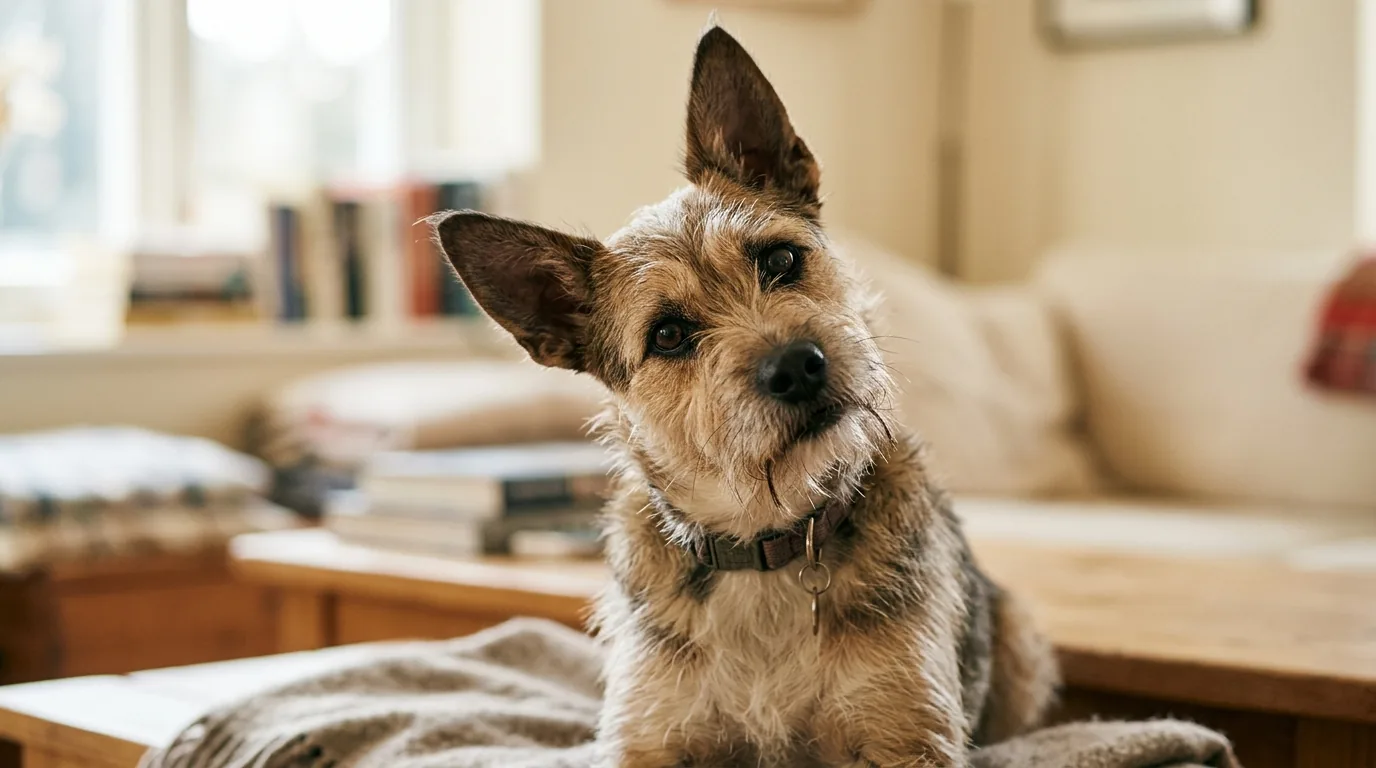
Dogs tilt their heads for three functional reasons: to localize sound more precisely (by repositioning the pinna of the ear), to see past their own muzzle (a real issue for long-snouted and flat-faced breeds), and to read human facial expression more clearly. A 2021 study by Sommese and colleagues found that dogs who can learn the names of many objects tilt their heads significantly more than dogs who can't — suggesting the tilt is a marker of attentive cognitive processing, not a deliberate cute gesture. None of this is the dog performing for you. It's working perception.
The three functional explanations
When a behaviorist looks at a head tilt, they aren't asking "why is the dog being cute." They're asking which of three perceptual problems the dog is solving in that moment. Usually it's more than one.
Sound localization
A dog's external ear — the pinna — is movable in a way the human ear is not. Most breeds can rotate, raise, or angle each ear independently. When a sound arrives, the brain compares the millisecond difference between when it reaches the left and right ear, and the spectral difference caused by the shape of the pinna at the moment of arrival. Tilting the head changes both inputs at once.
For a sound the dog can't immediately place — a high-pitched note from across the room, a word they've never heard, a doorbell on a TV show — the tilt is a triangulation move. It gives the auditory system a second sample from a different head position so the brain can resolve the source.
Stanley Coren's work on canine sensory perception describes this in detail. The tilt is functional. The fact that humans find it endearing is incidental to what the dog is doing.
Visual field
The second explanation has nothing to do with hearing. It has to do with the dog's muzzle blocking their own sight line.
Long-snouted breeds — Borzois, Greyhounds, Collies, Salukis — have a substantial blind spot directly in front of their face caused by the length of their own nose. The lower portion of a human face speaking to them, including the mouth, sits inside that blind spot when the dog is looking directly forward. A small tilt of the head moves the muzzle out of the way and clears the line of sight.
Brachycephalic breeds — Pugs, Bulldogs, Boxers, Frenchies — have the opposite anatomy and the same problem. Their faces are wide enough that binocular focus on a specific feature, like a moving mouth, can require a small tilt to get both eyes onto the same point.
Mesaticephalic breeds (Labradors, German Shepherds, the medium-muzzled middle of the canine range) tilt less often for visual reasons. They tilt more often for the next reason.
Reading the human face
Dogs read human faces. The data on this is no longer in dispute — Andics and colleagues at the Eötvös Loránd University Family Dog Project have published a decade of work showing dogs process human facial expression as a distinct category of stimulus in their brains.
Reading a face requires binocular focus on a small region — usually the eyes, sometimes the mouth. A small head tilt allows the dog to bring both eyes onto that region at the same angle and improves the resolution of what they're seeing. It's the same reason a person leans slightly forward when they're trying to read someone's expression at the other end of a table.
This is why head tilts cluster around moments of direct speech. The dog isn't waiting for a translation. They're tuning their visual system to read your face while you talk.
The "gifted dog" research
The most interesting recent finding on head tilts came out of Budapest. Sommese, Andics, Kovács, and Topál published an exploratory analysis in Animal Cognition in 2021, looking at a population of dogs they call "Gifted Word Learners" — dogs (mostly Border Collies) who can reliably learn and retrieve the names of dozens of toys.
The team noticed something specific while running their object-name tasks. The gifted dogs tilted their heads at a markedly higher rate than non-gifted control dogs when their owner asked for a named object. The behavior was lateralized in many of the dogs — individuals tended to tilt to the same side consistently across trials, suggesting a stable cognitive routine rather than a random motor habit.
The interpretation the authors offered was cautious and worth quoting fairly: head tilting in this context appeared to be associated with cross-modal mental imagery — the dog matching an auditory cue (the word) against a stored visual representation (the toy). The tilt may be a behavioral marker of that processing.
What this doesn't mean: that a dog who tilts their head is "gifted." Most tilts have nothing to do with object-name retrieval. What it does mean is that head tilt is connected to active listening and active processing, not to entertainment.
When the head tilt actually happens
Patterns from the observational literature on when the tilt appears most reliably:
High-pitched sounds. A doorbell on TV, a squeaky toy from another room, a child's voice, the chirp of a smoke alarm. High frequencies are harder to localize than low ones, which is why the tilt shows up.
Unfamiliar words. New vocabulary, especially when delivered with normal speech prosody, produces a tilt in dogs accustomed to hearing a defined set of cue words. The novelty is doing the work.
"Where's the X?" prompts. Owners of toy-name-learning dogs (and many ordinary pet dogs with a known fetch toy) reliably get a head tilt on the prompt itself, before the dog moves. This is the Sommese pattern.
Direct eye contact during speech. A tilt that appears specifically when you're looking at the dog and talking is almost always face-reading. It usually disappears when you break eye contact.
Mimicry of conversational turn-taking. Some dogs tilt during pauses in human speech — between sentences, not during them. Interpret cautiously, but the pattern is consistent enough to mention.
When head tilt is medical
Almost everything above describes a brief, situational head tilt that resolves as soon as the dog's attention shifts. That is normal.
A persistent head tilt is not normal and is one of the more reliable presenting signs of a vestibular problem. The distinction matters.
The most common cause in older dogs is idiopathic vestibular syndrome (sometimes called "old dog vestibular disease") — a sudden disruption of the inner-ear balance system that produces head tilt, nystagmus, and severe disorientation. The presentation can look like a stroke. The prognosis for the idiopathic form is generally good, with most dogs recovering substantially within one to three weeks, but the workup must be done by a veterinarian because the same signs can come from more serious causes.
Other medical sources of persistent head tilt include otitis interna (inner ear infection, often progressing from an untreated outer ear infection), otitis media, central vestibular disease (brain stem or cerebellar), and — much more rarely — neoplasia. Karen Overall's Manual of Clinical Behavioral Medicine notes that any acute behavior change of this kind in an older dog warrants a full neurological exam.
Communicative tilt vs. medical tilt
The two are distinguishable on the side of the dog if you know what to look for.
Communicative tilt. Brief — seconds to a minute. Directly tied to a stimulus (a word, a sound, a face). Resolves the moment the stimulus ends or the dog's attention moves. No other neurological signs. Dog can hold the tilt or release it voluntarily and walks normally between tilts.
Medical tilt. Persistent — minutes to hours and ongoing. Not tied to a specific stimulus. Dog cannot correct the position. Often paired with circling, nystagmus, ataxia (loss of coordination), or vomiting. Dog may seem distressed or disoriented.
If there is any doubt, treat it as medical and call a vet. The communicative explanations only apply when the rest of the dog looks neurologically intact.
What not to do
Two common owner mistakes around the head tilt:
Don't manufacture tilts for entertainment. The "what's that noise" voice and the deliberate use of nonsense words to provoke a tilt for a video is doing something specific — adding low-grade displacement stress to a dog who is sincerely trying to localize a stimulus that doesn't resolve. Once in a while is not harmful. As a repeated pattern it teaches the dog that auditory attention to the human is unrewarded, which over time blunts engagement.
Don't laugh hard at the response. Dogs are sensitive to laughter directed at them, particularly when paired with sustained eye contact. They read the prosody and the body language, not the joke. A dog who has been laughed at during a head tilt several times often stops tilting around that person — they've learned the response is socially aversive. The cute behavior was a working perceptual act. Punishing it with social discomfort suppresses the act.
What this teaches about reading dog body language
The head tilt is a useful case study in a larger point. The behaviors humans label as cute in dogs almost always have a functional explanation that's more accurate than the cute interpretation. The play bow is a meta-communication signal that everything following is non-serious, not a curtsy. The "guilty look" is appeasement to the owner's current posture, not remorse over an earlier act. The head tilt is sensory triangulation and face-reading, not performance.
This matters because the cute interpretation flattens the information out of the behavior. The functional interpretation preserves it. If the head tilt is a marker of attentive processing — and the Sommese data suggests it often is — then catching when your dog does and doesn't tilt tells you something real about which of your words they're working to understand and which they've tuned out.
That's the framework PetTranslator.ai applies to the photos owners upload. The system reads the visible signals — eye softness, ear set, lip line, head and neck angle, weight distribution — and returns a behavioral interpretation based on the same observational framework board-certified behaviorists use. Cute is a side effect. The signal is the point.
For broader context on this kind of reading, the dog body language field guide walks through every signal region a behaviorist evaluates. For the related question of how dogs process human emotional cues at all, see can dogs understand human emotions. And if the head tilt is appearing for the first time in an older dog and looks persistent rather than brief, the article on senior dog behavior changes covers the broader pattern of late-life shifts that warrant a vet visit.
Try it on your own dog
Watch for the tilt in three contexts over the next week — when a new sound enters the room, when you say your dog's known object names ("where's your ball?"), and when you make direct eye contact during a sentence. The pattern will tell you which of the three functional explanations applies most to your individual dog. Long-muzzled dogs tilt more for visual reasons. Border Collies and other working breeds tilt more during cognitive tasks. Most dogs tilt more for sound during unfamiliar acoustic events.
PetTranslator.ai uses this same observational framework on photos. Upload a clear image and the system returns a structured read — what the body is signaling, what context is likely producing it, what to do next. It won't diagnose vestibular disease. For daily reading practice on healthy behavior, it's a working instrument.
Sources
- Sommese, A., Andics, A., Kovács, A., Topál, J., "An exploratory analysis of head-tilting in dogs," Animal Cognition (2021) — the Gifted Word Learner study and the lateralization findings.
- Karen Overall, Manual of Clinical Behavioral Medicine for Dogs and Cats (2nd edition, Elsevier 2013) — the clinical reference for distinguishing communicative behavior from neurological presentation.
- Stanley Coren, How Dogs Think (Free Press, 2004) — for the sensory perception framework, including pinna mobility and sound localization in canines.
- Patricia McConnell, The Other End of the Leash (Ballantine, 2002) — for the communication-asymmetry framework between dogs and humans.
- AVSAB Position Statement on Humane Dog Training (2021) — the professional standard underlying the force-free framework used throughout this guide.
For an idiopathic vestibular workup, the American College of Veterinary Internal Medicine maintains regional directories of board-certified neurologists for cases that need imaging.
Khabir Mughal is the founder of PetTranslator.ai. This article was reviewed against Karen Overall's Manual of Clinical Behavioral Medicine and the Sommese et al. 2021 paper before publication.