TL;DR
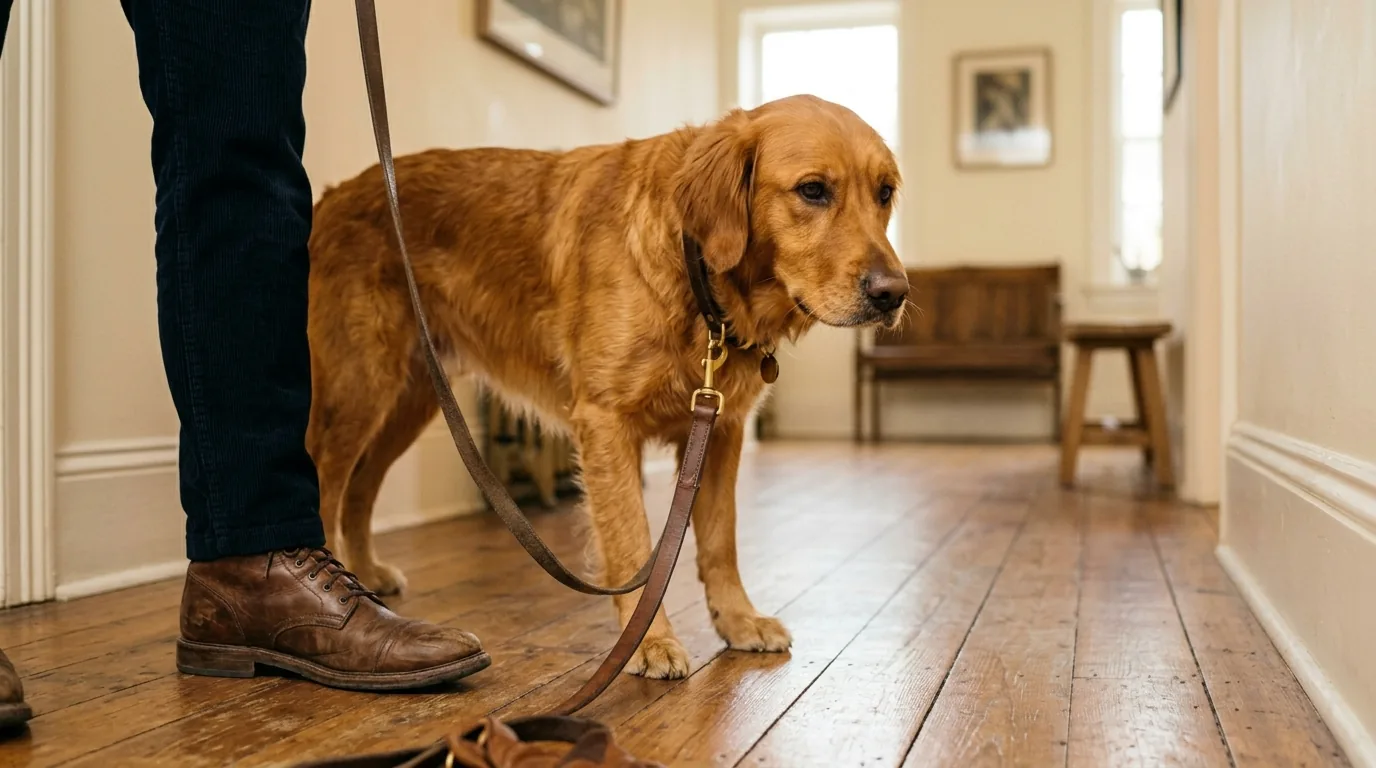
Dogs follow their humans because they're a highly social species that evolved alongside people for roughly thirty thousand years. Most following behavior is normal bonding — a dog tracking the most reliable source of food, walks, and company in their environment. Some of it isn't. The kind that comes with anxiety markers when you leave the room is a different signal, and reading it correctly matters. Here's how to tell the two apart.
Why dogs follow — the normal version
Dogs are one of the few species that actively seek proximity to a different species across the course of a lifetime. John Bradshaw, in In Defence of Dogs (Penguin, 2011), traces this back to the long co-evolution of dogs and humans — somewhere between fifteen thousand and forty thousand years of selection for the dogs that stayed close to people, watched them, and read them. A dog following you from the kitchen to the couch to the bathroom isn't unusual. It's the species default.
Four mechanisms drive the normal version of following.
Social species behavior. Dogs descend from a social carnivore. Their wild relatives travel in family groups, rest in proximity, and use line of sight as a cohesion signal. Domestic dogs apply the same wiring to the humans they live with. Being in the same room as a known group member is just what a healthy social canid does.
Resource expectation. You're the source of meals, walks, treats, leashes, doors opening, the squeaky toy coming out of the cupboard. Dogs are observational learners, and following the person who controls resources is a low-cost, high-payoff strategy. A dog who tracks you to the kitchen at six p.m. is not anxious. They're correct.
Comfort and proximity-seeking. Young dogs especially use physical proximity to regulate. Karen Overall, in Manual of Clinical Behavioral Medicine for Dogs and Cats (Elsevier, 2013), describes proximity-seeking as one of the baseline affiliative behaviors of the species. A puppy who rests against your leg isn't clingy. They're using a regulatory tool that has worked for them since they were on the litter.
Bonded breed traits. Some breeds were selected to work in tight cooperation with a single handler all day. Hungarian Vizslas, Golden Retrievers, Labradors, Cavalier King Charles Spaniels — these are the so-called Velcro breeds. A Vizsla who follows you to the bathroom isn't showing a problem. They're showing the trait the breed was built around. Read these dogs against their own baseline, not against an aloof breed's.
When following is normal AND happy
The cleanest signal that following is healthy isn't the following itself. It's what the dog does when the following stops.
A securely attached dog who follows you to the kitchen will settle on the floor while you cook. When you walk to the living room, they follow, then settle again. When you close a door behind you, they wait — maybe with a small sigh — and don't escalate. A handful of markers, drawn together, point to a healthy version of this behavior:
- The dog follows but settles when you stop, without continuing to stare, pace, or paw.
- No stress signals — no lip licking, yawning out of context, panting in a cool room.
- The dog can be in another room without panic. A closed door produces curiosity at worst.
- The dog sleeps without needing physical contact. Choosing to sleep on you is fine. Needing to in order to sleep is a different signal.
- The dog eats when you're not in sight. Food intake is one of the fastest behaviors to drop under stress.
If most of those check out, what you're seeing is a bonded dog using their species default. Nothing to fix.
When following crosses into anxious attachment
A different pattern appears in dogs whose following is anxiety-driven rather than bonding-driven. The dog isn't simply tracking you — they're monitoring you for departure cues, and the system is dysregulated.
Markers of anxious following, drawn from the clinical literature:
- Cannot be in a separate room without vocalizing, scratching at the door, or pawing. A closed bathroom door produces panic.
- Stress signals when you leave even briefly. Repeated lip licking, yawning out of context, panting in a cool room, a tight commissure on the mouth. (For the full inventory, see dog body language.)
- Refuses to eat or drink when you're out of sight. A dog who won't touch a meal in the next room is showing significant arousal.
- The "shadow dog" pattern. The dog is physically touching you at all times — not in the room with you, against your leg. Standing up to move requires stepping over them.
- Predeparture anxiety. Panic begins before you've actually left — when shoes come out, when keys move, when the work bag comes off the hook. The dog is reading the sequence and responding to the prediction.
Any one of these can appear in a healthy dog occasionally. The diagnostic question is whether the cluster appears together and whether it persists. (For a broader read on what stress looks like across contexts, see signs your dog is stressed.)
Hyperattachment vs separation anxiety — same spectrum?
This is the question newer research has tried to clarify, and the answer is more useful than the older "they're the same thing" framing.
Konok and colleagues, writing in Applied Animal Behaviour Science (2015), examined attachment styles in dogs and their relationship with separation-related disorder. Their finding: hyperattachment — the shadow-dog, can't-tolerate-distance pattern — is a risk factor for separation anxiety, but the two are not identical. A hyperattached dog isn't automatically a separation-anxiety dog. They're a dog whose attachment system is dysregulated in a way that makes the disorder more likely to develop if the conditions are right.
The practical implication is the part that matters. Recognizing hyperattachment early — at the shadow-dog stage, before the dog has had a full panic episode alone — opens a treatment window. Working on independence at that stage is dramatically more straightforward than working on it after the dog has built a panic response to being alone. Malena DeMartini-Price, in Treating Separation Anxiety in Dogs (Dogwise, 2014), makes the same point from the clinical side: the cases with the best prognosis are the ones caught before the dog has rehearsed the panic repeatedly.
If you've read the markers in the previous section and they cluster around your dog, that's the moment to start working on independence. Not when the door slams and the neighbor texts about barking.
What NOT to assume
Three common misreads, because they shape how people respond.
Following is not "they love me most." It's a real social signal — your dog is choosing proximity to you — but the storybook reading misses what's actually happening. The dog is tracking the person who controls resources and provides reliable safety. That can correlate with affection, but it isn't identical to it, and treating it as a love score leads to ignoring the anxious version when it appears.
Following is not dominance or "guarding." This is the older misread, drawn from outdated dominance-theory frameworks the American Veterinary Society of Animal Behavior has formally rejected. A dog who follows you from room to room is not asserting rank, not herding you, not "claiming" you. Reading it through that lens leads to confrontational training that makes anxious dogs worse.
Following is not always a problem. The reverse misread, increasingly common online. A bonded dog who tracks their owner around the house is not by default a case of separation anxiety. Context decides — the markers in the section above are what distinguish the healthy version from the dysregulated one. Treating ordinary bonded behavior as pathology creates problems where none existed.
What to do
If the markers point to anxious following — or you'd rather build resilience before they do — the work is straightforward in shape, less so in execution. The framework below is consistent with positive-reinforcement, AVSAB-aligned methodology.
Do: practice gradual independence. Start with sit-stay across short distances inside a single room, then across rooms, then through doorways. The goal is teaching the dog that you reliably come back, in small repeatable units, before the duration gets long.
Do: reward the dog for being calm in another room. Most owners only notice their dog when the dog is at their feet. Reverse it. When the dog settles on their bed in the next room, walk over, drop a treat, walk away. You are paying for the behavior you want to see more of.
Do: build value in their own space. A bed, a mat, a crate used as a positive base — not a punishment. Feed meals there. Drop high-value chews there. The dog should associate that location with good outcomes, so being there is rewarding in its own right, not just a place they're sent.
Do: address predeparture anxiety before actual departures. If the dog panics at shoes, work on shoes when you aren't leaving. Put them on, sit down, take them off. Pick up keys, set them on the table, walk away. The goal is decoupling the cues from the prediction of departure. Vary the cues so the sequence stops being a reliable signal.
Avoid: suddenly trying to "make them independent" via separation. The "just leave them alone for longer until they get over it" approach is flooding, and for an anxiety-driven dog it makes the problem worse. The panic episodes get rehearsed. Build duration up gradually instead.
Avoid: punishing the following. Pushing the dog away, scolding, knee-blocks, spray bottles — none of these address the underlying state, and most add a layer of confusion or stress on top of an already-dysregulated system.
When to call a professional
If the markers cluster — predeparture panic, refusal to eat alone, vocalizing or destruction when actually left — work with a credentialed professional rather than DIY'ing it. Look for CSAT (Certified Separation Anxiety Trainer), CDBC (Certified Dog Behavior Consultant), IAABC members, or a veterinary behaviorist (DACVB) for the more clinical cases.
For the full clinical picture and what the treatment process actually looks like, see dog separation anxiety.
Try it on your own dog
Reading the difference between healthy following and anxious following gets easier with repetition. Watch your dog the next time you stand up. Do they settle when you settle, or do they continue to monitor? Do they eat when you're in another room? When the bathroom door closes, what happens in the next sixty seconds?
PetTranslator.ai is built on the same framework. Upload a clear photo and the AI returns a structured read — the biometric markers it can see, a behavioral interpretation against AVSAB-aligned guidance, and an action plan. It won't replace working with a behaviorist on a complex separation case. For daily reading practice, it's a useful instrument.
Sources
- John Bradshaw, In Defence of Dogs (Penguin, 2011) — for the co-evolutionary background on dogs as a social species.
- Konok, V. et al., "Attachment styles in dogs and their relationship with separation-related disorder" (Applied Animal Behaviour Science, 2015) — for the hyperattachment-as-risk-factor framing.
- Karen Overall, Manual of Clinical Behavioral Medicine for Dogs and Cats (Elsevier, 2013) — for the clinical framework on affiliative behavior and proximity-seeking.
- Malena DeMartini-Price, Treating Separation Anxiety in Dogs (Dogwise, 2014) — for the prognosis-and-early-intervention framing.
- AVSAB Position Statement on Humane Dog Training (2021) — the professional standard for force-free, evidence-based behavior work.
For owners working with a serious separation case, the IAABC and AVSAB websites maintain searchable directories of credentialed positive-reinforcement professionals by region.
Khabir Mughal is the founder of PetTranslator.ai. This article was reviewed against the AVSAB Position Statement on Humane Dog Training and Karen Overall's Manual of Clinical Behavioral Medicine before publication.