TL;DR
Nighttime pacing in dogs traces back to six distinct causes — generalized anxiety, under-met exercise needs, medical pain or GI distress, cognitive dysfunction syndrome in older dogs, predeparture anxiety, and sensory decline. Age plus recent changes plus accompanying signs narrow it down quickly. New persistent pacing in a previously settled dog is a vet visit first, not a behavior problem to train through. The order of operations matters here.
If vocalizing and twitching occur only while the dog is fully asleep, compare the pattern with normal sleep barking and seizure warning signs before treating it as nighttime restlessness.
The age question — your first triage filter
Before anything else, ask one question: how old is the dog, and was the pacing always there?
A young to middle-aged dog who has recently started pacing at night is most often working through something behavioral — generalized anxiety, an unsettled environment, predeparture worry that bleeds into the evening, or insufficient daytime outlets for a working breed. Medical causes are still possible, but the base rate weights toward behavior.
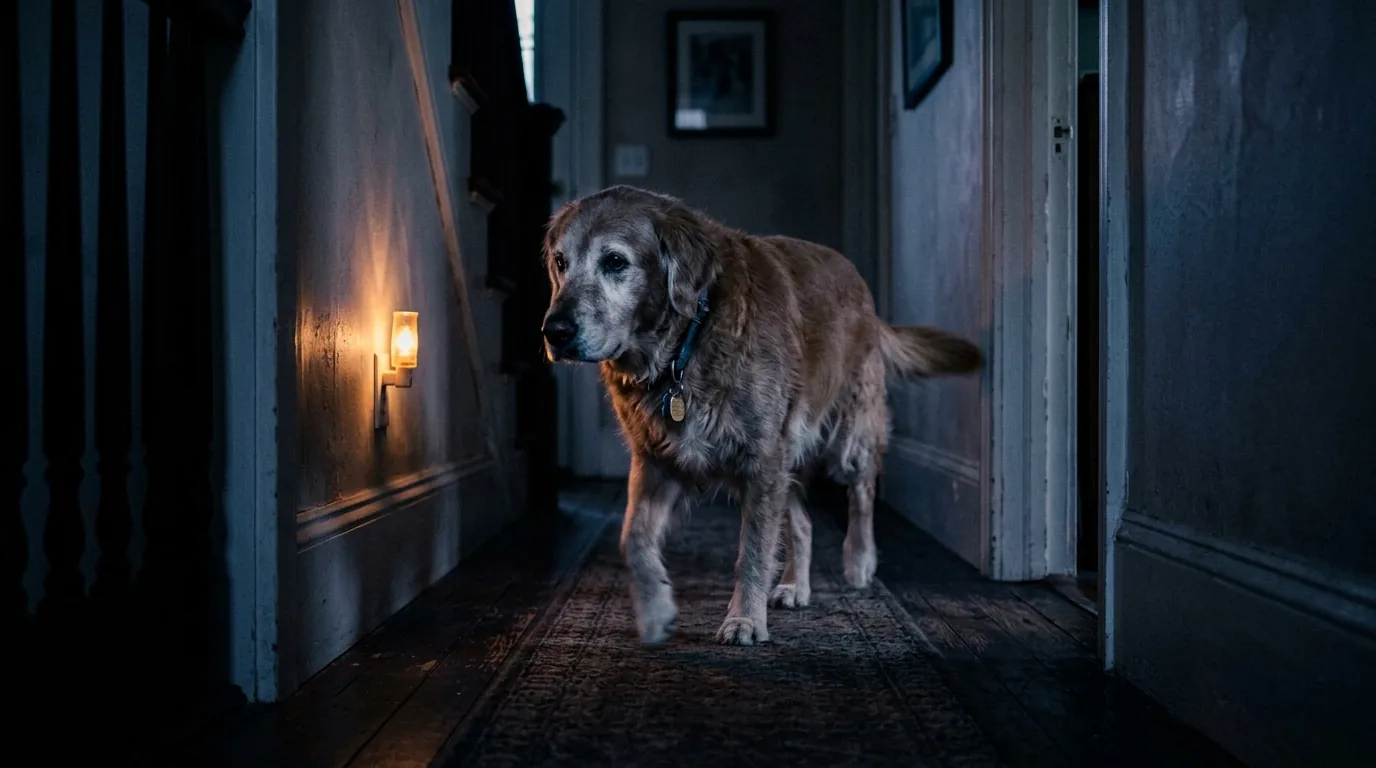
A senior dog — generally eight years and older, earlier in large and giant breeds — who has recently started pacing at night is showing a different profile. Cognitive dysfunction syndrome, orthopedic pain, declining vision or hearing, and metabolic conditions all rise sharply in the senior population. The right first step is a veterinary workup, not a behavior plan. Training a senior dog to "settle" through pain or disorientation doesn't fix what's wrong, and the longer the underlying cause runs unaddressed, the harder it becomes to reverse.
This is the single most important triage filter most owners skip.
The 6 causes — how to identify which
Six causes account for the bulk of nighttime pacing presentations. They overlap, but each carries a distinct pattern of accompanying signs.
1. Generalized anxiety or hypervigilance. The dog paces in the evening, startles easily, has trouble settling even during the day, and shows other anxiety markers — lip licking out of context, low-grade panting in a cool room, frequent body checks of the environment. Reading body language well matters here; see dog body language and signs your dog is stressed for the full signal set.
2. Under-exercised arousal. Most common in working, sporting, and herding breeds — Border Collies, Aussies, Labs, Vizslas, Malinois. The dog has banked physical and cognitive energy that hasn't been spent during the day, and it surfaces as restlessness at night. The diagnostic question is honest: did this dog get aerobic exercise and at least one cognitive task today, or did they get a fifteen-minute leash walk?
3. Predeparture anxiety or separation-related concern. Pacing concentrated around moments the dog has learned predict your absence — late at night, before the household settles, or before an early-morning departure. The dog reads cues you don't realize you're giving: bag positioned by the door, alarm set, work clothes laid out. See separation anxiety for the full pattern.
4. Pain or GI distress. A dog who can't find a comfortable position, lies down and immediately gets back up, stretches into the "prayer position" with chest low and hindquarters elevated, licks at one specific area of the body, or refuses food is signaling physical discomfort. Pacing as a position-search behavior is one of the most-missed early signs of orthopedic, abdominal, or dental pain.
5. Cognitive Dysfunction Syndrome (canine CDS). The senior-specific pattern. The dog gets "lost" in familiar rooms, stares at walls, reverses their sleep-wake cycle, and paces during the night while sleeping more during the day. CDS deserves its own section below.
6. Visual or hearing decline. A dog with worsening night vision or progressive deafness can't navigate the dim hallway they used to navigate easily. They pace because the environmental information they relied on is gone. This often co-occurs with CDS in senior dogs.
Cognitive Dysfunction Syndrome — the senior signal you can't miss
Canine cognitive dysfunction syndrome is, in clinical terms, the dog version of what happens to human cognition with age-related neurodegeneration. Karen Overall, in her Manual of Clinical Behavioral Medicine for Dogs and Cats, characterizes it as a progressive condition that's both under-diagnosed and meaningfully treatable in its earlier stages.
The standard framework is the DISHA acronym:
- D — Disorientation. Getting "lost" in familiar rooms, standing on the wrong side of a door, staring at walls or into corners.
- I — Interaction changes. A previously social dog withdraws; a previously independent dog clings. Either direction is a flag.
New daytime withdrawal matters too. If the dog has begun sitting alone in another room, log whether that choice comes with pain, appetite, navigation or sleep changes.
- S — Sleep-wake cycle alterations. This is where nighttime pacing fits. The dog sleeps more during the day and is restless and wandering at night. Owners often describe it as "my dog has their days and nights mixed up."
- H — House-soiling. New accidents in a previously house-trained adult, especially when the dog doesn't seem to register what they've done.
- A — Activity changes. Either less activity overall, or aimless repetitive activity (the pacing).
If a senior dog presents with two or more of these, CDS belongs on the differential. The veterinary literature is consistent on treatment: selegiline (sold as Anipryl) is the FDA-approved drug for CDS in dogs and improves signs in a meaningful fraction of treated dogs. Dietary intervention — Hill's Prescription Diet b/d, which is formulated with antioxidants and mitochondrial cofactors — has been shown to support cognitive function in older dogs. Fish-oil supplementation with EPA and DHA is commonly recommended as a supportive measure. The Landsberg, Hunthausen, and Ackerman chapter on senior cognitive changes in Behavior Problems of the Dog and Cat covers the full treatment landscape.
None of this is something an owner manages alone. The point of recognizing CDS early is to get the dog in front of a vet while there's still meaningful function to preserve.
When pacing is a vet visit — not a training problem
Five patterns shift pacing out of behavior territory and into medical territory. Any one of them warrants a vet appointment before any behavior plan:
- Sudden onset in a dog of any age, with no environmental change to explain it.
- Pacing with panting or trembling that isn't temperature- or exertion-related.
- Appetite change — eating less, refusing meals, or eating differently.
- Reluctance to lie down, or difficulty rising from lying. This is the orthopedic pain signature.
- Any new pacing in a dog over 8. The senior threshold is conservative on purpose. The cost of a vet workup is low; the cost of missing CDS, pain, or a metabolic condition is high.
The American Animal Hospital Association's senior care guidelines reinforce this point: behavioral changes in older dogs are flagged as a primary screening signal, not a normal part of aging.
When pacing IS a behavior issue (after medical is ruled out)
Once a vet has cleared the medical differentials, the behavior picture comes into focus. Three patterns account for most of what's left:
- Predeparture anxiety. Pacing concentrated around moments predicting your departure. The intervention is desensitizing the cues — keys, shoes, bag — so they stop predicting absence. See separation anxiety for the protocol.
- Generalized anxiety. Pacing as one of many anxiety markers across the day. The intervention is environmental management plus, in many cases, a referral to a veterinary behaviorist for adjunct medication.
- Environmental. The new streetlight outside the bedroom window. The neighbor's TV through the wall. The recent move. The dog is responding to a stimulus you may not be noticing.
What NOT to assume
A few common interpretations that lead owners in the wrong direction:
- "They just need more exercise." Sometimes true, often a placeholder. A senior dog with CDS doesn't pace less after a longer walk — they pace because their cognition is changing.
- "They're just being stubborn." Dogs don't pace for spite. They pace because something — internal or environmental — is keeping their arousal too high to settle.
- "It's just old age." Old age is a category, not a cause. CDS, arthritis, and sensory decline are old-age-associated conditions, and all of them are treatable enough to be worth treating.
- "I should crate them more so they stop." Crating a dog who's pacing from pain or cognitive disorientation increases distress, not settling.
What to do
A short, ordered list. Work through it in sequence:
- Note the age, the onset, and the duration. A two-night episode after a thunderstorm is different from three weeks of nightly pacing.
- Scan for accompanying signs. Lip licking, panting in cool rooms, appetite change, reluctance to lie down, disorientation. Each one narrows the differential.
- If the dog is over 8, or the pacing started suddenly, or any medical sign is present — book a vet appointment. Bring video of the pacing.
- If the dog is young to middle-aged and the medical picture is clean, audit the behavioral inputs. Exercise, mental enrichment, predeparture cues, environmental changes.
- Don't start training the dog out of it before you know what "it" is. Settle protocols on a dog in pain are counterproductive.
When to call a professional
For medical rule-outs: a veterinarian first, every time. If CDS is suspected, ask specifically about selegiline and dietary support — many general practitioners are familiar with the protocol but won't raise it unless asked.
For confirmed behavioral cases: a credentialed positive-reinforcement professional. Look for CSAT (Certified Separation Anxiety Trainer) for separation-related cases, CDBC (Certified Dog Behavior Consultant), IAABC members, or a veterinary behaviorist (DACVB) for cases involving suspected anxiety disorders that may benefit from adjunct medication. The American Veterinary Society of Animal Behavior's 2021 position statement on humane training is explicit about avoiding dominance-based or punishment-based approaches — they're not just outdated, they make anxiety presentations worse.
Try it on your own dog
PetTranslator.ai uses the same body-language framework veterinary behaviorists use — soft eye, lip line, posture, weight distribution, tail position. Upload a clear photo of your dog at rest and the AI returns a structured read on arousal level and visible stress markers. It doesn't replace a vet for medical questions, and it can't diagnose CDS. For the behavioral side of the picture, and for tracking change over weeks, it's a useful instrument.
Sources
- Karen Overall, Manual of Clinical Behavioral Medicine for Dogs and Cats (Elsevier, 2013) — the clinical reference for cognitive dysfunction syndrome diagnosis and the DISHA framework.
- Landsberg, Hunthausen, and Ackerman, Behavior Problems of the Dog and Cat (3rd edition, Saunders, 2013) — chapter on senior cognitive and behavioral changes.
- AAHA Senior Care Guidelines for Dogs and Cats — the American Animal Hospital Association's current guidance on behavioral screening in older patients.
- AVSAB Position Statement on Humane Dog Training (2021) — American Veterinary Society of Animal Behavior. The professional standard for force-free, evidence-based behavior work.
Khabir Mughal is the founder of PetTranslator.ai. This article was reviewed against the AVSAB Position Statement on Humane Dog Training and Karen Overall's Manual of Clinical Behavioral Medicine before publication.