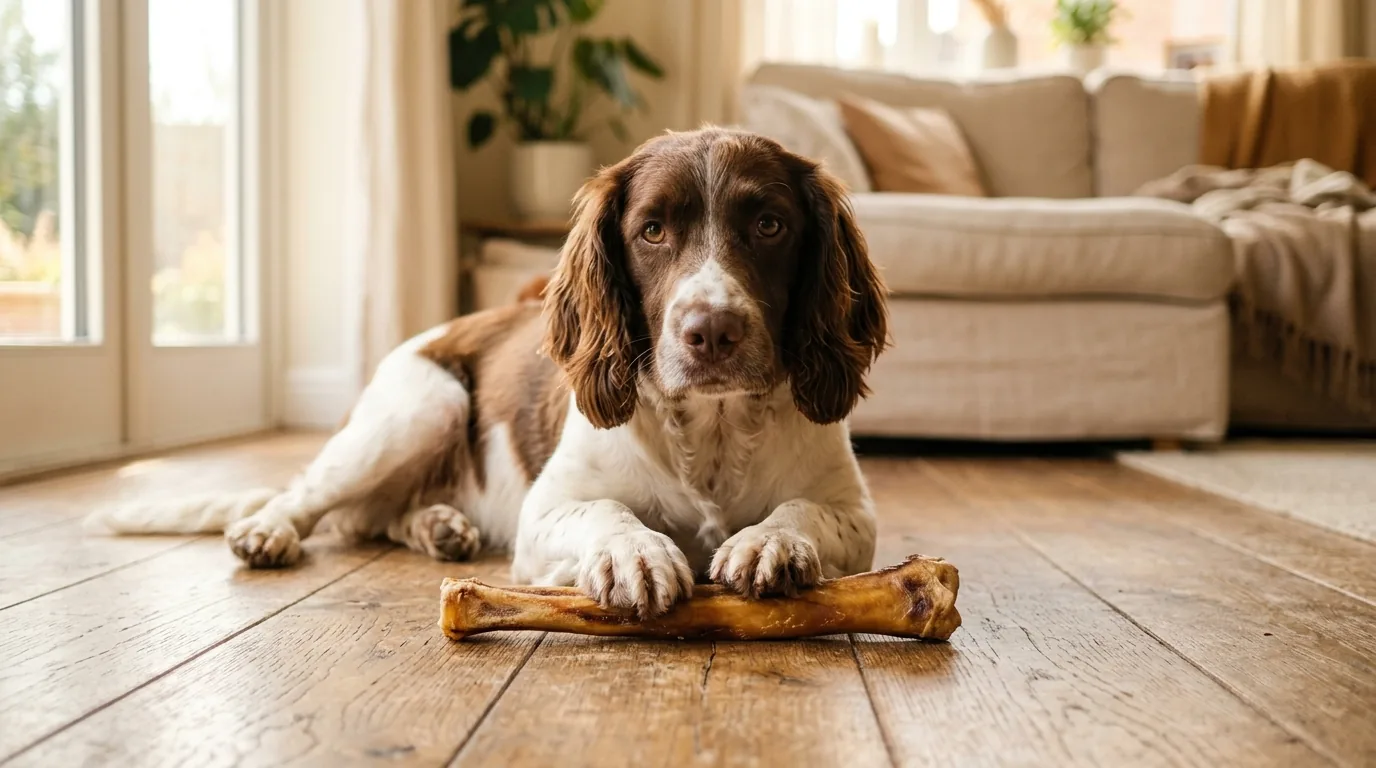
TL;DR. Resource guarding is when a dog protects food, toys, sleeping spots, or sometimes people. It is normal canine behavior with a survival logic — ancestral dogs who didn't guard a carcass didn't eat it. It becomes a problem when it escalates to biting in shared-living contexts. The force-free protocol — Jean Donaldson's "Mine!" approach — works. Punishment-based fixes make it measurably worse. Severe cases need a credentialed behaviorist, not another YouTube video.
What resource guarding is — and why it's normal
Resource guarding is the behavior pattern by which a dog signals, and if necessary defends, ownership of something they value. Food is the most cited example. The list is much longer than food.
The evolutionary logic is unambiguous. A dog who did not guard a carcass against rivals lost the carcass and contributed fewer copies of their genes to the next generation. Selection pressure built the wiring across thousands of generations. Modern dogs — every breed, every household — carry that wiring. What varies between individuals is the threshold at which it triggers, and the size of the inventory of things they treat as worth defending.
This matters because the framing changes the intervention. A dog who growls over a bone is not "bad" and is not "trying to dominate the household." A dog who growls over a bone is doing exactly what their nervous system was built to do when something valuable is at stake and a competitor approaches. The job of the household is not to crush the wiring out of them. The job is to teach them that, in this specific shared-living context, the approach of a human is not a competitor signal — it's a predictor of more good things.
A note on terminology. Resource guarding is sometimes called "possessive aggression" in older clinical texts. The behavior is the same; the modern term avoids loading the read with moral framing. It is not dominance. The dominance frame has been formally rejected by AVSAB and is discussed separately (why dominance theory is wrong).
What dogs guard
The inventory varies by individual. The common categories:
- Food. Most frequently reported. Includes the bowl, the contents of the bowl, and sometimes the area around the bowl.
- Bones, chews, high-value toys. Often the trigger threshold is higher than for kibble — a raw bone or a bully stick produces guarding in dogs who don't guard their dinner.
- Sleeping spots. Beds, crates, a specific couch cushion, the corner of the bedroom rug. Location-based guarding.
- Stolen items. Socks, tissues, a roll of paper towels. The "I got this and you can't have it back" pattern, sometimes paired with a chase invitation.
- A specific person. "Human guarding" — the dog positions between their preferred person and a second household member or another dog, and signals distance. This pattern is often mistaken for affection.
- A location or room. Doorway guarding, threshold guarding, the dog who blocks the hallway.
A dog can guard one category and ignore the others. A dog can also guard a particular item — the green Kong, not the blue one — for reasons that aren't obvious to the owner. The individual inventory matters, because the protocol is built around the actual triggers, not a generic list.
The escalation ladder
Behaviorists teach owners to read resource guarding as a ladder of escalating signals. Most dogs cycle through the lower rungs many times before they climb. Reading the lower rungs is the difference between a household that manages the behavior and a household that gets bitten.
- Freeze. The body stiffens over the resource. Movement slows, then stops. The dog is still chewing or eating, but the rhythm changes — a half-beat pause, then a held position.
- Whale eye. The head stays angled toward the resource while the eyes track the approaching person or dog. The whites of the eyes show as a half-moon around the iris. This is one of the earliest, most reliable warning signals and is covered in detail in the whale eye guide.
- Stiff body, closed mouth. All muscular slack disappears. The mouth, which may have been chewing, closes around the item or stops mid-chew. Hackles may or may not rise — hackles alone are not diagnostic.
- Growl. A vocal warning. Low-pitched, often modulated, usually paired with the body signals above. This is the dog telling you, clearly, to back off.
- Snap. A bite motion that deliberately does not make contact. The dog is showing what they're capable of without doing it. A snap is a warning, not a failed bite.
- Bite. Contact. The bite may be inhibited (no broken skin, no deep puncture) or uninhibited. Both are serious, both require professional involvement.
Most resource-guarding dogs cycle through rungs 1–3 many times in their life and never climb higher, because the people and animals around them learned to read the early signals and gave space. Dogs who climb to 5 and 6 are usually dogs whose early signals were missed, ignored, or punished out of them.
Why punishment makes it worse
This is the section that contradicts most of the popular advice. Punishment-based approaches to resource guarding are not just less effective. They are actively worse than doing nothing, and the data has been clear for over a decade.
Punishing the growl removes the warning. The dog still guards — the underlying nervous-system response to a perceived competitor is intact. What changes is the visible warning. A dog who has been corrected, leash-popped, or scruff-shaken for growling learns that the growl predicts a worse outcome. The growl drops out. The next time the threshold is crossed, the dog skips to rung 5 or 6. The owner reports the bite as "out of nowhere." It wasn't.
Punishing the freeze produces a more dangerous dog, not a safer one. Freezing is the dog's effort to communicate without escalating. A dog who has been corrected for freezing over a resource learns to suppress the visible freeze, while the internal arousal continues. The household loses the early read and the dog escalates faster the next time.
Punishment doesn't address the underlying anxiety about access. The dog is guarding because, at some level, they're worried about losing the resource. Punishment confirms that the approach of the human is a threat to the resource. The anxiety increases. The threshold drops. The next trigger is closer than the one before.
The data on confrontational methods is direct. Herron, Shofer, and Reisner (2009, Journal of Veterinary Behavior) surveyed 140 dog owners on their use of confrontational and non-confrontational training methods. Confrontational methods — alpha rolls, scruff shakes, leash corrections for growling, hitting, staring the dog down, taking food away by force — produced aggressive responses in 11% to 43% of dogs, depending on the method. Non-confrontational methods produced aggressive responses in single-digit percentages or fewer. The methods that look like they're "establishing dominance" are the methods most likely to produce a bite. This finding is consistent across the modern clinical literature. See also the broader discussion of positive reinforcement versus balanced training.
The force-free protocol — Jean Donaldson's "Mine!" approach
The protocol below is a high-level summary of the framework Jean Donaldson published in Mine! A Practical Guide to Resource Guarding in Dogs (Kinship Communications, 2002). It is the reference text in this area. For a serious case, work through the book itself or work with a credentialed professional. This summary is for orientation.
Step 1 — Manage the environment so the dog can't rehearse.
Every time the dog successfully guards — every time the approach of a person triggers the freeze-whale-eye-stiff sequence and the person backs away — the behavior gets reinforced. Management means restructuring the environment so the trigger doesn't keep firing. Feed in a separate room with the door closed. Pick up high-value chews when the household is busy. Don't allow the dog to steal items they will then defend. The point isn't permanent restriction. The point is to stop adding repetitions of the unwanted pattern while the new pattern is being built.
Step 2 — Counter-condition the approach so it predicts good things.
The dog currently treats the approach of a person as a competitor signal. The protocol rewires that prediction. The handler stays well below the dog's reaction threshold — far enough away that the dog does not freeze, whale-eye, or stiffen — and tosses a high-value food item near the dog's resource, then walks away. Repeated across many sessions, the approach starts to predict the appearance of something better than what the dog already has. The internal state shifts.
Step 3 — Trade-up training.
The dog learns that giving up the current resource produces a better resource. The handler offers a treat that exceeds the value of the item the dog has, the dog drops the item, the dog gets the treat, the dog gets the item back. The "gets it back" piece is essential. A dog who learns that drop predicts loss will guard harder. A dog who learns that drop predicts gain — and frequently regains the original item too — develops a different relationship with possession. Teach a solid "drop it" cue this way before you ever need it under pressure.
Step 4 — Generalize across resources, locations, and people.
A dog who has learned that the primary handler's approach is safe near the food bowl has not yet learned that the same applies to a different family member, in a different room, around a bone instead of kibble. The protocol generalizes one variable at a time.
Step 5 — Stay sub-threshold throughout.
The single most important rule. The handler never pushes the dog into a growl, a freeze, or a whale eye during training. The work happens below the line where the unwanted behavior fires. Pushing into the reaction is not "exposure therapy." It's rehearsal of the very pattern the protocol is trying to extinguish, and it sets the work back.
What NOT to do
The popular-advice categories that the clinical literature directly contradicts:
- Don't take food bowls away mid-meal to "show who's boss." This is a manufactured competitor signal that teaches the dog to guard harder.
- Don't reach into the bowl while the dog eats. Same problem. You are simulating exactly the threat the dog is wired to defend against.
- Don't punish growling. You are removing the warning, not the behavior.
- Don't perform the "hand in the food test." A dog who tolerates it is not safer. A dog who reacts has just been pushed into rehearsal of the unwanted pattern.
- Don't allow strangers or visitors to take items from your dog. The relationship the protocol is building is with the household. Strangers haven't built it.
- Don't use force-based "trades." A trade only works as counter-conditioning if the dog has the choice to refuse. A forced trade is just confiscation.
What TO do — practical management
The management layer runs in parallel with the training protocol. It exists to stop the dog from rehearsing while the new pattern is built.
- Feed in a separate room with the door closed, or in a crate the dog likes.
- Pick up bones and long-duration chews when you can't supervise.
- Teach a reliable "drop it" cue using the trade-up framework before you need it under pressure.
- Use leashes or baby gates in multi-dog homes to prevent guarding between dogs.
- Identify the specific triggers — particular items, particular locations, particular people — and avoid them outside of training sessions.
- Watch for early-stage signals at every meal and every chew session. Reading the ladder is part of management.
When to call a professional — almost always
A simple, low-grade guarding pattern in a single-dog household with adults only — a dog who freezes over a bone and resolves with management — can often be worked through with the framework above. Most cases are not that simple. The thresholds for professional involvement are deliberately conservative:
- Resource guarding involving children in the household. Immediate professional involvement. Children move unpredictably, signal poorly, and bite outcomes are worse.
- Guarding that has escalated over weeks or months. The trajectory matters more than the current rung.
- Guarding directed at people rather than objects. Human guarding is harder to manage and the protocol differs.
- Any bite that broke skin. Skin-broken bites require a behavior history, a bite assessment, and a structured plan.
- Multi-dog households with inter-dog guarding. The dynamic is harder to read and the management layer is more complex.
In any of those cases, the at-home protocol is not the right starting point. The right starting point is a credentialed professional who can take a behavior history, observe the dog, and build a plan around the specific pattern.
Who to call
Credentials matter because the field is unregulated. Anyone can call themselves a "dog trainer." The credentials that signal evidence-based, force-free practice:
- CDBC — Certified Dog Behavior Consultant, issued by the IAABC (International Association of Animal Behavior Consultants). The relevant general-population credential for resource-guarding work.
- Dip. ACVB — a Diplomate of the American College of Veterinary Behaviorists. A board-certified veterinary behaviorist. Appropriate for severe cases, or when medication is being considered as part of the plan.
- CSAT — Certified Separation Anxiety Trainer. Relevant when the guarding is part of a broader anxiety profile.
- KPA-CTP — Karen Pryor Academy Certified Training Partner. A force-free training credential, useful for the foundational obedience work that supports the protocol.
What to avoid: anyone who references "dominance," "alpha," "pack leadership," or "being the leader." Anyone who uses or sells prong collars, choke chains, slip leads as correction tools, or electronic / e-collars / "stim" collars. Anyone who proposes a quick fix to a behavior built across thousands of generations of selection pressure. A more detailed guide on screening and hiring is here: how to find a credentialed behaviorist.
Try the at-home reading tool
Resource guarding rarely arrives without a runway. The freeze, the whale eye, the stiff body — those signals are present in the days and weeks before a snap or a bite, and reading them early changes the trajectory. The PetTranslator.ai analyzer is built on the same behaviorist framework used throughout this guide. Upload a photo of your dog in a moment that concerns you and the report returns the observable markers, the likely state, and an action plan. It's not a substitute for a credentialed professional on a serious case. For daily reading practice — for catching the lower rungs of the ladder before they climb — it's a useful instrument.
Sources
- Jean Donaldson, Mine! A Practical Guide to Resource Guarding in Dogs (Kinship Communications, 2002). The reference text for the protocol summarized above.
- Karen Overall, Manual of Clinical Behavioral Medicine for Dogs and Cats, 2nd edition (Elsevier, 2013). Clinical chapters on possessive aggression and the diagnostic framework.
- Meghan E. Herron, Frances S. Shofer, Ilana R. Reisner, "Survey of the use and outcome of confrontational and non-confrontational training methods in client-owned dogs showing undesired behaviors," Journal of Veterinary Behavior (2009). The dataset on confrontational-method outcomes cited above.
- AVSAB Position Statement on Humane Dog Training (2021). The professional standard for force-free, evidence-based practice.
The IAABC and AVSAB websites maintain searchable directories of credentialed positive-reinforcement professionals by region.
Khabir Mughal is the founder of PetTranslator.ai. This article was reviewed against the AVSAB Position Statement on Humane Dog Training and Karen Overall's Manual of Clinical Behavioral Medicine before publication. For a serious guarding case, work with a credentialed behaviorist — /analyze is a reading tool, not a replacement for clinical care.