
Dogs stare at their owners for several different reasons, and the meaning is almost entirely a function of context plus the rest of the body. The most common reasons are bonding (soft eye, relaxed body), soliciting an action like food or a walk (often paired with a pawing or a sit at your feet), confused waiting during training, or — rarely — resource guarding signaled by a hard stare and a still body near a possession. A previously non-staring dog who starts staring constantly is a medical question, not a behavior one.
What the stare actually looks like
Owners use one word — staring — for a handful of very different facial patterns. A behaviorist reads them separately because they carry different signal weight.
Soft eye with a relaxed body. Lids are loose, blink rate is normal, the head may tilt slightly, weight is settled evenly across the legs, the mouth is loose. This is the affiliative stare. It's the one that triggers the oxytocin response Nagasawa's group documented in 2015, and it's the version most owners are picturing when they ask the question.
Hard stare with a still body. The muscles around the eyes and muzzle tighten, blinking reduces, the mouth often closes and the body loses fluid movement. Weight may anchor, move forward or shift back. During a close social interaction, treat that cluster as a warning and create space.
Sideways glance with visible eye white. The dog keeps the head turned while monitoring something, which may expose a crescent of sclera. Anatomy, head position and arousal all affect visibility, so it does not predict one next behavior. See the contextual whale eye guide.
The same dog can produce all three of these in the same hour, depending on what's happening around them. The question is never "is my dog staring" — it's "what kind of stare, attached to what kind of body."
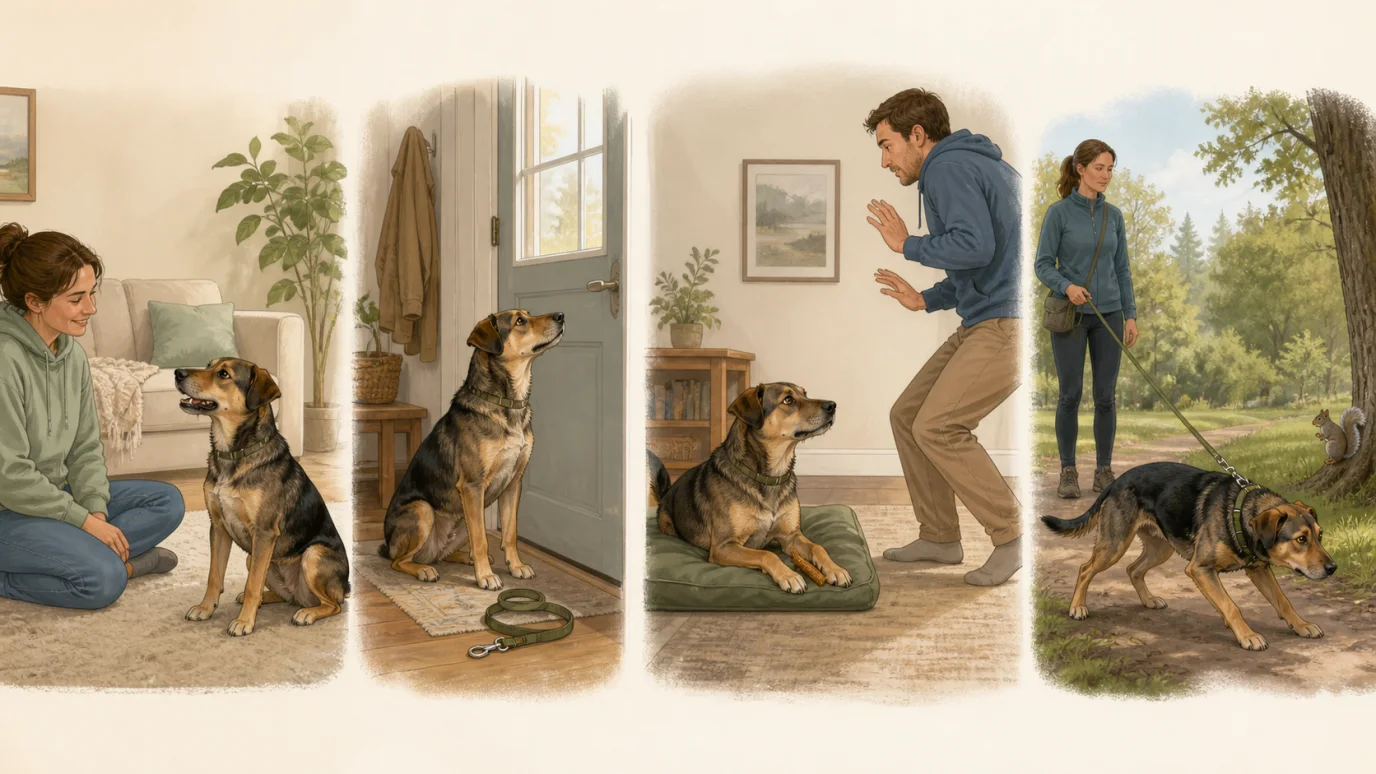
Eye direction alone is not the verdict. Compare facial tension, movement, target, nearby resources and the dog's ability to disengage.
Soft eyes versus a hard stare
| Feature | Soft social or request gaze | Hard social stare |
|---|---|---|
| Eyelids and brow | Loose, normal blinking | Muscles tighten, blinking reduces |
| Mouth | Loose or gently open | Often closes or tightens |
| Body | Fluid, able to reposition | Still, braced or slowly committed |
| Attention | Shifts between person and environment | Stays fixed or repeatedly snaps back |
| Context | Greeting, waiting, learned request | Approach, conflict, guarding or pressure |
| Safer response | Interact if the whole body stays loose | Stop advancing, avoid direct eye contact and add space |
There is no validated number of seconds that turns a look into a hard stare. Breed anatomy, visual task and individual behavior affect blink rate and eye shape. The transition from loose to fixed is more useful than a stopwatch.
What it likely means — five common contexts
1. Bonding gaze
A dog who watches you across the room with a soft eye and a relaxed body is doing something that, neurochemically, looks a lot like what happens between a human parent and infant. Nagasawa and colleagues measured urinary oxytocin in dog-owner pairs before and after a thirty-minute interaction and found a positive feedback loop: longer mutual gaze produced a rise in oxytocin in both the dog and the human, which in turn produced more gaze (Nagasawa et al., Science, 2015). The same pattern did not appear in hand-raised wolves who had similar contact with their handlers. It appears to be specific to the domesticated dog-human relationship.
What that means practically: the soft-eyed stare from across the room is a real social signal, not a projection. The dog is engaging with you. Returning the gaze softly — without leaning over them or escalating into a hard stare — strengthens the bond. This is the version owners think of when they say their dog "looks at them with love." The mechanism is more interesting than the projection.
2. Asking for something
Dogs are operant learners. They quickly learn which behaviors produce which outcomes, and most owners — without intending to — train their dogs to stare as a request. The dog sits at your feet while you eat. You eventually look down. Sometimes a piece of food drops, or you offer one, or you say "no" and they get attention. From the dog's point of view, all three outcomes confirm that staring at the human produces a response.
This is the stare that comes with the paw touch, the soft whine, the head on the knee. The body is usually relaxed; the eye is soft but persistent. The dog is making a request — usually for food, a walk, access to a closed door, or a toy that rolled under the couch.
The behavior itself isn't a problem. Whether you reinforce it is a training decision. If you respond to the polite stare with food sometimes, you've put the behavior on a variable reinforcement schedule, which is the most resistant-to-extinction schedule available. The stare will get more persistent over time, not less. That's a feature of how learning works, not a sign the dog is being demanding.
3. Confused waiting
In a training session, a dog will often stare at the handler while clearly trying to figure out what behavior earns the marker word and the reward. The body is engaged but the dog is mentally working — head may tilt, ears rotate forward, the gaze flicks between your face and your hands. Karen Overall describes this as the visual orienting pattern of a dog in a high-attention learning state (Overall, Manual of Clinical Behavioral Medicine for Dogs and Cats, Elsevier 2013).
This stare is informative for the handler. It usually means the criterion in the current trial is too high, and the dog is searching for the right answer. Lowering the criterion — going back to a step the dog already knows — almost always restores the behavior. The stare isn't defiance. It's a dog who hasn't been given enough information to succeed.
4. Resource guarding
A small fraction of staring is a warning. A dog who stands or lies near a possession — a chew, a bowl, a stolen sock, a sleeping spot, occasionally a person — and produces a hard stare with a still body is signaling that they don't want you to advance further. The stare is the second or third rung on the warning ladder, after the freeze and before the growl.
Resource guarding is a normal canine behavior with a treatable presentation. It is not a personality flaw and not a dominance problem. It's a fear-based behavior: the dog has learned that human approach predicts the loss of a valued resource, so they signal earlier to prevent that loss. The signal sequence matters more than the resource itself.
The thing not to do is punish the stare. Punishing the warning removes the warning but doesn't remove the underlying fear, and the dog moves up the ladder to a growl, a snap, or a bite. The AVSAB Position Statement on Humane Dog Training (2021) is explicit about this: confrontational methods produce more aggression, not less. If your dog produces a hard stare around a resource, see the resource guarding guide and work with a credentialed force-free behaviorist.
5. Medical or cognitive change
A previously non-staring dog who begins staring constantly — particularly an older dog, particularly accompanied by disorientation, sleep-wake cycle disruption, house-soiling, or reduced interaction — is a medical question. Canine Cognitive Dysfunction Syndrome (CCDS) is the dog analog of human dementia, and a fixed or unfocused stare into corners, walls, or the middle distance is one of the diagnostic markers (Landsberg, Nichol, & Araujo, Veterinary Clinics of North America: Small Animal Practice, 2012).
Other medical causes that present with staring include partial seizure activity (especially focal seizures, which can look like brief unresponsive episodes), pain (a dog staring at a specific body part), and visual changes (a dog staring intently while trying to compensate for declining sight). None of these are behavior problems. They're veterinary problems. A sudden behavior change always starts with a vet visit before it goes to a behaviorist.
6. Predatory or task focus
A dog may fix visually on wildlife, livestock, a moving toy or a working target. The body often lowers or leans forward, movement becomes quiet and economical, the mouth closes and the dog becomes difficult to disengage. This is not necessarily a social threat display, but it can create immediate risk to the target.
Increase leash distance and block the view without grabbing near the face. Do not release the dog to “see what happens.” Predatory behavior can occur without growling, barking or the defensive signals people expect before aggression.
A herding dog staring at stock under trained control is also different from an uncontrolled wildlife fixation. Context, cue response and physical management matter.
Hard stare during social conflict
A hard stare directed at a person or dog becomes more concerning when paired with sudden stillness, closed mouth, body blocking, lowered head over an item, rigid tail, lip lift or growl. The gaze may function as a distance-increasing warning, but it does not prove a bite will follow.
Common settings include:
- someone approaching food, a chew, bed or stolen object
- another pet approaching a person or resting place
- a direct dog-to-dog greeting with no room to curve away
- a stranger leaning, reaching or staring at the dog
- touch near a painful area
Stop the approach. Move children and other animals away, use barriers and avoid reaching for the resource. Do not test whether the dog will escalate. New behavior around touch or handling also needs veterinary assessment for pain.
What not to assume
Two readings circulate widely and are both wrong.
The first is that staring is automatically affection. The previous section is enough to retire that one — a hard stare over a chew is the opposite of affection. The stare carries no fixed meaning. The body it's attached to does.
The second is that a stare is a dominance challenge — that the dog is "testing" you, that staring back will reestablish your authority, that the right move is to win the staring contest. This reading is a remnant of dominance theory, an outdated framework rejected by the American Veterinary Society of Animal Behavior. The AVSAB Position Statement on Humane Dog Training (2021) summarizes the evidence: dominance-based methods increase the probability of aggression, damage the human-dog relationship, and do not address the underlying behavior. Meeting a hard stare with a hard stare is escalation. The dog reads it as a threat, and a threatened dog has a smaller and smaller decision space until the only option left is a bite.
Read the body. Don't compete with the eye.
What to do
DO read the rest of the body first. Mouth, tail, weight distribution, ears, blink rate. A stare with a loose mouth and a soft tail is a different conversation from a stare with tight lips and a still body. The fuller framework is in the dog body language field guide.
DO respond consistently when they ask politely. If your dog sits at your feet with a soft stare and a request — water, a walk, access to the back door — fulfilling the request when you can is fine. Inconsistency (responding sometimes, ignoring other times, scolding occasionally) is what produces the persistent escalating version most owners eventually find annoying.
DO see a vet for sudden changes. A previously non-staring dog who starts staring blankly at walls is a medical conversation. CCDS, focal seizures, pain, and visual decline are all on the differential. Don't try to train through what could be a neurological symptom.
AVOID meeting a hard stare with a hard stare. The right response to a hard stare is to soften your own eyes, turn your head slightly, lower your shoulders, and back off the situation. You are not negotiating for status. You are de-escalating an arousal state.
AVOID punishing the stare. Whether the stare is a polite request or an early warning, punishing it removes the communication. You don't change the underlying state the dog is in. You just teach the dog to skip the warning step. The next time you see the behavior, it will be a louder one further up the ladder.
AVOID staring back. Prolonged direct eye contact and leaning forward add social pressure. Turn slightly sideways, soften your gaze and move away in a curve if it is safe.
When to call a professional
Most staring is normal social or operant behavior and doesn't need an intervention. The patterns that do need a credentialed force-free professional are narrower:
- Hard stare with a still body around food, toys, beds, or people (resource guarding presentation)
- Hard stare paired with growling, snapping, or any bite history
- Sudden onset of constant staring in an older dog (vet first, then behaviorist if cleared)
- Unfocused staring into corners or walls with other signs of cognitive change
Credentials to look for: CDBC (Certified Dog Behavior Consultant), CSAT (Certified Separation Anxiety Trainer), IAABC (International Association of Animal Behavior Consultants), Fear Free, KPA-CTP (Karen Pryor Academy Certified Training Partner). All signal force-free, evidence-based methodology.
Try it on your own dog
The next time your dog stares at you, freeze the mental frame for a second. Soft eye or hard? Mouth loose or tight? Body settled or still? Where is the weight sitting? Is there a resource nearby? Practicing this read on a moment you already understand is how the skill builds.
PetTranslator.ai analyzes one clear photo against this framework — biometric markers it can observe, a behavioral interpretation, an action plan — using the same evidence base as this article. It's not a replacement for a behaviorist on a guarding or aggression case. For daily reading practice, it's a useful instrument.
Frequently asked questions
Does a hard stare mean a dog will bite?
No. It indicates intense fixed attention and, in a social context with tension, can be a warning. It does not predict one certain next action. Create space rather than testing it.
Why does my dog hard-stare at another dog?
The dog may be socially tense, frustrated, guarding, fearful or intensely focused. Avoid a direct greeting, move away in a curve and watch whether flexible movement returns.
Is a dog staring at a squirrel being aggressive?
It may be predatory focus rather than social aggression. That distinction does not remove risk to the squirrel or another small animal, so maintain secure distance and leash control.
Should I stare back to show authority?
No. Staring back can increase pressure and risk. Dominance contests are not an appropriate training framework. Turn partly sideways and create space.
When is staring a medical concern?
Call a veterinarian for sudden blank staring, unresponsive episodes, staring into walls or corners, disorientation, vision changes, pain signs or other new behavior changes.
Sources
- Nagasawa, M., Mitsui, S., En, S., Ohtani, N., Ohta, M., Sakuma, Y., Onaka, T., Mogi, K., & Kikusui, T. (2015). Oxytocin-gaze positive loop and the coevolution of human-dog bonds. Science, 348(6232), 333–336.
- Karen Overall (2013). Manual of Clinical Behavioral Medicine for Dogs and Cats (2nd ed.). Elsevier.
- AVSAB Position Statement on Humane Dog Training (2021). American Veterinary Society of Animal Behavior.
- Landsberg, G., Nichol, J., & Araujo, J. (2012). Cognitive dysfunction syndrome: A disease of canine and feline brain aging. Veterinary Clinics of North America: Small Animal Practice, 42(4), 749–768.
- Mills, D., Karagiannis, C., & Zulch, H. (2014). Stress — its effects on health and behavior: A guide for practitioners. Veterinary Clinics of North America: Small Animal Practice, 44(3), 525–541.
Khabir Mughal is the founder of PetTranslator.ai. This article was reviewed against the AVSAB Position Statement on Humane Dog Training and Karen Overall's Manual of Clinical Behavioral Medicine before publication.