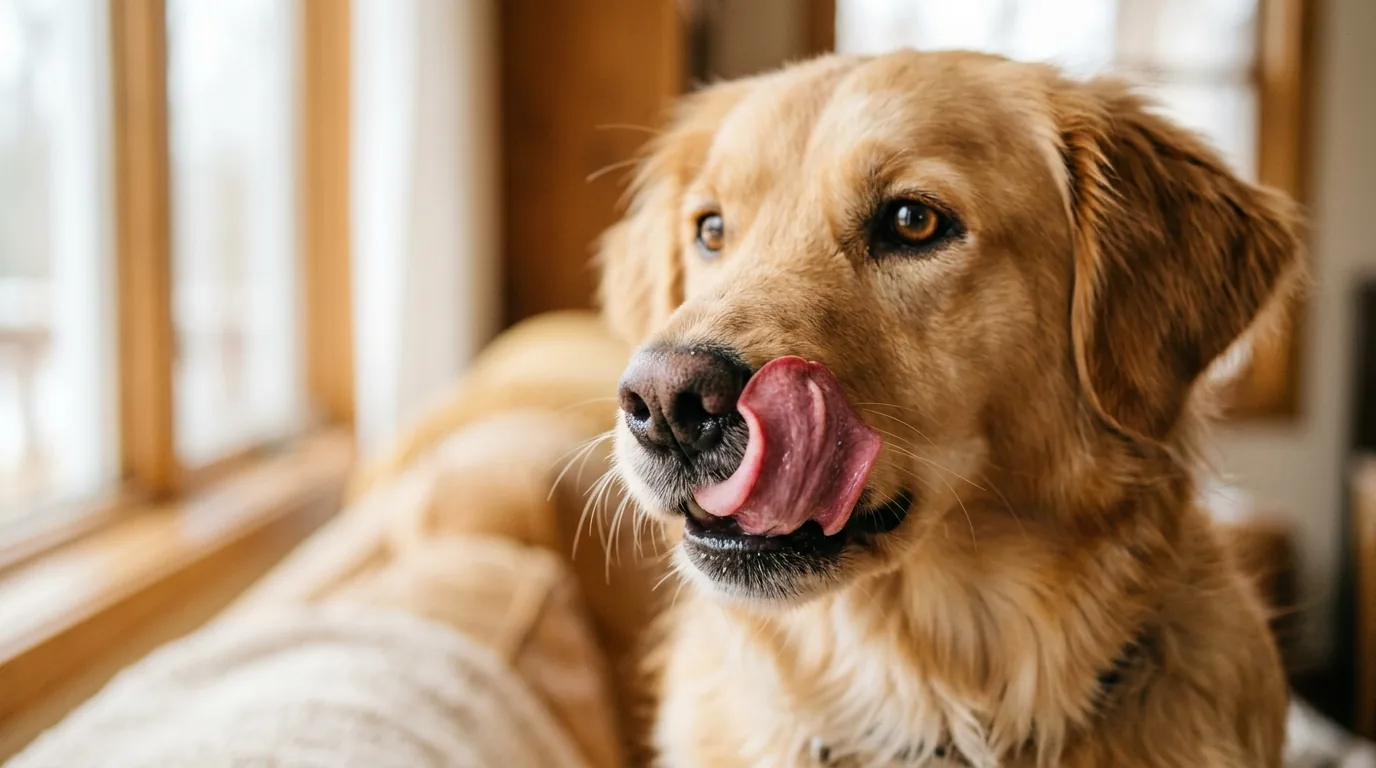
TL;DR. Most dog lip licking isn't about food at all. It's a displacement signal — a small, self-soothing behavior that appears when the dog is slightly stressed or uncertain. One flick of the tongue while you eat a sandwich is one thing. A flick of the tongue when a stranger leans over the dog at the park is another. Recognizing the difference is what separates catching low-grade stress early and missing it until the dog escalates.
What food-related lip licking looks like
There's a narrow set of situations where lip licking really does mean what most owners assume.
A dog who licks their lips when food is visible, when food is being prepared, when a treat is being shaped in your hand, or when something is sitting on their muzzle that they can feel — that's anticipation or grooming. The context is unambiguous. Food is present, or food has been present in the last few seconds, or the dog is hungry and looking at you the way they always look at you before dinner.
That's not what this article is about. The food version of lip licking is the one most owners notice and label correctly. The version most owners miss is the one the dog uses when there's no food anywhere in the picture.
What displacement lip licking looks like
Displacement lip licking is out of context. There's no food. The dog hasn't just eaten. Nothing is on their face. And the tongue still flicks across the lip line — sometimes once, sometimes repeatedly, often within the span of half a minute.
It rarely shows up alone. Watch for the cluster:
- A flick of the tongue with no food in sight
- A yawn shortly after, when the dog isn't tired
- A small head turn away from whatever is in front of the dog
- A brief look-away, then back
- Ear shifts that don't match the environmental sound
- A slight tightening across the shoulders or commissure
A single lip lick in a thirty-second window is normal. Three lip licks in thirty seconds, with another stress marker layered on, is the signal you're meant to read. The dog is regulating themselves through a moment of mild discomfort.
For a primer on reading these clusters together, see the full dog body language guide.
The science: why dogs lip-lick under stress
The framework for reading lip licking as a stress behavior comes from Norwegian trainer Turid Rugaas, whose 2005 book On Talking Terms with Dogs: Calming Signals catalogued roughly thirty observable signals dogs use to lower arousal — their own and others'. Lip licking is one of the most consistent entries in that catalogue. So is yawning out of context, head turning, sniffing the ground in the middle of a tense moment, and the slow approach in a curving line rather than a straight one.
Rugaas' framing is functional rather than emotional. The dog isn't "telling you" they're stressed in the human sense of telling. They're performing a self-soothing behavior that has the secondary effect of signaling discomfort to anyone watching. Karen Overall covers the same behaviors clinically in her Manual of Clinical Behavioral Medicine for Dogs and Cats, classifying lip licking among the displacement and appeasement behaviors that appear when a dog faces conflict between approach and avoidance.
The mechanism has parallels in human nervous-system regulation. Humans lick their lips, swallow, chew, or touch their face when slightly anxious — small motor patterns that engage the parasympathetic system and bring arousal down a notch. Dogs do something analogous with the tongue across the lip line. It isn't a one-to-one match, and it isn't a feeling to be read like a human emotion. It's a regulatory behavior with observable inputs and observable outputs.
Common contexts where displacement lip-licking appears
Once you start watching for it, the signal shows up in predictable places.
During training. A dog who is confused about what's being asked — the cue isn't clear, the criteria shifted, the reinforcement schedule changed — will lip lick between repetitions. It's an early indicator that the session has gotten too hard, not a sign the dog needs more drilling.
At the vet. Almost every dog lip licks in the exam room. The combination of slick floors, unfamiliar people leaning over them, and prior associations with handling produces low-grade displacement stress in even calm dogs. Fear Free veterinary protocols are built partly around recognizing and reducing these signals.
When approached by a stranger. A stranger walking up and bending toward the dog's face is one of the most common displacement triggers in adult dogs. Lip lick, slight head turn, soft whale eye — the dog is asking for a slower approach.
During unwanted handling. Grooming, nail trims, restraint at the vet, harness-fitting in a dog who finds the harness aversive. Lip licking during these moments is the dog telling you the handling is more than they can absorb without help.
When children are nearby. Children move unpredictably, lean over dogs, hug them around the neck, and stare at their faces — every one of those is a displacement trigger. A family dog who lip licks around the toddler isn't being "tolerant." They're showing stress that hasn't yet escalated.
When other dogs approach. During greetings, particularly head-on greetings or greetings with a high-energy unfamiliar dog, lip licking is one of the first signals the more cautious dog will offer.
The calming signal sequence. Lip lick → yawn → head turn → look away is the standard order Rugaas documented. When you see the sequence run start to finish, the dog has been moderately uncomfortable for at least several seconds. Patricia McConnell makes a similar point in The Other End of the Leash about how owners often miss the early steps and only notice when the dog has already disengaged.
What NOT to assume
A few corrections worth making explicit.
Lip licking is not always about food. The food version is the smallest slice of total lip licking owners see in a given week. The displacement version dominates the rest.
Lip licking is not a fixable behavior in itself. The behavior isn't the problem — it's an output of an underlying state. Trying to stop the lip licking without changing the underlying discomfort is like turning off a smoke alarm without putting out the fire. The displacement signal will reappear, or escalate, until the dog's actual situation changes.
Lip licking is not "the dog being polite to you" in the human sense. It isn't manners. It isn't deference in the way humans use the word. It's a regulatory behavior that happens to also communicate discomfort to anyone watching. Reading politeness into it tends to lead owners to feel flattered rather than concerned.
What to do when you see displacement lip licking
The right response is small and immediate.
Do.
- Note what was happening at the moment the lick appeared. The trigger is usually within arm's length of the dog and within the last few seconds.
- Reduce the stressor if it's reducible. The stranger backs off. The toddler is redirected. The grooming session pauses.
- Increase distance from the trigger. Even a few feet of additional space is often enough to lower arousal in a dog showing low-grade displacement.
Avoid.
- Insisting on the interaction. "He needs to get used to it" is the most common mistake. Repeated exposure to a stressor without a change in distance, intensity, or duration tends to sensitize the dog, not desensitize them.
- Punishing the signal. Yelling at a dog for lip licking — or for the yawning that often follows — removes the early warning while leaving the discomfort. The next signal up the ladder is usually a growl, then a snap.
- Forcing through. Continuing a vet exam, a grooming session, or a stranger greeting without giving the dog a break almost guarantees the displacement will escalate. A thirty-second pause is usually enough to reset.
When to call a professional
If displacement lip licking is near-constant — appearing across many contexts, multiple times per day, with no obvious single trigger — work with a credentialed positive-reinforcement professional rather than trying to handle it alone. The same is true if lip licking is paired with other anxiety markers: pacing, hypervigilance, inability to settle, sleep disruption, appetite changes, or stereotypic behaviors.
Rule out medical first. Nausea, dental pain, oral injury, and gastrointestinal discomfort all produce lip licking that can look exactly like displacement until a vet exam catches the real cause. A sudden onset of frequent lip licking in a previously settled dog is a vet visit, not a behavior session.
For behavior referrals, look for credentials: CDBC (Certified Dog Behavior Consultant), CSAT (Certified Separation Anxiety Trainer), KPA-CTP (Karen Pryor Academy Certified Training Partner), Fear Free certified, or a veterinary behaviorist (DACVB). Avoid anyone selling "dominance" or "pack leader" framings — the American Veterinary Society of Animal Behavior has formally rejected dominance-based methods.
Try it on your own dog
The fastest way to build the eye for displacement lip licking is to watch your own dog for a week in moments when no food is present. The doorbell. A stranger on a walk. A vet appointment. A nail trim. A trip to the groomer. Count the lip licks. Note what was happening in the five seconds before each one.
PetTranslator.ai is built around the same framework. Upload one clear photo of your dog and the analysis returns the biometric signals it can see — including lip line and tongue position — along with a behavioral interpretation and an action plan. It's useful for daily reading practice and for owners who want a second read on what they're already noticing.
Sources
- Turid Rugaas, On Talking Terms with Dogs: Calming Signals (Dogwise, 2nd edition 2005) — the foundational catalogue of displacement and appeasement signals, including lip licking.
- Karen Overall, Manual of Clinical Behavioral Medicine for Dogs and Cats (Elsevier, 2013) — clinical classification of lip licking among displacement behaviors.
- Patricia McConnell, The Other End of the Leash (Ballantine, 2002) — for the communication-asymmetry framework between dogs and humans, and for the early-warning sequence framing.
- Lili Chin, Doggie Language (Summersdale, 2020) — illustrated reference for recognizing lip licking and the calming signal sequence visually.
For owners working with a specific behavior concern, the IAABC and AVSAB websites both maintain searchable directories of credentialed positive-reinforcement professionals by region.
Khabir Mughal is the founder of PetTranslator.ai. This article was reviewed against the AVSAB Position Statement on Humane Dog Training and Karen Overall's Manual of Clinical Behavioral Medicine before publication.