TL;DR
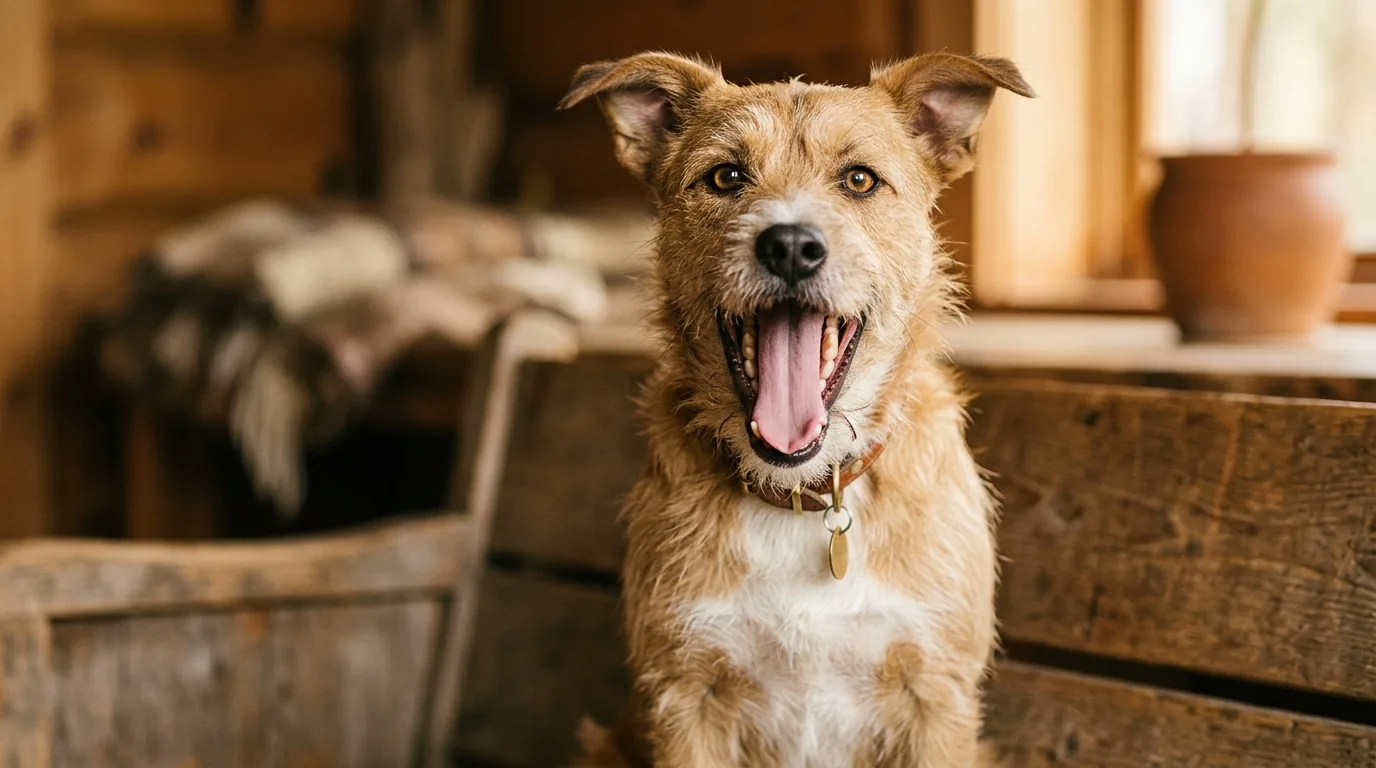
When a dog yawns and they're clearly not tired — at the vet, mid-training, while a stranger reaches toward them — the yawn is almost always a displacement signal. The dog is showing low-grade stress, and the yawn is a small self-soothing behavior, part of the calming-signal cluster Turid Rugaas documented in working dogs across decades of field observation. Reading the out-of-context yawn correctly is one of the most useful skills an owner can build.
Yawn when tired vs yawn when stressed: how to tell the difference
The two yawns look superficially similar. They're not the same behavior, and the differences are observable once you know where to look.
The tired yawn. Slow onset, full opening of the jaw, eyes squint shut at the apex, often followed by a stretch or a settle. It happens in sleep-related context — waking up, mid-afternoon on the couch, after dinner before bed. The body around the yawn is relaxed.
The stress yawn. More abrupt onset, often less full at the jaw, eyes stay open or only partially close at the apex. There is no sleep context — the dog was awake and engaged a moment earlier. It almost always appears alongside other low-grade stress signals: a lip lick within a few seconds, a head turn, a brief look-away, a shoulder shake. The body around the yawn carries some tension.
The single most useful tell is the eyes. A tired dog closes them. A stressed dog keeps them open enough to monitor the room.
The science: why dogs yawn under stress
There are two yawning behaviors in dogs, and they're worth keeping separate.
The first is contagious yawning. Joly-Mascheroni, Senju, and Shepherd published a study in Biology Letters in 2008 showing that dogs catch yawns from familiar humans at a measurable rate — 21 of 29 dogs in their experiment yawned within five minutes of a person yawning at them. Subsequent work has refined the picture (the effect is stronger with familiar humans and weaker in unfamiliar contexts), but the basic finding has held up: dogs participate in the same social-yawning loop primates do.
The calming-signal yawn is a different behavior. It's not triggered by another mammal yawning nearby — it's triggered by internal stress, and it functions as a self-regulation behavior, parallel to the way humans yawn under social pressure (a job interview, a public-speaking moment) rather than fatigue. The autonomic mechanism is shared. The trigger isn't.
Turid Rugaas's framework, laid out in On Talking Terms with Dogs: Calming Signals (Dogwise, 2nd ed. 2005), is the foundational reference here. Rugaas catalogued roughly thirty discrete signals that dogs use to lower arousal — their own, and the arousal of dogs around them. The yawn sits at the early end of the cluster, alongside the lip lick and the head turn. Karen Overall's Manual of Clinical Behavioral Medicine for Dogs and Cats treats the same behaviors clinically, under the umbrella of displacement responses.
The takeaway: when your dog yawns in a moment that has nothing to do with sleep, the most likely explanation is that their nervous system is doing a small piece of work to bring itself back down.
Common contexts for stress yawning
Some situations produce out-of-context yawning so reliably that behaviorists use them as teaching examples:
- At the vet. The waiting room. The exam table. The moment the thermometer comes out.
- During training. Especially during a session that has gone on too long, or one that has introduced too much novelty too fast.
- When a stranger reaches toward them. Particularly an over-the-head reach from an adult or an enthusiastic approach from a child.
- When another dog approaches. Frequently the yawn is directed at the approaching dog as a "let's slow this down" signal.
- During scolding or a harsh tone. Yawning under correction is one of the clearest displacement responses an owner can observe in their own home.
- Before a known stressful event. The car ride to grooming. The crate the dog associates with boarding. The shoes that mean a long walk to a busy place.
- During play with a more intense dog. A play yawn from the less aroused dog functions as a request to lower the energy. Behaviorists often see it just before the dogs take a break and shake off.
Each of these is a context where a behavior camera would catch a yawn that isn't about tiredness.
The calming signal sequence
Out-of-context yawning rarely appears alone. The typical pattern, observed across hundreds of training-session videos and applied behavior consultations, runs in a sequence:
- Lip lick (one or two quick flicks)
- Yawn
- Head turn away from the trigger
- Look-away (eyes follow the head)
- Ground-sniffing or scratch (displacement activity)
- Whole-body shake (the reset)
The whole sequence can run in fifteen seconds. Not every dog uses every step, and the order varies, but the cluster behavior is consistent. Reading it as a cluster — rather than reading the yawn in isolation — is what lets an owner intervene early.
If you catch the lip lick, you have a few seconds to lower the stimulus. If you only catch the yawn, you still have time. If you wait until the body shake, the dog has already done the self-regulation work and you've missed the early intervention window.
What NOT to assume
A few common misreads come up often enough to address directly.
Stress yawning is not laziness. A dog who yawns during training isn't bored or checked out. They're showing the trainer that the session is taxing their threshold, and the appropriate response is to lower difficulty, shorten the rep, or take a break. Pushing through the yawn often produces the next signal in the chain — a head turn, a sniff break, a refusal.
The calming-signal yawn is not the same as contagious yawning. You can't reliably trigger a calming yawn by yawning at your dog. The contagious yawn is a social-mirroring behavior. The calming yawn is an internal stress response. They share an output and not much else.
Stress yawning is not a sign you need to back off love. It's a sign the environmental arousal needs to come down. The dog isn't asking for less affection — they're showing that the current context is taxing their nervous system. Move them to a quieter space, give them a beat, and the calming-signal cluster usually resolves.
What to do when you see out-of-context yawning
A short field protocol that maps to the framework above.
Do.
- Note what was happening when the yawn appeared. The trigger is the data. Was a stranger approaching? Was the training session twenty minutes long? Was the car about to start?
- Lower the stimulus. Move away from the trigger, end the rep, give the room a beat.
- Give the dog space and time to self-regulate. The body shake at the end of the calming sequence is the dog telling you they've finished the work. Wait for it.
Avoid.
- Forcing the interaction. If the yawn appeared because a child was reaching toward the dog, the next step is not "they'll get used to it." The next step is space.
- Punishing. Punishing a stress response punishes the warning, not the underlying state. The state stays. The warning gets removed. The next signal up the escalation ladder is what fills the gap.
- Yawning back at the dog as a "trick." The internet has a version of this advice. It misunderstands the signal. Calming yawns aren't social-mirroring behavior; humans can't reliably perform the dog version, and the cat slow-blink equivalent doesn't exist for dogs.
The broader dog body language framework walks through why displacement signals appear in clusters. The companion piece on out-of-context lip licking covers the signal that almost always precedes the calming yawn. The piece on whale eye covers what appears next when the early signals are missed.
When to call a professional
Out-of-context yawning by itself is not a behavior emergency — most dogs do it occasionally in mildly stressful moments, and the appropriate response is environmental, not clinical. The cases that warrant a credentialed positive-reinforcement professional:
- Calming signals appearing constantly across normal household contexts (the dog yawns and lip licks all day, not just at known triggers)
- Calming signals followed by escalation (growling, snapping, biting) despite consistent attempts to lower the stimulus
- A sudden onset of stress signaling in a previously stable dog — this warrants a vet visit first to rule out pain or medical cause
- Stress signaling that doesn't resolve once the trigger is removed
Look for credentials: CSAT, CDBC, Fear Free, IAABC, KPA-CTP. All signal force-free, evidence-based methodology. Patricia McConnell's The Other End of the Leash (Ballantine, 2002) is a useful primer on why force-based methods amplify the underlying state rather than resolving it.
Try it on your own dog
Calming signals are easier to recognize once you've seen them labeled in your own dog several times. The fastest way to build the read is to capture a still frame in a moment you suspect — the dog yawning at the vet, mid-training, when a stranger walks past the window — and check the surrounding signals.
PetTranslator.ai is built around the same framework this article uses. Upload one clear photo of your dog and the AI returns a structured report with the observable signals it can see, a behavioral interpretation, and an action plan — using the calming-signal vocabulary from Rugaas and the clinical framework from Overall. For daily reading practice, it's a useful instrument.
Sources
- Turid Rugaas, On Talking Terms with Dogs: Calming Signals (Dogwise, 2nd edition 2005) — the foundational behavioral text on displacement and calming signals, including out-of-context yawning.
- Joly-Mascheroni, Senju & Shepherd, "Dogs catch human yawns" (Biology Letters, 2008) — the contagious-yawning study that established social mirroring of yawns in domestic dogs.
- Karen Overall, Manual of Clinical Behavioral Medicine for Dogs and Cats (Elsevier, 2013) — the clinical reference for displacement responses in canine behavior medicine.
- Patricia McConnell, The Other End of the Leash (Ballantine, 2002) — for the communication-asymmetry framework between dogs and humans, including why punishment of stress signals backfires.
For owners working with a specific behavior concern, the IAABC and AVSAB websites both maintain searchable directories of credentialed positive-reinforcement professionals by region.
Khabir Mughal is the founder of PetTranslator.ai. This article was reviewed against Turid Rugaas's calming-signals framework and Karen Overall's Manual of Clinical Behavioral Medicine before publication.