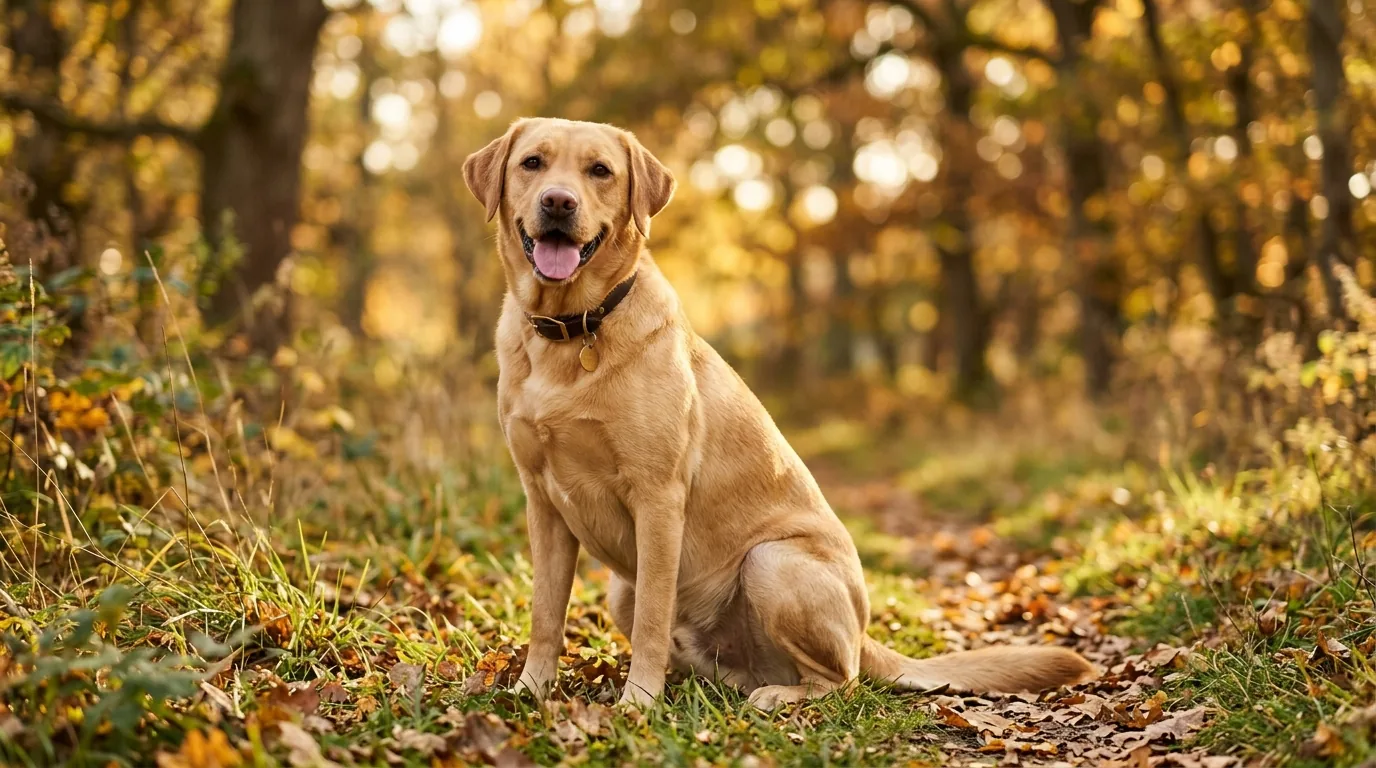
Labrador Retrievers are food-motivated, water-loving, retrieve-driven working dogs. The breed held the top spot as the most-registered dog in the United States for thirty consecutive years before being recently overtaken — that volume produced a vast pet population whose behavior repertoire most owners encounter daily without recognizing where it comes from. Body language reading on a Lab is generally easier than on more reserved breeds; most signals are clear and well-telegraphed. The harder work with this breed sits elsewhere — in the welfare problems the popularity created, particularly an obesity epidemic that now affects most of the breed.
Labrador temperament — what the breed actually looks like
Strip away the kennel-club description and a Labrador is a working gun dog developed on the harbors of Newfoundland and refined in nineteenth-century England by the second Earl of Malmesbury and the fifth and sixth Dukes of Buccleuch. The original brief was to retrieve fish that escaped the lines and, later, to retrieve waterfowl from cold North Atlantic and Scottish water. The behavior the modern breed carries is built on that brief.
Food-motivated to a degree few breeds match. A 2016 study by Eleanor Raffan and colleagues at Cambridge, published in Cell Metabolism, identified a deletion in the POMC gene present in roughly a quarter of pet Labradors and a higher proportion of assistance-dog Labs. The mutation disrupts the satiety signal — the dogs carrying it do not experience the same "I'm full" feedback the rest of the canine population does. This is not a metaphor. It is a documented genetic difference, and it has direct welfare implications for how Labs are fed and how their food-seeking behavior should be read.
Strong retrieve drive. A Lab who is built well will want to carry things from the moment they can walk. Modern pet Labs still want to carry — a toy at the door, a shoe across the room, a stick on every walk. The drive is the breed's defining feature, and it is the easiest channel for productive training.
Water orientation. The original retrievers swam to fishing boats and lobstered through breaking waves. The descendants of those dogs are drawn to water with an intensity that surprises first-time owners. A puddle is not a puddle to a Lab. It is an invitation.
Sociable across the board. Labs were selected to work easily with the handler and to tolerate being kenneled with other dogs between hunts. The pet population reflects that — most Labs are comfortable with strangers, comfortable with other dogs, comfortable in crowds. A Lab who is genuinely reactive is uncommon and usually has an explanation worth investigating.
Slower to mature than they look. A Lab is mentally a puppy until somewhere between two and three years old. Owners who assume that a sixty-pound dog has the impulse control of an adult are setting themselves up for frustration. The body finishes first.
High pain tolerance. Like the Golden, the Lab was bred to keep working through cold water and rough cover. Discomfort gets masked. By the time a Lab is openly limping or refusing the stairs, the underlying issue has usually been present for some time.
Body language patterns specific to Labs
Most signals from the general dog body language framework apply cleanly to Labradors. A few patterns are worth reading in their breed context.
The otter tail. Labradors carry a thick, tapered, otter-like tail that sits naturally just above the level of the spine when the dog is alert. It is one of the breed's defining structural features. Owners reading tail position on a Lab should calibrate accordingly — the relaxed Lab does not hold the tail low the way a German Shepherd does at rest. Mid-to-high carriage in a settled Lab is baseline, not arousal.
The open-mouth happy expression. A relaxed Lab often holds the mouth slightly open with the tongue draped and the commissure neutral. This is breed-typical resting expression and reads visually as "smiling." It is not panting in the stress sense. Stress panting in a Lab, as in other breeds, is faster, shallower, with tension across the shoulders and a more closed front of the mouth.
Soft mouth carrying. A correctly bred Labrador can hold an egg in the mouth without cracking the shell — the trait was selected for explicitly. Modern pet Labs still display this. A Lab walking around with a shoe in the mouth, no pressure, no chewing, is doing what the breed was built to do. Reading it as destruction leads to corrections that do not match what the dog is actually doing.
Bouncy approach with whole-body wag. In the general dog population a wagging tail is not a reliable friendliness signal on its own. In Labradors the correlation is stronger. A wide tail sweep that moves the entire rear end, paired with a bouncy gait and a loose face, almost always reads as affiliative in this breed. Most Labs are genuinely greeting-positive most of the time.
Suppressed stress in social context. The breed's affiliative drive can override stress signals the way it does in Goldens. A Lab at the vet who keeps approaching the technician is not necessarily comfortable — the drive to engage can carry the dog through discomfort. Watch the lip line, the blink rate, and the absence of relaxation rather than the presence of obvious avoidance.
Common behavior questions
A small number of questions account for most of what Lab owners bring to a behaviorist first. Each one is a feature of the breed, not a defect.
"Why does my Lab steal food off the counter?" Retrieval drive plus food motivation plus the POMC satiety issue in many lines. The dog sees food, the breed-typical response is to acquire it. Punishing the counter-surf does not address the underlying drive — it only teaches the dog to do it when nobody is watching. Management — closed bins, secured countertops, leashes during prep — is part of normal life with this breed.
"Why is my Lab obsessed with water?" Bred-for. The Labrador's coat is a double layer with a water-repellent outer guard and a dense insulating undercoat, the tail is a rudder, and the feet are webbed. The dog is essentially a swimming machine. Channel it — actual swimming, paddling pools, structured retrieve in safe water — rather than trying to suppress it.
"Why does my Lab mouth everything?" Soft-mouth retrieve behavior expressed through play. A Lab uses the mouth the way a Border Collie uses the eye — as the primary tool for engaging with the world. Teach an "off" cue, offer appropriate mouth targets, and the behavior shapes naturally. It is not aggression and it is not a precursor to biting.
"My Lab can't be left alone — is that normal?" Labs were selected for handler partnership and most do well with their family present. Severe distress when left alone — destruction, self-injury, house-soiling, vocalization that continues for the full absence — is separation anxiety and warrants work with a Certified Separation Anxiety Trainer. Mild restlessness for the first fifteen minutes is in the normal range. Sustained distress is not.
"Why does my Lab eat things they shouldn't?" Food motivation plus retrieve drive plus the POMC issue plus the breed's sheer physical size. Labs are statistically over-represented in cases of foreign-body ingestion at emergency veterinary clinics. Socks, corn cobs, rocks, toys, the children's homework. Treat the management seriously — gastrointestinal foreign body surgery is common in this breed for a reason.
Health-behavior overlap
This section matters more for Labs than the average pet owner expects. Behavior change in a Labrador should be treated as medical until proven otherwise.
Obesity. The single largest welfare issue in the breed. The Royal Veterinary College's VetCompass program, which analyzes anonymized primary-care records across hundreds of UK practices, has consistently found that a majority of pet Labradors carry excess weight, with prevalence estimates often running near the 60% range — far above the general dog population. The behavioral consequences are direct. An overweight Lab moves less, plays less, sleeps more, develops joint pain earlier, and becomes irritable around handling of painful areas. Weight loss often produces what looks like a personality change. It is not. It is the dog feeling well enough to behave like themselves again.
Hip and elbow dysplasia. Both conditions are over-represented in the breed. A young adult Lab who stops loving fetch, who hesitates at the bottom of the stairs, who becomes snappy when handled around the hips or elbows is communicating orthopedic pain. Imaging — not training — is the next step.
Cancer profile. The Lab does not carry the same overall cancer burden as the Golden, but several specific cancers — including mast cell tumors, lymphoma, and osteosarcoma — appear at elevated rates relative to the general dog population. New lumps, unexplained weight loss, and sudden behavior change in an older Lab warrant prompt veterinary workup.
Ear infections. The floppy ear traps moisture. A Lab that swims regularly, lives in a humid climate, or has any underlying allergy is at elevated risk for chronic otitis. Head shaking, ear rubbing, reluctance to be touched around the head, and new sound sensitivity are pain signals — not bad behavior.
Exercise-induced collapse. A specific autosomal recessive condition documented in the breed, caused by a mutation in the DNM1 gene, in which the dog collapses during periods of intense exercise. The dog is usually fine at rest and during normal activity, then loses coordination during sustained high-arousal output — long retrieve sessions, field trials, hot-weather work. The condition can be DNA-tested. Owners of Labs who collapse during exercise should pursue veterinary diagnosis rather than assuming the dog is being dramatic.
Hypothyroidism. Weight gain, lethargy, skin and coat changes, and a flat affect can all be hypothyroid. The condition is more common in Labs than in the general dog population and responds well to medication once diagnosed.
Exercise and mental needs
The breed's working heritage sets a non-negotiable daily floor.
Adult Labs need sixty to ninety minutes of meaningful exercise per day at minimum. Meaningful means more than a leash walk around the block — it means time off-leash in a safe environment, swimming, retrieve work, or scent-tracking. Young adults from twelve to thirty-six months often need closer to two hours, split across the day.
Mental work is not optional. Twenty minutes of nose work, food puzzles, structured retrieve drills, or basic obedience around the house can do more for an evening's behavior than an extra walk. A Lab whose body is tired but whose retrieve drive has been unmet will still find something to carry, chew, or eat.
Swimming, where it is available, is close to ideal exercise for the breed. Low-impact on developing joints, high cardiovascular output, and aligned with the dog's natural drive. A Lab with regular safe water access has a structural advantage in their daily output.
Under-exercised Labs do not become calm. They become destructive, vocal, anxious, or — most commonly — food-seeking and weight-gaining. Punishment of the symptom without addressing the exercise debt does not work.
Training implications
Labradors are among the easiest breeds to train and one of the most resilient — within the bounds of force-free methodology.
The breed's food motivation makes positive reinforcement extraordinarily effective. Marker training, shaping, and lure-reward all land cleanly in this breed, and a hungry Lab will work as hard for a piece of kibble as many breeds will work for steak. The challenge is over-arousal — a Lab who gets too excited about the food becomes sloppy, jumpy, and noisy, and the training session fails for arousal reasons rather than for motivational ones. Lower-value reinforcers, slower delivery, and shorter sessions usually solve it.
The breed is not particularly sensitive in the sense that some breeds are sensitive — Labs are robust dogs who can handle a training mistake without falling apart. That said, the American Veterinary Society of Animal Behavior's 2021 Position Statement on Humane Dog Training is clear that aversive tools — prong collars, choke chains, e-collars — are not appropriate for any dog. The Lab does not earn an exception. The breed's biddability and food drive mean that positive reinforcement alone will get the job done.
Recall is the single most important behavior to teach a Lab. The breed is built for off-leash work, and a reliable recall — built through positive reinforcement, generalized across environments, proofed against the specific distractions of water, other dogs, and food on the ground — opens up the kind of life this breed was meant to live.
Living with a Lab — what people do not tell you
Shedding is constant. Labs have a double coat that sheds year-round and blows twice a year. Brushing two to three times a week keeps it manageable; daily during blowouts.
The mud is real. A Lab who has access to water and dirt will use both. Owners who cannot tolerate a dirty dog are in the wrong breed.
The swimming obsession is not optional. If safe water is anywhere within reach on a walk, the Lab will be in it. This is a planning issue, not a behavior issue.
The social need is real. Labs left alone in yards for full workdays, or crated without adequate breaks, develop the predictable suite of separation-related behaviors. The breed wants company.
The feeding discipline matters more than for most breeds. Given the POMC satiety issue and the breed's general food motivation, free-feeding a Lab is functionally guaranteed to produce an overweight dog. Measured meals, treat-budgeted training, and weight monitoring are part of responsible ownership of this breed.
Common training mistakes
The patterns below show up in nearly every Lab case file.
Treating the soft-mouth carry as destruction. Punishing the dog for doing what the breed was built to do does not stop the behavior. It teaches the dog to carry the object out of reach, or to swallow it. Trade up, manage access, and channel the drive into appropriate retrieve work.
Free-feeding. With a breed carrying a satiety mutation in a quarter of the population and a documented obesity prevalence above 60%, leaving food down all day is not neutral. It is the dominant cause of the welfare problem the breed faces.
Under-exercising, then punishing the consequences. The most common pattern in surrender cases. A Lab who is not getting enough output will produce destruction, vocalization, or weight gain. Addressing the symptom without addressing the exercise debt fails.
Allowing greeting jumping because "they're just being friendly." Labs are large, strong, and enthusiastic. A friendly jump from a sixty-pound dog can knock down a child or an elderly visitor. The wiggle is the breed and is not the target. The jump is the target and can be trained.
Aversive tools. Already covered. Not appropriate, not necessary, and the breed's biddability makes them unnecessary in the first place.
Is a Labrador right for you?
Yes, if you want a social, water-loving, food-motivated dog AND you can commit to sixty to ninety minutes of daily exercise, disciplined feeding, regular grooming, and ongoing veterinary care for a breed with specific orthopedic and oncologic risks.
No, if you want a low-shedding dog, a low-energy dog, a dog who can be left alone routinely, or a dog who will be content with a slow daily walk around the block.
The Labrador is one of the most rewarding breeds to live with — for the right household, with the right activity level, and with realistic expectations about feeding and exercise. The wrong household ends up with an overweight, frustrated dog and a frustrated owner. The breed deserves better than that.
Try it on your own Lab
The framework here is the same one PetTranslator.ai uses to read the photos owners upload. Upload one clear photo of your Lab — at rest, mid-greeting, after a swim — and the AI returns a structured report grounded in this breed's specific signal patterns. The otter tail at rest, the open-mouth resting expression, the suppressed stress signals during social engagement — the model is trained to read them in context.
For complex cases — separation anxiety, sudden behavior change, suspected pain — work with a credentialed positive-reinforcement behaviorist. For daily reading practice and tracking changes over time, the tool earns its place.
Related reading
- Dog body language: the underlying framework — the general signal vocabulary referenced throughout this guide
- Golden Retriever behavior guide — the sister breed, with overlapping and divergent patterns worth comparing
- Puppy biting and mouthing — directly applicable to the breed's soft-mouth tendency
- How to find a credentialed behaviorist — for cases that exceed daily reading practice
Sources
The breed analysis in this guide is drawn from:
- Raffan E, Dennis RJ, O'Donovan CJ, et al. "A Deletion in the Canine POMC Gene Is Associated with Weight and Appetite in Obesity-Prone Labrador Retriever Dogs." Cell Metabolism 23, no. 5 (2016): 893–900. The original genetic study documenting the satiety mutation in the breed.
- O'Neill DG, Church DB, McGreevy PD, Thomson PC, Brodbelt DC. Multiple VetCompass publications from the Royal Veterinary College on Labrador health and obesity prevalence in UK primary-care veterinary practice.
- John Bradshaw, In Defence of Dogs (Penguin, 2011) — for the working-heritage framework and breed-typical behavior repertoires.
- Karen Overall, Manual of Clinical Behavioral Medicine for Dogs and Cats (2nd edition, Elsevier 2013) — for the clinical reading of health-behavior overlap and breed predispositions.
- AVSAB Position Statement on Humane Dog Training (2021) — the professional standard rejecting aversive training tools.
For owners working with a specific concern, the IAABC and AVSAB websites maintain searchable directories of credentialed positive-reinforcement professionals by region.
Khabir Mughal is the founder of PetTranslator.ai. This article was reviewed against the AVSAB Position Statement on Humane Dog Training and Karen Overall's Manual of Clinical Behavioral Medicine before publication.