TL;DR
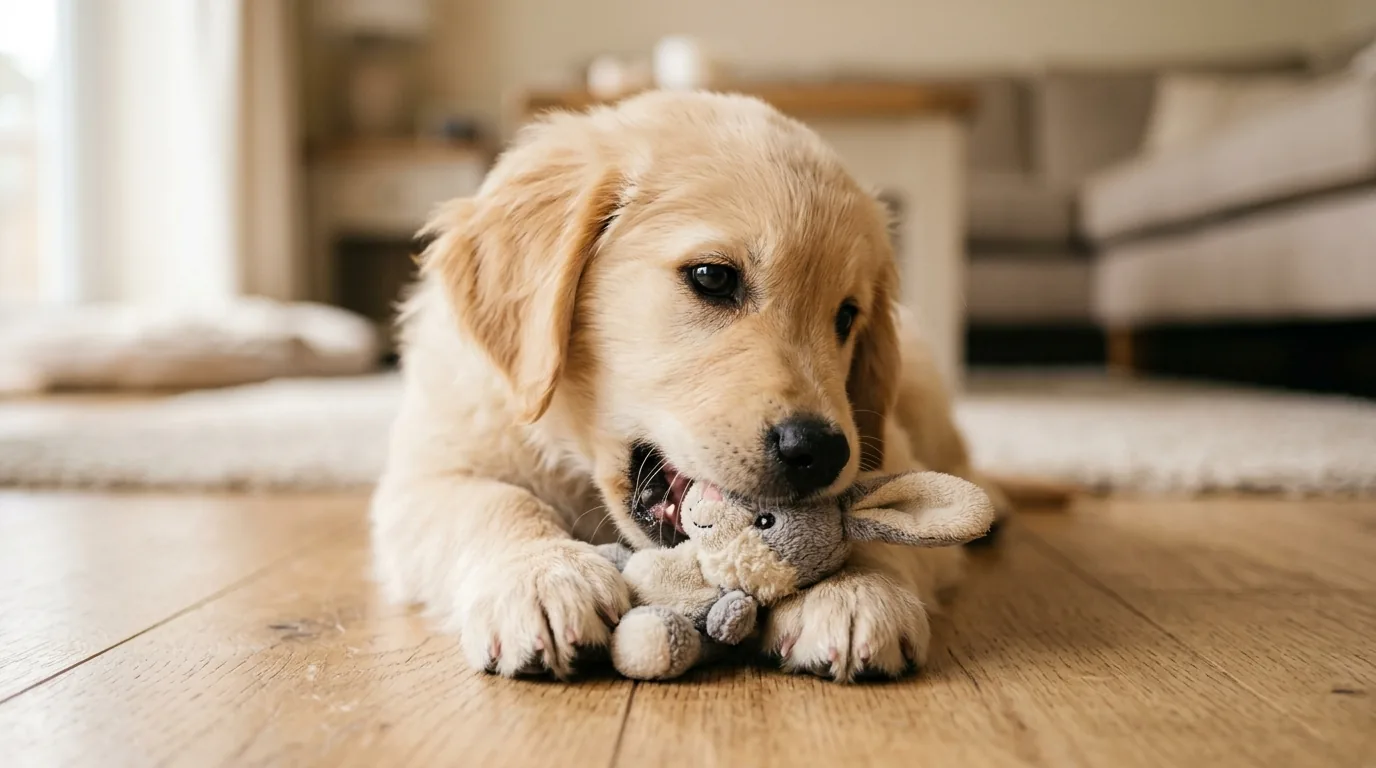
Puppy biting is normal, and it's also developmentally necessary. Puppies learn bite inhibition — the ability to control how hard they bite — through play with littermates, their mother, and the humans who respond to them appropriately. Suppressing biting outright produces adult dogs who hold pressure back until they decide to bite, then bite at full force. Redirecting onto appropriate targets and teaching pressure-control is the actual goal.
Why puppies bite — the developmental purpose
Most owners arrive at puppy biting as a problem to eliminate. The framing is wrong. Biting is one of the primary ways a puppy develops a critical safety skill, and the puppy who never bites during the developmental window is the puppy more likely to cause real injury as an adult.
Four things are happening when a puppy puts their mouth on a person:
Exploration. Puppies investigate the world primarily with their mouths. Texture, temperature, density, edibility — all of that information arrives through the mouth before it arrives through any other sense. A puppy who mouths your hand is reading you the way you'd read a label.
Teething. Between roughly twelve weeks and six months of age, deciduous (baby) teeth fall out and adult teeth come in. The process is genuinely uncomfortable. Pressure on the gums relieves the discomfort, and a puppy will seek surfaces to chew on with the same persistence a teething infant does.
Play. Mouthing is the primary canine play behavior. Two puppies in a litter spend most of their play time biting each other — neck, ears, legs, scruff. The mouth is the play tool the way the hand is for primates. A puppy who plays with you the way they'd play with a littermate is treating you as a social partner, which is what you want.
Bite inhibition learning. This is the one most owners miss. A puppy who never gets to bite never gets to find out how hard they can bite. The whole point of the puppy mouth phase is figuring out how much pressure causes harm, and the only way to learn that is through trial, feedback, and adjustment.
Skip any of these — especially the last one — and you don't get a non-biting adult. You get an adult who hasn't calibrated.
Bite inhibition — the critical developmental skill
Bite inhibition is the learned ability to control jaw pressure. A dog with strong bite inhibition can put a full set of teeth on a person's arm and not break skin. A dog with weak or absent bite inhibition cannot make that adjustment, even when they're not trying to cause damage.
Puppies learn bite inhibition through three feedback channels:
- Littermates. A puppy who bites a littermate too hard during play hears a sharp yelp and watches the littermate stop playing. The fun ends. The puppy who bites softer keeps the play going. After enough cycles, the lesson is wired in: hard bites end the fun, soft bites continue it.
- Mother. A puppy who bites the nursing mother too hard while feeding causes her to stand up and move away. Same lesson, different teacher.
- Humans. When a puppy is taken home at eight weeks, the human household takes over as the feedback source. A bite that's too hard should end the interaction. A bite that's softer can be redirected without ending the interaction.
This is what veterinary behaviorist Ian Dunbar built much of his early puppy work around: the window for teaching bite inhibition closes by roughly five months of age, and what the puppy learns during that window calibrates their bite pressure for the rest of their life.
Adult dogs with strong bite inhibition can be startled, hurt, cornered, or frightened, and the instinctive bite will still pull pressure. Adult dogs without it can't pull pressure even when they want to. The difference between a snap that leaves no mark and an emergency room visit is whether the dog learned this skill before five months.
Why suppression (rather than redirection) is dangerous
The instinct for many owners is to stop the biting entirely — say "no," push the puppy away, scold the behavior into extinction. The result of that strategy is not a non-biting dog. The result is a dog who has learned to inhibit the warning communication around biting, not the biting itself.
Here's the failure mode. A puppy who is punished every time they put teeth on a person learns that displaying mouth pressure is dangerous. They suppress the entire signal — no mouthing, no warning bites, no calibration. Then they grow up. At some point, an adult dog who has suppressed all mouth signaling encounters a situation that pushes them past their threshold — a child stepping on their tail, a stranger reaching over their head, pain from an injury. They have no graded response. They go from no signal to a full-pressure bite, because the in-between range was punished out of them.
This is why the AVSAB Position Statement on Humane Dog Training explicitly rejects punishment-based methods, and why credentialed behaviorists train pressure control rather than pressure suppression.
The goal isn't a puppy who never bites. The goal is a puppy who learns to bite softly enough that it doesn't cause harm.
The method that works — redirect, yelp, remove
The method that produces strong bite inhibition is simple, and it works because it copies the feedback a puppy would receive from a littermate.
Step 1. When the puppy bites you, say "ouch" in a soft yelp. Not a yell, not a deep scolding "no." A short, slightly high-pitched sound — closer to the way another puppy would react than the way a frustrated adult human would. The acoustic register matters. A yelp tells the puppy "that hurt." A yell tells the puppy "this human is scary."
Step 2. Turn away or stand up. Play stops for ten to thirty seconds. Withdrawal of attention is the consequence. The puppy doesn't get hit, doesn't get scruffed, doesn't get pinned. They lose the social interaction for a short window. In behavioral terms this is negative punishment — removing something the puppy wants in order to reduce the behavior — and it's the same mechanism a littermate would use.
Step 3. Re-engage with an appropriate target. Offer a chew toy, a rope, a frozen washcloth, a flirt pole. The puppy still has a mouthing need to satisfy. Redirecting onto something acceptable keeps the underlying behavior available while shifting the target.
Run this loop consistently. Every household member runs the same loop. Within two to three weeks most puppies have made the connection: hard mouth ends the play, soft mouth keeps it going, toys are the place where any pressure is fine.
What to do and what not to do
Do: Keep several varied toys within reach in every room the puppy spends time in. Rotate them. The puppy needs an immediate alternative when the redirect happens — searching for a toy across the house breaks the loop.
Do: Offer frozen chews during peak teething (four to six months). Frozen washcloths, frozen carrots, and freezer-safe rubber chews all provide cold pressure on inflamed gums.
Do: Pause play immediately when bites land. Latency matters. A consequence three seconds after the bite is connected to the bite. A consequence thirty seconds later is not.
Do: Stay calm. Excitement in your voice or movement reinforces the biting because the puppy reads arousal as continued play.
Avoid: Muzzle-grabbing, scruff-shaking, or pinning the puppy on their back. These are fear-based methods rooted in debunked dominance theory. They don't teach bite inhibition — they teach the puppy that human hands and faces are threats. The AVSAB has formally rejected dominance-based methods, and so should you. (More on this in why dominance theory is wrong.)
Avoid: Yelling, hitting, or alpha-rolling. These create fear without teaching pressure control. A fearful puppy is more likely to grow into a fearful adult, and fearful adults are the dogs most likely to bite.
Avoid: Pulling your hand away fast when bitten. Fast withdrawal triggers the predatory chase response and makes the puppy bite harder. Slow, deliberate withdrawal is what you want.
Avoid: Using your hands as toys. Wrestling, finger-wagging in front of the puppy's mouth, or letting them tug on your sleeve teaches the puppy that human body parts are play targets. Use toys.
Special cases
A few situations need more than the standard redirect loop.
Older puppy still biting hard. A puppy who has reached four months or older and shows no improvement after several weeks of consistent redirection — or who is escalating rather than tapering — needs a credentialed professional. Look for CPDT-KA, CDBC, or KPA-CTP credentials. (See how to find a credentialed behaviorist.)
Biting children. Supervise every interaction between a puppy and a child. Don't leave them alone in a room, ever. Children move at speeds and pitches that trigger predatory and play arousal in puppies, and a child's threshold for what counts as a hard bite is lower than an adult's. If a puppy is biting a child repeatedly, work with a professional rather than improvising.
Bites that draw blood or cause bruising. This is past the standard puppy-biting range and into territory where context matters — fear, pain, resource guarding, medical issues. Escalate to a credentialed behaviorist or a veterinary behaviorist. Don't treat broken-skin bites as ordinary puppy mouthing.
Biting near food, bones, or toys. Biting that appears specifically when a person approaches a food bowl, a chew, or a possession is resource guarding, not generic puppy biting. The redirect method above won't address it. Read the resource-guarding guide and work with a professional if the behavior is escalating.
Teething timeline — what to expect
Knowing where your puppy is in the teething process helps you predict when biting will peak and when it'll taper.
- Three to four weeks. Deciduous teeth erupt. Most puppies are still with their litter at this stage.
- Eight to twelve weeks. Puppy comes home. Deciduous teeth are sharp. Bite inhibition learning is at its most receptive.
- Four months. Deciduous teeth begin to fall out. Gum discomfort increases.
- Four to six months. Adult teeth come in. This is the peak biting and chewing period. Expect frozen-chew demand to spike.
- Six to eight months. Most adult teeth are fully in. Teething discomfort resolves. Biting frequency should be tapering noticeably.
A puppy whose biting isn't tapering by eight months — or is intensifying — is signaling that something other than teething is driving the behavior. That's the point to bring in a professional.
When biting is not normal puppy behavior
Most puppy biting is normal play and developmental mouthing. A smaller subset is not. The signs that you're looking at something other than ordinary puppy biting:
- Bites that target specific people repeatedly. A puppy who bites one family member consistently and not others is showing something pattern-based — often resource guarding around that person, or a learned fear response.
- Bites that follow specific triggers. Bites that appear only when paws are touched, collar is grabbed, or an object is taken away aren't generic biting. They're conditioned responses to specific handling, and they need targeted counterconditioning work.
- Bites without a recoverable play state. Normal puppy play biting has a recoverable arc — the puppy bites, you yelp, you pause, the puppy resets. A puppy who bites and stays in a stiff, hard-eyed, non-recovering state isn't playing.
- Bites in older puppies that escalate. A puppy past eight months whose biting is getting more intense rather than less is not learning bite inhibition. Something is interfering. This needs professional assessment.
Reading the body language alongside the biting is what tells you which category you're in. The full guide on puppy body language covers the signals to watch for. If you also haven't read the socialization window piece, do — bite inhibition is one of several skills that wire in during a narrow developmental window, and missing the window has consequences.
Try it on your own puppy
PetTranslator.ai uses the same framework a credentialed behaviorist would — biometric markers, behavioral interpretation, action plan — applied to a photo or short clip of your dog. For a puppy in the middle of a biting phase, it's a useful reading instrument: upload an image of your puppy in the moment of mouthing, and the report tells you whether what you're seeing is play arousal, displacement stress, or something that warrants a professional.
It doesn't replace a CPDT-KA or CDBC working a complex case. For everyday reading practice during the puppy-biting phase, it's an instrument worth having.
Sources
The framework in this guide draws from:
- Ian Dunbar, Before and After Getting Your Puppy (New World Library, 2004) — the foundational work on bite inhibition development and the closing window for learning it.
- Karen Pryor, Don't Shoot the Dog! (Bantam, 1985; revised 1999) — the behavioral mechanics of negative punishment (removing attention) versus positive punishment (adding aversives).
- Karen Overall, Manual of Clinical Behavioral Medicine for Dogs and Cats (Elsevier, 2013) — the clinical reference on developmental behavior and the consequences of suppression-based training.
- AVSAB Position Statement on Puppy Socialization (2008) — the professional position on early developmental windows.
- AVSAB Position Statement on Humane Dog Training (2021) — the formal rejection of dominance-based and aversive methods.
For owners working through escalating biting or any pattern outside ordinary puppy mouthing, the IAABC and AVSAB websites both maintain searchable directories of credentialed positive-reinforcement professionals by region.
Khabir Mughal is the founder of PetTranslator.ai. This article was reviewed against the AVSAB Position Statement on Humane Dog Training and Ian Dunbar's bite inhibition framework before publication.