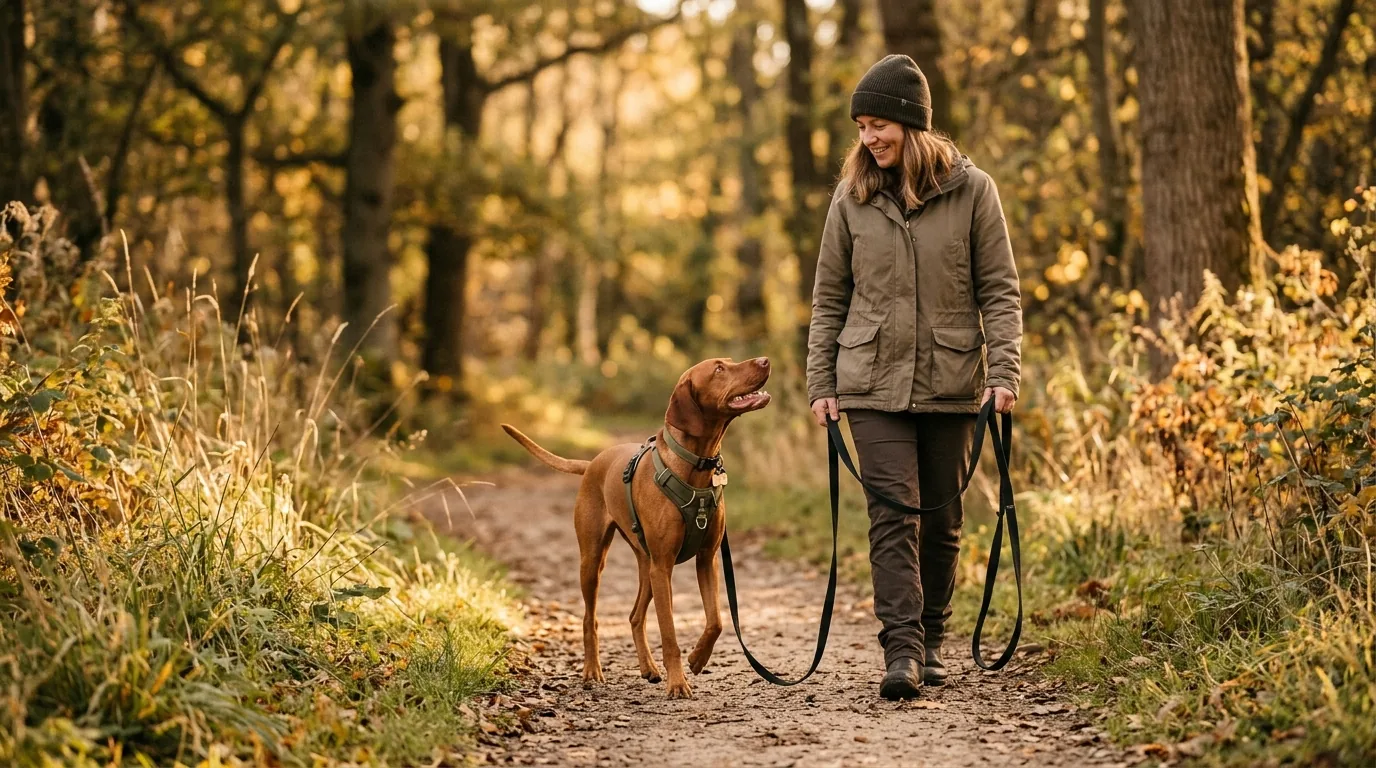
TL;DR. Leash reactivity is what happens when a dog who is calm off-leash reacts disproportionately to triggers — other dogs, people, bikes, cars — the moment a leash is clipped on. It's so common in city and suburban dogs that most behaviorists treat it as the default presentation, not the exception. The cause is almost always frustration, barrier-induced anxiety, or a learned association between the trigger and an aversive outcome. Force-free protocols (BAT 2.0, LAT) resolve it. Corrections worsen it, sometimes permanently.
Reactions that seem inconsistent often reflect trigger stacking: several manageable stressors accumulate until the next dog, bike or noise tips the dog over threshold.
Why the leash specifically triggers reactivity
The same dog who plays politely at the daycare can detonate at the sight of another dog forty feet away on a sidewalk. That isn't contradiction. The leash itself changes the behavioral physics of the encounter in five ways most owners have never been told about.
Barrier frustration. A dog on-leash who wants to investigate or move away from a stimulus can do neither. The leash creates a physical barrier between motivation and outcome. Frustration in dogs presents the same way it presents in toddlers — escalating arousal, vocalization, and physical strain against the barrier. Barrier frustration is one of the most reliably documented mechanisms behind leash reactivity in the behavioral literature (Overall, 2013).
Direct-line approach. Off-leash, polite dogs greet on curves. They arc, they sniff laterally, they break eye contact, they pause to read the other dog. On-leash, the geometry of two owners walking toward each other forces a head-on, eye-locked, direct approach — the canine equivalent of two strangers walking directly into each other's faces. It's socially rude in dog-to-dog terms, and many dogs respond to that rudeness with a warning display.
Loss of escape route. A worried off-leash dog has a first option: leave. Distance is a dog's primary tool for managing perceived threat. The leash removes that option. With escape gone, the only remaining responses are appease or escalate. Many dogs escalate.
Tension transmission. Most owners tense the leash, hold their breath, and shorten their stride the instant they spot a trigger. The dog reads that change instantly — through the leash, through posture, through the smell of cortisol — and interprets it as confirmation that the trigger is, in fact, a threat. The owner's anticipation of reactivity becomes part of the cue chain that produces it.
Forced posture. A leash held high, especially with any tension, pulls a dog into an upright, chest-out, head-up stance. That posture mimics a confident or confrontational signal to other dogs. The dog on the other end of the encounter reads it as a challenge and responds in kind. The original dog had no intent to challenge — the equipment made the signal for them.
Five mechanisms, each independently capable of producing a reactive response. In most reactive dogs, several stack on top of each other every single walk.
Common leash reactivity triggers
Triggers are usually narrower and more specific than owners realize. The pattern is rarely "all dogs" — it's almost always "this category of dog under these conditions." Naming the trigger precisely is half the protocol.
- Other dogs. Most often same-sex, same-size. Often a specific morphology — bully breeds, fluffy white dogs, dogs with prick ears, dogs with short noses. Many reactive dogs are fine with the dogs they know and reactive only to unfamiliar dogs of a certain look.
- People. Often men. Often men in hats, in beards, in uniforms, in sunglasses. Often joggers and cyclists, because the silhouette and movement pattern differ from normal walking.
- Cars. Especially loud trucks, motorcycles, and anything with sudden acceleration. Reactivity here often traces back to a single startle event in adolescence.
- Bikes and scooters. Wheels at dog-eye height, fast and silent motion. Predatory chase drive can layer on top of fear here, which is why these triggers escalate quickly.
- Skateboards. Worst-case wheels — fast, loud, ridden by a moving human silhouette. Skateboards are over-represented in serious reactivity cases.
- Specific neighbors. Single-individual reactivity, often tied to one early negative encounter (a startled jump, a confrontation in a hallway). The dog generalizes from the individual to the route.
A reactive dog isn't reactive to "the world." They're reactive to two or three specific shapes that move in specific ways. The protocol begins with knowing which.
Reading your dog's threshold
Threshold is the point where trigger intensity begins to narrow a dog's flexible behavior. It changes with distance, duration, movement, environment, health and earlier events. The full dog training threshold guide explains how to estimate it without treating one behavior as a pass/fail test.
Sub-threshold. The dog notices the trigger, registers it briefly, and remains engaged with the handler. Ears may flick forward, eyes may glance, body may shift slightly — and then the dog returns to baseline.
At-threshold. The dog locks onto the trigger. Ears pinned forward, body weight shifting, breathing changing, attention fully captured. Treats may still be accepted but with delay. This is the cliff edge.
Over-threshold. The dog may bark, lunge, flee, scan frantically or become fixated and immobile. Familiar responses become slower or unavailable. Some dogs still eat while highly aroused, so taking food does not prove the setup is comfortable.
Planned behavior work belongs below the point where flexibility collapses. Above it, prioritize distance and safety rather than testing cues or correcting the reaction. Learning still occurs during intense events, but it may be the wrong learning: the trigger predicts pressure and the reactive response is rehearsed.
The protocol that works: BAT 2.0
Behavior Adjustment Training 2.0, developed by Grisha Stewart (2016), is the modern force-free protocol of record for leash reactivity. The mechanics are straightforward.
Distance is the active ingredient. The handler positions the dog at a distance where the trigger is visible but the dog remains sub-threshold. The dog is allowed to look at the trigger on their own terms — to gather information, to make their own assessment. The moment the dog voluntarily disengages and looks back at the handler, the handler marks ("yes" or a clicker) and rewards by walking away from the trigger. The reward isn't the treat. The reward is the distance.
Repeat that loop, multiple sessions, multiple days, slowly closing the working distance only as the dog stays sub-threshold reliably at the current one. Most owners try to close distance within a single session. That fails. Threshold work moves in days and weeks, not minutes.
A long line — 15 to 25 feet, biothane is the standard material — is integral. It restores the agency the standard six-foot leash removed. The dog gets room to arc, room to disengage, room to move away on their own initiative. Agency itself is therapeutic.
The "look at that" protocol
Leslie McDevitt's LAT ("Look at That") from Control Unleashed (2007) is a complementary protocol, often used in combination with BAT. The mechanics:
- Position the dog sub-threshold relative to a trigger.
- The instant the dog notices the trigger — ears flicking forward, head turning — the handler marks ("yes") before any reactive response begins.
- The dog turns back to the handler to collect a treat.
- Repeat.
The conditioning loop reverses the trigger's emotional valence. The trigger stops being a precursor to threat and becomes the predictor of food. Over time the dog automatically breaks eye contact with the trigger and checks in with the handler. The reactive sequence is replaced with an attention sequence.
Both BAT and LAT depend on the same thing: working below threshold, every session, every time.
Equipment that helps
A small set of equipment makes the work easier without introducing aversive pressure.
- Front-clip harness — the Freedom No-Pull and PetSafe Easy Walk are the two clinical staples. The front-clip mechanically redirects the dog's forward momentum without putting pressure on the neck or head. It reduces pulling, which reduces the leash tension that contributes to the forced-posture problem.
- Long line — 15 to 25 feet of biothane, not a retractable. A long line gives the dog room to arc and disengage. A retractable provides none of that benefit and a great deal of injury risk.
- High-value treats — something extraordinary. Kibble doesn't work for sub-threshold counterconditioning. Real meat, freeze-dried liver, cheese, hot dog. The reinforcer must outcompete the trigger.
- Treat pouch worn at hip — speed of delivery matters. By the time the handler digs into a pocket, the moment has passed.
- Calming aid — for anxiety-driven reactivity (as opposed to frustration-driven), an Adaptil collar releases a synthetic version of the appeasing pheromone canine mothers produce. The clinical evidence is modest but real. The popular "calming chew" category — chamomile, L-theanine, melatonin in over-the-counter doses — is largely unsupported by controlled trials.
Equipment to avoid
Each of the following has clinical evidence of harm in reactive dogs specifically, and is rejected by the AVSAB Position Statement on Humane Dog Training (2021).
- Prong collars. Pain applied at the moment a dog sees a trigger does the opposite of what handlers think it does. The dog forms an association — trigger appears, neck pain follows — and reactivity escalates. Many dogs who present at behaviorist clinics with severe reactivity have a prong collar in their history.
- E-collars and shock collars. Same mechanism, more intense stimulus, more reliable association formation. The trigger becomes the predictor of pain.
- Choke chains and slip leads. Punish any independent decision the dog makes — including the decision to disengage, which is the behavior the protocol is trying to build.
- Retractable leashes. No fine motor control over distance. Documented injury risk to dogs and handlers, including amputations of human fingers. Useless for threshold work.
- Head halters. The Gentle Leader and similar devices are controversial. A subset of dogs tolerates them. A larger subset finds the pressure across the muzzle aversive and shuts down — appearing "calm" while in a state of learned helplessness. Use only with careful conditioning, and only if a credentialed force-free professional advises it.
Daily management while the protocol runs
Reactivity work takes months. The dog still needs walks. Management is what keeps the in-progress protocol from being undone every day.
Walk at off-peak times. Early morning and late evening reduce trigger density. Fewer rehearsals of the reactive response means faster progress in formal sessions.
Cross the street before the trigger gets close. The goal is to keep every walk sub-threshold. If a trigger is coming, the handler moves first. Don't wait to see what happens.
Use visual blockers. Parked cars, bushes, dumpsters, building corners. Breaking line of sight with the trigger drops the dog's arousal almost instantly.
Build an emergency u-turn cue. A trained verbal cue ("this way" or similar) paired with a treat and a 180-degree pivot. Practiced when nothing is happening so it works when something is.
Decompression walks. One or two sessions a week on a long line, in a low-density environment, with sniffing as the primary activity. Sniffing lowers heart rate and engages the parasympathetic nervous system in ways no other walking format does. A decompression walk is a behavioral reset.
When to call a professional
Some reactivity cases are not appropriate for owner-only management. Signs that a credentialed force-free behavior consultant should be involved:
- Threshold can't be reached even at the maximum visible distance — the dog reacts at the longest sight line available.
- Reactivity is escalating week over week despite consistent management.
- Bite history of any kind, regardless of provocation.
- The handler doesn't feel safe walking the dog.
- The dog is generalizing — new triggers are appearing on top of the original ones.
Look for credentials: CDBC (Certified Dog Behavior Consultant), CSAT (Certified Separation Anxiety Trainer if separation distress co-presents), Fear Free, IAABC (International Association of Animal Behavior Consultants), KPA-CTP (Karen Pryor Academy Certified Training Partner). All of these signal force-free, evidence-based methodology. Avoid any trainer who references "dominance," "alpha," "pack leadership," or who proposes a balanced or correction-based approach to reactivity. The behavioral evidence against those methods, particularly for reactive dogs, is unambiguous.
For a fuller treatment of the distinction between reactivity and aggression, see reactive vs aggressive dog. For the broader case against correction-based training, see positive reinforcement vs balanced training. For how to vet a behavior professional, see how to find a credentialed behaviorist. For the body language signals that precede reactive responses, see dog body language.
Try it on your own dog
The first step in any reactivity protocol is accurate reading of the dog's state — sub-threshold, at-threshold, or over-threshold — in the moment. That skill takes practice.
PetTranslator.ai uses the same AVSAB-aligned framework a behavior consultant uses. Upload a photo from a walk and the AI returns a structured report of the biometric signals it can see — ear set, eye state, lip line, body tension, weight distribution — and an interpretation of the dog's arousal level. It won't replace a behaviorist on a serious case. For learning to read your own dog's threshold accurately, it's useful instrumentation.
Sources
The framework in this guide is drawn from:
- Grisha Stewart, Behavior Adjustment Training 2.0 (Dogwise, 2016) — the protocol of record for leash reactivity work.
- Leslie McDevitt, Control Unleashed (Clean Run Productions, 2007) — origin of the LAT protocol and a foundational text for arousal management.
- Karen Overall, Manual of Clinical Behavioral Medicine for Dogs and Cats (Elsevier, 2013) — the clinical reference for diagnosis of reactivity and barrier frustration.
- Patricia McConnell, Feisty Fido: Help for the Leash-Reactive Dog (McConnell Publishing, 2006) — the short-format owner guide most commonly recommended by behavior consultants.
- AVSAB Position Statement on Humane Dog Training (2021) — American Veterinary Society of Animal Behavior. The professional standard for force-free, evidence-based behavior work.
For owners working with a specific reactivity case, the IAABC and AVSAB websites both maintain searchable directories of credentialed positive-reinforcement professionals by region.
Khabir Mughal is the founder of PetTranslator.ai. This article was reviewed against the AVSAB Position Statement on Humane Dog Training, Grisha Stewart's BAT 2.0, and Karen Overall's Manual of Clinical Behavioral Medicine before publication.