TL;DR
A reactive dog produces big responses — barking, lunging, body tension — to specific triggers, but typically lacks any intent to harm. An aggressive dog is willing to escalate to harmful contact. Most dogs labeled "aggressive" by their owners are actually reactive. The two categories require different protocols, and mislabeling tends to produce the wrong intervention. Reading the distinction correctly is the first step toward the right plan.
Reactivity — what it actually is
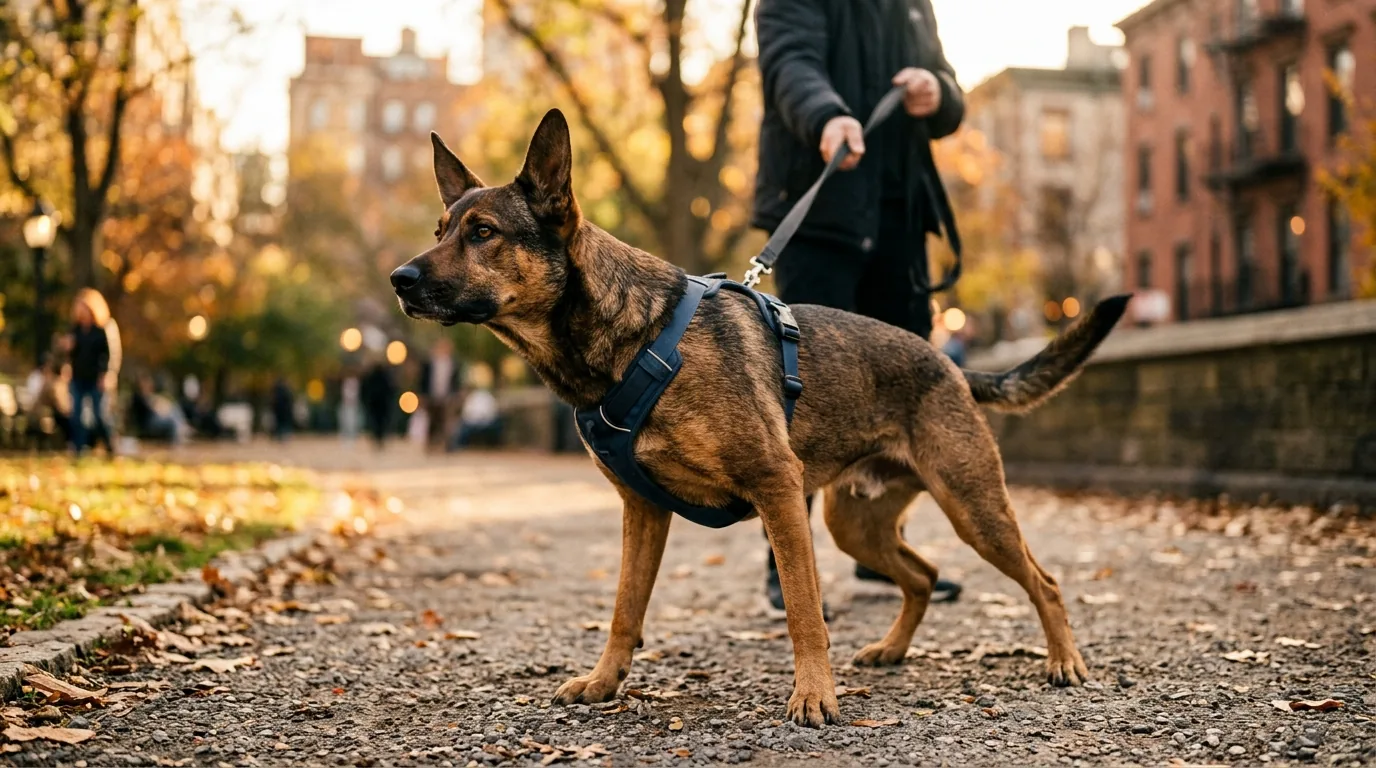
Reactivity is a disproportionate response to a specific stimulus. The trigger could be another dog across the street, a stranger at the door, a passing car, a bike, a sound on the other side of the fence. The hallmark is the size of the response relative to the actual event: a calm dog notices the trigger and resumes what they were doing; a reactive dog blows up.
The body language is loud. High arousal, repeating barks, lunging into the leash, sometimes spinning in tight circles, sometimes redirecting onto the leash itself with a mouth that grabs and shakes. The dog is over threshold and has lost access to their normal repertoire of behaviors.
The underlying state is almost always one of four things: fear, frustration, generalized over-arousal, or a deficit in impulse control. None of those are "the dog is trying to hurt something." They are a dog that doesn't know what else to do with what they're feeling.
Here is the part owners miss most often. When a reactive dog actually reaches the trigger — when the gap closes and contact becomes possible — most reactive dogs do not bite. They go quiet. They look away. They skip past. The volume of the display does not predict willingness to escalate. It often predicts the opposite: the louder the warning, the less the dog wants the encounter to happen.
Aggression — what it actually is
Aggression is the willingness to escalate to harmful contact, against a human or another animal. The defining feature is not noise, distance, or even body language at the warning stage — it is what the dog does when the option to bite presents itself.
Aggression can present quietly. A silent stare followed by a bite is more concerning than thirty seconds of loud barking from the end of a leash. A dog who freezes, holds eye contact, and closes their mouth into a tight line is signaling at a higher grade than a dog who is barking and bouncing. Loud displays are usually warnings. Stillness is usually closer to action.
The clinical categories matter because each one has a different treatment plan:
- Fear aggression. The most common form. The dog perceives a threat, cannot retreat, and bites to make the threat go away.
- Resource guarding. Defense of an item, location, or person against perceived loss. See the resource guarding guide for the protocol.
- Predatory aggression. Modified prey drive directed at small animals or, rarely, small children. Distinct from other categories because it is unemotional.
- Territorial aggression. Defense of a defined space, usually the home or yard.
- Social aggression. Aggression in the context of interactions between dogs that know each other. Rare in well-socialized animals.
- Pain-driven aggression. Aggression that appears or worsens with a medical condition. Always rule out pain before working any aggression case.
Most genuinely aggressive dogs are not silent until the bite. They warn first. The warnings appear in the body language: whale eye, lip licking out of context, a freeze, a low growl, a stiffened posture. The dogs that bite "without warning" almost always warned — the warnings were missed, or punished out of the dog earlier in life.
Why the distinction matters
The protocols are not interchangeable. A reactivity protocol applied to a genuinely aggressive dog can put a handler at risk. An aggression protocol applied to a reactive dog wastes months on case management the dog never needed.
Reactive dogs respond well to specific force-free frameworks. BAT, CARE, LIFE, and LAT — all defined below — are built around keeping the dog under threshold and giving them better options than the reactive display. Most reactive dogs, worked correctly, live full lives with a combination of training and environmental management. The display reduces. The dog stops dreading walks. The owner stops crossing the street.
Aggressive dogs require professional case management. The right professional is a Certified Dog Behavior Consultant (CDBC) through the IAABC, or a board-certified veterinary behaviorist (Dip. ACVB). The plan typically includes a behavioral history, a medical workup to rule out pain or neurological factors, careful management of bite risk, a counter-conditioning program built specifically for the dog, and in many cases medication. See the credentialed behaviorist guide for how to find the right person.
The framing also shifts what the household believes about the dog. A reactive dog is not a dangerous dog. Many "aggressive" dogs are, on closer reading, scared dogs whose warnings were turned up because everyone around them got nervous. Both deserve precise language and a precise plan.
How to tell which one your dog is
Two questions sort most cases.
The reactivity test. Does the behavior escalate only at distance? Is the dog louder, more lunging, more agitated as long as a gap exists between them and the trigger — and does the behavior shut off, soften, or convert into something else (sniffing, looking away, skipping past) when the gap closes? That pattern points to reactivity.
The aggression test. Does the dog continue to engage at contact distance? Is there a history of bites? A bite that breaks skin, a bite that holds, a bite that recurs across different triggers — these move the case into aggression territory regardless of how the dog presents at distance.
Bite history is the dividing line, with one important caveat. Reactive dogs can produce bites accidentally. The most common form is redirected aggression — the dog is over threshold at the leash, the handler grabs the collar to pull them away, and the dog turns and bites the hand that is closest. This is not the same clinical picture as a dog who walks across a room and bites a guest in a quiet moment. Both leave a mark; the mechanisms are different.
When the picture is ambiguous, treat it as aggression until a credentialed professional sorts it. Risk should always be priced conservatively.
Common reactivity types
Reactivity is rarely "general." Most reactive dogs have a specific trigger profile.
- Barrier reactivity. The dog reacts strongly to triggers when there is a physical barrier between them — a leash, a fence, a window, a car. Removing the barrier sometimes removes the behavior, because the frustration component drops.
- Stranger-dog reactivity (dog-reactive on leash). The most common reactivity in pet dogs. The dog explodes at other dogs while leashed and is often fine off-leash with the same dogs.
- Sound reactivity. Doorbells, sirens, garbage trucks, fireworks. Often paired with a sensitivity component that predates the trigger learning.
- Sight reactivity. Bikes, joggers, cars, skateboards. Often shaped by herding or chase drive in working breeds.
- Frustration-based reactivity. The dog wants to interact with the trigger and cannot. The display reads as aggressive but the underlying state is unsatisfied appetite. The treatment plan is different.
Naming the type matters. The protocol for barrier reactivity is not the protocol for sound reactivity. Owners who skip this step and run a generic "calm down at the trigger" plan usually plateau within a few weeks.
What factors reactivity
Five inputs show up across the case literature:
- Genetics. Some breeds and lines carry higher arousal floors and more reactive nervous systems. This is a factor, not a sentence.
- Under-socialization. A puppy who did not encounter a broad range of people, dogs, surfaces, sounds, and contexts during the 3-to-14-week socialization window often shows higher reactivity as an adult.
- A single negative experience inside the socialization window. One frightening encounter during a sensitive period can shape a long-term trigger.
- Living conditions. Apartment dogs in high-stimulation environments — busy hallways, constant elevator pings, dog density in the building — accumulate arousal in a way that surfaces as reactivity outside the home.
- Handler arousal. Anxiety in the human transmits down the leash. A handler who tightens the leash at the sight of another dog is teaching the dog that "another dog" predicts "the leash gets tight," which predicts something to react to.
None of these are blameworthy. They are simply the inputs that the training plan has to account for.
Force-free protocols that work
Four named protocols cover most reactivity work. All four are force-free and operate by keeping the dog under threshold while building new associations and new behaviors.
BAT — Behavior Adjustment Training. Developed by Grisha Stewart. The dog is walked at a distance from the trigger that allows them to remain functional, and they are given agency to disengage and move away on their own. Over sessions, the working distance closes. BAT is the protocol of choice when the underlying state is fear, because it gives the dog control over the encounter rather than imposing one.
CARE — Counter-conditioning at sub-threshold. Pair the appearance of the trigger with something the dog values, at a distance where the dog can still take food and still respond to cues. Over time, the trigger predicts the good thing rather than predicting the explosion. CARE is the protocol of choice when the underlying state is conditioned arousal.
LIFE — Lifestyle and Environmental management. The plan around the plan. Walks during low-traffic windows, route changes to avoid known triggers, decompression in long-line settings, visual barriers in the home. LIFE doesn't fix reactivity by itself, but it lowers the arousal floor enough that the other protocols can work.
LAT — Look At That. Developed by Leslie McDevitt as part of the Control Unleashed program. The dog is taught to look at the trigger and then back at the handler for reinforcement. The trigger becomes a cue for orienting to the handler. LAT is the protocol of choice when impulse control is the missing piece.
In real cases these protocols are layered, not chosen one-at-a-time. A typical reactive-dog plan runs LIFE constantly, CARE for the bottom rung of the trigger ladder, and BAT or LAT for the working rungs.
What does not work
Five interventions persist in popular training advice. None of them survive the case literature.
- "Just expose them more." Flooding a reactive dog with their trigger reliably makes the reactivity worse, often dramatically. The dog learns that the trigger is everywhere and inescapable.
- Corrections at the moment of reactivity. A leash pop, a verbal correction, or any aversive applied at the peak of the display teaches the dog that the trigger predicts pain. The conditioned association deepens.
- Allowing greeting at threshold. "Let them work it out" between an over-threshold dog and another dog is the protocol that produces bite incidents.
- Aversive equipment. Prong collars, choke chains, and electronic collars used to suppress reactivity have been studied directly. Herron, Shofer, and Reisner (2009, Journal of Veterinary Behavior) surveyed owner-applied confrontational training methods and found that aversive techniques increased aggressive responses in a substantial fraction of dogs studied. The AVSAB Position Statement on Humane Dog Training (2021) reflects this evidence base.
- Dominance framing. The dog isn't reacting because they think they're in charge. They're reacting because they're frightened, frustrated, or over-aroused. See why dominance theory is wrong.
The reactivity case is hard enough without working from an outdated framework. Force-free, evidence-based, and patient is the path.
When to call a professional
Five conditions move a case from "owner-managed" to "credentialed-professional":
- Any bite history involving humans or other animals
- Reactivity that is escalating week-over-week despite a stable protocol
- Multi-dog household reactivity between residents, especially with bite history
- Reactivity that has reduced quality of life — walks impossible, visitors impossible, the dog can't be left home with another household member
- Sudden onset reactivity in a previously stable dog (rule out pain first — see a vet)
The right credentials are CDBC (Certified Dog Behavior Consultant), IAABC (International Association of Animal Behavior Consultants), CSAT (Certified Separation Anxiety Trainer) for the separation-anxiety-flavored cases, KPA-CTP (Karen Pryor Academy Certified Training Partner), and at the clinical end Dip. ACVB (board-certified veterinary behaviorist). Avoid anyone who uses dominance language, who recommends aversive tools, or who promises a fix in a single session.
Try it on your own dog
Reading the difference between reactivity and aggression is a skill that develops with practice. Most owners are reading a dog whose behavior is closer to one category than the other, and naming it correctly is the work.
PetTranslator.ai is built around the same framework a credentialed behaviorist uses to read a case. Upload a clear photo of your dog in a moment that concerns you, and the system returns a structured read of the signals it can see — body tension, eye position, lip line, weight distribution — along with where the picture sits on the reactivity-to-aggression gradient and what a force-free next step looks like. It doesn't replace working with a CDBC on a serious case. For day-to-day reading practice, it gives a starting framework.
Sources
- Grisha Stewart, Behavior Adjustment Training 2.0: New Practical Techniques for Fear, Frustration, and Aggression in Dogs (Dogwise, 2016) — the foundational text on BAT.
- Leslie McDevitt, Control Unleashed (Clean Run Productions, 2007) — source for LAT and the broader sub-threshold framework.
- Karen Overall, Manual of Clinical Behavioral Medicine for Dogs and Cats (Elsevier, 2013) — clinical reference for the differential between reactivity and aggression categories.
- Herron, Shofer, Reisner, "Survey of the use and outcome of confrontational and non-confrontational training methods in client-owned dogs showing undesired behaviors" (Journal of Veterinary Behavior, 2009) — the survey commonly cited on the association between aversive methods and aggressive responses.
- AVSAB Position Statement on Humane Dog Training (2021) — the professional standard for force-free, evidence-based behavior work.
For owners working with a specific case, the IAABC and AVSAB websites both maintain searchable directories of credentialed positive-reinforcement professionals by region. For background on reading the body language signals referenced throughout this article, see the dog body language field guide.
Khabir Mughal is the founder of PetTranslator.ai. This article was reviewed against the AVSAB Position Statement on Humane Dog Training, Karen Overall's Manual of Clinical Behavioral Medicine, and the Herron et al. 2009 survey before publication.