TL;DR
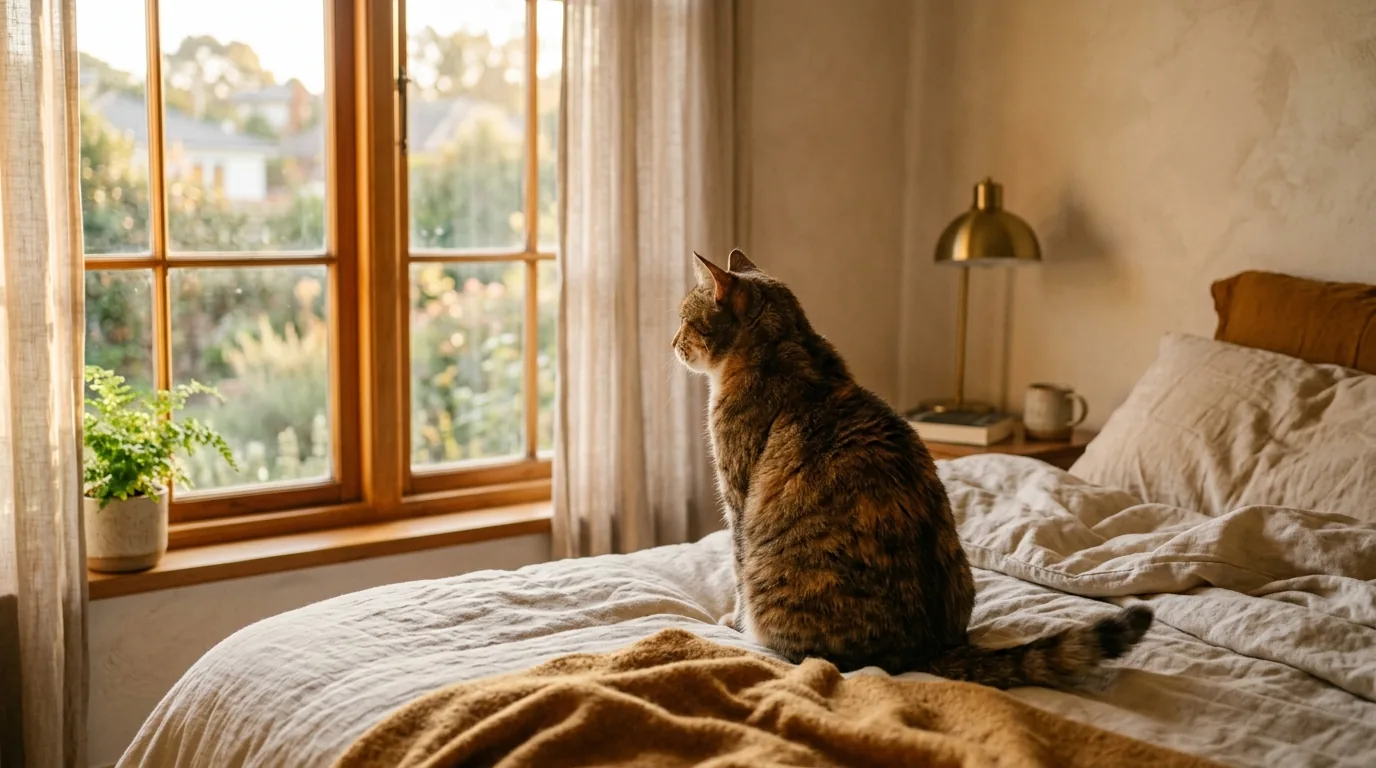
Cats sit at an unusual evolutionary spot: they hunt smaller animals, but larger animals also hunt them. That dual position shapes how they orient their bodies. Exposing the back is a vulnerable position, and cats don't do it around anything they're worried about. When your cat sits with its back to you, it's a high-trust signal — the opposite of what most humans assume. They've decided you don't need to be watched.
Why cats face threats — the predator-prey framework
Domestic cats sit in a strange evolutionary spot. They are obligate carnivores who hunt rodents, birds, and insects — predators by design. They are also small enough that coyotes, larger raptors, dogs, and historically wildcats outsize them. John Bradshaw's Cat Sense makes this point directly: the domestic cat retained the behavioral profile of a solitary predator who is also potential prey, and that dual position drives an enormous amount of what they do.
A predator who is also prey watches threats. Cats orient toward anything they consider a possible threat — they keep it in their visual field, they track its movement, and they leave a clear line of retreat. Facing a threat directly is the default. Turning the back to it isn't.
The cat's visual system reinforces this. Their field of view spans roughly 200 degrees — wider than a human's — but they still cannot see directly behind them. The space behind a cat is a blind spot, and they treat it accordingly. A cat will not put a blind spot toward something they need to monitor.
That single fact reshapes how to read the behavior in your living room.
What sitting back-to-you actually signals
When your cat settles on the couch with its tail toward your knee and its eyes pointed at the wall, the cat has made a quiet calculation. They've decided you are not something they need to watch. That decision is more substantial than it sounds.
Three signals stack inside it.
High trust. The cat has assigned you to the category of safe presences — alongside other resident cats they've successfully integrated with, or trusted family members they've lived with for years. Karen Overall's Manual of Clinical Behavioral Medicine for Dogs and Cats describes this as a form of social bonding that develops with reliable, low-pressure interactions. A cat who turns their back has had enough of those interactions to drop the monitoring posture.
Watchful comfort. This is the part most humans miss. The cat isn't ignoring the room — they're watching it. They've positioned themselves so that the two of you are now covering different angles. You watch their back, they watch the doorway. It's a kind of partnered surveillance, and in feline social groups it's how related cats often arrange themselves at rest.
Resource confidence. The cat is sitting in a relaxed posture in your home, with food access, water, litter, and resting space all accounted for. You are part of the security system, not a competitor for it. Sarah Ellis and John Bradshaw note in The Trainable Cat that the body postures of cats around humans they trust mirror the postures cats use around bonded conspecifics — same loose body, same willingness to expose the back.
If the cat then lies down, tucks the paws, and starts a slow blink toward the window — they've fully settled. The room is calm, the human is safe, the surveillance is shared.
The opposite signal: facing you with hard eye and still body
The other side of this same coin is the reading most owners overlook. If a cat is facing you directly, with a still body, dilated pupils, and a hard unblinking stare — that's not affection either. That's the same instinct in reverse. The cat is monitoring you because something feels off.
The trigger is usually environmental. A new piece of furniture, a recent visitor, an unfamiliar smell on your clothes, a household conflict the cat picked up on. The cat doesn't have a verbal way to ask you about it, so they keep you in their field of view until the situation resolves.
This is why behaviorists read body language in pairs. The back-to-you posture and the hard-stare-toward-you posture sit on opposite ends of the same scale — one says "I don't need to monitor you," the other says "I need to monitor you right now." Knowing which one your cat is showing is the difference between a relaxed home and a quietly stressed one.
For a fuller breakdown of how to read these signals together, see our cat body language guide.
Common contexts where back-to-you shows up
A few situations where this posture appears reliably:
- On the bed while you work at a desk. The cat lies facing the bedroom door, back angled toward you. They are watching the entry to the room while you sit in their established safe zone.
- On the windowsill when you're nearby. Cat faces the glass, back to the room. They are tracking outdoor activity (birds, neighbors) while you cover the indoor space.
- On your lap facing away. The cat sits in physical contact with you but oriented outward. This is one of the highest-trust postures a cat will offer — physical contact and a turned back, at the same time.
- In a doorway, back to you, watching the hallway. Same logic, different staging. The cat has positioned themselves at a sightline boundary and is monitoring the hallway while you cover the room behind them.
In each of these the underlying logic is identical: the cat is in a relaxed state, has accepted you as a safe presence, and has voluntarily put their blind spot toward you because they don't need to defend that direction.
What about facing the wall?
A slightly different question gets asked alongside this one — what if the cat is facing the wall, not just the room? The reading depends on the cat's age and how recently the behavior started.
Sometimes facing the wall is a security preference. Cats often choose corners, edges, and tight spaces because three out of four directions are physically blocked. A wall behind them is functionally similar to a wall in front of them — it removes one direction they'd otherwise have to monitor. Younger and healthy adult cats who occasionally sit facing a wall in a quiet corner are usually doing exactly this.
Sometimes it's stress. A cat who suddenly starts facing walls more often than they used to, especially with a tense body and dilated pupils, may be responding to an environmental change you haven't identified yet.
And sometimes — in older cats — it's a cognitive concern. Cats over twelve who develop sudden onset facing-the-wall behavior, especially if paired with disorientation, increased vocalization at night, or changes in litter habits, may be showing signs of feline cognitive dysfunction. Karen Overall's clinical work flags this pattern as worth a veterinary workup. The fix isn't behavioral. It's medical.
What not to assume
A few quick corrections to the common misreads.
It is not rude. Cats don't operate on human social conventions of face-to-face attention. Turning the back isn't a snub.
It is not the cat "ignoring you." They're aware of you the whole time. Their ears are tracking your movement even when their eyes aren't. Cats can rotate each ear about 180 degrees independently, which means they can monitor sound from the rear without changing posture.
It is not a signal they want you to leave. A cat who wanted distance from you would move. They'd leave the room, go under the bed, find a high perch out of reach. Choosing to stay near you with the back turned is the opposite of a request for space.
What to do
A short do-and-avoid list for the moment you notice your cat doing this:
- Do recognize it as a compliment. The cat is making a trust statement.
- Do continue what you were doing. The cat has chosen this proximity. Going about your normal routine reinforces the safe-presence signal you've already established.
- Avoid picking the cat up to "get attention back." Interrupting a settled posture to enforce face-to-face contact erases the trust signal you just received and often creates the next round of avoidance behavior.
- Avoid turning the cat to face you. Forcing the orientation undoes the calculation the cat just made. Let the cat hold the position they chose.
If you'd like to offer something back, try a slow blink in their direction. They'll often return it without turning around — they can read the room peripherally. For more on that exchange, see why does my cat slow blink at me.
When to call a professional
The behavior on its own doesn't warrant a vet or a behaviorist. What does warrant one is a change in pattern.
A cat who used to face you and now sits with their back to you, combined with other changes — reduced appetite, changes in litter habits, hiding more, vocalizing more — is showing something else. The back-to-you posture in isolation is a trust signal. The back-to-you posture as part of a cluster of recent behavioral changes can be a medical signal.
Rule out the medical explanation first. A veterinary exam to check for pain, dental issues, urinary problems, or early cognitive dysfunction is the appropriate first step before any behavioral consultation.
For ongoing behavioral concerns once medical causes are ruled out, look for credentialed positive-reinforcement professionals — IAABC-certified feline behavior consultants and AVSAB-aligned veterinary behaviorists are the relevant credentials. Avoid anyone using punishment-based methods on cats; the evidence for harm is clear and the evidence for effectiveness is not.
Try it on your own cat
The fastest way to build a read on your own cat is to catch them in this posture and note the surrounding context — where the cat is, where you are, what the room is doing, what their tail is doing. Pattern recognition develops with repetition.
PetTranslator.ai uses the same framework discussed here to analyze the photos you upload. Send in a clear photo of your cat — ideally one with the body posture visible — and you'll receive a structured report covering posture, orientation, ear set, eye state, and tail position, with a behavioral interpretation and a recommended action.
Sources
- John Bradshaw, Cat Sense (Basic Books, 2013) — for the predator-prey framework and the social structure of domestic cats.
- Karen Overall, Manual of Clinical Behavioral Medicine for Dogs and Cats (Elsevier, 2013) — for clinical observation of trust behaviors and the diagnostic criteria for feline cognitive dysfunction.
- Sarah Ellis & John Bradshaw, The Trainable Cat (Penguin, 2016) — for the comparison between cat-to-cat affiliative postures and cat-to-human bonded postures.
For owners working through a specific behavioral concern, the IAABC and AVSAB websites maintain searchable directories of credentialed feline behavior consultants by region.
Khabir Mughal is the founder of PetTranslator.ai. This article was reviewed against Karen Overall's Manual of Clinical Behavioral Medicine and Bradshaw's Cat Sense before publication.