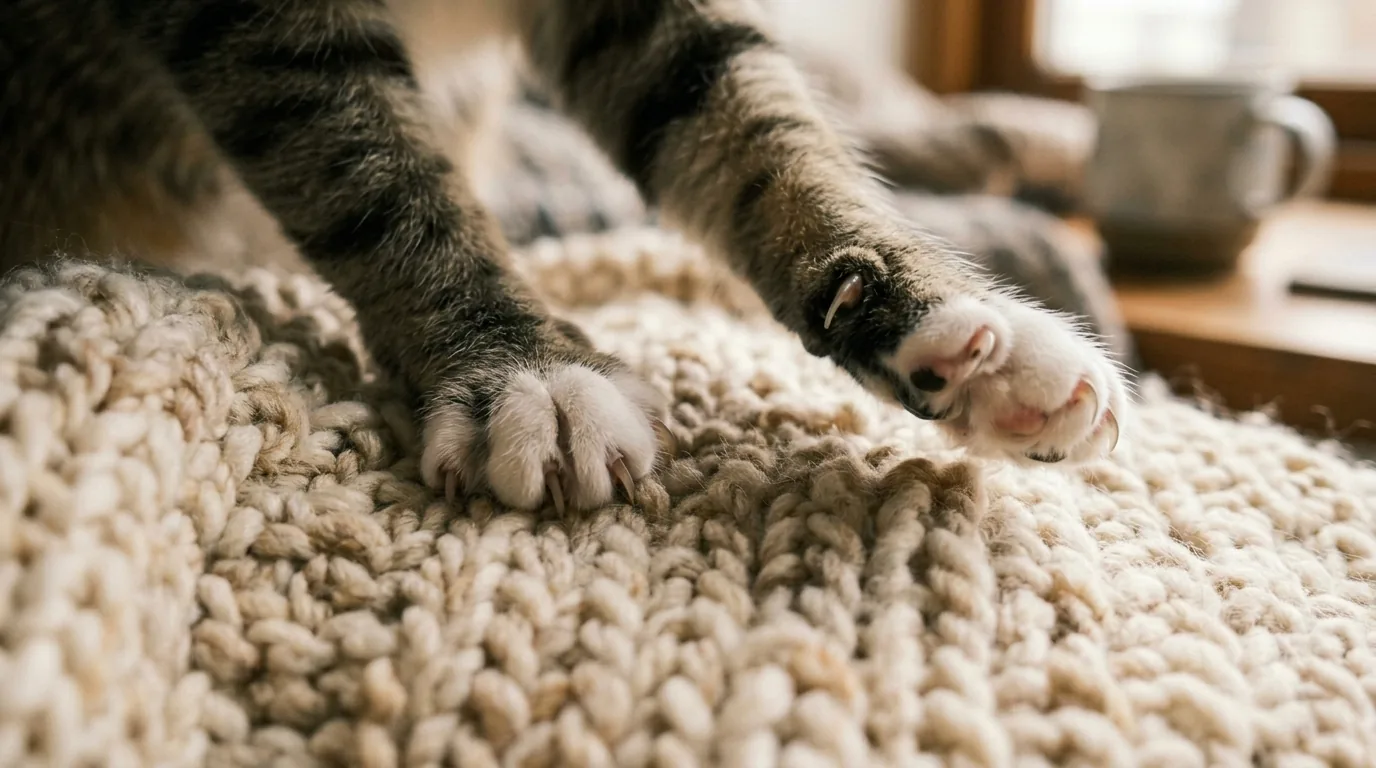
TL;DR. Kneading — the rhythmic alternating paw push, often called "making biscuits" — is a retained kittenhood behavior. Kittens push at their mother's belly during nursing to stimulate milk flow. Adult cats keep the gesture for relaxed, secure moments, usually paired with purring. It isn't primarily territorial marking, and it isn't the cat "asking for milk." It's a comfort-state signal that survived weaning.
What kneading looks like (and isn't)
A kneading cat presses down with one front paw, then the other, in a slow alternating rhythm. The toes spread on the down-press and relax on the lift. Most cats do it on something soft — a blanket, a folded sweater, an owner's lap or chest, occasionally a partner cat after mutual grooming. Some cats add a soft purr. Some drool. A smaller number knead with their back legs braced and a forward-leaning posture, which looks more vigorous but means the same thing.
Kneading isn't claw-scratching. Scratching is a vertical or diagonal raking motion that targets a coarse surface, sheds the outer sheath of the claw, and leaves a visible scent and visual mark — an entirely separate behavior with its own ethogram. Kneading is rhythmic, soft-surface, and almost always associated with a settled body. The two get confused because both involve the front paws, but a behaviorist reads them as different signals from different motivational states.
The drool, when it shows up, is also a retained kittenhood signal. A nursing kitten produces saliva during milk anticipation, and some adult cats carry that anticipatory drool response into kneading sessions. It's normal — and worth distinguishing from medical drooling, which presents differently (more on that below).
Why kittens knead
The behavior starts during nursing. A kitten alternates front paws against the mother cat's mammary region to stimulate the milk-letdown reflex — a hormonal cascade that releases oxytocin and pushes milk into the nipple. The kneading is mechanical, but it pairs with the warmth, the smell of the queen, and the calorie reward. By the time a kitten is a few weeks old, the entire cluster — paw rhythm, purr, drool, body relaxation, proximity to the queen — is wired together as a single comfort state.
John Bradshaw's Cat Sense lays out this framework directly. The domestic cat is, behaviorally, an animal that retains many juvenile behaviors into adulthood — a process called neoteny. Kneading is one of the clearest examples in the feline ethogram. The mechanical purpose disappears at weaning. The behavior doesn't.
Why adult cats keep doing it
If kneading is mechanically about milk, why does a ten-year-old cat with no living mother still do it on a folded blanket?
Because the behavior was never just mechanical. It was a neuro-affective package — paw rhythm plus oxytocin release plus warmth plus the smell of safety. Once that package is wired in early life, it stays available as a self-soothing routine. The adult cat reaches for it the same way a human adult might reach for a familiar pillow before falling asleep.
The contexts in which adult cats knead are remarkably consistent:
- On a soft blanket, often the same blanket every time
- On an owner's lap or chest, particularly when the owner is settled and warm
- On a partner cat after a mutual grooming session
- On a soft surface immediately before settling down to sleep
In all of those contexts the cat's other signals point in the same direction — slow blink, half-closed eyes, soft purr, loose body, tail neutral or wrapped. Kneading rarely shows up in a tense or aroused cat. When it does, it's almost always on the cat's own preferred blanket, with the rest of the body settled — the cat is self-regulating, not signaling outward.
Purring overlaps with kneading for the same reason. Sarah Ellis and John Bradshaw describe purring as another retained kittenhood signal — kittens and queens purr during nursing as a low-frequency contact signal that doesn't carry far. Adult cats reuse it in calm-contact moments. The fact that kneading and purring often co-occur isn't coincidence. They're two parts of the same kittenhood comfort cluster.
What kneading is NOT
Three popular explanations come up constantly. None of them survive careful reading.
Not primarily territorial marking. Cats do have scent glands in the interdigital region of their paws, and some scent transfer probably happens during kneading. But the behavior pre-dates and outweighs the scent function in the literature. A cat who is kneading a blanket on an owner's chest is not in a marking-driven motivational state — the body language, the context, and the relationship to weaning all point to comfort-retention rather than territorial signaling. Marking behaviors in cats look different (cheek-rubbing on objects, urine-spraying on vertical surfaces, scratching with visible claw marks) and arise in different contexts.
Not a pain or anxiety signal. A relaxed cat kneading on a blanket is showing a comfort state, not distress. Kneading only becomes diagnostically interesting when it shows up alongside other stress markers — vocalization changes, hiding, appetite shift, dilated pupils, sudden onset in a previously non-kneading adult — and at that point the kneading is a secondary observation, not the primary concern.
Not "asking for milk" in adult cats. The adult cat is not cognitively requesting milk from a long-dead mother. That's an anthropomorphic narrative laid over a much simpler behavioral story — the cat is reaching for a self-soothing routine that happens to have originated at the nipple.
Why some cats knead more than others
Individual variation is large. Some cats knead daily. Others almost never. Two well-supported patterns explain part of the variance.
Early weaning. Kittens removed from the queen before about eight weeks of age — through orphaning, hand-rearing, or premature rehoming — show a higher rate of kneading-and-suckling behavior into adulthood. The behavior often appears as a tightly linked cluster: paw rhythm plus nipping or sucking on a blanket, the owner's sweater, or even the owner's skin. Behaviorists read this as compensatory comfort behavior — the cat is reaching repeatedly for a regulatory routine that was cut short in development.
Temperament. Independent of weaning age, some cats are more contact-seeking by individual temperament, and contact-seeking cats are more likely to knead in front of their humans. A cat who rarely kneads isn't a less affectionate cat — they may simply do their comfort routines out of sight, or rely on different ones (tail-wrapping during sleep, slow-blink contact, head-bunting).
The behavior isn't a measure of bond strength. It's a measure of which comfort routines an individual cat uses, and how visibly.
The drool factor
For some cats, kneading and drooling go together. The drool is usually thin, clear, bilateral (from both sides of the mouth), painless, and stops when the cat stops kneading. It's the retained anticipatory salivation from kittenhood. Owners often find a small damp patch on the blanket after a long session. It isn't a medical concern.
Medical drooling looks different and deserves a vet visit. The pattern to watch for:
- One-sided drooling rather than bilateral
- Foul odor from the mouth
- Bloody or thick saliva
- Drooling outside of kneading sessions, especially at meals or at rest
- Pawing at the mouth, dropping food, head-shaking
- Sudden onset in a cat that didn't previously drool
Any of those patterns points toward dental disease, an oral foreign body, or a systemic issue. The benign comfort-drool, by contrast, only shows up during the kneading routine and stops when the cat settles.
What NOT to assume
Kneading isn't "I love you" in human-language terms. It's a comfort-state signal, not a declaration. A cat who kneads on you is reusing a kittenhood routine in your presence — which does mean the cat feels safe enough on you to enter that state, which is information worth having. It just isn't equivalent to a verbal expression. The signal is "I am in a kittenhood-comfort state." The cat doesn't have a separate symbolic layer above that.
Kneading hard with claws extended isn't aggression. A vigorous kneader with full claw extension is showing intensity of comfort, not hostility. The claws are doing what claws did at the nipple — anchoring the paw to the surface for traction during the push. The cat isn't escalating. They're just kneading at a higher amplitude. Trim claws, use a blanket buffer between the cat and your skin, and don't read the intensity as a problem.
What to do
Enjoy it. Kneading is one of the clearest available signals that a cat feels secure enough in their current context to enter a self-soothing routine. That's a useful thing to know about your home environment and your relationship.
A few practical notes:
- Use a blanket buffer if claws are sharp. A folded throw between the cat and your lap protects skin without interrupting the behavior.
- Trim claws on a routine schedule. Every two to three weeks for most indoor cats. Kneading is far more comfortable for both parties with shorter claws.
- Don't punish kneading. Punishing a comfort routine teaches the cat that comfort routines are unsafe near you, which has predictable downstream effects on the relationship. If the location is the problem (a particular sofa, say), redirect to a kneading-friendly blanket nearby rather than interrupting the behavior itself.
- Don't try to start a non-kneader kneading. Cats who don't knead in front of their humans aren't broken. They have other routines.
When kneading is concerning
Kneading is almost never a primary medical or behavioral concern on its own. It becomes one when it changes.
Talk to a veterinarian first if any of the following appear in a previously stable cat:
- A sudden, marked increase in kneading frequency or intensity with no obvious environmental cause
- Kneading paired with new vocalization patterns — yowling, persistent meowing, or sudden silence in a cat who is normally chatty
- Kneading at unusual times, particularly during the night in a cat who didn't previously do it
- Kneading paired with appetite change, hiding, or litter-box change
- Compulsive kneading-and-suckling that the cat can't interrupt and that interferes with eating or rest
Any sudden behavior change in an adult cat is a medical question before it's a behavioral one. Rule out pain, dental disease, hyperthyroidism, and cognitive change with a vet exam first. If the medical workup is clean and the pattern continues, that's the point to bring in a credentialed behavior professional (CCAB, IAABC certified cat behavior consultant, or a veterinary behaviorist).
This guide pairs with the broader frameworks in our cat body language reference and the contextual signals covered in cat slow-blink and cat tail meanings. Kneading is one signal in a larger system, and it reads more accurately alongside the others.
Try it on your own cat
Reading a kneading session is a useful daily-practice exercise. Watch the rest of the body — eyes, tail, ear set, breathing rate, what surface the cat chose, how long the session lasts, what the cat does when it ends. Those details turn a single behavior into a small picture of the cat's regulatory state.
PetTranslator.ai is built around the same framework. Upload one clear photo of your cat mid-knead and the /analyze flow returns a structured read — the biometric markers it can see, a behavioral interpretation in plain language, and notes on what to watch for. It's a daily-practice instrument, not a substitute for working with a vet or behaviorist on a complex case.
Sources
- John Bradshaw, Cat Sense (Basic Books, 2013) — for the neoteny framework and retained-kittenhood behavioral model.
- Karen Overall, Manual of Clinical Behavioral Medicine for Dogs and Cats (Elsevier, 2013) — the clinical reference for behavioral observation, including notes on early-weaning effects.
- Sarah Ellis and John Bradshaw, The Trainable Cat (Penguin, 2016) — for the affiliative-signal framework and the relationship between purring and kneading.
- John Bradshaw and Charlotte Cameron-Beaumont, "The signalling repertoire of the domestic cat and its undomesticated relatives" in The Domestic Cat: The Biology of Its Behaviour (2nd edition, Cambridge University Press, 2000) — for the comparative ethogram of feline contact and affiliative signals.
For owners working with a sudden behavior change or compulsive kneading-and-suckling pattern, the IAABC website maintains a directory of credentialed cat behavior consultants.
Khabir Mughal is the founder of PetTranslator.ai. This article was reviewed against Bradshaw's Cat Sense and Karen Overall's Manual of Clinical Behavioral Medicine before publication.