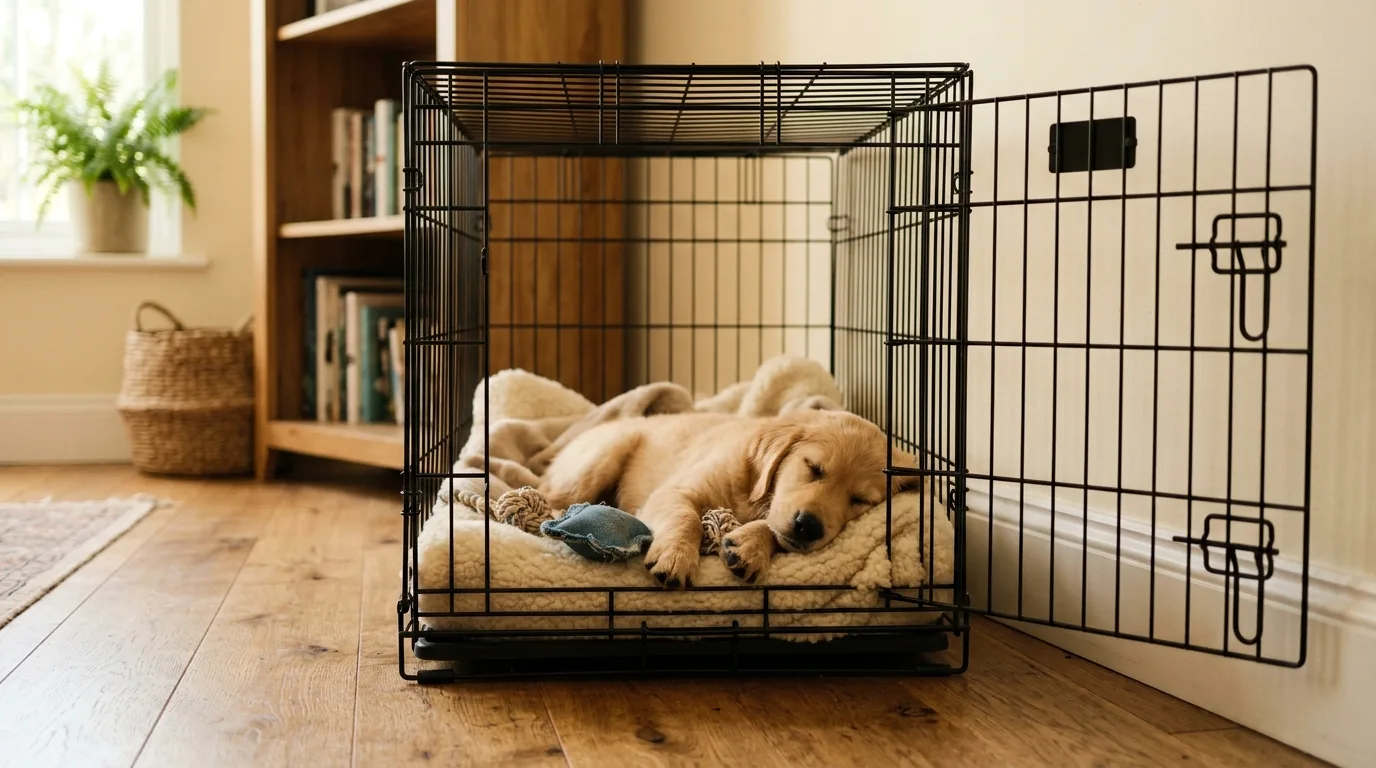
Crate training works when the crate becomes a place the puppy chooses, not a place the puppy endures. The popular advice — put the puppy in the crate at night, ignore the crying, and they'll learn — produces compliant puppies in the short term and crate-averse adult dogs in the long term. There is a better protocol. It takes two to three weeks instead of three nights, and the outcome is a dog who walks into the crate voluntarily for the rest of their life.
This guide walks through the behaviorist version: gradual positive conditioning, what to do day by day, what to do if the puppy cries, and the small number of cases where a crate is the wrong tool entirely.
TL;DR
Crate training works when the crate becomes a positive space, not a punishment chamber. The "let them cry it out" method builds lifelong negative associations with the crate and with confinement generally — and it raises the risk of separation-related problems later. The behaviorist approach uses gradual positive conditioning over two to three weeks, layering food, rest, and short closed-door sessions in a fixed order. The result is a dog who chooses the crate voluntarily and stays calmer about confinement throughout life. This protocol is not appropriate for dogs with diagnosed separation anxiety or for rescues with prior crate trauma — for those dogs, crates often make the underlying problem worse.
Why crate training matters
A crate isn't required for every dog, but for most puppies it solves four problems at once.
Housetraining. Healthy puppies are reluctant to soil the area they sleep in. A correctly sized crate compresses the sleeping area to a size the puppy won't urinate in, which speeds up the development of bladder control and a clear hold-it-then-go-outside routine. (See the housetraining section below for the mechanism.)
Safe rest space. Puppies need fourteen to eighteen hours of sleep per day and most of them won't take that sleep voluntarily in a busy household. A crate gives them a quiet, enclosed space they can retreat to without being touched by children, other pets, or visitors. Sleep-deprived puppies show more biting, more reactivity, and slower learning — the rest matters.
Vet and travel preparation. A dog who is comfortable in a confined space handles airline carriers, vet recovery cones, post-surgical crate rest, and boarding kennels with substantially less stress. Crate-trained dogs spend less time panicking when life requires confinement later.
Management during the chewing phase. Puppies between three and ten months explore with their mouths. A crate prevents access to electrical cords, shoes, baseboards, and ingested foreign bodies during the hours an owner cannot supervise. It's a management tool, not a substitute for training, and that distinction matters.
The reasoning is straightforward: a crate is a useful instrument when the puppy is conditioned to it correctly. The conditioning is everything.
Why "cry it out" doesn't work
The most common crate training advice on the internet is some version of: lock the puppy in the crate at night, ignore the crying, and within three nights they'll stop. The puppies do stop crying. They stop because they've learned that crying produces no response, not because they've learned that the crate is safe. That distinction shapes everything that comes after.
Three things happen during a cry-it-out crate introduction.
The crate becomes paired with panic. Classical conditioning doesn't require the puppy's permission to operate. When an enclosed space repeatedly co-occurs with elevated cortisol, racing heart rate, and unsuccessful escape attempts, the enclosed space itself acquires negative valence. The puppy who eventually stops crying isn't relaxed — they've shifted into learned helplessness, which is a poor state to begin training from.
Separation-related distress risk rises. Malena DeMartini-Price's clinical work documents a pattern where dogs forced to "tough out" early confinement show more separation-related problems as adults, not fewer. The intuitive logic — they cried, then they stopped, so they got over it — doesn't match what actually happens neurologically. The dog generalizes that confinement-while-alone is unsafe, and that generalization sticks.
Handler trust degrades. Puppies in the first sixteen weeks are doing rapid social bonding to their primary humans. A puppy who cries for hours from inside a crate while the human they bonded to does nothing is updating their model of that human. It doesn't produce a hostile dog, but it does produce a dog whose baseline assumption is that distress calls go unanswered. Recall, cooperative handling, and stress recovery all run on that baseline.
The cry-it-out method does work in the narrow sense that the crying stops. It fails in every other sense that matters.
Choosing the right crate
The wrong crate undermines the protocol before it begins.
Size. The crate should be large enough for the puppy to stand up without ducking, turn around comfortably, and lie down stretched out. It should not be larger than that during the housetraining phase. A puppy in an oversized crate will urinate in one corner and sleep in the other, and the housetraining advantage disappears. Most wire crates ship with a divider for exactly this reason — set it to the puppy's current size and expand as they grow.
Type. Wire crates with a removable tray are the standard recommendation for housetraining. They ventilate well, they're easy to clean, and the visibility prevents the puppy from feeling sensory deprivation. Plastic airline-style crates work for some dogs (often more den-like, often calmer for nervous puppies) but are harder to clean during the accident phase. Soft-sided fabric crates are not appropriate for puppies — they chew through them and learn that the crate is escapable, which complicates everything later.
Location. During the first two weeks the crate belongs in a populated area of the house — living room, bedroom, kitchen — not in a basement or laundry room. Puppies are profoundly social animals and isolation amplifies stress. A puppy crated near humans during the day and in the bedroom at night learns the crate as "the place I rest near my people," which is the association you want.
The protocol — Day 1 to Week 3
The protocol below is layered. Each phase establishes a precondition for the next. Skipping ahead because the puppy "seems fine" is the most common cause of failure, because the underlying conditioning isn't yet stable enough to hold under the increased difficulty.
Day 1 to 3: open crate, no pressure
The door stays open. The puppy is not asked to go inside, not lifted inside, not lured inside under any time pressure. The crate is simply present, with soft bedding, in a populated room.
The owner's job during these three days is to make small deposits of value into the crate. Treats appear inside the crate when the puppy isn't looking and the puppy discovers them. A favorite chew appears just past the threshold. Meals are placed near the entrance — not inside yet — so the puppy eats while looking into the crate.
The goal is for the puppy to start choosing to investigate the crate on their own. Any approach to the crate is reinforced; any exit is allowed without restriction. The puppy never goes in under pressure.
Day 4 to 7: meals inside, door briefly closed
Once the puppy is voluntarily entering the crate to grab treats, meals move inside. The bowl starts near the door and gets pushed deeper into the crate over successive meals until the puppy is eating with all four feet inside.
When the puppy is calmly eating fully inside the crate, the door closes gently — only while they eat, only for the duration of the meal, and it opens again the moment they finish. The puppy should never have to ask to be released. The door opens before the puppy starts wondering when it will open.
Crying during this phase usually means the duration is too long. Shorten the closed-door window and rebuild gradually. The protocol moves at the puppy's pace, not the calendar's.
Week 2: short closed-door sessions while owner present
The puppy is now eating meals inside with the door closed. The next layer is closed-door rest periods while the owner is in the same room. Start with two to three minutes, with a high-value long-lasting chew (a frozen Kong, a stuffed marrow bone) that occupies them. Release before they finish the chew.
Build duration in small increments. Two minutes, then five, then ten. The owner stays visible — reading on the couch, working at a desk — but doesn't engage with the puppy through the bars. The crate becomes the place where the puppy works on something rewarding while the owner is calmly nearby.
By the end of week two most puppies will settle into the crate voluntarily for fifteen to thirty minutes with a chew, owner present, no fuss.
Week 3: brief alone time
The owner now leaves the room briefly. One minute out of sight, then back. Three minutes, then back. Build duration the same way duration was built inside the room. If the puppy panics — vocalizing intensely, not just fussing — the duration was too long. Return to a shorter increment.
Alone time at night is layered on top of this same progression, not introduced separately. A puppy who has worked through day-1-to-week-3 in daytime sessions usually settles into nighttime crating without crying, because the underlying conditioning is already in place.
By the end of week three the goal is a puppy who can spend one to two hours in the crate while the owner is out, calmly, with a chew. That's a serviceable baseline. Longer durations build from there.
The housetraining principle
The reason crate training accelerates housetraining isn't punishment-based — it's anatomical. Healthy puppies have a strong innate inhibition against urinating or defecating in the area where they sleep. The bladder fills, the puppy becomes uncomfortable, and the discomfort produces a strong motivation to leave the sleeping area to relieve themselves.
The correctly sized crate compresses the sleeping area enough that the puppy has nowhere "away" to relieve themselves inside it. So they hold it. As soon as the door opens, the owner carries or leads the puppy directly outside to a designated spot, and the puppy relieves themselves outside. The outdoor elimination is reinforced with quiet praise and a small treat. The pattern repeats — wake, outside, eliminate, reward, return to crate — for roughly two to four weeks until the puppy generalizes "outside = where elimination happens."
Two failure modes break this. First, an oversized crate gives the puppy a "bathroom corner" and the inhibition collapses. Second, leaving the puppy crated longer than their bladder can hold — generally one hour per month of age, plus one, with a maximum of four hours for a young puppy — forces them to eliminate inside and teaches them that the crate is a place where soiling happens. The housetraining advantage requires the crate to remain a place the puppy never has to soil. That means short, frequent outings.
Reading distress vs. settling-in fussiness
Not every vocalization is panic. Distinguishing the two matters because the appropriate response is opposite.
Settling-in fussiness looks like brief whimpering, a few minutes of fidgeting, the puppy circling and resettling on the bedding. It usually appears in the first one to three minutes inside the crate and resolves on its own. The body is loose. The puppy is processing the transition, not panicking.
Distress looks like sustained high-pitched vocalizing that doesn't subside, attempts to dig or chew at the crate door, panting in a cool room, dilated pupils, no interest in food or chews placed inside. The body is rigid. The puppy is in a stress response, not adjusting.
The response to settling-in fussiness is to wait. Opening the door in response to whining teaches the puppy that whining produces release, and the duration of whining will lengthen over time. Open the door when the puppy is quiet — even a five-second quiet window is enough to reward.
The response to distress is to interrupt the session and rebuild from a shorter increment. The puppy is signaling that the current duration is past their threshold. Forcing them through it converts the protocol into a cry-it-out method, which is the failure mode this guide is built to prevent.
The line between the two is not always obvious in the moment. When in doubt, err toward shorter durations and slower progressions. The protocol has room for that without losing efficacy.
What doesn't work
A short list of methods that show up in popular training content and reliably produce worse outcomes.
Letting the puppy cry it out. Discussed at length above. Produces compliance, not relaxation, and elevates separation-related distress risk.
Hitting, banging, or shaking the crate to silence crying. Pairs the crate with handler-produced threat. Damages handler trust without lowering crate stress.
Using the crate as a punishment for misbehavior. "Go to your crate" said in an angry voice teaches the puppy that the crate is where negative outcomes happen. The dog can't compartmentalize "this crate is good when I go in voluntarily, bad when sent." The association blends.
Leaving the puppy crated too long. A young puppy crated for eight hours overnight without a midnight outing will inevitably soil, and that soiling breaks the housetraining mechanism. The rough rule — one hour per month of age plus one, max four during the day for puppies — exists for biological reasons, not arbitrary ones.
Skipping straight to closed-door confinement on day one. The most common shortcut, and the one that produces the most crate-averse adult dogs. Door pressure before voluntary entry is unstable conditioning. It often works for the first week and falls apart later.
When not to crate
Crates are not appropriate for every dog. Two categories require a different approach.
Dogs with diagnosed separation anxiety. Malena DeMartini-Price's clinical work is explicit on this point: for dogs with separation-related panic, confinement during alone time intensifies the panic rather than containing it. The dog with SA does not feel safer in a smaller enclosed space — they feel more trapped. Crate training a dog with SA often produces self-injury (broken teeth, bloodied gums, torn nails from attempts to escape) and accelerates the underlying problem.
If a puppy or adult dog is showing signs consistent with separation anxiety — vocalization that doesn't subside, destructive behavior focused on exit points, house-soiling only when alone, self-injury during alone time — the crate is not the right tool. Work with a CSAT (Certified Separation Anxiety Trainer) on a desensitization protocol. (See our guide to finding a credentialed behaviorist and the separation anxiety guide for more.)
Rescues with crate trauma. Adult dogs from shelter or hoarding situations sometimes arrive with strong negative associations to crates already established. A dog who panics at the sight of a crate, refuses to enter under any condition, or shows displacement stress (lip licking, yawning, whale eye) when a crate appears is signaling a history. For these dogs, the protocol above is not a sufficient counter-conditioning intervention on its own. Confinement training in these cases often uses an X-pen, a baby-gated room, or a tethered station instead of a crate, and the work proceeds with a behaviorist.
Try it on your own puppy
The protocol above is the framework. Reading whether a specific puppy is in settling-in fussiness or genuine distress is the practical skill — and most owners build that skill faster when they have a structured way to check what they're observing.
PetTranslator.ai is built around the same body-language framework board-certified behaviorists use. Upload a photo of the puppy in or near the crate and the analysis returns the biometric signals it observes — ear position, eye softness, lip line, posture, tail carriage — with a structured behavioral interpretation. For owners working through the early weeks of crate conditioning, it's a useful instrument for catching displacement stress before it escalates. (For broader signal-reading practice, see puppy body language and the related work on the puppy socialization window.)
Sources
The protocol in this guide is drawn from:
- AVSAB Position Statement on Humane Dog Training (2021) — American Veterinary Society of Animal Behavior. The professional standard for force-free, evidence-based training methodology, including explicit rejection of confrontational and aversive methods.
- Ian Dunbar, Before and After Getting Your Puppy (New World Library, 2004) — the foundational text on positive-reinforcement puppy raising, including the layered approach to crate introduction.
- Karen Pryor, Don't Shoot the Dog! (Bantam, 1985) — the framework for understanding why conditioning, not compliance, produces durable behavior change.
- Karen Overall, Manual of Clinical Behavioral Medicine for Dogs and Cats (Elsevier, 2013) — the clinical reference for distinguishing distress signals from adjustment behavior.
- Malena DeMartini-Price, Treating Separation Anxiety in Dogs (Dogwise, 2014) — the clinical work documenting why crates intensify rather than contain separation-related panic, and the basis for the "when not to crate" section.
For owners working with a specific concern, the IAABC and AVSAB websites both maintain searchable directories of credentialed positive-reinforcement professionals by region.
Khabir Mughal is the founder of PetTranslator.ai. This article was reviewed against the AVSAB Position Statement on Humane Dog Training and Malena DeMartini-Price's clinical guidance on separation-related behavior before publication.