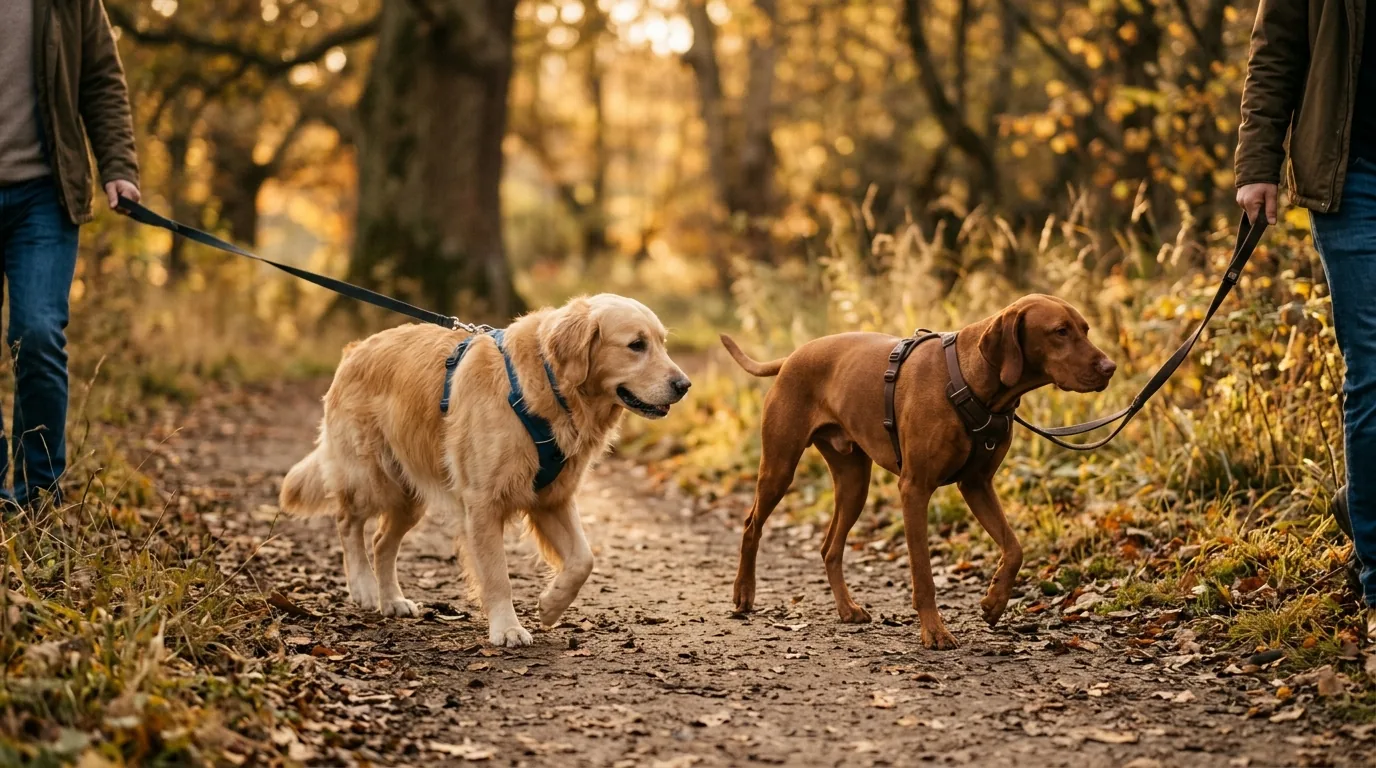
TL;DR. Dog introductions work best on neutral ground, with parallel walking before face-to-face contact, and with the home introduction done last and managed. The "let them sort it out in the backyard" approach creates lasting problems — resource guarding, reactivity, chronic stress between the two animals. A staged protocol takes 1-2 weeks of slow integration but produces lasting cohabitation rather than the chronic tension that follows a rushed first meeting.
Why proper dog introductions matter
Dog-to-dog introductions sit in an awkward middle of difficulty. They're easier than cat introductions, where the resident animal's territory is the entire home and a botched first meeting can take months to unwind. But they're harder than the cultural script suggests — the one where two dogs meet in the backyard, scuffle for a minute, and then "figure it out."
That script produces a lot of broken dogs.
First impressions stick in dog social cognition. A resident dog who experiences a forced, high-arousal first meeting with a new dog often carries that imprint forward: tension at the doorway, hard stares across the room, a low growl whenever the other dog approaches a resource. Resource guarding between cohabiting dogs is one of the most common presentations in clinical behavior practice, and a substantial fraction of those cases trace back to a poorly managed first week.
Adult dogs are also less plastic in their social repertoire than puppies. A puppy who has a rough introduction may rebound within days. An adult dog who has a rough introduction may carry the friction for life — Patricia McConnell's case files in Feeling Outnumbered? document this pattern across hundreds of multi-dog households.
The point worth holding onto: the dogs aren't usually the problem. The introduction methodology is. Two dogs who would have cohabited well under a staged protocol can be set against each other for years by a rushed first day.
Before the new dog arrives
Preparation reduces the surface area where things can go wrong.
Health screening. The new dog needs a vet check before entering the home — current vaccinations, a fecal exam for parasites, a general health screen. A dog who feels sick is a dog who has less tolerance for social pressure, and parasites can pass between cohabiting dogs in days.
Spay/neuter status. Intact same-sex pairs are the hardest combination by a meaningful margin. Two intact males in the same home, or two intact females, will negotiate hormonal status alongside social status, and the negotiation can escalate. Most behaviorists recommend neutering at least one dog before introduction in same-sex pairings.
Resident dog assessment. Honest read on the existing dog. How does this dog do with other dogs in general — on walks, at the park, at a friend's home? A resident dog with a history of reactivity or resource guarding needs a slower protocol and ideally a credentialed behaviorist supervising the introduction. The new dog isn't going to fix the old dog's social skills.
Resource management plan. Before the new dog walks through the door, set up two of everything in separate locations — two food bowls, two water bowls, two beds, two crates. High-value items (chews, bones, food puzzles) are stored, not accessible.
Spatial setup. Each dog needs their own space they can retreat to. A crate, a separate room, a baby-gated section of the house. Baby gates ready at choke points.
The goal of this phase is simple: the new dog arrives into a home that has already been physically prepared to keep the two animals apart for as long as the protocol requires.
Phase 1 — Neutral territory introduction (Day 0)
The first meeting happens off your property.
A neutral location — a park, a parking lot, a friend's yard the resident dog hasn't claimed — removes the territorial layer from the first interaction. Two handlers, one per dog, both holding loose leashes. The leashes stay loose because tension on a leash is read by both dogs as tension in the handler, and that reading transfers into the dogs' own body language within seconds.
Start at distance. Twenty feet or more, depending on the space and the dogs. Walk in parallel — same direction, matching pace, with the dogs on the outside of the handlers so the people sit between them. Five to ten minutes of parallel walking before any closer contact.
What the handlers are watching for during the parallel walk:
- Loose body in both dogs, with weight distributed evenly
- Soft eyes, no hard staring across at the other dog
- Normal sniffing of the environment (a sign the dog is processing, not fixating)
- Tail at neutral or mid-level, with motion that matches the body
If both dogs stay loose, the handlers can gradually close the distance over the next several minutes. Closer, but still parallel. The first face-to-face contact, when it happens, is brief — a few seconds of loose-leash sniffing, then the handlers move the dogs apart and resume walking. Long first-meeting sniffs are where escalations start.
End the meeting positive. Both dogs should be a little tired and ready to leave each other's company. The introduction works because it stopped before either animal hit their tolerance ceiling.
Phase 2 — Arrival home (Day 0-1)
The home introduction is staged.
The resident dog enters the home first, alone, and settles. Then the new dog enters second, on leash, with their handler. Brief on-leash tour of the common spaces — kitchen, living room, the rooms the dogs will share. The resident dog is not in the room during this initial tour, or is held on a leash on the other side of a baby gate.
After the tour, the new dog goes to their assigned space — the crate or the separate room — with their own food, water, and bed. They get a chance to decompress in a quiet space that is theirs.
Both dogs get a high-value chew at the same time, in separate locations. This builds a positive association with the presence of the other dog (good things appear when the other dog is around) without putting them in proximity to each other.
The first night, both dogs sleep in their own spaces. Crated, gated, or behind closed doors. There is no shared sleeping arrangement in week one.
Phase 3 — Separate but parallel (Days 1-3)
The first few days inside the home are deliberately under-saturated with direct contact.
Both dogs live in the home but spend most of their time in separate spaces. Brief on-leash interactions, controlled by the handlers. Meals on opposite sides of a baby gate so the dogs can see and smell each other while eating, but neither dog can access the other's food.
Decompression walks together, parallel, on loose leashes. The parallel-walk format from Phase 1 transfers into the daily routine — it's a low-pressure way for the dogs to spend time near each other while doing something they both find regulating.
Phase 4 — Supervised together time (Days 3-7)
The second half of the first week begins to test off-leash sharing of space.
Short sessions. Both dogs off-leash in a shared room, supervised by both handlers. High-value resources are removed from the space — no food bowls, no toys, no chews, no contested beds. The space is intentionally boring, because boredom is where two dogs can learn to share air without anything to negotiate over.
What the handlers are reading:
- Play versus tension. Play has bouncy, asymmetric movement, with both dogs alternating roles. Tension has stillness, hard staring, and stiff bodies.
- Voluntary engagement. A dog who chooses to approach the other dog briefly and then move away is regulating. A dog who fixates on the other dog from across the room is not.
- End the session before either dog shows fatigue or irritation. Five minutes of clean shared time is better than fifteen minutes that ends in a snap.
Beds remain in separate locations. Each dog has their own spot to retreat to. The retreat option matters — a dog who can leave a social situation rarely needs to escalate to make it stop.
Phase 5 — Increased integration (Days 7-14)
The second week extends what worked in the first.
Longer stretches of unsupervised time, with monitoring. Low-value toys reintroduced first, one at a time, with both handlers present. Higher-value chews stay separated indefinitely — many multi-dog households never reintroduce them, because the cost (resource guarding) outweighs the benefit (one less management step).
Separate feeding stations continue indefinitely. This is the single most reliable preventive intervention for food guarding between cohabiting dogs. Each dog eats their meals in their own location, alone, and the bowls are picked up after.
Continued monitoring during week two looks for the slower signs of stress. Sleep disturbance — either dog sleeping less, or moving locations frequently — is a stress indicator. Eating changes are a stress indicator. A dog who was eating normally and starts skipping meals is signaling that something in the social environment is off.
Reading the signals during introductions
Throughout all five phases, the handlers are reading body language in real time. The signal vocabulary divides cleanly into three categories:
Positive signals. Play bows, loose tail wagging with body motion, voluntary engagement followed by voluntary disengagement, both dogs sleeping in the same room (eventually), soft eyes, neutral or relaxed ears.
Caution signals. Closed mouth held tight, body stiffness, prolonged stare without blinking, low growl, whale eye, lip lift showing teeth without commitment, hackles raised across the shoulders. If any of these appear, increase the distance immediately.
Stop signals. Hard freeze, full snarl, snap, fight. Separate the dogs immediately, end the session, and consult a credentialed behaviorist before resuming any direct contact.
The most reliable single rule: when in doubt, increase distance. Distance is the universal de-escalator in dog social conflict.
Common mistakes
A handful of patterns appear in nearly every botched introduction.
Introducing on-leash in a confined space. Leashes restrict the dogs' ability to give themselves the distance they need, and confined spaces remove the option of moving away. The combination produces tension that wouldn't have existed in open air.
"Let them work it out." This phrase is responsible for a meaningful share of the multi-dog behavior cases that arrive in behaviorists' inboxes. Dogs can sometimes work it out. When it goes wrong — and it goes wrong often enough — the injury rate is high and the relational damage lasts.
Same-sex, same-size pairs without extra slow protocol. Two adult male dogs of similar size, or two adult female dogs of similar size, sit at the difficult end of the difficulty spectrum. They need slower introductions, more space, and a longer integration window.
Leaving high-value resources accessible during early phase. A bone left out, a food bowl not picked up, a favorite bed in a contested room — any of these can convert a stable first week into a fight.
Punishing growling between the dogs. Growling is a warning. Punishing the growl removes the warning but leaves the underlying discomfort. The next signal up the escalation ladder is the bite. This is one of the most consistently documented findings in modern behavior science, and one of the most counter-intuitive for owners who want to "stop the bad behavior."
Special situations
Adult resident + puppy. Usually the easiest combination. Adult dogs with good social skills often show excellent self-regulation around puppies — they tolerate behavior they wouldn't tolerate from another adult, and they correct the puppy with quick, low-grade signals. The adult still needs uninterrupted retreat space, because puppies are exhausting.
Two adult intact males. The hardest combination. Consider neutering at least one dog before introduction, and budget for a slower protocol regardless. A behaviorist consult before the dogs meet is worth the cost.
Senior resident + new dog. A senior dog who has lived alone for years may not want a roommate. The honest question is whether the resident's quality of life improves with a new dog in the home, or worsens. The new dog's energy level matters — a young high-energy dog paired with a senior often degrades the senior's daily experience, even when the social dynamic is otherwise fine.
History of reactivity in either dog. Work with a CDBC (Certified Dog Behavior Consultant) or veterinary behaviorist before introducing. The protocol above assumes two reasonably socialized adult dogs; reactive dogs need a different protocol entirely. The reactive vs. aggressive distinction matters for what kind of professional to work with.
When to call a professional
Some signals warrant a credentialed behaviorist rather than self-directed troubleshooting:
- Any bite that draws blood, in either direction
- Fights that escalate rather than de-escalate over multiple sessions
- Resource guarding between the two dogs (food, toys, beds, people)
- Resident dog shows stress signs — sleep disturbance, eating changes, increased reactivity outside the home — that don't resolve within two weeks
A board-certified veterinary behaviorist (DACVB), a CDBC, or an IAABC-credentialed consultant can run a structured behavior workup and design a protocol matched to the specific dogs. Generic obedience trainers are not the right resource for this. The AVSAB position statement on humane dog training (2021) lays out the credentialing landscape and the methodology distinction.
Try it on your dogs
Reading the dogs' body language in real time is the operating skill that makes the protocol work. Most owners can learn it, but they need reps.
PetTranslator.ai is built around the same signal framework behaviorists use. Upload a photo from any phase of the introduction — the parallel walk, the first home tour, the supervised together time — and the AI returns a structured read on what each dog's body is showing. It won't replace a behaviorist on a complex case, and it isn't a substitute for the protocol above. For owners building their reading skill across the two-week integration window, it's a useful instrument.
Sources
- Patricia McConnell, The Other End of the Leash (Ballantine, 2002) — for the communication-asymmetry framework between dogs and humans.
- Patricia McConnell, Feeling Outnumbered? How to Manage and Enjoy Your Multi-Dog Household (McConnell Publishing, 2008) — the dedicated reference for cohabiting dogs.
- Karen Overall, Manual of Clinical Behavioral Medicine for Dogs and Cats (Elsevier, 2013) — the clinical reference for behavioral observation and intervention design.
- Jean Donaldson, Mine! A Practical Guide to Resource Guarding in Dogs (Kinship Communications, 2002) — the standard reference on resource guarding, including the cohabitation cases that arise from rushed introductions.
- AVSAB Position Statement on Humane Dog Training (2021) — the professional standard for force-free, evidence-based behavior work.
Khabir Mughal is the founder of PetTranslator.ai. This article was reviewed against the AVSAB Position Statement on Humane Dog Training and Karen Overall's Manual of Clinical Behavioral Medicine before publication.