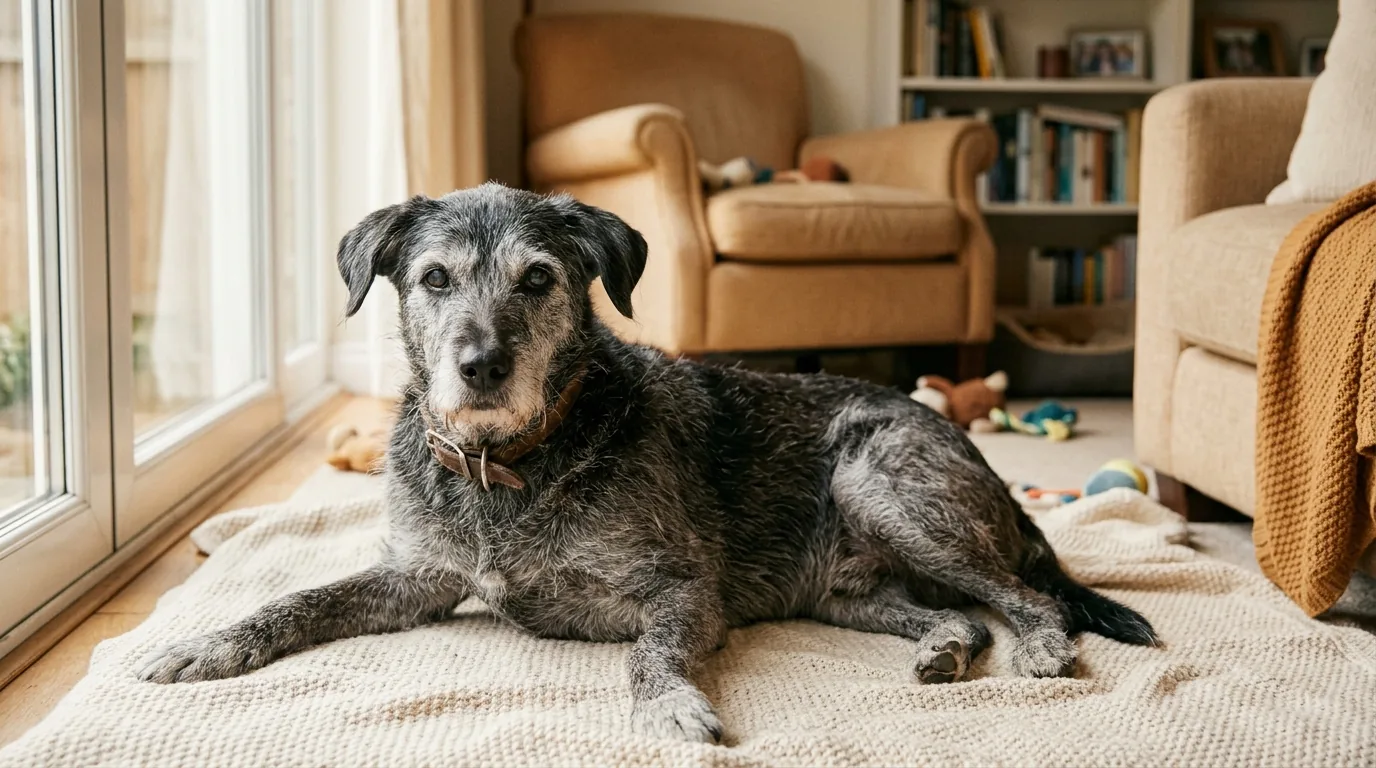
TL;DR. Dogs hide pain. It's a survival adaptation — a wild canid that limped was a canid that got eaten, and modern dogs still carry the wiring. Owners chronically under-detect pain in their own dogs, and most of what gets called "just slowing down" in a senior dog is actually treatable orthopedic, dental, or internal pain showing up as a behavior change. Reading the early signals means earlier intervention, and earlier intervention means more good years.
Why dogs hide pain — the survival logic
The veterinary pain literature has shifted noticeably over the last two decades, and the reason is straightforward: clinicians stopped asking whether a dog was in pain and started assuming it based on the procedure or the diagnosis. The AAHA pain management guidelines (Epstein et al., 2015) lay out the reasoning explicitly. Dogs evolved from animals for whom visible discomfort was a predator magnet. A wolf with a limp didn't last long. A dog whose ribs hurt didn't advertise it.
That selection pressure is gone, but the behavioral wiring isn't. A senior Labrador with hip dysplasia will, in most cases, keep eating, keep wagging at the door, keep greeting visitors — and walk noticeably stiffer for the first thirty seconds out of his bed, then mask it. Stoic breeds hide pain more aggressively than expressive ones. Working breeds, Labradors, terriers, and many herding breeds are notorious for under-signaling. A Cavalier in the same amount of pain will be more obviously off, because the breed signals discomfort more readily. Same pain, different presentation.
This is the framing that matters for owners. Absence of obvious limping is not absence of pain. It's the dog doing what dogs do.
Behavioral signs that ARE pain (often misread as "getting old")
The list below contains the signals most often dismissed with some version of "she's just slowing down." In a dog over seven, every one of these is worth a vet visit before it gets written off.
Reluctance to climb stairs or jump on furniture. A dog who used to bound onto the couch and now pauses, looks, and chooses the floor is not making a personality decision. The most common explanation is musculoskeletal pain — hips, knees, lumbar spine, or shoulders.
Slower to rise from lying down. "Stiff for the first few steps" is the single most common owner observation in early canine osteoarthritis. The dog gets up, walks it off, and looks normal on the walk. The stiffness is the diagnostic finding, not the walking-it-off part.
Reduced enthusiasm for walks. A dog who used to vibrate at the leash and now waits for it without much affect is communicating something. Pain is the most common driver. So is cognitive change, but pain is more common and more treatable, so it's the first thing to rule out.
Decreased play. Less interest in toys, less interest in playing with other household dogs, shorter play bouts before disengaging. Read this as a pain signal until proven otherwise.
Sleeping more, or in different spots. A dog who moves off the orthopedic bed and onto the cool tile floor isn't being weird — tile relieves pressure on inflamed joints. A dog who suddenly avoids a particular bed may find that surface painful.
Sleep posture changes differ from loose, brief vocalizing or twitching during REM; the dog sleep-barking guide shows the signs that need veterinary attention.
Hesitation at thresholds. Door frames, top of a staircase, the lip of a car trunk. A dog who hesitates where they didn't used to is anticipating discomfort.
Bunny hopping. Using both back legs together in a rabbit-like motion when running. This is a classic hip pain signal, common in dogs with hip dysplasia or advanced hip arthritis.
Shifting weight off a limb. Stand a dog still and watch the weight distribution. A dog who consistently keeps one leg slightly unweighted, or who shifts their weight noticeably when they pause, is offloading a painful limb.
An intermittent limp should not be dismissed because it disappears during excitement. The guide Do dogs fake injuries? explains how learned repetition can occur while keeping pain-first triage intact. A voluntary crossed-paw resting pose is different from crossing, scuffing or weakness during movement.
Behavioral signs that are EARLIER (and easier to miss)
The signs above are the ones owners eventually notice. The signs below are the ones that show up months before the obvious ones, and they're the signs that allow early intervention.
Subtle personality change. Slightly less affectionate. Slightly more withdrawn. Less interested in coming over for petting. Owners commonly describe this as "she's getting old, she just wants her space now." Pain produces exactly this profile. So does cognitive dysfunction, so does hypothyroidism, so do half a dozen other treatable conditions.
If the dog has started sitting alone in another room, compare that new withdrawal with their previous resting choices and record movement, appetite and sleep at the same time.
Decreased grooming. Coat looks worse than it used to. Mats appearing where they didn't before. Dental tartar accumulating visibly. A dog who hurts when they twist to groom a flank will stop grooming that flank.
Increased panting at rest. Panting in a cool room, with no recent exertion, in a dog who isn't anxious about anything in the environment. Stress panting and pain panting overlap. In a senior dog with no obvious stressor, treat resting panting as a pain signal until ruled out.
Lip-smacking outside food context. A dog who licks their lips repeatedly with no food, no anticipation of food, and nothing on their face is showing a displacement signal. In senior dogs this is often a pain signal — most commonly dental, sometimes abdominal.
Restlessness. Can't settle. Lies down, gets up, lies down again, shifts position three times in five minutes. The dog can't find a position that doesn't hurt. This is one of the most under-recognized pain signs in older dogs.
Increased thirst. Polydipsia has many causes — Cushing's, kidney disease, diabetes, hypothyroidism — and some of them produce pain or pain-like behavior. Worth flagging to the vet regardless of cause.
Sudden irritability when touched. A dog who used to accept being touched on the hips and now flinches or moves away is telling you something specific about that anatomical region. Believe them the first time.
Behavioral signs of ORTHOPEDIC pain specifically
Orthopedic pain — joints, muscles, tendons, spine — is the most common pain source in older dogs and the easiest to read once you know what to look for.
- Stiffness rising after rest, easing with movement. This is the classic osteoarthritis signature.
- Reluctance to be touched along the back or over the hips.
- Reduced range of motion in the neck. A dog who can't turn their head fully to look behind them has cervical spine pain or muscular guarding.
- Brief skipping or "three-legging" — picking up a leg for a few strides, then putting it back down.
- Sitting "puppy-style" with both back legs flopped out to the side. Some dogs sit this way their whole lives, but a dog who adopts this posture later in life is often offloading hip pain.
The Glasgow Composite Measure Pain Scale, the most widely validated behavioral pain scale in dogs, formalizes this kind of observational reading into a clinical instrument. Veterinary teams use it because it works.
Behavioral signs of DENTAL pain (massively under-diagnosed)
Dental pain is the most under-treated pain source in companion dogs. The WSAVA Global Pain Council has been explicit about this for years: by the time a tooth is symptomatic enough that an owner notices, the disease is advanced. The signals are subtle.
- Dropping food from one side of the mouth.
- Chewing consistently on one side.
- Reluctance to eat hard kibble; preferring soft food or food softened with water.
- Bad breath that's getting worse.
- Pawing at the face or rubbing the muzzle along the carpet.
- Tooth grinding (uncommon in dogs but documented, especially in oral pain).
- A subtle personality change with no other obvious cause — sometimes the only sign of a fractured tooth or a root abscess.
A senior dog whose only complaint is "she's a little off" can turn out, on a full dental exam under anesthesia, to have three painful teeth. Owners are routinely shocked at how much energy and personality come back after a dental.
Behavioral signs of INTERNAL pain
Pain inside the abdomen or chest reads differently from pain in a limb. The dog can't isolate it to a region the owner can see.
- "Prayer position" — front legs and chest down, back end up — is a classic signal of cranial abdominal pain, often pancreatitis.
- Hunched standing posture. The dog tucks their abdomen up and rounds their back.
- Reluctance to lie down completely. The dog hovers in a half-down position because lying flat compresses something painful.
- Frequent position changes when lying down. Same restlessness as in orthopedic pain, but with abdominal guarding.
- Sudden distension of the abdomen, unproductive retching, and visible distress. This is gastric dilatation and volvulus until proven otherwise — a surgical emergency. Get to a vet now, not in the morning.
The "just aging" trap
Most senior-dog behavior change is medical, not "just aging." Pain is the most common medical driver. Untreated pain in older dogs accelerates decline, because a dog who hurts moves less, loses muscle, gains weight, sleeps poorly, and develops more pain — a closed loop. Treating the pain often opens the loop. Owners commonly describe the experience as "we got years back."
The corollary: "she's just old" is not a diagnosis. Aging is not, in itself, a pain mechanism. Specific conditions associated with aging — osteoarthritis, dental disease, intervertebral disc disease, neoplasia, organ dysfunction — produce pain. The age is correlated with the conditions, not with the pain directly. Identifying the condition matters, because most of them have treatments.
The vet workup you should expect
A thorough senior pain workup looks roughly like this. Walk in expecting it; push back gently if your vet wants to do less.
- Orthopedic exam. Hands-on palpation of every joint, range of motion testing, gait observation, sometimes a neuro screen.
- Dental exam. A conscious oral exam reveals the surface of the problem. A full dental evaluation requires anesthesia and dental radiographs — most painful tooth pathology lives below the gum line and won't show on a conscious exam.
- Bloodwork. Complete blood count, full chemistry, urinalysis, thyroid panel (T4 minimum, ideally full thyroid panel). In senior dogs, baseline bloodwork annually is standard of care.
- Imaging. Radiographs of hips, spine, or any focal area of concern. Abdominal ultrasound if internal pain or systemic illness is suspected.
- Specialist referral. Orthopedic surgeons, neurologists, internal medicine specialists, and board-certified veterinary behaviorists exist because some cases need them. A vet who refers is a vet doing their job.
Treatment that helps
Modern canine pain management is genuinely good. The standard of care has moved well beyond "give him an aspirin." The IVAPM and AAHA both recommend multimodal management — meaning more than one mechanism of treatment combined.
- NSAIDs. Carprofen, meloxicam, deracoxib, robenacoxib, grapiprant. The first-line drug class for canine osteoarthritis. Generally well tolerated with appropriate monitoring (bloodwork before and during).
- Gabapentin. Useful for neuropathic and chronic pain components, often added to an NSAID rather than replacing it.
- Adequan. Injectable polysulfated glycosaminoglycan, used in osteoarthritis with some clinical support.
- Monoclonal antibody therapy. Bedinvetmab (anti-NGF) is a newer monthly injection with strong data for osteoarthritis pain.
- Physical therapy and hydrotherapy. Underwater treadmills and structured physio with a credentialed canine rehabilitation therapist can change a dog's trajectory.
- Acupuncture. Some evidence, particularly for musculoskeletal pain. Often used as an adjunct.
- Joint supplements. Glucosamine, chondroitin, omega-3 fatty acids. Modest evidence, low risk, reasonable to include.
- Environmental modifications. Orthopedic bed, ramps onto the bed or into the car, non-slip rugs over hardwood, raised food bowls if appropriate. Reduces daily mechanical stress on painful joints.
- Weight management. The single most impactful intervention for orthopedic pain after the medical workup. Every excess pound of body weight is more load on every painful joint, every step.
Avoid human pain medications. Acetaminophen is toxic to dogs at low doses, ibuprofen is toxic, naproxen is toxic. The veterinary NSAIDs are formulated for canine metabolism for a reason.
Try it on your own dog
For owners learning to read pain signals at home, the most useful exercise is comparison. Take a photo or short video of your dog in a few standard moments — getting up from a nap, standing still in the kitchen, sitting on the floor — and look at posture, weight distribution, and facial tension. Compare to a clip from a year ago.
PetTranslator.ai is built around that kind of structured behavioral reading. Upload one clear photo of your senior dog and the analysis returns a structured report — observable posture and facial markers, a behavioral interpretation, and whether the pattern is consistent with a comfort or discomfort profile. It is not a replacement for a vet exam. It's a useful instrument for the moments between exams, and a way to bring specific observations into the appointment instead of "she just seems off."
Related reading
- Senior dog behavior changes: what's medical and what's cognitive
- Canine cognitive dysfunction in senior dogs
- Why your dog paces at night
- How to find a credentialed behaviorist
Sources
- Epstein, M., Rodan, I., Griffenhagen, G., et al. (2015). 2015 AAHA/AAFP Pain Management Guidelines for Dogs and Cats. Journal of the American Animal Hospital Association, 51(2), 67–84. The clinical standard for companion-animal pain assessment and treatment.
- WSAVA Global Pain Council Guidelines — Mathews, K., Kronen, P. W., Lascelles, D., et al. (2014). Journal of Small Animal Practice, 55(6), E10–E68. The international consensus document on companion-animal pain recognition and management.
- Karen Overall (2013). Manual of Clinical Behavioral Medicine for Dogs and Cats. Elsevier. The clinical reference for behavioral observation and differentiating medical from behavioral causes of senior change.
- International Veterinary Academy of Pain Management (IVAPM) — continuing-education materials and the certified-veterinary-pain-practitioner (CVPP) framework.
- Reid, J., Nolan, A. M., Hughes, J. M. L., Lascelles, D., Pawson, P., Scott, E. M. (2007). Development of the short-form Glasgow Composite Measure Pain Scale (CMPS-SF). Animal Welfare, 16(S), 97–104. The validated behavioral pain assessment used in clinical practice.
Khabir Mughal is the founder of PetTranslator.ai. This article was reviewed against the AAHA 2015 Pain Management Guidelines and the WSAVA Global Pain Council documents before publication. It does not substitute for an in-person veterinary examination; a senior dog with new behavioral changes belongs at the vet.