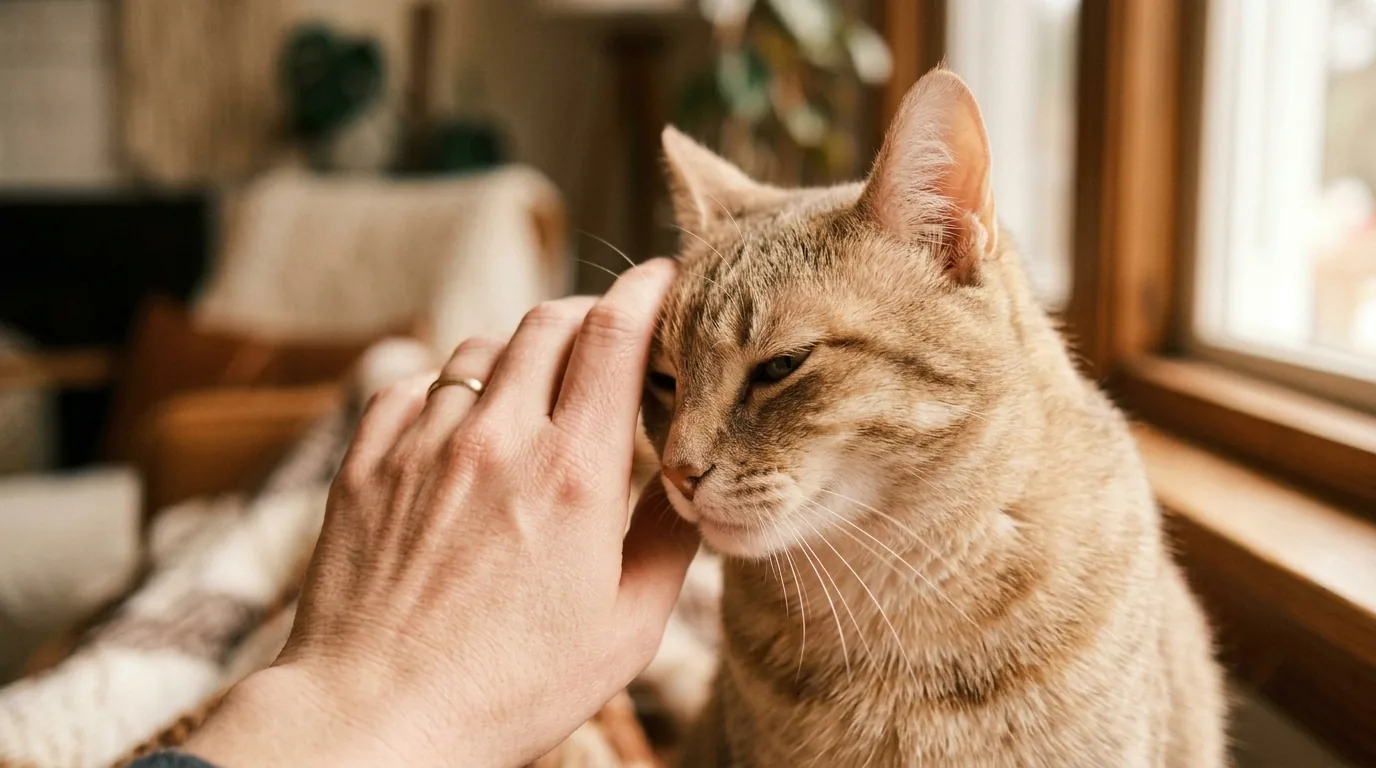
TL;DR. Cat headbutting — the behavioral term is bunting — is one of the strongest affiliative signals a cat gives a human. Cats carry scent glands on the forehead, cheeks, and chin, and when they press their head against you they're depositing pheromones and merging your scent into their trusted-group map. It isn't a generic "I love you." It's a specific identity-marking behavior, and it's a higher-trust signal than most people realize.
What bunting actually is
The behavioral literature uses the word bunting for the gesture most owners call headbutting. A cat performs it by pressing the cheek, forehead, or chin against a target — a hand, a face, a piece of furniture, the corner of a doorframe. The contact is soft, deliberate, and often slow. Some cats follow the head press with a full-body rub along the same surface, dragging the flank and tail base across whatever they've claimed.
This is not the same gesture as the hard, sudden head contact that appears in dog or human aggression. True aggressive headbutting in domestic cats is rare and looks entirely different — fast, single-impact, accompanied by tension across the body and a closed mouth with whiskers swept back. Bunting is the opposite signal. The body is loose, the eyes are usually soft or half-closed, and the head presses in and lingers.
Confusing the two is uncommon in practice. Once an owner sees both, the difference is unmistakable.
The scent-gland science
The reason bunting carries the meaning it does is that a cat's face is, biologically, a scent-marking instrument. Cats carry sebaceous and apocrine scent glands in several locations on the head and body — most densely on the forehead (the temporal area), the cheeks, the perioral region around the lips and chin, and at the base of the tail. Lower-density gland regions exist along the flanks and on the paw pads.
When a cat bunts, those head and cheek glands deposit a chemical signature onto the target. The pheromone secreted from the facial region has been studied as the "feline facial pheromone," and the fraction most associated with calm-territory marking is called F3. The Feliway product line is built around a synthetic analog of this F3 fraction, which is the same chemical signal a cat deposits on a doorframe or a sofa corner when they bunt it. The behavior and the molecule are tightly linked. A cat that has bunted a surface has, in the cat's own scent map, marked that surface as safe, known, and part of the territory.
This is the mechanism behind the gesture. It's also why bunting is more meaningful than it looks.
What bunting means in cat-cat communication
In multi-cat households and in feral colonies, bunting is one of the main signals that cats use to maintain affiliative bonds with one another. Researchers studying free-living cat groups have documented bunting between bonded individuals as part of greeting behavior — a returning cat will often approach a colony-mate and bunt before settling near them. The same scent exchange appears between cats that allo-groom, the term behaviorists use for one cat grooming another.
Bunting also contributes to group cohesion at the colony level. Cats who share territory share scent, and the shared scent profile — built up over time through mutual bunting and rubbing — functions as a group identity marker. A cat introduced to an established household can be tracked through this process; the resident cats often bunt the newcomer (and the spaces the newcomer occupies) only after several weeks of stable cohabitation. The scent merge takes time.
This is one reason new-cat introductions go faster when scent is exchanged deliberately, through rotating bedding or rubbing a soft cloth across one cat's cheek and presenting it to the other. The introduction protocols in introducing a new cat to a resident cat lean on this mechanism directly.
What bunting means in cat-human communication
When a cat bunts a human, the same scent-marking system is at work. The cat is depositing facial pheromones onto the person and, in doing so, classifying them as part of the trusted group. This is identity-merging, not simple affection — the cat isn't expressing a generic positive emotion, they're filing the human into the same scent category as their own territory, their bonded conspecifics, and the safe objects in the house.
A few comparisons make this clearer:
- Bunting is a higher-trust signal than purring. Cats purr in many contexts, including stress and pain — a cat at the vet may purr as a self-soothing behavior. Bunting almost never appears under those conditions. A cat in defensive arousal does not bunt.
- Bunting is a lower-effort signal than allo-grooming. Cats that groom their humans (with the tongue, on the hand or arm) are showing the same affiliative classification at a higher intensity. The two behaviors live on the same continuum.
- Bunting is one of the most consistent positive social signals cats produce. A bunt directed at a human in a relaxed context is, in practical terms, the cat saying you're in. That's the read.
A bunt is also less ambiguous than slow-blinking, which can appear in mildly alert contexts as well as relaxed ones. Bunting is, in most cases, unambiguous.
When cats bunt
Bunting tends to cluster around a few specific moments, and recognizing the moment matters as much as recognizing the gesture.
Greeting after separation. Many cats bunt their owners when they come home from work or wake up in the morning. This is a re-scenting behavior — the cat is updating their scent map after a period of absence. It's the cat version of saying yes, still you, still in the group.
During relaxed interaction. A cat curled near a person on the couch may bunt them periodically during the session. The intensity is low, the body is loose, and the bunt is often followed by settling deeper into the contact.
Before settling down to rest. A cat that bunts and then lies down adjacent to a person is anchoring themselves to a trusted scent before sleep. Sleep is a vulnerable state for any predator, and the cat is choosing to enter it in a marked, safe zone.
On objects. Cats bunt doorframes, table legs, the corners of furniture, and the edges of bookshelves constantly. This is not about humans at all — it's straightforward territory marking. The doorframe at the entry to a room is one of the most-bunted objects in any cat-occupied house.
Reading the difference between affiliation and demand
Not every bunt carries the same motivation, and this is one of the rare situations where context separates two readings that look similar on the surface.
A soft, slow bunt with a loose body — eyes half-closed, ears in a neutral or slightly forward position, tail held in a relaxed mid-level carriage — is affiliative. The cat is scent-marking. The behavior is its own reward, and the cat will often look settled before and after.
A fast, repeated, insistent bunt at a meal time or in front of a treat cabinet is something different. The cat has learned that bunting produces a result — a person standing up, a bowl being filled — and the behavior has been operantly reinforced. The cat may still mean it affectionately. They've also added a trained demand layer on top of the scent-marking layer.
Both are positive. They aren't identical in motivation, and reading them as identical can lead to frustration when the demand version doesn't get the response the cat expects. Watch the body. The affiliative version is loose. The demand version is faster, more directed, and usually paired with vocalization.
What NOT to read into
A few common over-readings to avoid:
Bunting is not "I love you" in the human-emotional sense. It's an identity-merging signal. The cat is doing something specific — scenting you into the group — and the gesture means exactly what it does, no more and no less. The cat isn't expressing a sentence. They're filing you correctly.
Bunting is not a request for head pets. This catches a lot of owners off guard. Many cats will bunt enthusiastically and then dislike being petted on the head in response. The bunt is a deposit, not a request. If a cat bunts and then flinches when a hand reaches for the top of the head, the cat isn't being inconsistent — the two behaviors aren't connected in the cat's frame.
Bunting on objects is not about humans. A cat that bunts the corner of the sofa or the leg of a chair is marking the object. They aren't expressing anything about the owner. The behavior is the same biological mechanism, but the social meaning isn't there because there's no social partner involved.
How to reciprocate (without being weird)
The simplest response to a bunt is to allow it without moving and without immediately escalating to physical interaction. The cat is performing a specific behavior; the most useful thing a human can do is let the behavior complete.
For owners who want to engage more actively, offering a finger or a flat hand at the cat's face height is a clean invitation. Many cats will bunt against a presented hand, and the gesture itself is reinforcing for them — they're getting the scent deposit they wanted, and the human isn't doing anything that disrupts it.
What to avoid: reaching reflexively for the top of the head to pet hard in response to a bunt. As above, many cats don't want head pets despite bunting. If a hand contact is the goal, the cheek and the side of the neck are usually safer targets — the gland regions the cat was already trying to use are also the regions most cats accept touch on. The top of the skull, the lower back, and the base of the tail are higher-risk zones for many cats. Reading where the cat positions their back relative to you before and after the bunt usually clarifies the cat's preference for the next contact.
For the wider context on how cats use their whole body to signal — ears, tail, posture, weight — the cat body language guide covers the full framework. Bunting is one signal inside a larger system, and reading it in isolation is less useful than reading it alongside everything else the cat is doing.
Try it on your own cat
Once an owner starts watching for bunting deliberately, the frequency is usually higher than they thought. Most household cats bunt their humans multiple times a day, often in moments the owner had previously read as nothing — a brief head-press while walking past, a quick cheek-rub against a foot, a chin-press at the edge of the laptop. These are all the same behavior, and they all carry the same meaning.
PetTranslator.ai uses the same behavioral framework this guide uses. Upload one clear photo of your cat — ideally in the moment after a bunt, or during a relaxed greeting — and the AI returns a structured report: the affiliative signals it can see in the body, the trust-level read, and what the gesture sequence indicates about the cat's current scent map. It's a useful instrument for building the reading skill across daily interactions.
Sources
The framework in this guide is drawn from:
- John Bradshaw, Cat Sense (Basic Books, 2013) — the standard reference on domestic cat behavior and social signaling.
- Karen Overall, Manual of Clinical Behavioral Medicine for Dogs and Cats (2nd edition, Elsevier 2013) — the clinical reference for feline behavioral observation, including scent-marking and affiliative behaviors.
- Sarah Ellis & John Bradshaw, The Trainable Cat (Penguin, 2016) — for the applied framework on reading cat social signals and reciprocating without breaking the interaction.
- Bradshaw, J.W.S. & Cameron-Beaumont, C. — work on the signalling repertoire of the domestic cat, covering the role of scent-gland deposits in feline social communication.
- Pageat, P. & Gaultier, E. "Current research in canine and feline pheromones," Veterinary Clinics of North America: Small Animal Practice, 33(2), 2003 — the foundational paper on the feline facial pheromone fractions, including the F3 marker.
For owners working with a specific behavior concern, the IAABC and AVSAB websites both maintain searchable directories of credentialed positive-reinforcement professionals by region.
Khabir Mughal is the founder of PetTranslator.ai. This article was reviewed against Karen Overall's Manual of Clinical Behavioral Medicine and John Bradshaw's Cat Sense before publication.