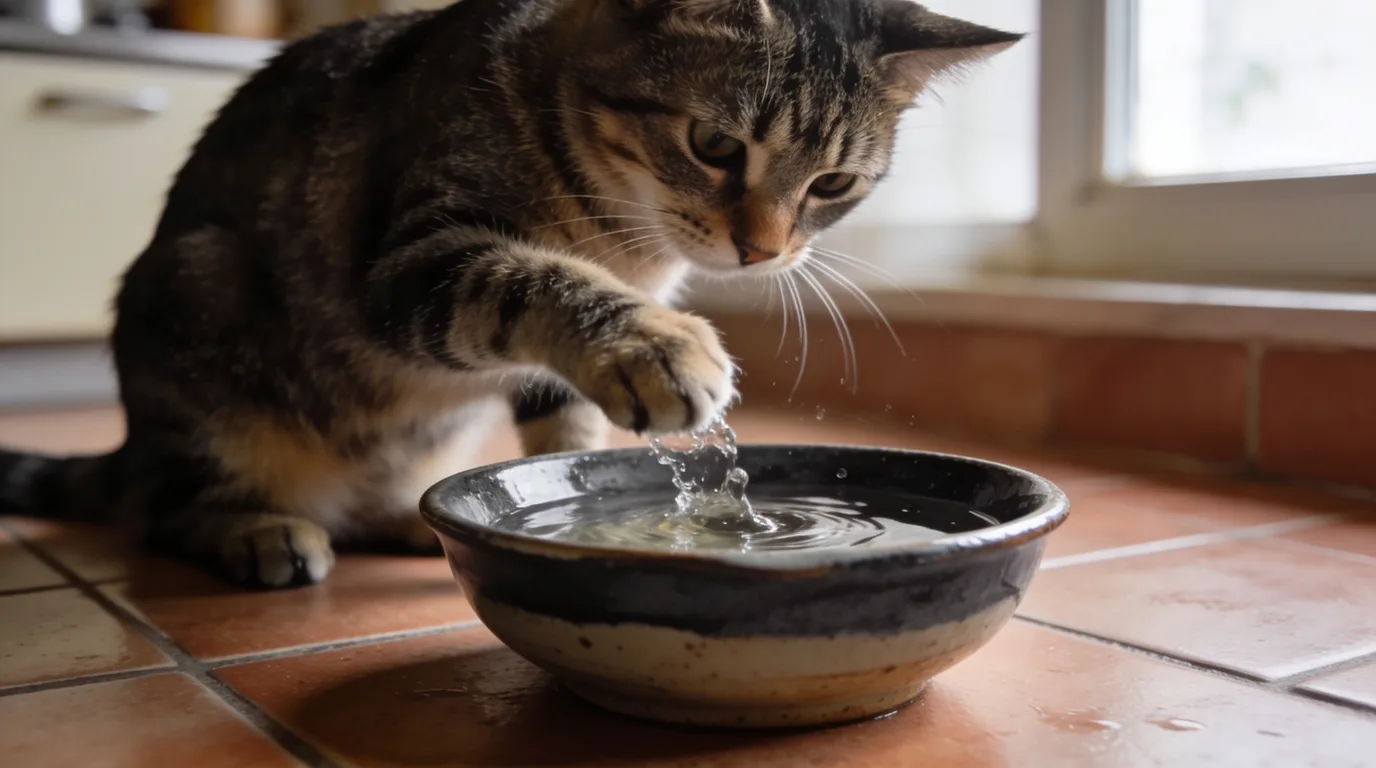
Pawing, splashing, dipping and tipping the water bowl has two separate answers, and they need to be assessed in parallel rather than in sequence. The behavioral answer is usually mundane: the bowl is the wrong shape, in the wrong place, made of the wrong material, or it is the only object in the room that responds when the cat touches it. Add to that a genuine sensory problem — cats see poorly at close range, and a still water surface in a dark bowl is nearly invisible to them — and pawing at the surface to find where the water actually is becomes an entirely rational solution rather than a game.
The second answer is the one most articles mention last or not at all. A change in how much a cat is interested in water is a clinical sign. Increased drinking, increased time spent at the bowl, drinking from taps and glasses and plant saucers, or a sudden new fascination with water in a cat that never had one, points at polydipsia — and in cats, polydipsia points first at chronic kidney disease, hyperthyroidism and diabetes mellitus. All three are common, all three are manageable, and all three are diagnosed far too late in cats that were assumed to be playing. This article covers the behavioral explanations properly, then gives the numbers and the measurement method that let you rule the medical lane in or out at home in three days.
What the behavior actually looks like
Before explaining it, separate the presentations. They do not all mean the same thing.
Pawing the surface, then licking the paw. The classic. Usually about locating the water surface, not about play.
Pawing hard enough to splash, repeatedly, with the water going everywhere. More consistent with play or with an under-stimulated cat.
Tipping or shifting the bowl. Often about the bowl itself — instability, material, or an unpleasant edge contact — or about moving the resource away from something the cat dislikes.
Scratching or pawing the floor around the bowl. A distinct behavior. This resembles caching or covering, the same motor pattern used over food and over waste, and it appears in some cats around food and water stations without indicating a problem with the water.
Dipping and drinking from the paw rather than the bowl. Some cats do this consistently and permanently. Where it is longstanding and the cat is otherwise well, it is a stable individual quirk and needs no fix beyond a mat.
Sudden new interest in any water source in the house. This is the presentation that gets the medical workup, regardless of how playful it looks.
The behavioral explanations
Bowl-edge contact and the whisker question
The popular version says that contact between the whiskers and the sides of a deep, narrow bowl causes "whisker fatigue," a painful overstimulation that drives cats away from the bowl. The term appears everywhere, usually stated as established fact.
Here is the honest position. The anatomy is real and not in dispute: the mystacial vibrissae are thick, deeply embedded, richly innervated mechanoreceptors with dedicated representation in the somatosensory cortex, and they are used actively — cats move them forward around close objects and use them to assess prey and gaps. It is entirely plausible that repeated contact with a bowl rim is aversive. What does not exist is a substantial body of controlled evidence establishing a distinct condition called whisker fatigue, with defined criteria and a demonstrated mechanism. There is some small-scale work suggesting cats show a preference for wider, shallower dishes, and there is a very large body of clinical experience saying that switching to a wide shallow bowl helps a subset of cats. That is enough to justify the intervention, which is free and harmless. It is not enough to justify the confident pathologising language.
The practical version, stated without overclaiming: some cats avoid or manipulate water in narrow, deep, steep-sided bowls and stop doing so in wide shallow ones. Try it, because it costs nothing. Do not assume it will work.
The moving-water preference
Cats often prefer running water — taps, showers, fountains, dripping outdoor sources — and the usual explanation is that moving water in a natural environment is less likely to be stagnant and contaminated, so a preference for it is adaptive. That reasoning is sound and probably part of the story.
The evidence on whether fountains actually increase water intake in pet cats is mixed. Some cats show a clear, sustained preference for a fountain and drink measurably more from it. Others show a brief novelty effect that decays within days. Others ignore it. Individual variation dominates the group averages, which is a recurring feature of feline behavior research and a reason to be sceptical of any product marketed on a universal claim.
There is also a mechanical contribution independent of preference: moving water is visible. A surface with motion, sound and light reflection can be located from a distance by an animal whose close-range vision is poor. Some of what looks like preference is probably detectability.
Near vision, the meniscus, and why pawing makes sense
This is the most under-explained factor and probably the most important one for the pawing presentation specifically.
Cats are built for detecting motion in low light at a distance. They have a high proportion of rod photoreceptors, a reflective tapetum lucidum, and excellent motion sensitivity. The trade-offs are lower visual acuity than humans and poor focus at close range — the near field within roughly 25 to 30 centimetres of the face is not sharply resolved. This is the same reason cats frequently appear to lose track of a treat placed directly under their nose and locate it by smell and whisker contact instead.
Now consider what a still water surface looks like to that visual system. It is transparent, motionless, and often sitting in an opaque bowl in a dimly lit corner. The only optical cue to where the surface is sits at the meniscus, the thin curved line where the water meets the side of the bowl. A cat approaching to drink has to solve a genuine problem: locate an invisible plane, accurately enough to avoid submerging the nose.
Touching the surface with a paw solves it immediately. It confirms the depth, and the resulting ripples make the surface visible. The behavior that owners read as play is, in many cats, a sensible sensory strategy — which is why it is more common with full, still, dark-coloured, deep bowls and often disappears with a shallow, light-coloured bowl in a well-lit spot.
Play and enrichment in an under-stimulated cat
An indoor cat in a quiet house has a limited set of objects that respond to being touched. The water bowl is one of them. Batting it produces immediate, variable, contingent feedback — motion, sound, reflection, spreading wetness — which is close to an ideal reinforcer for a species built to detect and react to small moving stimuli.
The signature of this version is different from the sensory version. It is vigorous rather than exploratory, it happens in bouts rather than immediately before drinking, it often escalates when the household is asleep or absent, and it frequently co-occurs with other markers of insufficient outlet: night activity, ambushing ankles, knocking objects off surfaces, and conflict with housemate cats. It responds to enrichment and structured predatory play, not to bowl changes.
Location aversion
Where the bowl sits matters more than most households assume, and three placements cause the majority of problems.
Next to the food. The most common arrangement in homes and the one least matched to feline preference. Cats are descended from arid-environment ancestors that took most of their water from prey and did not routinely drink at the kill site, and many cats behave as though water adjacent to food is less attractive. Whether the mechanism is contamination avoidance or something else, the applied finding is consistent: separating water from food increases use.
Next to or near the litter box. Self-evident once stated, and extremely common in small homes where both get pushed into the bathroom or the utility room.
In a corner, against a wall, or beside an appliance. Drinking requires the head to be lowered and the visual field restricted, which is a vulnerable posture. Cats prefer to do it somewhere with sightlines and more than one exit. A bowl wedged in a corner beside a fridge that cycles on unpredictably is a bowl the cat will approach tentatively, drink from briefly, and interact with oddly.
Material, temperature and freshness
Plastic bowls scratch, hold odour and biofilm, and some cats clearly dislike them. Glass, ceramic and stainless steel do not, and are easier to keep genuinely clean. Water left standing for a day picks up dust, food particles and the smell of the room. Temperature matters to some individuals. None of these is dramatic on its own; together they explain a meaningful number of cases.
Breed and individual variation
Some cats simply interact with water more than others, and the pattern runs in families and in some breeds — Bengals, Maine Coons and Turkish Vans are the ones most often named. Flag this as observational and largely anecdotal rather than established: there is very little controlled breed-level behavioral data in cats, and reputation effects contaminate owner reports. A lifelong water-playing Bengal is unremarkable. A Bengal that starts at eleven years old is not.
The medical lane: when interest in water is polydipsia
Here are the numbers, because the rest of this section is useless without them.
Normal total water intake for a cat is roughly 45 to 60 ml per kilogram of body weight per day. That is total — water drunk plus water contained in food. Sustained intake above that range warrants a veterinary conversation. Sustained intake above roughly 100 ml per kilogram per day is unambiguous polydipsia and warrants one urgently.
The diet caveat is what makes this confusing in practice. Canned and pouched food is roughly 70 to 80 percent water; dry food is around 8 to 10 percent. A wet-fed cat gets most of its daily requirement from the bowl of food and may drink almost nothing visibly. A dry-fed cat has to make up nearly all of it by drinking. Which means the same measured bowl intake means completely different things depending on the diet, and a change of diet is the first alternative explanation to exclude before assuming disease.
| Cat weight | Normal total intake per day | Roughly what that looks like on dry food | Threshold for concern (drinking alone) |
|---|---|---|---|
| 3 kg | 135–180 ml | Most of it from the bowl | Sustained above 180 ml/day |
| 4 kg | 180–240 ml | Most of it from the bowl | Sustained above 240 ml/day |
| 4.5 kg | 200–270 ml | Most of it from the bowl | Sustained above 270 ml/day |
| 5 kg | 225–300 ml | Most of it from the bowl | Sustained above 300 ml/day |
| 6 kg | 270–360 ml | Most of it from the bowl | Sustained above 360 ml/day |
On a wet-food diet, measured drinking of even half these figures can be worth mentioning, because the food is already supplying most of the requirement.
How to actually measure it
Owners are poor estimators of how much a cat drinks, and clinics ask for numbers. Three days of measurement produces a far more useful conversation than a description.
- Isolate access. In a multi-cat household this is the hard part. Measure only if you can confine the cat of interest with its own water for the measurement window, or if the household has one cat. Otherwise measure total household intake and divide by cats as a rough screen — noting that this masks the individual.
- Use a scale, not a measuring jug. Water weighs one gram per millilitre. Weigh the full bowl, weigh it again 24 hours later, and the difference in grams is the intake in millilitres. A kitchen scale accurate to one gram is sufficient and far more precise than reading a jug.
- Run an evaporation control. Put an identical bowl with the same volume of water somewhere the cat cannot reach, in the same room. Weigh it on the same schedule. Subtract its loss from the measured bowl. In a warm or dry house evaporation can account for a surprising fraction of an apparent increase.
- Count every source. Fountains, second bowls, the bathroom tap, the shower tray, plant saucers, the dog's bowl. A cat drinking heavily from an unmeasured source will look normal on the measured one.
- Average across three days, and record the diet, the ambient temperature, and any recent change to either.
- Weigh the cat at the same time, on the same scale, and record it. Weight loss alongside increased drinking narrows the differential considerably.
What polydipsia points at in cats
| Condition | Typical signalment | Companion signs beyond drinking | Usual first tests |
|---|---|---|---|
| Chronic kidney disease | Older cats; prevalence rises steeply past about ten | Weight loss, poor coat, reduced grooming, nausea, larger litter clumps, reduced appetite | Blood biochemistry, SDMA, urine specific gravity, blood pressure |
| Hyperthyroidism | Middle-aged to older | Weight loss with a good or increased appetite, restlessness, night vocalizing, vomiting, unkempt coat, fast heart rate | Total T4, blood pressure |
| Diabetes mellitus | Often overweight, middle-aged, more common in males | Increased appetite with weight loss, urinating large volumes, plantigrade stance in advanced cases | Blood glucose, fructosamine, urinalysis |
| Hypercalcaemia | Any age | Reduced appetite, constipation, lethargy | Total and ionised calcium |
| Post-obstructive or drug-related diuresis | Recent urinary obstruction; steroids or diuretics | Context-specific | History and biochemistry |
| Diet change | Any | None — intake shifts because water moved from food to bowl | None; correct the assumption first |
Two of these are worth flagging for their behavioral presentation, because they are the ones this site's readers encounter as behavior problems first. Hyperthyroidism routinely arrives at a behavior consultation as night vocalizing, restlessness and new irritability in a middle-aged or older cat. Chronic kidney disease arrives as reduced grooming, a change in resting places, and increased drinking that the household has re-labelled as a personality trait. Both are the sort of thing covered in behavior change in senior cats and in the general triage sequence in why is my cat acting weird.
Fixes, ranked by how often they work
| Fix | What it addresses | How to do it | Realistic expectation |
|---|---|---|---|
| Move water away from food | Location aversion | At least a couple of metres, ideally a different room | High yield, zero cost — do this first |
| Move water away from the litter box | Location aversion | Different room entirely | High yield, zero cost |
| Wide, shallow bowl | Bowl-edge contact, surface visibility | Wider than the cat's whisker span; fill to the brim | Helps a clear subset; cheap enough to be worth trying on all cats |
| Multiple stations | Access, competition, choice | One per cat plus one, in separate rooms and on separate floors | High yield in multi-cat homes |
| Glass, ceramic or stainless steel | Odour, biofilm, taste, scratching | Replace plastic; wash daily with unscented detergent and rinse well | Moderate; matters more for some individuals |
| Fill to the brim | Surface visibility, whisker contact, meniscus location | Top up daily rather than letting the level drop | Moderate, and it directly targets the pawing behavior |
| A fountain | Moving-water preference, detectability | Choose a quiet pump and a ceramic or steel basin; clean the filter on schedule | Genuinely mixed — some cats love it, some ignore it, motor noise puts some off |
| A silicone mat under the bowl | The mess, not the behavior | Any wipeable mat | Solves the owner's actual complaint immediately |
| Better lighting or a lighter bowl interior | Near-vision and surface location | Move the station out of a dark corner | Underrated for the pawing presentation |
| A station with sightlines and two exits | Vulnerability during drinking | Off the wall, away from appliances and doorways | Moderate |
| Structured predatory play plus food puzzles | Under-stimulation | Two short wand sessions daily, largest meal after the evening one | The fix if the behavior is genuine play |
| Increase dietary water | Total intake, urinary health | Wet food, or water added to food, discussed with your vet | The most effective single lever on hydration |
Testing which explanation applies
Rather than changing five things at once and learning nothing, run a preference trial. Set up three or four stations simultaneously and let the cat tell you.
Offer, in different rooms: a wide shallow ceramic bowl filled to the brim, a standard bowl of the type currently used, a fountain, and one bowl in a well-lit open location versus the current location. Keep the water source and temperature identical across all of them. Weigh each station daily for five to seven days, subtracting an evaporation control. The station with the highest consistent intake is the answer, and it is frequently not the one the household expected.
This also produces the total-intake figure you need for the medical question, which is why it is worth doing properly.
What people get wrong
"Whisker fatigue is a diagnosed condition." It is a plausible hypothesis with a real anatomical basis and thin controlled evidence. The intervention it recommends is harmless and sometimes effective. The certainty attached to it online is not earned, and repeating unearned certainty is how genuinely useful feline advice loses credibility.
"A fountain will fix hydration." For some cats. For others there is a novelty spike and then nothing. Measure before and after rather than assuming, and remember that the largest single lever on a cat's total water intake is usually the moisture content of the food, not the delivery method of the water.
"Cats hate water." Cats generally dislike being soaked and restrained, which is a different proposition. Plenty of cats interact readily with water they control — taps, ripples, dripping, shallow trays — and the aversion is to loss of control and to the thermal and grooming consequences of a wet coat, not to water as a substance.
"He is just playing." Sometimes true. But it is also the sentence standing between a great many cats and a timely diagnosis of kidney disease, hyperthyroidism or diabetes. The correct response to "he is just playing" is a three-day measurement, not an argument.
"He drinks from the toilet, so he prefers it." The water is cool, it moves periodically, and the bowl is wide with a visible surface — all of which are properties you can supply elsewhere. Cleaning products and bowl-block chemicals make it a genuinely poor option, and a lid plus a better station upstairs solves it.
"Milk will help him drink more." Most adult cats have reduced lactase activity and cow's milk commonly causes gastrointestinal upset. It is not a hydration strategy.
"Plastic bowls cause feline acne, so plastic is dangerous." The association between plastic bowls and chin acne is widely reported clinically, and the plausible mechanism is scratched surfaces harbouring bacteria rather than the polymer itself. Switching to ceramic, glass or steel and washing daily is a reasonable precaution. It is not an emergency.
When to see a vet
Same day, without waiting:
- Straining in the litter box with little or no urine produced — in a male cat this is a suspected urethral obstruction and is fatal within roughly 24 to 48 hours untreated
- Crying or vocalizing while urinating
- No food intake for 24 hours; 48 hours is a hard emergency
- Hiding combined with not eating
- Sudden aggression in a cat with no aggression history
- Collapse, weakness, disorientation, or open-mouth breathing at rest
- Repeated unproductive vomiting
Within the week, with a urine sample if you can collect one:
- Measured intake sustained above roughly 60 ml per kilogram per day, or any clear sustained increase over the cat's own baseline
- Noticeably larger or more frequent urine clumps in the litter box
- Weight loss, with a normal or increased appetite or without
- A coat that has become unkempt, greasy or matted — reduced grooming is an early and under-reported sign
- New night vocalization or restlessness in a cat over about eight
- Drinking from unusual sources when a clean bowl is available
- Any of the above in a cat over seven, even alone
Frequently asked questions
Why does my cat paw the water before drinking?
The paw may help locate a still surface, test a bowl the cat finds awkward or turn drinking into a rewarding activity. Watch whether the cat drinks afterward and compare different bowl shapes and locations instead of assuming one universal reason.
How can I stop my cat from splashing water everywhere?
Try a wide, stable bowl on a washable mat, fill it consistently and offer another station in a quiet, well-lit location. A fountain helps some cats but not all. Avoid punishment; it can make the drinking area feel unsafe.
When should playing with water concern me?
Arrange a veterinary check when the interest is new or comes with increased drinking or urination, weight loss, appetite change, vomiting, weakness or reduced grooming. Straining with little or no urine is an emergency.
Working out which cat you have
The distinction that matters is between a cat solving a sensory problem, a cat that is bored, and a cat whose thirst has changed. The first two are read from behavior and posture at the bowl — approach speed, head position, ear orientation, whether the cat drinks after pawing or only paws, and how the session ends. The third is read from a kitchen scale. Run both.
PetTranslator.ai handles the first part. Upload one clear photo of the cat at the bowl and it returns a structured report shaped the way a behaviorist writes a session note: observed body-language markers first, behavioral interpretation second, a confidence score with its reasoning, an explicit list of what could not be assessed from a single frame, and a Do/Avoid plan. It does not diagnose, and where a presentation belongs in the medical column it says so rather than talking around it.
Sources
- AAFP and ISFM Feline Environmental Needs Guidelines — the five-pillar framework, including the principle of multiple separated key resources that underpins the placement advice here.
- John Bradshaw, Cat Sense (Basic Books, 2013) — feline sensory biology, the arid-ancestor background, and a consistently sceptical treatment of what is and is not established.
- Karen Overall, Manual of Clinical Behavioral Medicine for Dogs and Cats (2nd ed., Elsevier, 2013) — clinical reference for behavioral differential diagnosis and the medical-first principle.
- ISFM Consensus Guidelines on the Diagnosis and Management of Feline Chronic Kidney Disease — clinical framing for polydipsia as a presenting sign.
- ISFM Guidelines on the Diagnosis and Management of Hyperthyroidism in Cats — presentation, testing and behavioral signs.
- International Renal Interest Society (IRIS) staging guidelines — the standard framework for staging feline chronic kidney disease.
- The Ohio State University Indoor Pet Initiative — practical guidance on water station placement, enrichment, and environmental stability for indoor cats.
- AVSAB Position Statement on Humane Dog Training — the force-free professional standard, applied here to feline work.
Khabir Mughal is the founder of PetTranslator.ai. This article separates the behavioral and medical explanations deliberately, because the behavioral ones are usually right and the medical ones are the ones that cost cats time. It is not veterinary advice — a sustained increase in drinking warrants bloodwork, a urine specific gravity and a blood pressure measurement.