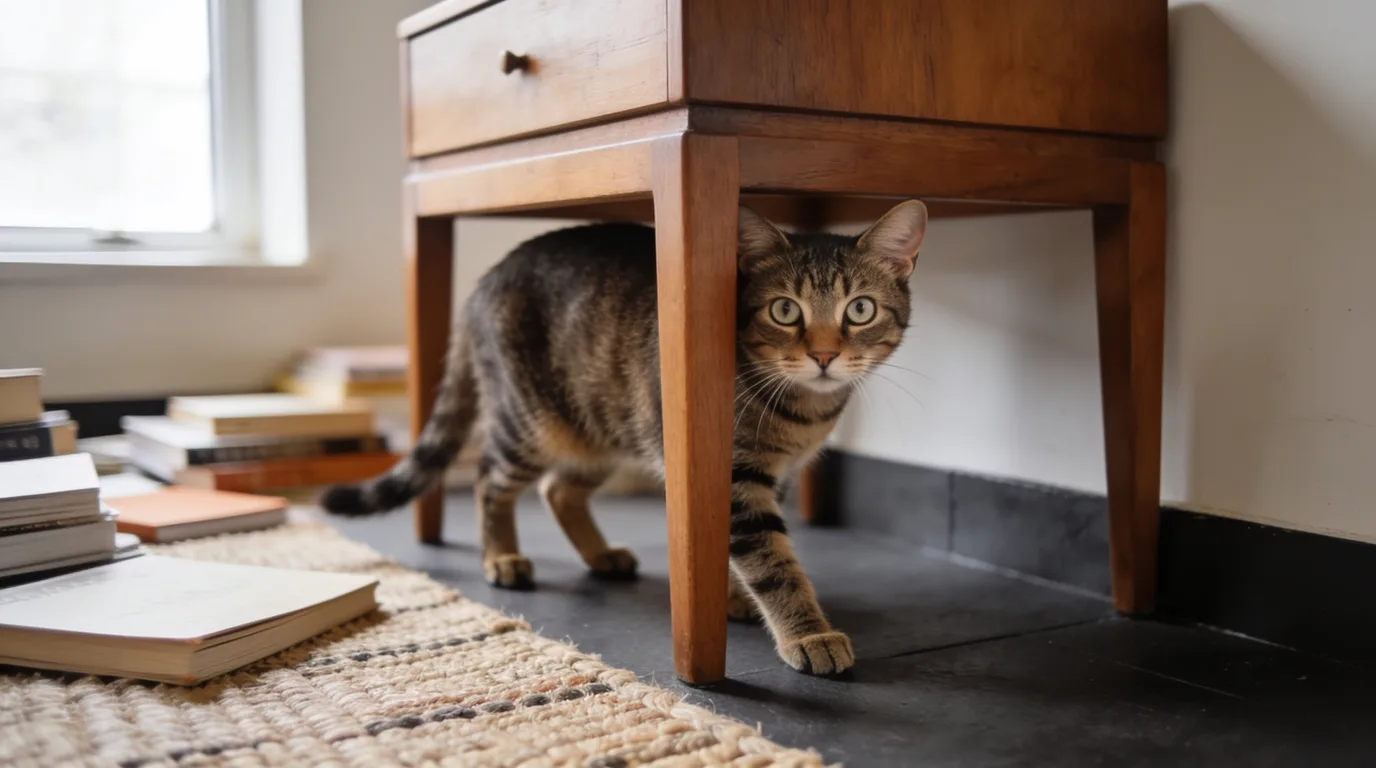
Here is the answer that matters most, before anything else: in cats, a sudden change in behavior is a medical finding until a veterinarian rules medicine out. That is not a liability hedge tacked onto the end of an article. It is the single highest-yield rule in feline behavior work, and it exists because the domestic cat retained an unusual capacity to suppress visible signs of illness and pain. A dog with a painful hip limps. A cat with a painful hip stops jumping onto the kitchen counter, and the household records that as "she's mellowing out."
If medicine is genuinely cleared, the second-highest-probability explanation is a change in the cat's environment or resources — very often a change the humans in the house do not classify as a change at all. What follows is a triage sequence in the order a clinician would run it: rule out medical, audit the environment, read the behavior itself, then intervene in a fixed hierarchy. Running the steps out of order is the most common reason owners spend months on a behavior problem that was a bladder, a tooth, or a thyroid.
A structured online cat behavior assessment can organize observations after urgent medical causes are addressed. It cannot diagnose illness or replace an examination.
Before the appointment, keep a behavior journal and turn the useful observations into a concise pet behavior report for your vet. Dates, triggers and recovery patterns are more actionable than labels such as “weird” or “aggressive.”
Why the base rate is different in cats
Dog owners are told to rule out medical causes too, and they should. But the prior probability is not the same, and pretending it is does cats real harm.
Three things stack up. Cats evolved as small solitary predators that were themselves prey, and overt displays of weakness carried a survival cost; the behavioral result is a species that stays quiet, stays still, and withdraws rather than complaining. They are also observed in a narrow band of contexts — the couch, the bowl, the bed — while the contexts where deterioration would show (sustained movement, jumping, hunting) are the ones that quietly disappear first. And several of the most common feline diseases present primarily as behavior. Hyperthyroidism presents as night vocalizing and restlessness. Chronic kidney disease presents as increased drinking and reduced grooming. Degenerative joint disease — present radiographically in the majority of cats over about ten years old — presents as "he doesn't get on the windowsill anymore." Lower urinary tract disease presents as urinating on the bed.
Add one more asymmetry. In dogs, stress usually shows up as behaviors added: pacing, barking, chewing, pulling, jumping. In cats, stress usually shows up as behaviors subtracted: less grooming, less eating, less playing, less time in shared rooms, less movement. Subtracted behavior is harder to notice, gets noticed later, and is easier to reinterpret as personality. A cat who has stopped doing three things is often further along than a cat who has started doing one.
Step 1 — Rule out medical
Split this into two tiers. The first tier is a same-day emergency. The second is a veterinary appointment within the week.
Vet today — do not wait for morning
Straining in the litter box, especially a male cat. Repeated trips to the box, crouching and straining, producing nothing or a few drops, sometimes with blood, is a suspected urethral obstruction until examined. This is the most time-critical presentation in feline medicine. A blocked cat cannot excrete potassium; hyperkalemia follows, then cardiac arrhythmia, then death — commonly within 24 to 48 hours of the obstruction becoming complete. Males and neutered males are at far higher risk because the urethra narrows distally. Owners frequently misread it as constipation, because the posture is identical. Assume urinary and go.
Vocalizing while urinating or in the box. Pain on urination. Same pathway as above.
Not eating for 24 hours. Call the same day; 48 hours is an emergency, not a fussy eater. Prolonged anorexia — particularly in overweight cats — can precipitate hepatic lipidosis, in which fat mobilized to the liver overwhelms it. The clock genuinely matters more here than it does in dogs.
Open-mouth breathing, panting, or rapid shallow breathing at rest. Cats do not pant to cool down the way dogs do. Open-mouth breathing at rest is respiratory distress until proven otherwise, and cardiac disease is a leading cause. Transport calmly, minimize handling.
Sudden hind-limb weakness or dragging, usually with loud crying. Classic presentation of feline aortic thromboembolism — a clot lodging where the aorta divides, secondary to underlying heart disease. Limbs are typically cold, pads pale or bluish. Severely painful; go immediately.
Hiding combined with not eating. Either alone is a signal. Together, in a previously normal cat, treat it as urgent.
Sudden aggression in a cat with no aggression history. Pain, hyperthyroidism, hypertension, and neurological disease all present this way. A behavior consult for new-onset aggression should not begin before a physical exam and bloodwork.
Collapse, seizure, disorientation, head pressing, or sudden apparent blindness. Sudden blindness with widely dilated pupils in an older cat often indicates hypertensive retinopathy — secondary to kidney disease or hyperthyroidism — and can sometimes be partially reversed if treated fast.
Suspected lily exposure. Any part of a true lily — petals, leaves, pollen, even vase water — can cause acute kidney injury. This is an emergency at the point of exposure, not the point of symptoms.
A string or thread visible under the tongue or protruding from the anus. Do not pull it. Linear foreign bodies saw through intestine.
Vet this week
- Drinking or urinating noticeably more (kidney disease, diabetes, hyperthyroidism)
- Weight loss despite a normal or increased appetite (hyperthyroidism, diabetes, malabsorption)
- An unkempt, greasy, or matted coat — reduced grooming is often the first sign of pain, dental disease, or obesity-related restriction
- Overgrooming to thin fur or bald patches, usually on the belly or inner thighs
- Bad breath, dropping food, chewing on one side, or pawing at the mouth
- Hesitating before a jump, or choosing lower perches — the most under-reported sign of feline arthritis
- New night vocalizing in a cat over about eight — see behavior change in senior cats and cat meowing at night
- Any change in litter box habits lasting more than a couple of days — start at why your cat is peeing outside the litter box
- Sleeping in a new location, particularly a cold, hard, or hidden one
- A hunched posture with the head held low and the eyes partly squinted
On pain scoring. The Feline Grimace Scale, developed and validated at the Université de Montréal, scores acute pain in cats from five facial features: ear position, orbital tightening, muzzle tension, whisker position, and head position. It is freely available, designed for acute rather than chronic pain, and worth learning — it trains the eye to catch the exact facial changes owners routinely overlook.
Step 2 — The environmental change audit
When owners say "nothing changed," they usually mean nothing changed in the categories humans track. Cats track different categories. The AAFP and ISFM Feline Environmental Needs Guidelines organize a cat's requirements into five pillars: a safe place; multiple, separated key resources; opportunity for play and predatory behavior; positive and predictable human interaction; and an environment that respects the cat's sense of smell. Disruption to any pillar is a candidate cause, and most disruptions are invisible to the person causing them.
Work through this list literally, going back four to six weeks.
Litter and elimination. New litter brand, type, texture, or scent. A different box, a hood added or removed, a liner, a mat. Box moved, even by a few feet. A new cleaning product used on or near the box. Reduced scooping frequency. A washing machine or furnace that now cycles near the box.
Food and water. Diet change, including a silent reformulation of the same product. New bowl, new bowl material, bowl moved. Feeding station relocated next to an appliance, a door, or a route another animal uses. A new automatic feeder or fountain — the motor noise is louder to a cat than to you.
If the new behavior is pawing, splashing or spending longer at the bowl, compare ordinary play with the warning signs in why cats play with water.
Territory and furniture. New sofa, new rug, rearranged room, a removed cat tree, a blocked windowsill, a door that used to be open, a new baby gate. Cats map territory in three dimensions; removing vertical routes changes the map more than owners expect.
Other animals — including ones outside. A cat visible through the window or spraying near the door is one of the most common and most missed triggers in this entire category. It reliably produces indoor spraying, litter box avoidance, and redirected aggression toward housemates. Also: a new pet, a visiting pet, a neighbor's dog audible through a wall.
Scent. A new detergent, shampoo, diffuser, or scented candle. Clothes carrying another animal's scent. And the classic: one cat returns from the vet smelling or behaving differently and is attacked by a housemate who has known them for years. The cat non-recognition aggression guide explains safe separation, medical recovery and structured reintroduction.
Sound. Construction next door, a smoke alarm chirping on a low battery, a new appliance, a doorbell chime, fireworks. Cats hear well into the ultrasonic range; some of the sounds bothering them are ones you cannot hear.
Schedule and people. A new shift, a return to the office, school starting, a houseguest, a roommate moving out, a change in when the household sleeps. Predictable human interaction is one of the five pillars for a reason.
Health and handling events. A recent vet visit, grooming, nail trim, boarding, a new collar, a course of medication.
Research from Ohio State by Judi Stella and Tony Buffington gave this a hard edge. In work comparing cats with feline interstitial cystitis to healthy controls, both groups showed increased "sickness behaviors" — vomiting, reduced food intake, elimination outside the box — during weeks when their normal routine was disrupted. Healthy cats got sick-looking from an unstable environment. That is why the environmental audit sits at step two rather than step five.
Step 3 — Read the behavior itself
Now map the specific behavior. The table gives the highest-probability medical and environmental explanations for each presentation, plus the first move. It is a triage aid, not a diagnostic key.
| Observed behavior | Check medically first | Common environmental cause | First move |
|---|---|---|---|
| Urinating outside the box, on soft surfaces | Lower urinary tract disease, kidney disease, diabetes, arthritis making entry painful | Box aversion, location, litter change, multi-cat competition | Vet urinalysis, then litter box rules |
| Straining, frequent tiny urinations, crying | Urethral obstruction or cystitis | Stress-associated idiopathic cystitis | Emergency vet, same day |
| Spraying vertically on walls or doors | Urinary disease still possible | Outdoor cat visible, territorial insecurity, new animal | Block the sightline; see spraying vs urinating |
| Hiding for more than 24 hours | Pain, fever, systemic illness | Recent household change, noise, new person | Vet if paired with reduced eating; otherwise why cats hide |
| Sudden aggression toward a bonded housemate cat | Pain, hyperthyroidism, hypertension | Non-recognition after a vet visit; redirected aggression from an outdoor trigger | Separate calmly, vet check, structured reintroduction |
| Aggression during petting | Skin pain, arthritis, dental pain, hyperesthesia | Petting past the cat's tolerance threshold | Shorten sessions, watch tail and ear signals |
| Overgrooming to bald skin | Allergy, parasites, pain referred to the area, hyperthyroidism | Chronic stress, conflict, insufficient outlets | Dermatology and pain workup before a stress diagnosis |
| Night yowling in a senior cat | Hyperthyroidism, hypertension, kidney disease, cognitive dysfunction, deafness | Boredom, reinforced attention-seeking, disrupted light cycle | Bloodwork and blood pressure first |
| Eating more, losing weight | Hyperthyroidism, diabetes, GI disease | Rarely environmental | Vet within the week |
| Eating less or refusing food | Dental disease, nausea, kidney disease, pain, upper respiratory congestion | Bowl location, diet change, competition at the station | 24 hours is a call; 48 is urgent |
| No longer jumping to high perches | Degenerative joint disease, muscle loss, vision change | Perch removed or route blocked | Pain trial with your vet; add mid-height steps |
| Staring at walls, skin rippling, sudden bolting | Feline hyperesthesia, dermatologic pain, neurological disease, hypertension | Rarely purely environmental | Read the skin-rippling guide, then contact a vet with video |
| New, intense clinginess | Pain, vision or hearing loss, endocrine disease | Owner schedule change, household instability | Vet check, then increase predictability |
| Eating fabric, plastic, or litter (pica) | Anemia, GI disease, nutritional issue | Under-stimulation, early weaning history | Vet first — pica has real medical differentials |
| Frantic 3 a.m. activity in a young cat | Rarely medical if isolated | Normal crepuscular activity plus insufficient daytime predatory outlet | Restructure play and feeding, not punishment |
Feline stress signals are not dog stress signals
Owners who learned body language from dog content misread cats consistently: the feline repertoire is smaller, quieter, and weighted toward withdrawal rather than appeasement. Full breakdown in cat body language. The triage-relevant differences:
Withdrawal is the primary coping strategy. A stressed dog often seeks proximity. A stressed cat leaves. Hiding is functional self-regulation, not sulking, and forcing the cat out extends recovery.
Stillness is a high-grade signal, not good behavior. A cat who has not moved in ten minutes at the vet is not calm. Behaviorists read frozen stillness as more concerning than active resistance, because the cat has stopped trying to manage the situation.
The early signals are millimetric. A slow look-away. One ear rotating to the side — see airplane ears. Whiskers dropping back against the cheek. A sudden out-of-context grooming bout. A tail-tip twitch escalating to a thump, then a lash. There is no feline equivalent of the dog's broad, legible calming-signal repertoire.
Grooming changes are diagnostic in both directions. Under-grooming suggests pain, illness, or shutdown. Over-grooming suggests dermatologic disease, pain, or chronic stress.
Elimination is a channel dogs do not have in the same way. Cats respond to insecurity by changing where and how they eliminate. That is a territorial and physiological response, not a message.
The Cat-Stress-Score, developed by Kessler and Turner in cattery research, formalized this kind of reading — a graded scale built from posture, ear and eye position, activity, and vocalization rather than any single behavior. The lesson is the same as in dogs: read four channels before concluding, and read them against your own cat's baseline.
Step 4 — The intervention hierarchy
Work down this list in order. Levels five and six should not be reached before one through four have genuinely been done.
1. Medical clearance. Non-negotiable. A behavior plan layered on untreated pain fails, and the failure gets blamed on the plan.
2. Restore and expand resources. The highest-yield, lowest-risk intervention in feline behavior, and almost always under-done. Litter boxes at the number of cats plus one, in separate locations, uncovered, large, unscented clumping litter. Separated feeding and watering stations. Resting spots at multiple heights. At least one enclosed hiding place per cat that nobody removes them from. Scratching substrates in both vertical and horizontal orientations, placed where the cat wants to scratch rather than where it looks tidy.
3. Reduce or remove the trigger. If an outdoor cat is the problem, apply opaque film to the lower third of the window, remove the perch giving the sightline, and stop leaving food outside. If noise is the problem, move the resources away from it. If handling is the problem, shorten and soften it. Restoring predictability to feeding and interaction times belongs here too.
4. Add appropriate outlets. Interactive wand play, run to completion of the predatory sequence — stalk, chase, pounce, catch, then a food reward — rather than an unresolved chase that leaves arousal high. Two short sessions daily beat one long one. Food puzzles matter more than most owners believe; work by Mikel Delgado and colleagues documented improvements in weight, activity, and some stress-associated behaviors in household cats. Sarah Ellis and John Bradshaw's The Trainable Cat is the best practical source here.
5. Desensitization and counterconditioning. For a specific identified trigger, once the environment is right. Sub-threshold exposure paired with something the cat values, progressing slowly. Done above threshold it sensitizes rather than desensitizes — the usual reason home attempts backfire.
6. Pheromone analogues and supplements. Honestly reported: the evidence is mixed. Some controlled trials show benefit for specific presentations; several reviews have judged the overall quality of evidence low. A possible marginal gain layered onto a corrected environment, never the intervention itself.
7. Medication, prescribed and monitored. For genuine anxiety disorders, appropriate psychopharmacology is welfare-improving and evidence-supported. It belongs with a veterinarian or veterinary behaviorist, alongside a behavior plan — not instead of one.
What people get wrong
"He's doing it out of spite." There is no evidence for retributive reasoning in cats. The bed is soft, absorbent, elevated, and saturated with your scent — exactly the surface an insecure or medically uncomfortable cat selects. The location is information about the cat's state, not about their opinion of you.
"Nothing changed." Something almost always did, in a category humans don't file as change. Run the step-two list literally rather than from memory; the audit exists because recall is unreliable here.
"It's just old age." Old age is not a diagnosis. Sleeping more, jumping less, grooming less, and getting grumpier are the presenting signs of arthritis, dental disease, kidney disease, hyperthyroidism, hypertension, and cognitive dysfunction — all common, all manageable, several treatable to the point where owners describe getting their cat back.
"She's still eating, so she's fine." Eating is a low-sensitivity indicator; plenty of significantly ill cats keep eating. The inverse is high-signal: a cat who has stopped eating is telling you something serious, quickly.
"Punishment worked — she stopped." She stopped in your presence. Suppression in front of the punisher is not resolution, and the underlying state is now paired with you.
"The behavior is the problem." The behavior is the output. Confining a cat to a bathroom "until she relearns the box" without addressing bladder disease, litter substrate, or social competition treats the output and leaves the cause running.
When to see a vet
Same day, without waiting:
- Straining in the litter box, producing little or no urine — especially a male cat
- Crying or vocalizing while urinating
- No food intake for 24 hours (48 hours is a hard emergency)
- Open-mouth breathing, panting, or laboured breathing at rest
- Sudden hind-limb weakness, dragging, or cold hind paws with crying
- Hiding combined with not eating
- Sudden aggression with no history
- Collapse, seizure, disorientation, head pressing, or sudden blindness
- Suspected lily exposure, or any suspected toxin
- A string or thread visible under the tongue or at the anus — do not pull
- Pale, white, or bluish gums
- Repeated unproductive vomiting, or a distended, painful abdomen
Within the week: any second-tier sign above, and any behavior change persisting more than a few days without an obvious environmental explanation.
If the cat is medically cleared and the behavior persists, the next call is a credentialed behavior professional, not a general trainer. Look for DACVB (Diplomate, American College of Veterinary Behaviorists), CCBC (Certified Cat Behavior Consultant), CFBC, IAABC Cat Division membership, or Fear Free certification. Avoid anyone using dominance framing or aversive tools. The IAABC, AVSAB, and American College of Veterinary Behaviorists each maintain searchable regional directories; for inter-cat aggression and litter box cases, a veterinary behaviorist is worth the wait. Walkthrough in how to find a credentialed behaviorist.
Running the triage on your own cat
Most owners can run steps one and two unaided. Step three — reading the behavior against the cat's own baseline, without importing dog assumptions — is the part that takes practice, and where a structured second opinion helps.
PetTranslator.ai runs this framework on a photo. Upload one clear image of your cat and it returns a report shaped the way a behaviorist writes a session note: observed body-language markers first, behavioral interpretation second, a confidence score with its reasoning, an explicit list of what could not be assessed from a single frame, and a Do/Avoid plan. It does not diagnose, and it flags medical-first presentations rather than talking around them.
Sources
- AAFP and ISFM Feline Environmental Needs Guidelines (2013), Journal of Feline Medicine and Surgery — the five-pillar framework used in the environmental audit.
- Karen Overall, Manual of Clinical Behavioral Medicine for Dogs and Cats (2nd ed., Elsevier, 2013) — the clinical reference for behavioral observation, differential diagnosis, and the medical-first principle.
- John Bradshaw, Cat Sense (Basic Books, 2013) — evolution of feline social and territorial behavior.
- Sarah Ellis and John Bradshaw, The Trainable Cat (Penguin, 2016) — applied, force-free protocols for handling, enrichment, and desensitization.
- Stella, Lord and Buffington — research at Ohio State on sickness behaviors in healthy cats and cats with feline interstitial cystitis during periods of routine disruption.
- The Ohio State University Indoor Pet Initiative — owner-facing guidance on environmental enrichment and routine stability for indoor cats.
- Kessler and Turner (1997), Animal Welfare — development of the Cat-Stress-Score in boarding cattery research.
- Feline Grimace Scale, Université de Montréal — validated facial-expression tool for scoring acute pain in cats.
- Dantas, Delgado, Johnson and Buffington — work on food puzzles for cats and their effects on activity, weight, and stress-associated behavior.
- AVSAB Position Statement on Humane Dog Training (2021) — the force-free standard, which applies to cats as well as dogs.
Khabir Mughal is the founder of PetTranslator.ai. This article was reviewed against the AAFP and ISFM Feline Environmental Needs Guidelines and Karen Overall's Manual of Clinical Behavioral Medicine before publication. It is not veterinary advice — for any sudden change in your cat's behavior, see a veterinarian first.