
A pet behavior journal app is useful when it helps you compare like with like. It is less useful when it becomes a collection of mood labels such as “anxious,” “naughty” or “happy” with no record of what the pet actually did.
The goal is not to document every minute. It is to preserve enough context to answer practical questions: Is this new? Is it happening more often? Does it follow a person, place, sound, activity or time of day? Is recovery changing? Did appetite, mobility, sleep or medication change at the same time?
For an intermittent movement change, use the same structure rather than deciding that a dog is faking an injury. Record the limb, surface, speed, activity and recovery for the veterinary team.
What a behavior journal should do
A good journal keeps each pet's observations separate, adds a reliable date and time, accepts short notes and media, and makes repeated events comparable. Search, filters, tags and export are helpful only after the entries themselves are consistent.
Look for:
- separate profiles for every animal
- automatic date and time with manual correction
- quick entries that take under a minute
- custom event and context tags
- frequency, duration and recovery fields
- photo and short-video attachment
- notes for appetite, water, elimination, sleep, mobility and medication changes
- a chronological view that keeps original entries intact
- export or a concise summary for a veterinarian or behavior professional
- clear privacy, retention and deletion controls
Wearable activity data can add movement and rest patterns, but it does not explain why a behavior occurred. A GPS walk, sleep estimate or activity score needs the same household context as any other observation.
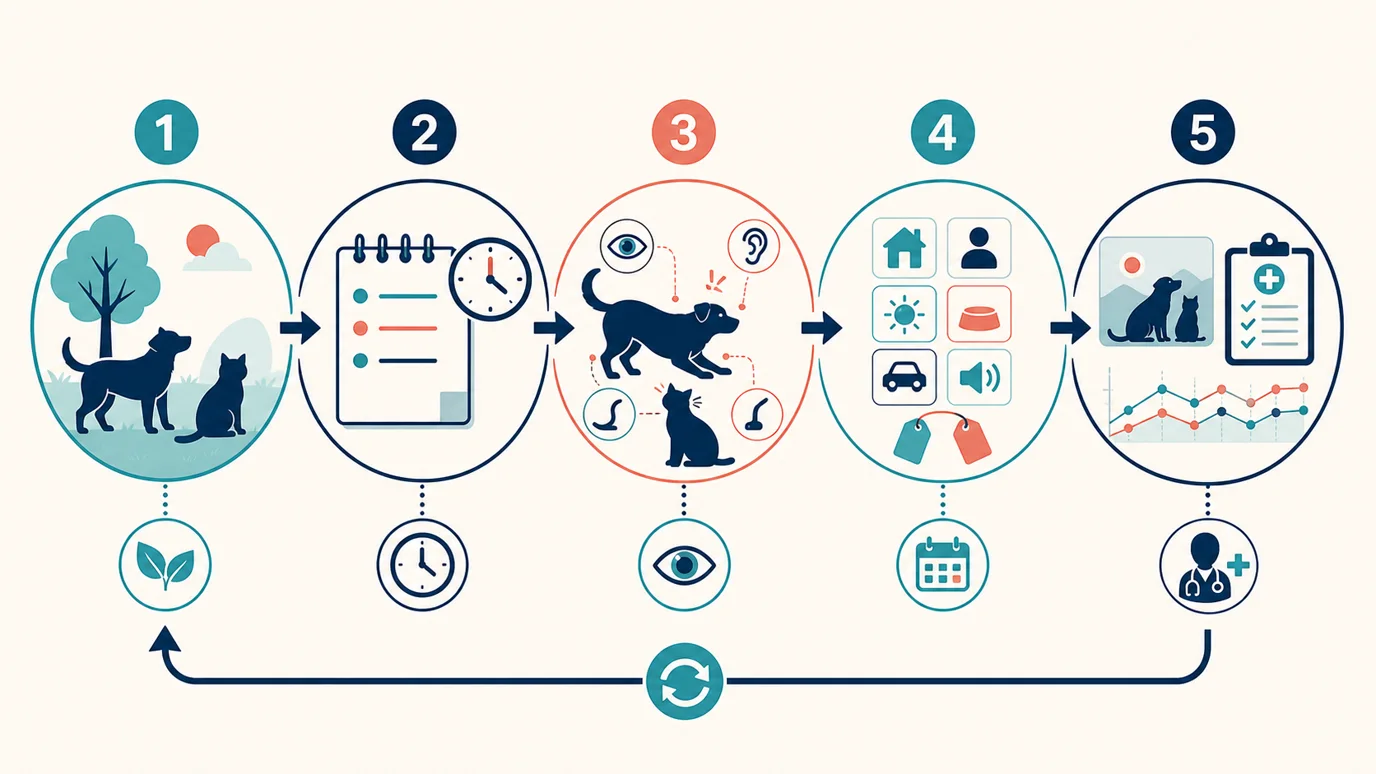
The six fields worth recording
1. The exact event
Name something visible and countable: “barked at person outside window,” “urinated beside litter tray,” “left when hand approached,” or “did not jump onto sofa.” Avoid broad categories such as “bad behavior.”
2. What happened just before
Record the immediate context. Include who was present, location, distance, sounds, handling, food, another animal and relevant routine. “Visitor entered and leaned over the dog” is more useful than “visitor day.”
3. Body language and action
Describe posture, movement, facial markers and sound. For example: body lowered, ears rotated back, head turned away, lips closed, one growl, moved behind chair. Separate observations from your interpretation.
4. Duration and recovery
Time the event when practical. Note how long it took before ordinary activity resumed. Recovery may reveal change even when the visible response looks similar.
5. What happened next
Did the trigger move away? Did you add distance? Did the pet take food, hide, sleep, play or repeat the behavior? This completes the antecedent-behavior-consequence sequence used in clinical behavior histories.
6. Health and routine context
Log only changes relevant to that day: appetite, drinking, urine, stool, vomiting, sleep, grooming, movement, touch sensitivity, medication, travel, visitors or household schedule. A new behavior can have a medical contributor even when it first appears in a social situation.
Use a 30-second entry format
Consistency usually fails because the journal asks too much. Use one compact structure:
7:35 pm, living room. Doorbell rang. Nori froze with body low and ears sideways for about 5 seconds, then ran behind sofa. Would not take a treat immediately; came out and ate after 4 minutes. Appetite and movement otherwise unchanged today.
This entry contains time, place, antecedent, visible behavior, duration, recovery and a brief health check. Add the clip if it already exists and was safe to record.
Use tags sparingly. Five stable tags applied for a month are more informative than 30 overlapping tags used once. Good starting tags might be visitors, handling, other-pet, outside-noise and alone-time.
Establish a baseline before chasing trends
Record three to seven ordinary days when possible. Baseline includes positive and neutral behavior, not only incidents:
- normal greeting and social contact
- resting places and sleep timing
- play or exploration
- food and water routine
- toilet habits
- ordinary movement such as stairs or jumping
- response to familiar handling
Without a baseline, an app can show a chart but cannot tell whether the values are unusual for this individual. A quiet senior cat and an active adolescent dog should not be measured against one generic mood score.
AAHA guidance supports using the same questions repeatedly because standardized observations make change easier to see. The consistency matters more than an elaborate dashboard.
Review weekly, not after every entry
Daily interpretation encourages overreaction to normal variation. Once a week, ask:
- Did frequency, duration, intensity or recovery change?
- Which contexts occurred before most events?
- Did the behavior spread to a new place, person or activity?
- Did ordinary eating, sleeping, moving, playing or social behavior change too?
- Did an intervention consistently help, do nothing or make things worse?
- Is the apparent trend based on enough comparable entries?
Keep raw counts beside percentages. “Three of four visitor arrivals” is more honest than a chart showing a 75% rate without the denominator.
Common tracking mistakes
Logging only difficult days
If calm days disappear from the journal, frequency and improvement become hard to judge. Add a one-tap “no event today” entry during an active tracking period.
Changing definitions midway
Decide what counts before you start. Does “barking episode” mean each bark, one continuous bout, or any barking separated by less than a minute? Write the rule into the journal.
Treating a score as a diagnosis
An app-generated stress, mood or health score may organize observations, but it cannot establish anxiety, pain, cognitive disease or aggression risk. Ask how the score is derived and whether the underlying entries remain visible.
Provoking the behavior for data
Do not approach a hiding cat, repeat painful handling, crowd a freezing dog, recreate a fight or expose the pet to a feared stimulus so the chart has another point. Welfare and safety take priority over a complete dataset.
Tracking too many variables
Start with one defined concern, its immediate context, recovery and a short health check. Expand only when a veterinarian or behavior professional asks for more.
When a journal should become a vet call
Arrange veterinary assessment for a sudden behavior change, new aggression, house soiling, confusion, altered sleep, reduced appetite, increased thirst, touch sensitivity, reduced jumping or movement, overgrooming, or a marked change in social contact. Bring the original log and media.
The pet behavior report for your vet turns journal entries into a one-page appointment summary. It also explains how to record natural video without creating another incident.
Where PetTranslator fits
PetTranslator.ai creates separate pet profiles and stores structured analyses of submitted photos or short videos. Paid plans include behavioral trends and a journal. The analysis separates visible markers from interpretation, provides a confidence level and suggests Do/Avoid actions.
That makes it useful for preserving selected moments in a consistent format. It does not passively monitor a pet, verify what happened outside the frame, diagnose disease or replace a complete behavior history. A photo-based entry should sit beside your record of timing, context and recovery.
Start with the photo-analysis checklist, then use the species-specific dog analyzer guide or cat analyzer guide. Check current plans and limits, and read the privacy policy before uploading sensitive household media.
A simple two-week plan
Day 1: Define one event and what counts as an episode. Record an ordinary baseline.
Days 2 to 7: Make brief entries after natural events. Add a no-event entry on quiet days. Do not change the environment for the sake of testing.
Day 7: Review frequency, duration, recovery and contexts. Avoid drawing a conclusion from one cluster.
Days 8 to 14: Continue the same definitions. If a safe management change is already recommended, note when it was used without deliberately presenting the trigger.
Day 14: Create a concise summary and decide whether the concern is improving, stable, spreading or becoming more intense. Share the record with the appropriate veterinarian or credentialed behavior professional.
For stress-specific tracking, use the dog stress ladder or cat stress-signs guide to improve your descriptions without turning one body part into a verdict.
Sources
- Merck Veterinary Manual: diagnosing behavior problems in dogs: repeat questionnaires, ABC context, frequency, duration, intensity, schedule and environment.
- AAHA behavior questionnaires for dogs and cats: consistent screening can reveal patterns but does not replace a complete history.
- AAHA: incorporating behavioral assessments into every examination: tracking individual change against prior records.
- AAHA chronic pain assessment in dogs: standardized owner measures, pet-specific activities, trends and bias limits.
- AAHA feline life-stage checklists: medically relevant changes in behavior, appetite, hydration, elimination, mobility, sleep and grooming.
Khabir Mughal is the founder of PetTranslator.ai. This guide was checked against current veterinary guidance and the pet-journal app market on August 18, 2026.