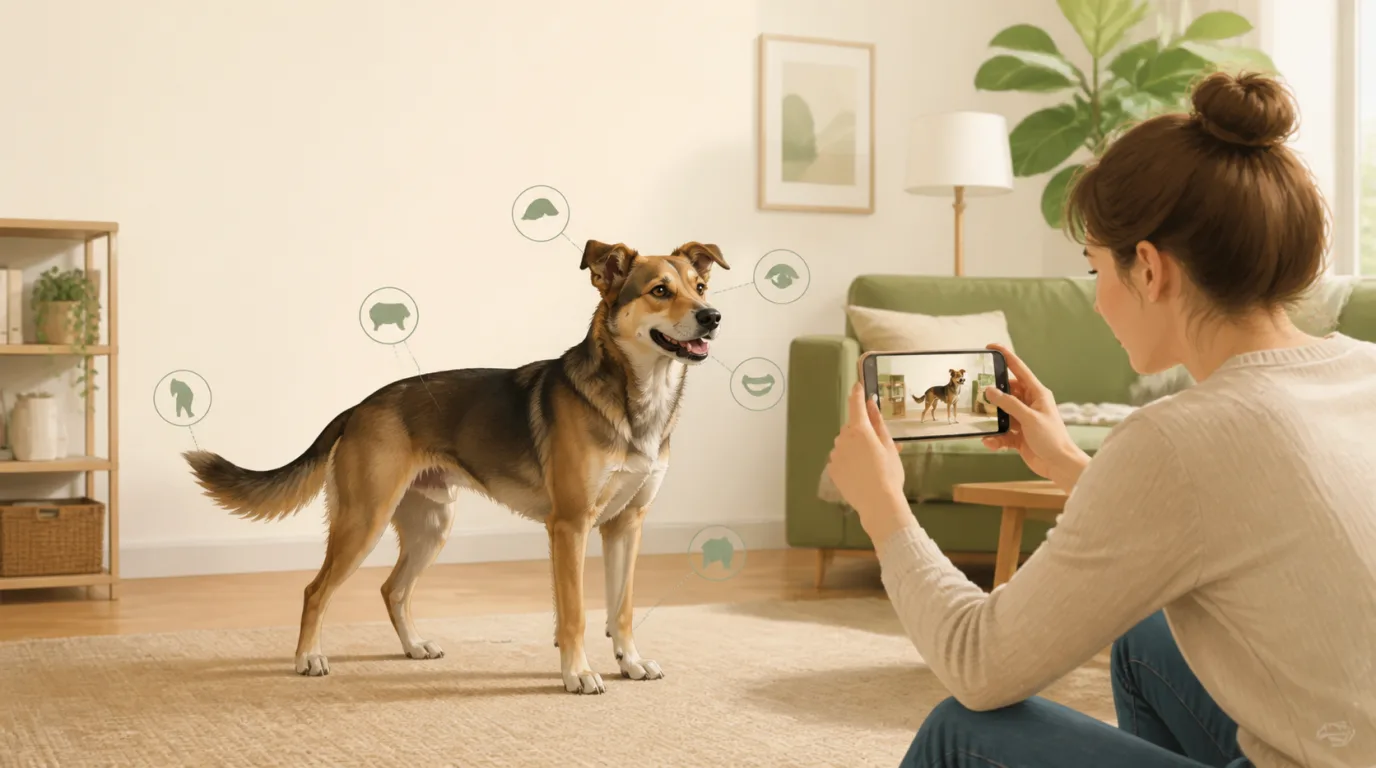
An AI dog body language analyzer can inspect a photo or short video for visible signals such as ear position, eye tension, mouth shape, tail carriage, posture and weight distribution. A responsible analyzer then combines those observations with the situation you describe and returns a cautious interpretation. If you are still choosing an image, start with the species-neutral pet behavior photo analysis checklist.
It cannot read a dog's thoughts. It cannot diagnose pain or anxiety, certify that a dog is safe, or turn a bark into a sentence. PetTranslator.ai is designed around that boundary: observation first, interpretation second, uncertainty shown rather than hidden.
What the analyzer looks for
Dogs communicate with clusters, not isolated gestures. A wagging tail does not automatically mean friendly. Ears held back do not automatically mean fear. The value comes from reading several regions together and comparing them with the dog's normal appearance and immediate context.
PetTranslator looks for visible features including:
- ear direction and tension at the base
- eye openness, gaze and visible sclera
- mouth opening, lip line, jaw tension, lip licking and panting context
- head and neck orientation
- body height, muscular tension and stillness
- weight shifted forward, centered or backward
- tail height and movement when visible
- the relationship between the dog, person, object or exit in frame
The full dog body language guide explains these signals in detail. The analyzer's job is to apply the same whole-body discipline to the media you provide, not to attach a fixed emotion to one ear or tail position.
How AI dog behavior analysis works
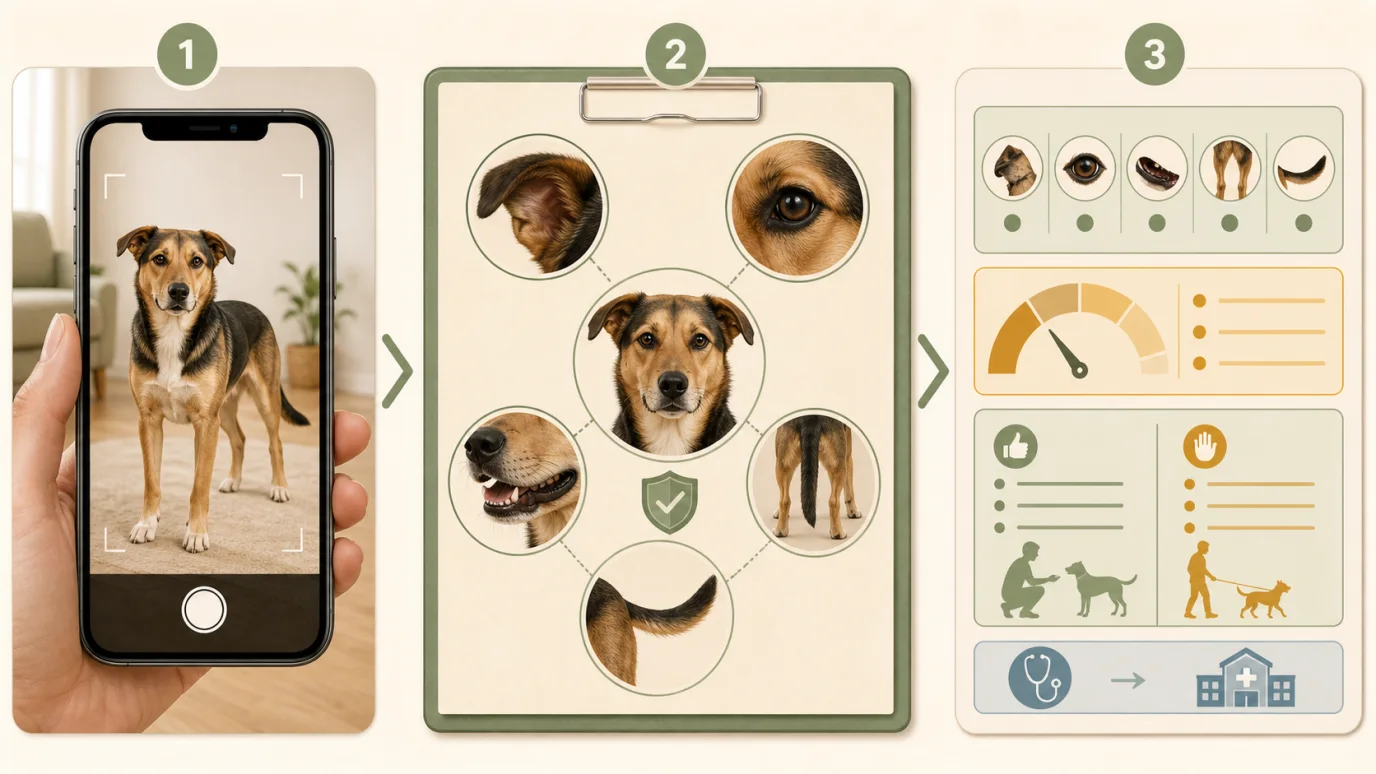
The useful workflow has four parts.
1. You provide a photo or short video
A still image can preserve a half-second signal that was easy to miss. A short clip adds transitions, movement, pauses and recovery. Neither automatically supplies the event history, so your note matters too.
2. The system records observable markers
The report should say what is visible before saying what it might mean. For example: mouth closed, commissures tight, ears rotated back, weight shifted away, tail below the spine. That list can be checked against the image.
3. It weighs context and signal agreement
The same panting can occur after exercise, in heat, during stress or with a medical problem. "Just finished running" changes the interpretation. So does "resting in a cool room and suddenly panting." Context narrows possibilities, but it does not justify inventing information outside the frame.
4. It produces a bounded report
PetTranslator returns visible observations, a behavioral interpretation, a confidence level, and a Do/Avoid plan. A lower-quality or ambiguous input should produce more uncertainty, not a more dramatic story.
What you receive in a PetTranslator report
Observed markers. A structured list of the body regions the system can assess and what appears visible.
Interpretation. A plain-language explanation of the patterns those markers may support, phrased as a likelihood rather than a declaration of the dog's private thoughts.
Confidence. An indication of how well the visible signals agree and how much the image quality or framing limits the read.
Do/Avoid plan. Immediate, force-free handling suggestions appropriate to the observed pattern, such as adding distance, preserving an exit, pausing an interaction or collecting better evidence.
Escalation boundary. Medical changes, serious aggression and high-risk situations belong with a veterinarian or qualified behavior professional. The report should make that boundary clearer, not blur it.
Premium reports can be exported as a PDF for your records or to support a veterinary conversation. The PDF organizes observations; it is not a veterinary report or diagnosis.
How to take a useful dog photo
The best input is not necessarily the prettiest portrait.
- Include the whole dog. Keep ears, face, torso, legs and tail in frame when possible.
- Use a side or three-quarter view. A head-on close-up hides weight distribution and much of the tail.
- Use even light. Backlighting and deep shadows can conceal eyes, mouth and ear set.
- Keep the real context visible. If it is safe, include the doorway, person, dog or object the dog is responding to.
- Do not create the behavior for the camera. Never approach, restrain, tease or expose a dog to a trigger to obtain an image.
- Add a factual note. Describe what happened immediately before, where the dog was, and what changed afterward.
A useful note reads: "A visitor entered 20 seconds earlier. Milo moved behind the chair, stopped taking treats and held this position until the visitor sat down." It is more informative than "Milo was acting weird."
When video is better than a photo
Use a short clip when the question depends on sequence: a greeting, approach and retreat, repeated lip licking, pacing, freezing, gait change or recovery after a sound.
Video can reveal whether the body becomes loose or stiff, whether the dog takes an offered exit, and what happened before a single captured posture. Research on emotion perception also supports reading bodies and dynamic information rather than relying on faces alone.
Record only naturally occurring behavior from a safe distance. If a dog has threatened, snapped or bitten, do not recreate the setup. Safety management and professional assessment come first.
What an AI analyzer cannot tell you
It cannot know one exact emotion from one frame
Visible behavior can support several explanations. A lowered posture may reflect fear, pain, learned behavior or the mechanics of movement. The report can rank plausible interpretations, but certainty requires history and often direct assessment.
It cannot predict a bite
Body language helps people recognize discomfort and create space. It does not provide a guarantee that a dog will or will not bite. A still, quiet dog can be at higher risk than a noisy dog if escape has been removed.
It cannot diagnose pain or disease
Posture, panting, withdrawal or irritability may be medically relevant, but an image cannot identify the cause. Sudden changes, asymmetry, altered gait, breathing difficulty, collapse, repeated vomiting or obvious pain require veterinary care.
It cannot replace baseline knowledge
Breed structure, coat, cropped ears, docked tails, age and disability change what can be seen. A report should acknowledge hidden or unavailable markers. Comparing the dog with their own normal posture is often more useful than comparing them with a generic dog.
It cannot make a dangerous situation safe
Do not use an analysis result as permission to approach a guarding, cornered, injured or highly aroused dog. Create distance and contact an appropriate professional.
How to judge any dog-analyzer app
Use this checklist, including on PetTranslator.ai:
| Question | More credible | Red flag |
|---|---|---|
| What does it claim? | Interprets visible signals | Translates exact thoughts or sentences |
| Does it show evidence? | Lists observable markers | Gives only an emotion label |
| How does it handle ambiguity? | Shows uncertainty and missing information | Produces certainty for every upload |
| Does it use context? | Asks what happened before and after | Treats every posture identically |
| What advice follows? | Force-free, low-risk next steps | Punishment, dominance or confrontation |
| Where does it stop? | Refers medical and serious behavior cases | Claims to diagnose or replace professionals |
| What happens to uploads? | States storage and training use plainly | Hides data practices |
For a broader category review, read do pet translator apps work?.
Privacy and pricing
PetTranslator processes uploaded photos, short clips and context to return the report. Current policy states that uploads are not used to train AI models and are not sold or published for marketing without explicit written permission. Account owners can delete analyses. Retention and account details are explained in the privacy policy.
You can start with three free analyses without a credit card. Paid plans add higher limits and features such as PDF export; see current pricing before choosing a plan.
Use the result as an observation aid
The most useful outcome is not an emotion badge. It is a better question: which visible markers changed, what happened around them, and what low-risk response should come next?
That makes an AI dog body language analyzer a learning and documentation tool. It can slow down a fast interaction, make signals easier to compare and help you prepare clearer notes. Your veterinarian and behavior professional still provide the medical examination, case history, risk assessment and individualized treatment that an upload cannot. The guide to a dog behavior assessment online explains which professional tier and assessment format fits different concerns.
Sources
- Bodily emotional expressions are a primary source of information for dogs, but not for humans: research showing the importance of whole-body information and limits in human dog-emotion categorization.
- Context and prediction matter for the interpretation of social interactions across species: evidence that social interpretation remains context-dependent, even for experienced observers.
- Dogs recognize dog and human emotions: evidence that dogs integrate visual and auditory emotional information.
- Visual perception of emotion cues in dogs: a critical review: review of methodological limits and face-focused bias in canine emotion research.
- AVSAB position statements: current professional guidance supporting reward-based, humane dog training.
Khabir Mughal is the founder of PetTranslator.ai. This page describes the current product and was checked against canine emotion-perception research and AVSAB guidance on August 18, 2026.