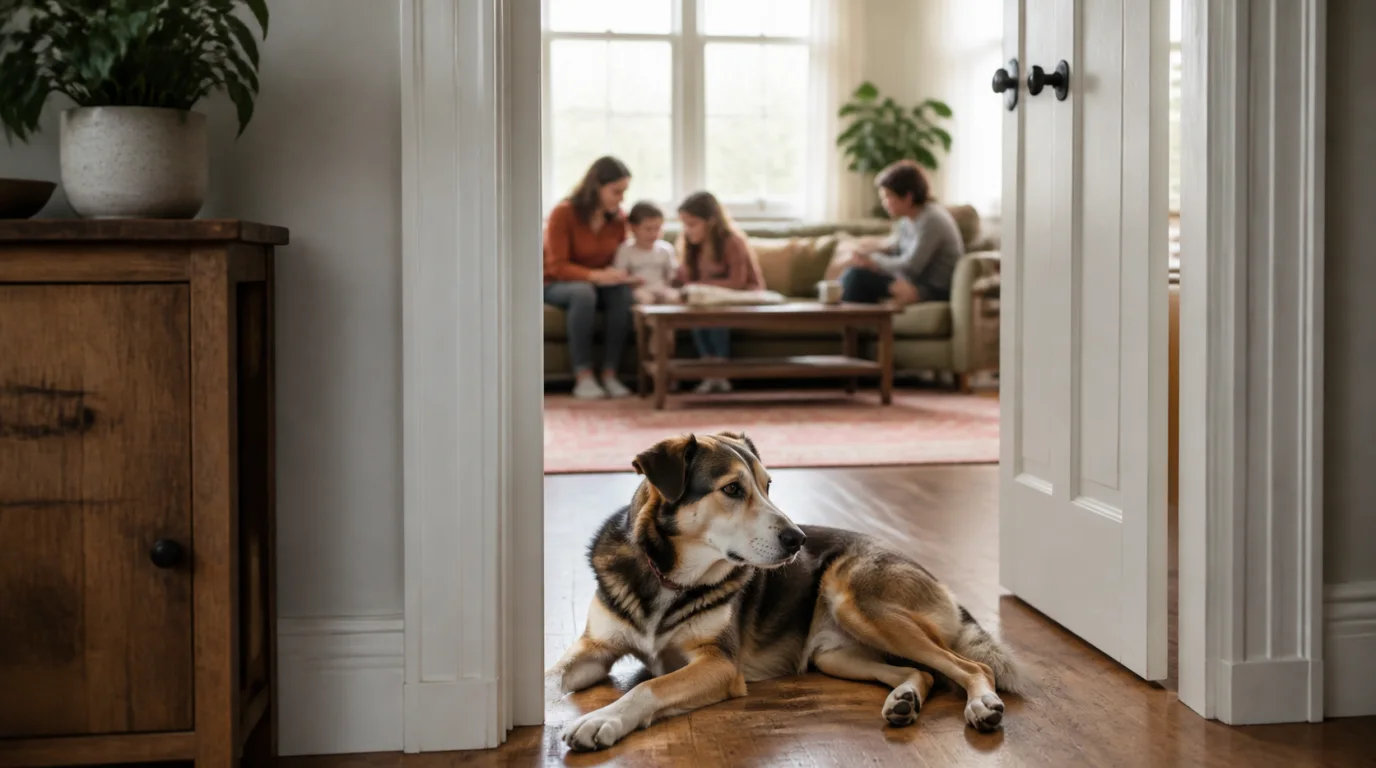
A dog may sit alone in another room because it is quieter, cooler or more comfortable. Voluntary solitude is not automatically sadness or rejection. The question changes when the behavior is new, lasts longer than usual, or appears with other physical or behavioral changes.
Compare the dog with their own baseline, not with a belief that every contented dog should stay beside a person.
Normal solitude versus withdrawal
| Observation | More consistent with ordinary preference | Adds concern |
|---|---|---|
| Choice | Dog walks to a familiar resting place and can leave freely | Dog hides in an unusual or hard-to-reach place |
| Body | Loose posture, normal breathing, ordinary sleep | Tension, trembling, panting, repeated repositioning or inability to settle |
| Response | Dog notices normal household activity and re-engages as usual | Dog is difficult to rouse, avoids familiar people or reacts unusually to touch |
| Routine | Pattern is longstanding and predictable | Sudden increase or a clear change from baseline |
| Physical signs | Normal appetite, movement and toileting | Limping, stiffness, appetite change, vomiting, diarrhea, coughing or accidents |
| Senior changes | Normal navigation and sleep cycle | Confusion, staring, getting stuck, night pacing or reversed sleep pattern |
One concerning sign does not name the cause, but it can change how quickly you should seek care.
The other room may simply feel better
Dogs choose resting places for practical reasons. A tile floor may be cooler than a carpet. A back room may be away from television, children, visitors or kitchen activity. Sunlight, airflow, bedding and the ability to watch a doorway can all affect the choice.
Some dogs also sleep more deeply when nobody is touching or stepping around them. If the dog has always used the room, looks comfortable, gets up easily and joins normal activities, the behavior may need no correction.
Do not repeatedly call the dog back to prove affection. Letting a dog rest undisturbed can be a healthy part of shared life.
A learned routine can look deliberate
A dog may go to another room at the same time each day because that location predicts a nap, a patch of sunlight or relief from household noise. The routine can persist after a schedule change.
Look at what happens before the dog leaves. Does a noisy appliance start? Do children arrive home? Does another pet take the couch? Does the room become warmer? These details are more useful than assigning a human motive such as sulking.
If another animal is controlling access to people, food, beds or routes, the dog may be leaving to avoid conflict. Watch for staring, blocking, following, freezing or one-sided displacement. Provide separate resting and feeding areas and get qualified help if tension is escalating.
Sudden isolation can be a pain or illness sign
Dogs in discomfort may seek a quiet, protected place. They may also reduce social contact because rising, being touched or moving through a busy room hurts.
Check for changes in:
- walking, stairs, jumping and getting up
- appetite, drinking and body weight
- urination and bowel movements
- breathing, panting and coughing
- sleep timing and restlessness
- grooming, licking or sensitivity
- response to familiar people and activities
Pain does not always cause crying. A quieter dog may be the only early clue. The pain signs in older dogs guide covers posture and routine changes that are easy to miss.
Contact a veterinarian when the withdrawal is sudden, persists, or accompanies another change. Do not wait for a dog to become visibly distressed before asking.
Fear and social pressure
A dog may retreat from visitors, loud sounds, handling, conflict or an unpredictable household interaction. The body can look low or tense, with ears back, a closed mouth, trembling, vigilance or reluctance to pass a person or animal.
Do not pull the dog out or force social exposure. Keep the exit open, reduce pressure and prevent anyone from following into the resting area. If the dog relaxes when the trigger is farther away, that response gives you useful context.
New fear or withdrawal still warrants veterinary assessment because pain and sensory change can alter tolerance. After health concerns are addressed, a reward-based behavior professional can help with a gradual plan.
Is it depression or separation anxiety?
Choosing another room while people are home is not the defining pattern of separation anxiety. Separation-related distress appears around actual or anticipated separation and can include vocalizing, destruction, escape behavior, elimination, panting, pacing or inability to eat when alone.
Likewise, isolation alone does not diagnose depression. A broad loss of interest, appetite or normal engagement needs a veterinary workup because pain and illness can produce the same picture. The guide Is my dog depressed? explains that differential.
Voluntary solitude and distress behind a closed door also differ. A dog who happily rests elsewhere may panic if confined away from the family. Record the door state and whether the dog chose the distance.
Senior dogs need a wider check
An older dog may choose a quieter room because hearing, vision, joint comfort and sleep patterns have changed. Cognitive dysfunction can also affect navigation, social interaction and the day-night cycle.
Watch for disorientation, staring, getting stuck behind furniture, house-soiling, altered greetings, night waking or repetitive pacing. The senior dog behavior guide and night-pacing guide explain what to document.
Age does not make a new change “just old age.” It makes a thorough examination more important.
Keep a short observation log
For two or three days, unless signs require faster care, record:
- Where the dog rests and whether the door is open.
- Time of day and room temperature.
- Household people, animals, sounds and activity.
- Body posture and breathing.
- Response when invited once, without pressure.
- Appetite, water, toileting, walking and sleep.
- How long the dog stays and what ends the episode.
The behavior-journal guide provides a reusable format. Video can show how the dog walks into the room, settles and rises, but do not disturb sleep solely to record a response.
What a photo or video can show
A photo may show room choice, posture, ears, eyes and surrounding stressors. Video can add movement, breathing, response to ordinary sounds and the transition into and out of the room.
PetTranslator.ai can organize visible observations and changes over time. It cannot diagnose pain, illness, cognitive dysfunction, depression or separation anxiety.
Frequently asked questions
Is my dog upset with me if they sit in another room?
There is no reason to assume that. Check comfort, noise, temperature, routine and the dog's normal preference. Human relationship labels are less useful than the visible sequence.
Why has my dog suddenly started hiding in another room?
Sudden withdrawal can accompany pain, illness, fear or a household change. Look for physical and routine changes and arrange a veterinary assessment, especially if the pattern persists.
Should I make my dog stay with the family?
No, not when the dog is safely choosing rest. Preserve access and invite once if needed. Forcing contact can increase pressure and conceal the reason the dog moved away.
Sources
- AAHA. Help! Is this a pet emergency?.
- AAHA. 2022 Pain Management Guidelines for Dogs and Cats.
- AAHA. Age and behavior.
- Merck Veterinary Manual. Behavior problems of dogs.
- AVSAB. Humane dog training position statement.
Khabir Mughal is the founder of PetTranslator.ai. This article was researched against current veterinary pain and behavior guidance. It was last reviewed on September 1, 2026.