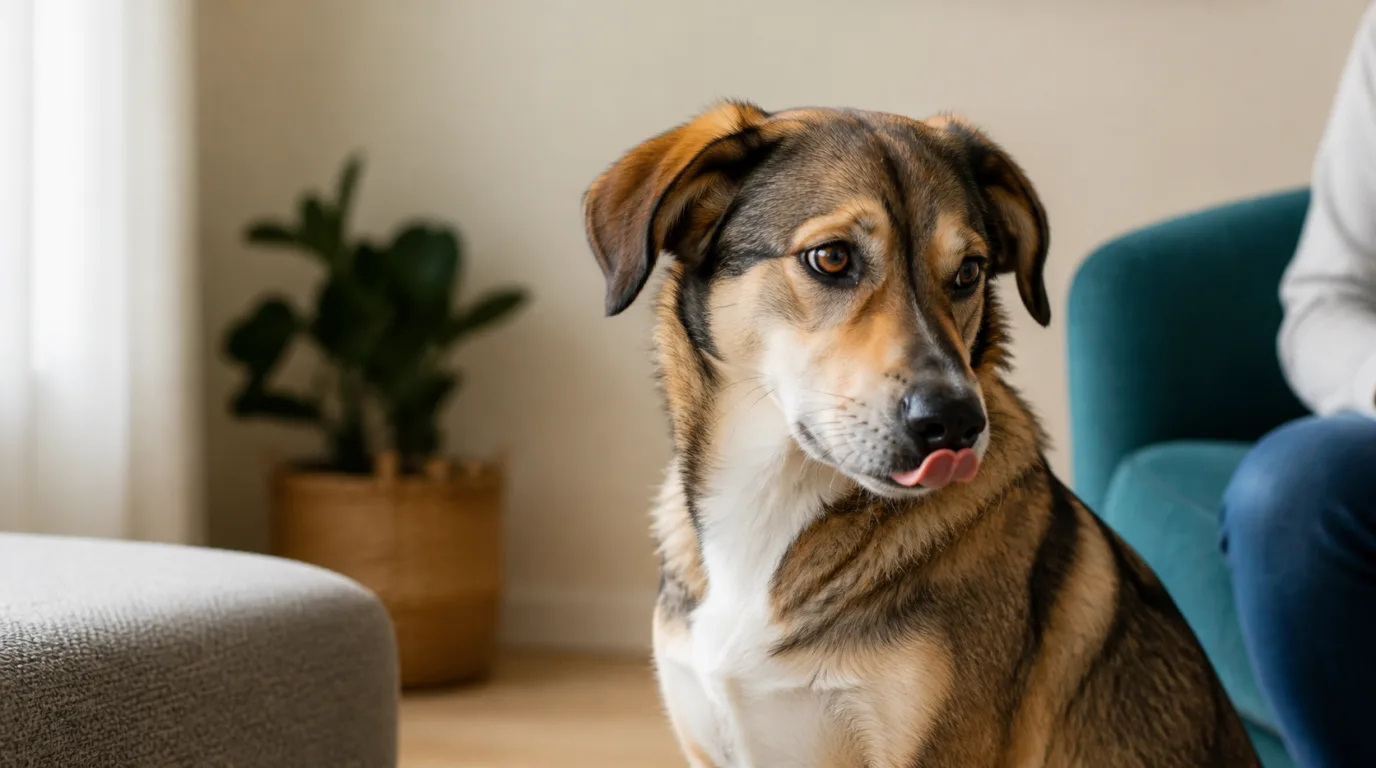
Dog calming signals are small behaviors such as looking away, licking the nose, yawning, sniffing, slowing down or turning the body aside. A dog may use them when uncertain, socially pressured or trying to avoid conflict. The behavior alone is not a translation. Its timing, context and accompanying body language determine whether it matters.
If your dog licks their nose after eating, that is probably cleanup. If the same lick appears when a stranger bends over them, followed by a head turn and a tense mouth, it may be an early request for space.
What are dog calming signals?
Norwegian dog trainer Turid Rugaas popularized the term "calming signals" for movements she observed during tense approaches and social interactions. You may also see professionals call them appeasement signals, displacement behaviors, cut-off signals or stress signals. These labels overlap, but they do not mean exactly the same thing.
- An appeasement signal may communicate a non-aggressive intention to another individual.
- A displacement behavior is an ordinary action that appears out of its usual context, often when motivations conflict.
- A stress signal describes an observable behavior associated with discomfort or arousal without claiming a specific social function.
"Calming signal" is useful shorthand, but it can sound more certain than the evidence allows. A dog may lick their nose because of food, nausea, social tension or simple grooming. A yawn can reflect tiredness, anticipation or discomfort. Read the action as a clue, then check the rest of the scene.
Research supports that some of these behaviors carry social information. In a 2017 pilot study of dog-to-dog meetings, head turning, nose licking, freezing and turning away were among the most commonly observed candidate signals. The dogs produced more signals while interacting, especially with unfamiliar dogs. Because the study involved only 24 dogs, it supports careful observation rather than a universal dictionary.
A later study of 53 dogs approached by unfamiliar people found that blinking, nose licking and lip wiping were associated with a non-reactive attitude, while head turning was associated with a non-reactive attitude during the threatening approach. The behaviors were not exclusive to conflict, which is another reason context matters.
How to tell a signal from an ordinary action
Use four checks before interpreting anything.
- What happened immediately before it? Look for an approach, touch, sound, restraint, training request or unfamiliar dog.
- Does the action fit the practical context? Sniffing on a walk is expected. Sudden ground sniffing when another dog rushes straight toward yours may carry different information.
- What else changed? Check the eyes, ears, mouth, tail, posture, movement and weight distribution.
- Is this different from the dog's baseline? Some dogs lick frequently, show more eye white because of their anatomy or move slowly because of age or pain.
One brief gesture with no other change may mean little. A quick sequence of avoidance, tension and displacement deserves more attention. The complete dog body language guide explains how to read these regions together.
12 common calming signals
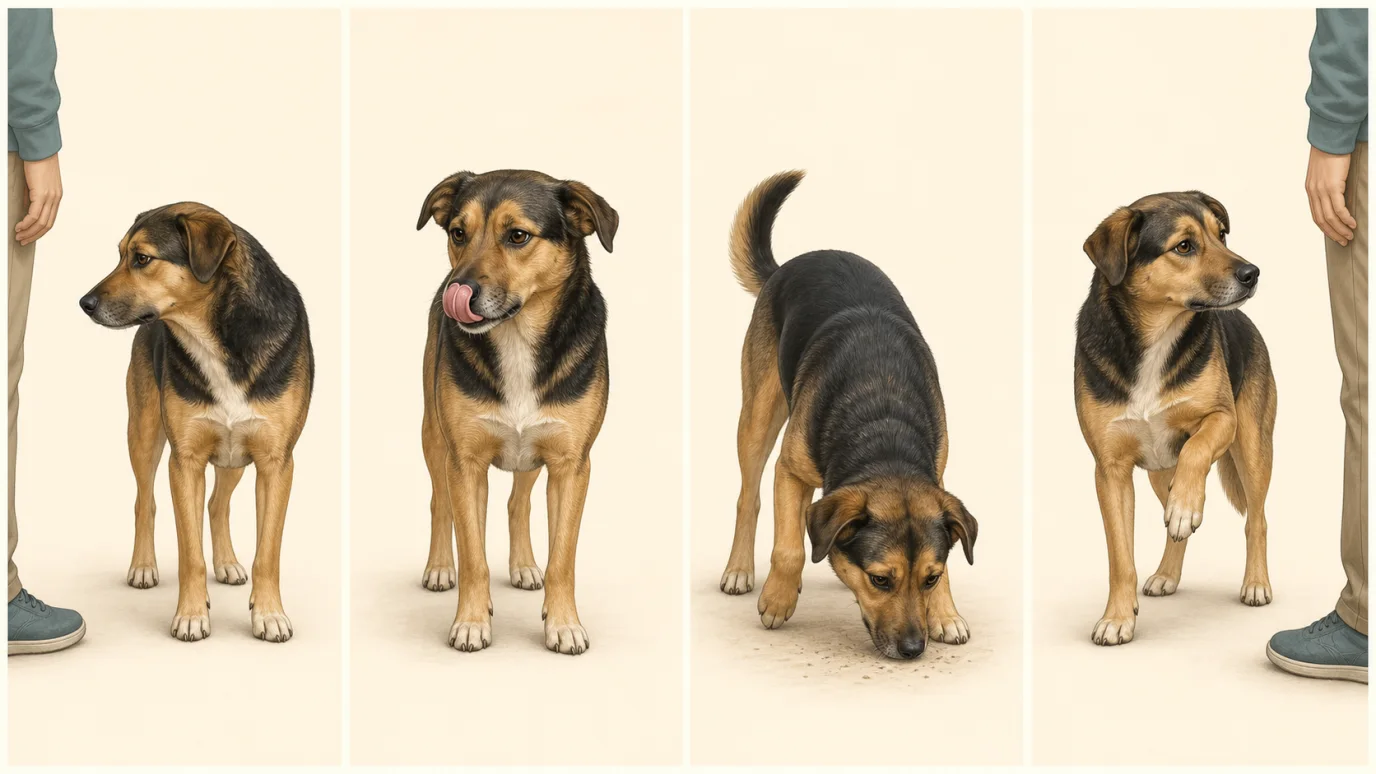
The same dog demonstrates four observable cues. From left: head turn, nose lick, ground sniff and paw lift. None has one fixed meaning, so compare the cue with the trigger, posture and the dog's usual behavior.
| Signal | Ordinary explanation | When social pressure or stress is more plausible |
|---|---|---|
| Looking away | Attention moved to a sound or object | Appears as a person or dog approaches, especially with facial tension |
| Turning the head | Tracking the environment | Repeatedly turning away from touch, restraint or direct staring |
| Turning the body away | Repositioning or leaving | The dog angles or presents their side when another individual closes distance |
| Lip or nose licking | Food, grooming, dry mouth or nausea | No food is present and the lick follows an approach, handling or difficult request |
| Yawning | Tiredness or waking | Appears during conflict, restraint, a long training session or an unfamiliar interaction |
| Sniffing the ground | Normal scent investigation | Starts abruptly when social pressure rises and stops when the trigger leaves |
| Moving slowly | Fatigue, age, pain or environmental caution | The dog slows during a direct approach or after a harsh cue |
| Curving approach | Following scent or terrain | The dog avoids a straight, face-to-face approach to another dog or person |
| Freezing | Focus, listening or stalking | The whole body becomes still and tense during an interaction or unwanted touch |
| Paw lift | Pointing, anticipation, injury or a trained behavior | A tentative lift appears with a low posture, head turn or lip lick |
| Shaking off | Wet coat, itch or waking | A full-body shake follows a tense greeting, handling or stressful event |
| Scratching or self-grooming | A real itch or routine grooming | Appears suddenly in the middle of a demanding or uncertain interaction |
The table is a comparison tool, not a scoring system. Medical causes remain possible, especially when a behavior is frequent, sudden or appears outside social situations.
What are dog appeasement gestures?
Appeasement describes a possible social function: behavior that may reduce conflict or communicate non-threatening intent. It is not a personality type and it is not a synonym for obedience. The same visible action can be affiliative in one greeting, fear-related in another interaction and ordinary movement in a third.
Two broad patterns help organize what you see.
Active, affiliative appeasement
The dog voluntarily moves toward a familiar person or dog with a loose, curved body. Ears may sweep back, eyes soften or squint, the head lowers slightly, a front paw lifts and the tail wags low and broadly enough to move the hips. Some dogs lick near the muzzle or show a loose grin.
This can be part of a friendly greeting. The key features are voluntary approach, fluid movement and continued ability to leave. It still does not prove that the dog wants hugging, head patting or restraint.
Passive, fear-related appeasement
The dog stays low or rolls partly over while weight shifts away. The tail may tuck, ears pin, mouth tighten and head turn away while the eyes monitor the person. Movement becomes slow, still or retreat-oriented. This pattern asks for less pressure, not more contact.
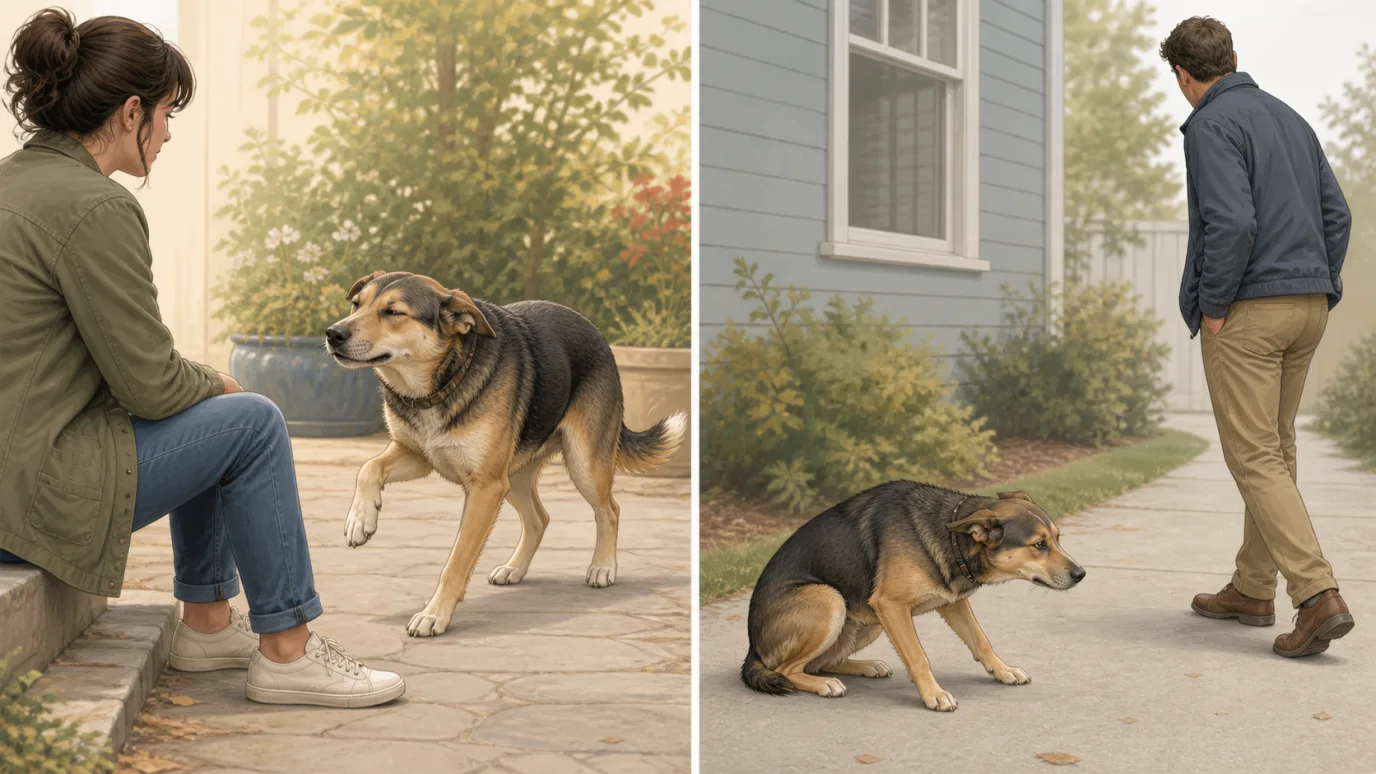
Movement and muscle tension separate the patterns. The active dog approaches loosely; the passive dog stays low or shifts away while the person stops advancing.
| Feature | Active affiliative pattern | Passive fear-related pattern |
|---|---|---|
| Movement | Approaches voluntarily in curves | Freezes, creeps, leans or moves away |
| Muscles | Loose and fluid | Compact, rigid or trembling |
| Tail | Low, broad wag with body movement | Tucked, still or narrow movement |
| Face | Soft squint, relaxed mouth, ears softly back | Averted head, tight mouth, pinned ears, possible eye white |
| Best response | Stay neutral and let the dog choose contact | Stop approaching and open an exit |
These categories are observation aids, not formal diagnoses. Dogs can show mixed signals. A dog may approach because social pressure, a leash or a learned greeting pattern limits other choices. When movement says “closer” but tension says “uncertain,” pause and let the dog decide what happens next.
“Submissive” is often used for both patterns, but it can hide the practical difference between friendly approach and fear-related withdrawal. “Guilty” is also misleading: lowered posture, ears back and lip licking after a person scolds reflect the present interaction, not proof that the dog understands or regrets an earlier act.
Read clusters, not isolated gestures
Imagine a dog at a family gathering. A visitor walks straight toward the dog, leans over and reaches for the top of the head. The dog licks their nose, turns away and shifts their weight backward. Those actions form a coherent cluster because they start as the visitor applies pressure and point in the same direction: the dog is uncomfortable with the approach.
Now imagine the dog yawns once after waking, stretches and walks toward the kitchen with a loose body. Calling that a calming signal would add a story the scene does not support.
Useful questions include:
- Did the behavior start when a specific trigger appeared?
- Does it stop or soften when distance increases?
- Is the dog's body becoming looser or tighter?
- Can the dog disengage, take food and return to normal activity?
- Is the behavior becoming faster, more frequent or more intense?
Subtle signals can precede more obvious signs such as a tucked tail, escape attempts, growling or snapping. Dogs Trust lists head and body turns, out-of-context lip licking, yawning, freezing and facial tension among early signs of stress. Catching that early stage gives you more safe options.
Four situations where owners often miss them
A child hugs the dog
The dog turns their head, licks their nose and holds still. Adults may read the stillness as patience. In context, the dog has lost the option to move away and is showing discomfort. End the hug calmly and give the dog an escape route. Children and dogs need active adult supervision even when the family dog has never bitten.
A stranger reaches over the dog's head
The dog lowers slightly, turns away or sniffs the ground. Ask the person to pause and stand sideways. Let the dog choose whether to approach. Reaching farther because the dog moved away increases pressure.
Training stops making sense
The dog begins sniffing, scratching or looking away after several failed repetitions. Check whether the cue is clear, the environment is too difficult or the session has gone on too long. A short break and an easier repetition are more useful than repeating the cue louder.
The veterinary exam
Lip licking, yawning, freezing and leaning away can appear during handling. Tell the veterinary team what you see. Ask whether the exam can pause, move to the floor, use food if medically appropriate or follow a lower-stress handling plan. A dog who freezes is not necessarily comfortable or consenting.
What to do when you notice calming signals
Respond to the situation rather than trying to stop the gesture.
- Pause the approach, touch or request.
- Turn your body slightly sideways and soften direct eye contact.
- Add distance or provide a clear route away.
- Give the dog time to look, sniff and recover without being followed.
- Resume only if the body becomes loose and the dog freely chooses to re-engage.
Food can support a well-planned behavior program, but offering a treat does not make unwanted handling safe. If the dog takes food with a rigid body, watch the posture rather than assuming the eating proves comfort.
Avoid these responses
- Do not punish looking away, growling or moving away.
- Do not hold the dog in place so they "get used to it."
- Do not crowd a dog who has frozen.
- Do not invite another dog closer because yours has not barked.
- Do not test the same trigger repeatedly to confirm your interpretation.
Giving space is not rewarding fear. It changes the immediate conditions so the dog does not need to escalate.
When the situation needs professional help
Contact a veterinarian when the behavior is new, frequent or accompanied by pain signs, appetite changes, vomiting, drooling, mobility changes, sleep disruption or unusual withdrawal. Lip licking, slowing, freezing and reluctance to be touched can have medical causes.
Seek qualified behavior help when:
- the signals progress to growling, snapping or biting
- the dog cannot recover after the trigger passes
- ordinary walks, visitors, grooming or veterinary care are becoming difficult
- avoidance is increasing despite your attempts to reduce pressure
- children or vulnerable adults share the environment
The guide to finding a credentialed behaviorist explains what qualifications to look for. For immediate bite risk, use barriers and distance while arranging professional help. Do not attempt a staged interaction for a photo or video.
What a photo can and cannot show
A clear image can capture ear position, eye shape, mouth tension, head direction, posture and weight shift. It cannot show what happened a moment earlier, how long the behavior lasted or whether the dog recovered when the trigger moved away. Short video usually provides better context for movement-based signals.
PetTranslator.ai separates visible observations from interpretation and provides a confidence estimate. Use that report to organize what you notice, not to diagnose anxiety or declare what a dog is "saying." Include the setting, recent events and any health changes when you review the result.
Frequently asked questions
Are calming signals always signs of stress?
No. The same actions also occur during grooming, exploration, tiredness, anticipation and play. Timing, context, accompanying signals and the dog's normal baseline determine whether discomfort is a reasonable interpretation.
Can people use calming signals with dogs?
Turning sideways, avoiding a direct looming approach, moving slowly and allowing distance can reduce social pressure. There is not enough evidence to claim that copying a yawn or lip lick reliably communicates a specific message to every dog.
Is freezing a calming signal?
Freezing appears in lists of calming, appeasement and stress-related behaviors, but it can also reflect intense focus, stalking or pain. During close interaction, a tense freeze is a reason to stop and create space. Do not touch the dog to test the interpretation.
What is the difference between calming signals and displacement behaviors?
Displacement describes an ordinary behavior appearing outside its expected context, often during conflict or uncertainty. "Calming signal" proposes a possible regulatory or social function. One observed action may fit both descriptions, but the function cannot be known from appearance alone.
Are appeasement gestures the same as submission?
Not exactly. Appeasement proposes a conflict-reducing or non-threatening social function. “Submission” is often used as a broad status label and can obscure whether the dog is approaching loosely, freezing in fear or trying to leave. Describe the posture and movement instead.
Does an appeasement roll mean the dog wants a belly rub?
Not necessarily. A tense dog with a tucked tail, pinned ears and tracking eyes may be trying to stop an interaction. Do not touch. A loose dog who voluntarily re-engages may enjoy contact, but use a pause-based petting consent check.
Sources
- Mariti C, Falaschi C, Zilocchi M, et al. Analysis of the intraspecific visual communication in the domestic dog: a pilot study on the case of calming signals. Journal of Veterinary Behavior. 2017;18:49-55.
- Firnkes A, Bartels A, Bidoli E, Erhard M. Appeasement signals used by dogs during dog-human communication. Journal of Veterinary Behavior. 2017;19:35-44.
- Cavalli C, et al. Appeasement function of displacement behaviours? Dogs' behavioural displays exhibited towards threatening and neutral humans. Animal Cognition. 2023.
- Overall KL. Appeasement, calming signals, and information capture: how do our subjects tell us what matters to them?. Journal of Veterinary Behavior. 2017;19:v-viii.
- Dogs Trust. Signs your dog may be stressed.
- Rugaas T. On Talking Terms with Dogs: Calming Signals. 2nd ed. Dogwise Publishing; 2006.
Khabir Mughal is the founder of PetTranslator.ai. This article was researched against peer-reviewed canine communication studies and current animal-welfare guidance. It was last reviewed on August 18, 2026.