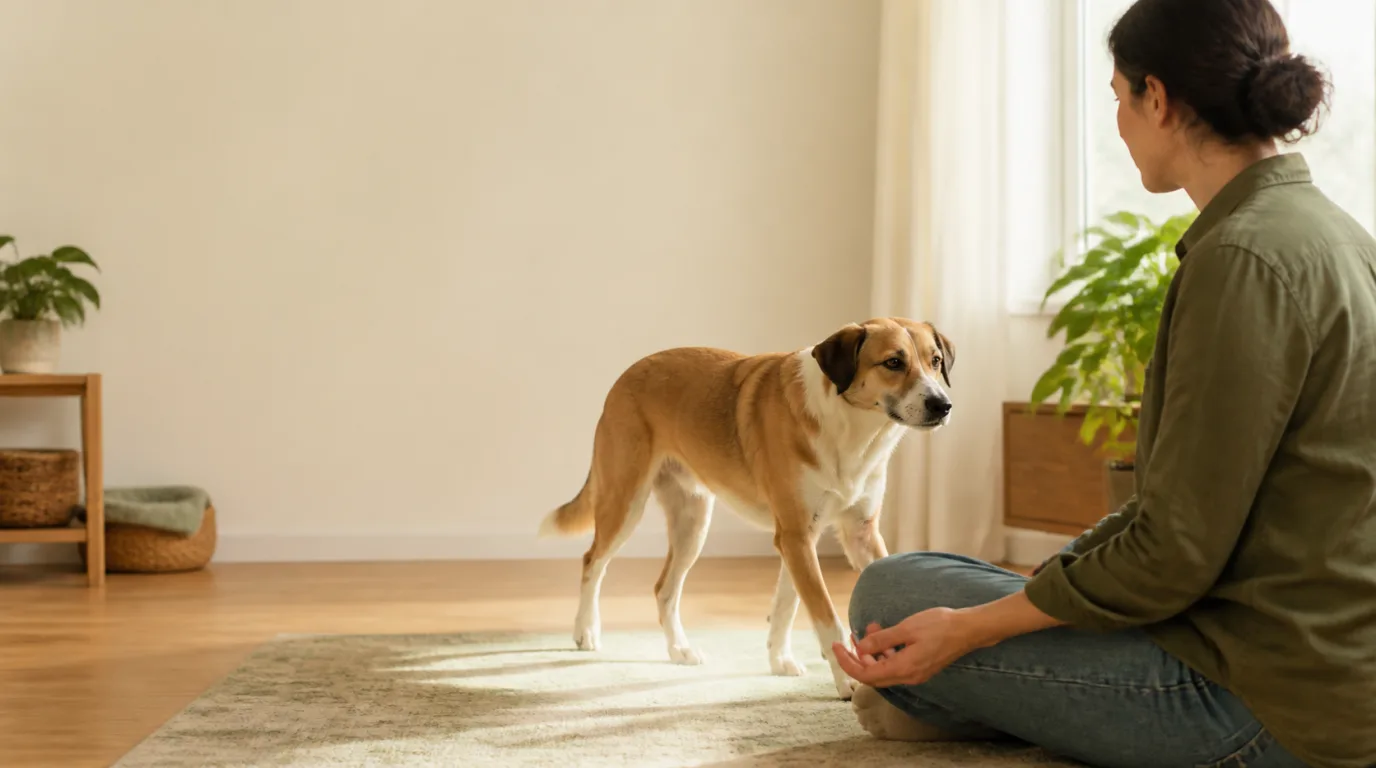
A dog petting consent test is a brief start-stop check: offer a few seconds of gentle touch, remove your hands, then watch what the dog chooses to do. A loose dog who deliberately moves back into contact may want more. A dog who turns away, stiffens, leaves or does not re-engage gets a pause.
The familiar name is useful, but this is not a scientifically validated pass/fail test. Dogs cannot give informed consent in the human legal sense. “Assent” is more precise: observable, voluntary participation that can be withdrawn. The goal is not to make a dog produce a yes. It is to make no easy, safe and effective.
Before touching, check the setup
Do not begin with your hand already on the dog. First ask whether the dog is awake, loose and able to move away.
A reasonable starting setup has:
- an open exit rather than a corner, crate or tight leash
- a dog who chose to approach or remain nearby
- loose movement and a soft face
- no food, toy, puppy or resting place being guarded
- no recent growl, freeze, retreat or attempt to hide
- an adult who can stop immediately
Skip the test if the dog is sleeping, eating, injured, trapped, highly aroused or already asking for distance. Do not wake a dog with touch. With an unfamiliar dog, ask the caregiver first and accept “no” without trying to persuade the dog.
How to do the petting consent test
- Let the dog choose proximity. Turn slightly sideways and keep your hands low. Do not lean over, stare or push a hand into the dog's face.
- Touch briefly. If the body remains loose, stroke the shoulder or chest gently for about three seconds. Avoid hugging, patting the head or holding the collar.
- Remove both hands. Pause long enough for the dog to make a choice. Stay neutral rather than calling, patting your lap or luring with food.
- Read the whole response. Continue only when the dog's movement back toward contact is deliberate and the rest of the body remains comfortable. Repeat the pause throughout the interaction.
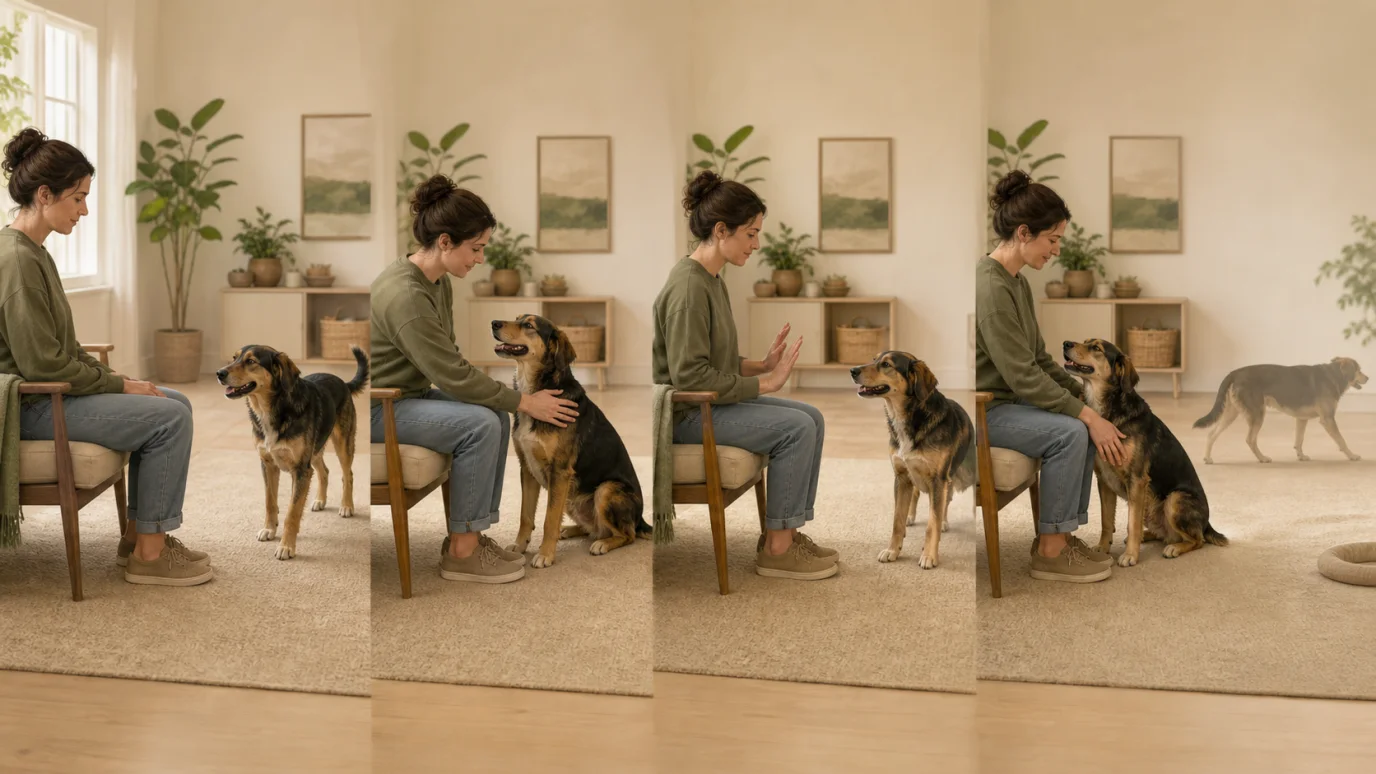
The pause matters. It gives the dog a real opportunity to request more contact or end the interaction.
Three seconds is a convenient observation window, not a biological threshold. A shorter touch may be appropriate for a cautious dog. If any discomfort appears before the pause, stop immediately.
Signs that may support continuing
Look for an active choice together with a loose body. Examples include:
- moving the shoulder or chest back under the resting hand
- leaning in with relaxed muscles
- nudging the hand, then staying soft when contact resumes
- repositioning to present a preferred area
- leaving briefly and returning to seek contact
Continue in another short interval, not indefinitely. Preferences can change within the same session.
One signal is not enough. A paw placed on you can be a learned request, an attempt to create space or simple balance. A dog who comes close may want information, warmth or proximity without wanting touch. Check what happens when the hand remains still.
Signs to stop
Stop and give space if the dog:
- turns the head or body away
- steps away, hides or places a barrier between you
- freezes or becomes stiff
- closes the mouth abruptly or fixes the gaze
- pins the ears, tucks the tail or leans back
- lip-licks, yawns or lifts a paw in a tense context
- growls, shows teeth, snaps or tries to escape
The guide to dog calming signals explains why a head turn or lip lick needs context. During close touch, several of these changes together are enough reason to stop. Do not repeat the contact to see whether the dog “really means it.”
What if the response is unclear?
No clear re-engagement means wait. Stillness is not permission. Neither is tolerating your hand, taking treats, wagging, rolling over or failing to leave when the exit is difficult.
If the dog remains nearby but does not seek renewed contact, enjoy the proximity without touching. You can try another day in an easier setting. Some dogs prefer sitting beside a person to being stroked.
Conflicting signals also call for a pause. A dog may lean closer while the body stays rigid, or paw while repeatedly turning the head away. Motivation can be mixed. You do not need to resolve the dog's internal state before choosing the safer response.
Abrupt ground sniffing during social pressure can be another request for time or distance, but ordinary scent investigation remains the more common explanation.
Where should you pet a dog?
Many dogs find the chest, shoulder or side less intrusive than a hand descending over the head. That is a starting point, not a universal preference. Individual dogs may solicit ear scratches, back strokes or no petting at all.
Avoid turning the check into restraint. Do not hug, pin, hold the muzzle, trap the dog between your knees or follow when they move away. Belly exposure is particularly easy to misread. A loose dog may invite touch, while a tense dog may be using an appeasement posture. Read the full belly-up body-language guide before assuming it is a belly-rub request.
Children and unfamiliar dogs
A child should not conduct this test without close adult control. Children can miss subtle tension and may move suddenly when a dog disengages. The safer default with an unfamiliar dog is no petting.
If the caregiver agrees and the dog is loose and approaching, the adult should manage the interaction. Keep faces away from the dog's face, leave the dog an exit and end at the first sign of avoidance. Never ask a child to hug a dog or disturb one who is resting, eating or caring for puppies.
The same caution applies when a friendly-looking dog is on leash. A wag does not guarantee comfort, and the leash may remove the option to leave.
Petting is not always a reward
Some dogs seek prolonged social touch. Research has found that dogs in particular experimental settings spent more time near a person providing petting than one providing vocal praise. Other work shows that experience and context shape responses to human contact.
That does not mean petting rewards every dog in every moment. If a dog freezes or leans away when you pet them after a recall, the touch may weaken rather than reward the behavior. Let the dog's response tell you whether food, play, access to sniffing or touch is valuable then.
Optional affection versus necessary care
The start-stop check is designed for optional social touch. Grooming, medication and veterinary procedures sometimes cannot wait for voluntary re-engagement. Even then, discomfort should not simply be overridden.
Cooperative-care training can teach a dog to approach a station, present a body part and take breaks during handling. For necessary procedures, a veterinarian may recommend environmental changes, pre-visit medication, pain control or sedation. Food during handling can improve the experience, but eating alone does not prove the dog is relaxed.
Do not use repeated “consent tests” on a painful area. Train easy handling skills when the dog is well and work with qualified professionals when care is urgent.
When touch sensitivity may be pain
A dog who suddenly avoids petting may be protecting a painful area. Look for a reaction tied to one location, trouble rising, altered gait, reluctance to jump, reduced activity, sleep changes or new irritability.
Arrange a veterinary examination for a new, persistent or worsening change. The guide to pain signs in older dogs provides a broader checklist, though pain can affect dogs of any age. Seek prompt care after injury or with severe pain, weakness, collapse, breathing difficulty or inability to stand.
If medical causes are addressed but handling fear continues, consult a reward-based trainer or veterinary behavior professional. Our guide to finding a credentialed behaviorist explains the main qualifications.
What a photo or video can show
A photo can capture posture, ears, eyes, mouth and hand position, but it cannot show whether the dog chose to approach or what happened during the pause. A short video is better for the sequence.
Record only a naturally occurring, safe interaction. Do not provoke tension for the camera. PetTranslator.ai can organize visible markers and separate observation from possible interpretation, but it cannot certify consent, predict a bite or diagnose pain.
Frequently asked questions
What is the three-second rule for petting a dog?
Pet gently for about three seconds, remove your hands and watch whether the dog voluntarily re-engages. Three seconds is a practical pause point, not a validated biological rule.
Does leaning mean my dog wants more petting?
It can, especially when the dog deliberately moves back into contact with a loose body. Leaning with stiffness, avoidance or a blocked exit is ambiguous, so pause.
Why does my dog paw me when I stop petting?
The paw may request more contact, but it can also be a learned attention behavior or an attempt to affect your position. Check the dog's whole body and resume briefly only if they remain loose.
Should I offer my hand for a dog to sniff?
You do not need to push a hand toward the dog's nose. Stand or sit sideways with hands low and let the dog choose whether to approach, investigate or leave.
Can I use the test with a nervous dog?
Do not start touch when the dog is tense, retreating or trapped. Give space first. A professional can help with a gradual handling plan if everyday care is difficult.
Sources
- Preventive Vet. How to ask your dog if they want to be petted.
- VCA Animal Hospitals. Teaching calm and handling exercises.
- VCA Animal Hospitals. Using predictable rewards to train your dog.
- RSPCA. Understanding a dog's body language.
- Feuerbacher and Wynne. Dogs prefer petting to vocal praise in choice procedures.
- Bhattacharjee et al. Free-ranging dogs and repeated social interaction with unfamiliar humans.
- Kuhne et al. Dogs' affective responses to tactile human-dog interactions.
Khabir Mughal is the founder of PetTranslator.ai. This article was researched against veterinary handling guidance, welfare guidance and canine touch research. It was last reviewed on August 18, 2026.