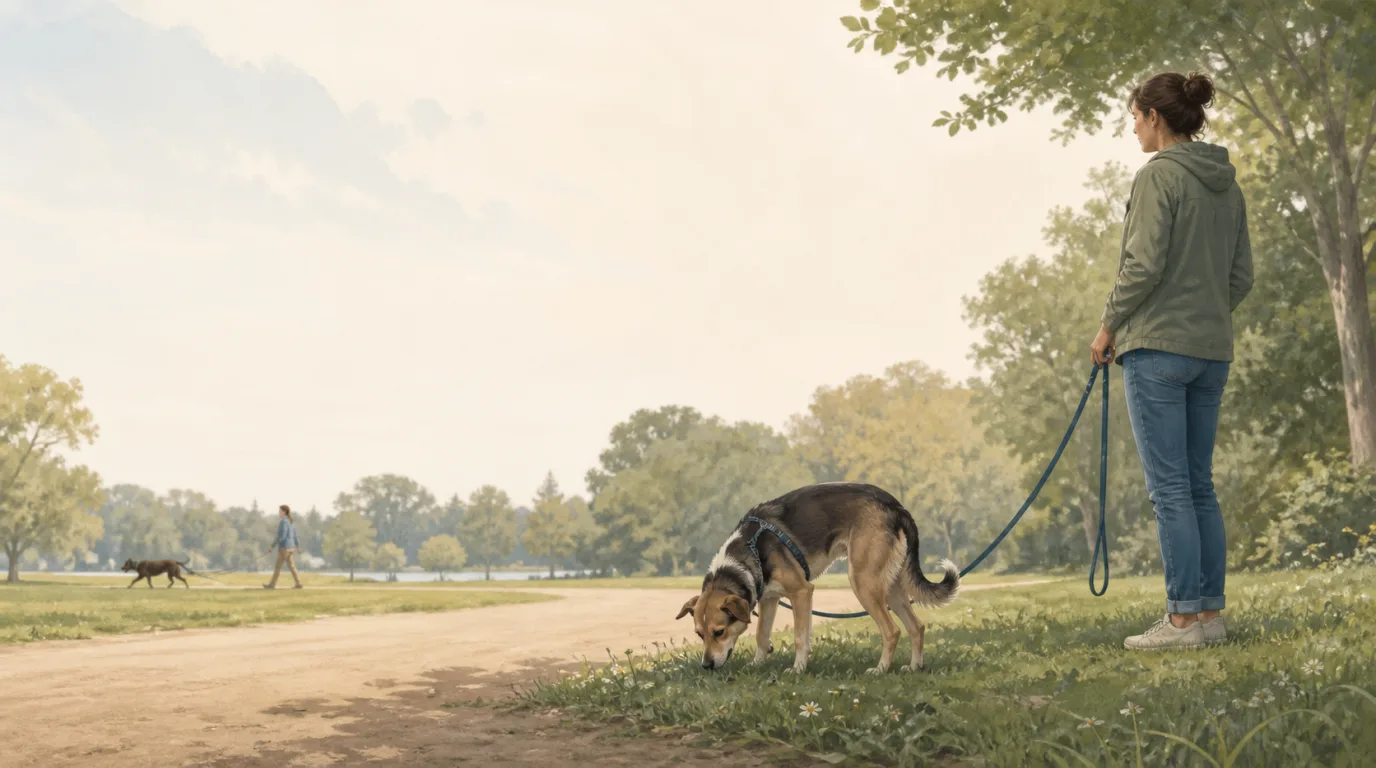
Ground sniffing is usually normal dog behavior, not a stress signal. It becomes relevant to stress when it begins abruptly as pressure rises, appears with tension or avoidance, and changes after the dog gets more distance. The nose-down action alone cannot tell you why it happened.
A dog may sniff the same patch because it contains detailed scent information. Another may drop their nose when a dog approaches because investigating the ground delays or avoids a direct greeting. Both look similar in a photo. Timing and the rest of the body separate them.
The five-part context check
Use five questions instead of labeling the sniff on sight:
- Timing: Did sniffing start before or immediately after a person, dog, noise or difficult request appeared?
- Pattern: Is the dog exploring loosely, following a trail, searching for food, fixed on one area or scanning frantically?
- Posture: Are the body, tail, mouth and movement loose, or are they low, rigid, fast or hesitant?
- Choice: Can the dog leave, change direction and lift their head, or is the leash tight and the route blocked?
- Recovery: Does the dog loosen when pressure decreases, or remain vigilant and unable to disengage?
One answer rarely settles the question. A cluster and repeatable sequence make a stress interpretation more plausible.
Five kinds of ground sniffing
| Pattern | What you may see | Likely context | Response |
|---|---|---|---|
| Ordinary investigation | Loose route, varied surfaces, easy head lifts | Gathering scent information | Allow time to explore safely |
| Tracking | Purposeful movement along a continuous route | Following a person, animal or odor trail | Manage the leash and environment |
| Foraging | Searching patches, eating or checking likely food areas | Food seeking or a trained scent game | Prevent unsafe scavenging |
| Possible displacement | Abrupt nose drop during social or task pressure | Conflict, uncertainty or delay | Pause and add space |
| High-arousal sniffing | Fast, forceful scanning with tension and poor disengagement | Excitement, frustration, fear or a fresh animal trail | Increase distance and reduce intensity |
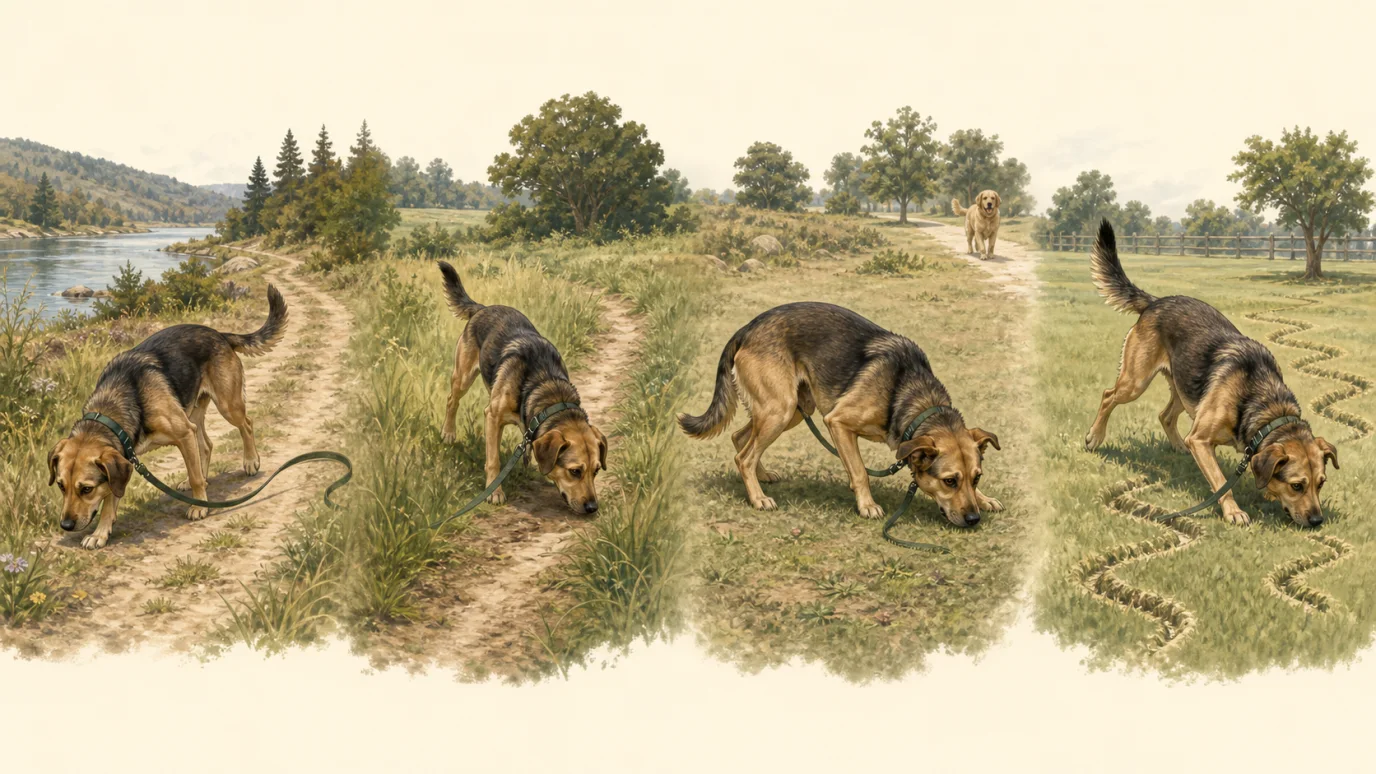
The nose position is similar. Direction, muscle tension, trigger and ability to disengage change the interpretation.
Sniffing one spot is not automatically displacement, and moving across an area is not automatically relaxed. Odor travels and pools according to wind, surface and moisture. A dog following the scent of a recently passing animal may look frantic without responding to a visible social threat.
What is displacement sniffing?
Displacement behavior is an ordinary action appearing at a moment when it does not seem to serve its usual function. It is often associated with conflicting motivations, frustration or stress. A dog may want to approach another dog and avoid a direct interaction at the same time, then sniff while those options compete.
Researchers have grouped environmental sniffing with behaviors such as nose licking, yawning and looking away in studies of canine responses to social situations. The findings support contextual observation, not a universal translation. The complete dog displacement behavior guide covers the broader category and evidence.
Some trainers call ground sniffing a calming signal. It may reduce social pressure by interrupting direct orientation, but observation cannot prove that every dog is intentionally sending a message. “The dog dropped their nose as the stranger approached” is solid. “The dog was telling the stranger to calm down” is a hypothesis.
During a dog-to-dog approach
Imagine another dog walking directly toward yours. Your dog slows, turns slightly and begins sniffing. The movement may be a way to avoid a head-on greeting or cope with uncertainty. Do not drag the dog forward because the dogs “need to say hello.”
Move away in a curve and keep the leash loose enough for natural movement. If your dog lifts their head, loosens and resumes ordinary exploration at greater distance, the change supports a social-pressure interpretation.
If the body stays stiff, the gaze repeatedly snaps back or the dog surges toward the other dog, sniffing has not made a close greeting safe. End the approach. Dogs do not need to greet every dog they pass.
During training
A dog who suddenly sniffs after several errors may be distracted by odor, uncertain about the cue, tired or affected by the environment. Repeating the cue louder does not identify which.
Pause, move to an easier location and ask for a well-practiced behavior once. Reinforce success, then give a break. If performance returns when distance or difficulty changes, the original setup was part of the problem.
Do not punish sniffing or keep the leash tight to prevent it. Removing the visible behavior does not resolve confusion or stress. Also check the simple explanations: the ground may genuinely be interesting and the reward you offer may not compete with it.
Sniffing on walks
Dogs use scent to investigate other animals, food, territory and environmental change. A walk that allows safe sniffing offers choice and sensory information. Constantly pulling a dog away can reduce that value.
That does not make every sniff “calming.” Reviews of canine scent activities find varied tasks, measures and outcomes. Claims that sniffing always lowers heart rate, switches on one nervous-system branch or regulates every anxious dog go beyond the evidence.
A useful sniff walk has a suitable environment, comfortable equipment, time to investigate and an ability to move on. A dog zigzagging rigidly after a fresh wildlife trail may become more aroused. Read the individual instead of treating nose work as a universal sedative.
What to do when sniffing may signal stress
- Stop advancing toward the likely trigger.
- Soften the leash and create distance in a curve.
- Let the dog sniff if the area is safe.
- Watch whether loose movement and easy disengagement return.
- End the interaction if stiffness, fixation or escape behavior continues.
- Record the trigger, distance, posture and recovery if the pattern repeats.
You do not need to interrupt the sniff to make the dog look at you. A trained turn-away cue can help before the dog becomes intensely focused, but food should not lure a worried dog closer to the trigger.
When sniffing may need medical attention
Behavioral context does not explain every change. Contact a veterinarian if sniffing is newly relentless or occurs with:
- nasal discharge, bleeding, sneezing or noisy breathing
- pawing at the nose or face
- coughing, gagging or difficulty breathing
- sudden loss of smell, appetite or interest in food
- confusion, circling, staring or other neurological changes
- compulsive floor licking or ingestion of non-food material
- marked behavior change without a clear environmental trigger
Urgent care is appropriate for breathing difficulty, suspected inhaled foreign material, toxin exposure, collapse or severe neurological signs.
Recurring stress on walks may also require a veterinary review and qualified behavior plan. The guide to leash reactivity covers distance-based management, while finding a credentialed behaviorist explains professional qualifications.
What a photo or video can show
A photo can show head position, tail carriage, muscle tension, leash pressure and nearby triggers. It cannot show when the sniff started, the route of the nose or whether the dog loosened after distance increased.
Short video from a safe distance is more useful. Do not recreate a stressful pass for recording. PetTranslator.ai can list visible markers and possible contexts, but it cannot smell the environment, diagnose anxiety or determine the function of sniffing from one frame.
Frequently asked questions
Why does my dog sniff the ground when another dog approaches?
They may be gathering scent, avoiding a direct greeting or showing displacement during uncertainty. Add distance and watch whether the body loosens rather than forcing contact.
Is frantic sniffing a sign of anxiety?
It can occur with fear or frustration, but a fresh animal trail, food search or excitement can look frantic too. Check posture, trigger, ability to disengage and recovery.
Should I let my dog sniff on every walk?
Provide regular safe opportunities, while preventing scavenging and moving on when needed. The amount depends on the dog, location and purpose of the walk.
Does sniffing calm a reactive dog?
It may help some dogs disengage or use distance, but it is not proof of calm and does not replace trigger management. A rigid dog who keeps checking the trigger still needs more space.
How can I tell tracking from stress sniffing?
Tracking usually follows a coherent odor route with purposeful movement. Stress-related displacement is more likely to begin at a pressure change and appear with tension or avoidance. Real cases can overlap.
Sources
- Cavalli et al. Appeasement function of displacement behaviours?. Animal Cognition. 2023.
- Beerda et al. Manifestations of chronic and acute stress in dogs. Applied Animal Behaviour Science. 1997.
- Mariti et al. Analysis of intraspecific visual communication in domestic dogs. Journal of Veterinary Behavior. 2017.
- Duranton et al. Audience effect on domestic dogs' behavioral displays. Scientific Reports. 2022.
- Mellor et al. The value of sniffing: a scoping review of scent activities for canines. Applied Animal Behaviour Science. 2024.
- AKC. Displacement behavior in dogs.
Khabir Mughal is the founder of PetTranslator.ai. This article was researched against peer-reviewed canine behavior and scent-activity research. It was last reviewed on August 18, 2026.