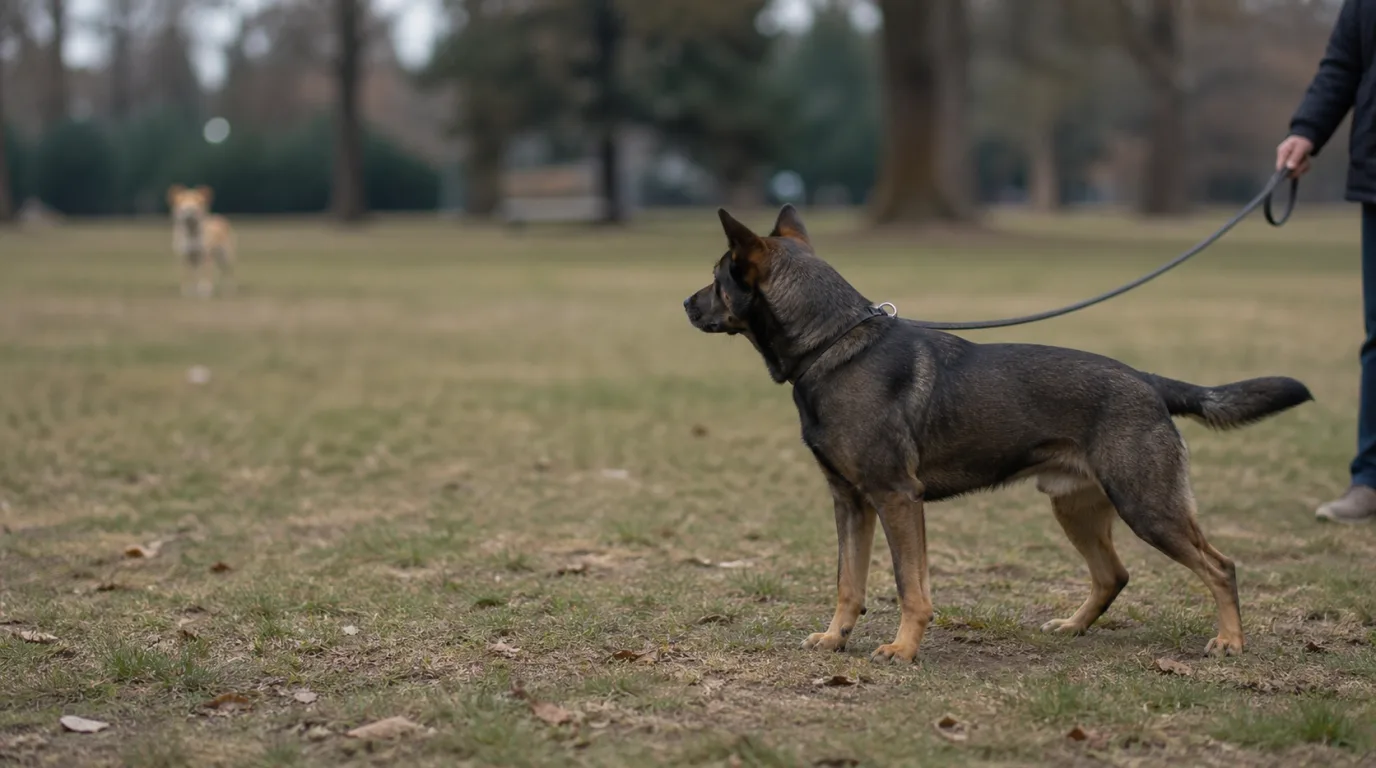
A stiff dog body means fluid movement has been replaced by tension. The legs may brace, mouth close, gaze fix and tail become still or move in short tight strokes. In a social interaction, stiffness is a reason to pause and create space. It can reflect fear, intense focus or rising conflict, but it is not proof that the dog will bite.
Stiffness can also be physical. A dog who moves rigidly after rest, avoids stairs or stiffens when touched may be painful. Context and movement over time separate body language from mobility problems.
For another posture-versus-movement distinction, see why dogs cross their paws: a relaxed resting pose differs from limbs crossing or scuffing during gait.
What does a stiff dog look like?
Compare the dog with their own loose baseline. A comfortable dog usually bends through the spine, shifts weight easily, changes direction and carries the mouth, tail and limbs without obvious bracing.
Possible stiffness signs include:
- straight, braced legs
- reduced curve through the neck and spine
- weight anchored or leaning strongly forward or back
- a mouth that suddenly closes or tightens
- a fixed gaze or reduced blinking
- a tail held still or wagging narrowly and rapidly
- slow, economical movement instead of loose curves
- difficulty disengaging from a person, animal or object
Long coats can hide muscle tone, and some dogs naturally stand squarely. The transition from loose to rigid is often more informative than the pose itself.
Stiffness versus freezing
A stiff dog may keep walking, wagging, eating or tracking a trigger. A freeze is a more complete stop in movement and often sound. Both deserve attention during a pressured interaction, but they are not interchangeable.
The guide to dog freezing body language distinguishes a tense freeze from listening, predatory stillness and pain-related hesitation. This page focuses on tension that remains visible during movement or a held stance.
Four stiff-body contexts
| Pattern | Weight and movement | Other clues | Safer next step |
|---|---|---|---|
| High social arousal | Braced or forward, direct orientation, minimal curve | Closed mouth, fixed gaze, high or still tail | Increase distance and avoid a greeting |
| Fear-related tension | Low or back-shifted, leaning or creeping away | Ears back, wide eyes, tucked tail, escape attempts | Stop approaching and open an exit |
| Play losing flexibility | Movement becomes direct, pauses disappear, one dog cannot disengage | Harder contact, fixed pursuit, fewer role reversals | Call a calm break before escalation |
| Pain or mobility stiffness | Short careful steps, trouble rising, reduced range of motion | Worse after rest or activity, touch sensitivity, routine change | Veterinary assessment |
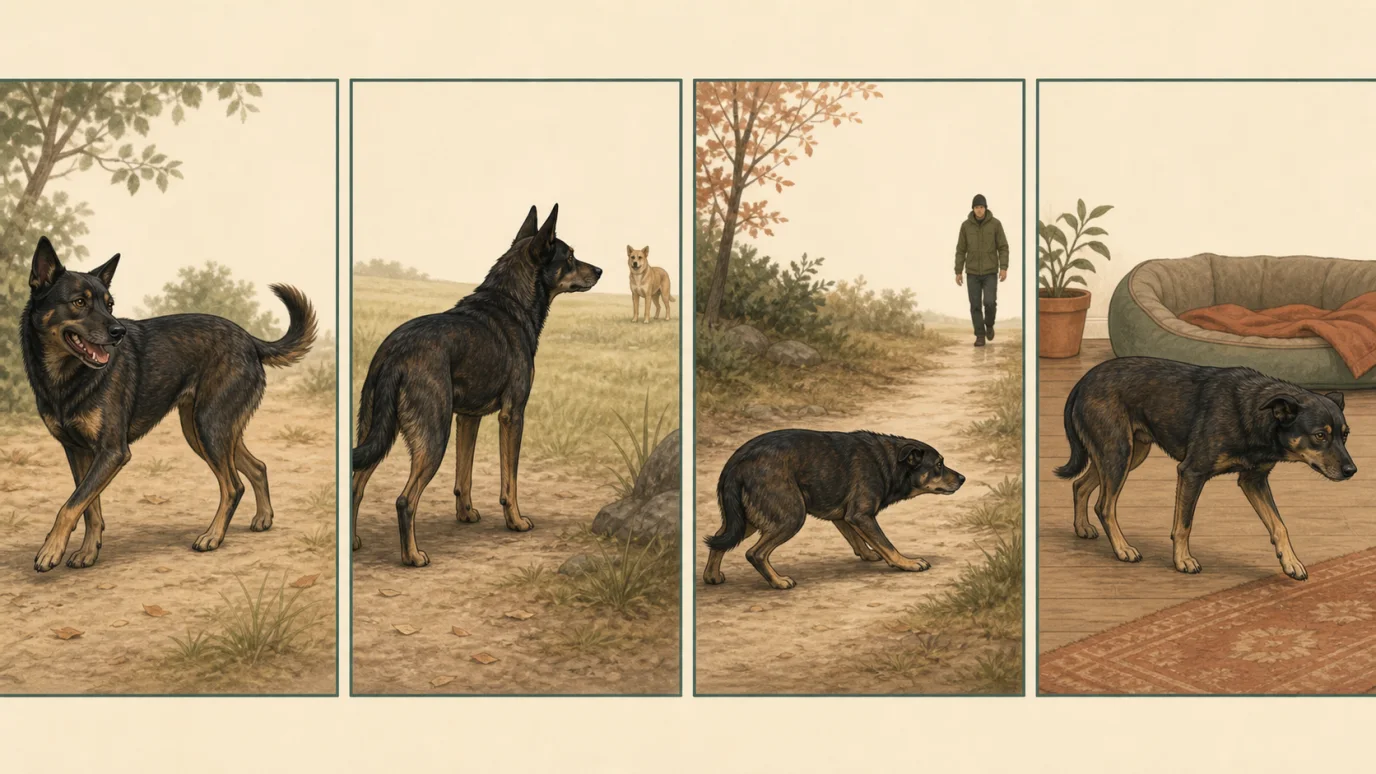
From left: a loose baseline, forward social tension, backward fear tension and possible mobility stiffness. Body direction and the trigger help separate similar-looking rigidity.
Weight forward: focus or social pressure
A dog standing tall with weight toward the front feet, neck extended and gaze fixed is prepared to move closer. That may be predatory focus, frustration, guarding or social conflict. Check what the dog is oriented toward and whether attention can shift.
Forward stiffness during a dog-to-dog greeting is not relaxed interest. Skip the greeting and move away in a curve. Do not shorten the distance to “let them work it out.” If the dog loosens and can sniff or look away at greater distance, that response supports a social-pressure interpretation.
Forward weight does not prove aggressive intent. It does indicate commitment of attention, which reduces your margin for a close interaction.
Weight back: fear or avoidance
A fearful dog may be rigid while leaning away, crouching or keeping the rear legs ready to retreat. The ears may pin back, tail lower and eyes continue monitoring the trigger. Some dogs move slowly rather than running because the route feels blocked or movement might draw attention.
Stop advancing. Turn sideways, reduce direct eye contact and make space. A stiff dog who is not barking is not necessarily calm. The dog stress ladder shows how quiet tension can sit above subtler displacement behavior.
Can a stiff wag mean friendliness?
Wagging tells you that the dog is aroused, not that the interaction is safe. A loose social wag tends to involve broad movement and often travels through the hips. A high, narrow or rapidly vibrating wag on a rigid body carries a different risk profile.
Read the tail with the legs, mouth, gaze and weight. The dog tail-position guide covers height, speed and range. Do not approach an unfamiliar dog solely because the tail moves.
Stiffness during play
Healthy play is usually inefficient and flexible: curved approaches, bouncy movement, pauses, role reversals and voluntary re-engagement. Brief stillness can be part of play, but concern rises when one dog becomes persistently rigid, pursues directly and does not respond when the other dog moves away.
Call both dogs apart for a short break before conflict. If one returns while the other avoids, hides or stays close to a person, end the session. Repeated mismatch needs better partner selection or professional assessment.
Do not use growling alone to judge play. Vocal play can be loose, while silent rigidity can signal a problem.
Stiffness around food, toys, beds or people
A body that tightens when someone approaches a possession can be an early resource-guarding signal. Chewing may slow, the mouth close over the item, gaze harden or the dog reposition between the resource and approacher.
Do not reach for the item, grab the collar or punish the warning. Use management to prevent close approaches, especially by children, and get a qualified plan. Punishment may suppress visible warnings without changing the underlying concern.
Stiffening during touch or handling
If a dog becomes rigid during petting, hugging, grooming, lifting or veterinary handling, stop optional contact and allow movement away. Stillness is not consent. A previously tolerant dog who stiffens around one body area needs a pain assessment.
When the body loosens again, use a brief petting consent check before deciding whether the dog is actively asking for more contact.
Essential care may require cooperative-care training, medication and a veterinary handling plan. Do not repeatedly touch the area to test the reaction.
When stiffness is probably physical
Behavioral tension usually follows a social or environmental trigger and changes when that pressure changes. Physical stiffness often appears across settings and follows movement patterns.
Look for:
- difficulty rising after sleep
- short steps, limping or uneven weight
- reluctance to jump, climb stairs or enter a car
- slower sitting or lying down
- reduced play or walks
- altered sleeping position
- flinching, guarding or irritability with touch
- stiffness worse after activity or rest
Pain guidelines emphasize loss of normal behavior as well as new abnormal behavior. A dog does not need to cry for pain to matter. The guide to pain signs in older dogs provides a broader mobility checklist, but young dogs can also have orthopedic or neurological problems.
Arrange a veterinary examination for new, persistent or worsening stiffness. Seek urgent care after trauma, with inability to stand or bear weight, severe pain, weakness, collapse, a swollen abdomen, breathing difficulty or loss of bladder or bowel control.
A five-second safety read
When a dog stiffens:
- Stop approaching or touching.
- Identify what changed immediately before the tension.
- Check weight direction, mouth, gaze, tail and exit access.
- Add distance or a barrier without grabbing near the face.
- Observe whether loose movement returns.
Do not recreate the situation for confirmation. Recurrent stiffness around people, dogs or resources warrants qualified help. The guide to finding a credentialed behaviorist explains appropriate credentials.
What a photo or video can show
A photo can show braced legs, weight direction, mouth tension, gaze and tail carriage. It cannot show the loss of fluid movement that made the posture concerning or whether the dog loosens with distance.
Video from the side is better for gait and transitions. Record only naturally occurring behavior from a safe distance. PetTranslator.ai can list visible markers and possible interpretations, but it cannot predict a bite or diagnose pain from body stiffness.
Frequently asked questions
Does a stiff body mean a dog is aggressive?
No. Stiffness indicates tension or reduced movement and can occur with fear, focus, guarding, conflict or pain. During a close social interaction, give space because risk may be increasing.
Why does my dog stiffen when another dog approaches?
The dog may be uncertain, frustrated or intensely focused. Avoid a direct greeting, add distance and watch whether flexible movement and disengagement return.
Why does my dog stiffen when I pet them?
They may dislike the contact, feel trapped or have pain. Stop touching and let the dog move away. New or location-specific stiffness needs veterinary assessment.
Is a stiff wag a happy wag?
Not necessarily. A narrow or fast wag on a rigid body reflects arousal. Use the dog's mouth, eyes, legs, weight and context before deciding whether interaction is welcome.
How is stiffness different from freezing?
Stiffness is loss of fluidity while the dog may still move. Freezing is a more complete stop. Both can occur during fear, focus or social tension, while physical pain can also reduce movement.
Sources
- ASPCApro. Canine body language tips.
- VCA Animal Hospitals. Canine communication: interpreting dog language.
- AAHA/AAFP Pain Management Guidelines for Dogs and Cats.
- Monteiro et al. How chronic pain impacts the lives of dogs.
- University of Pennsylvania Behavior Medicine. Dog body language basics.
- Best Friends Animal Society. Dog body language.
Khabir Mughal is the founder of PetTranslator.ai. This article was researched against canine-behavior guidance, pain-management guidelines and chronic-pain research. It was last reviewed on August 18, 2026.