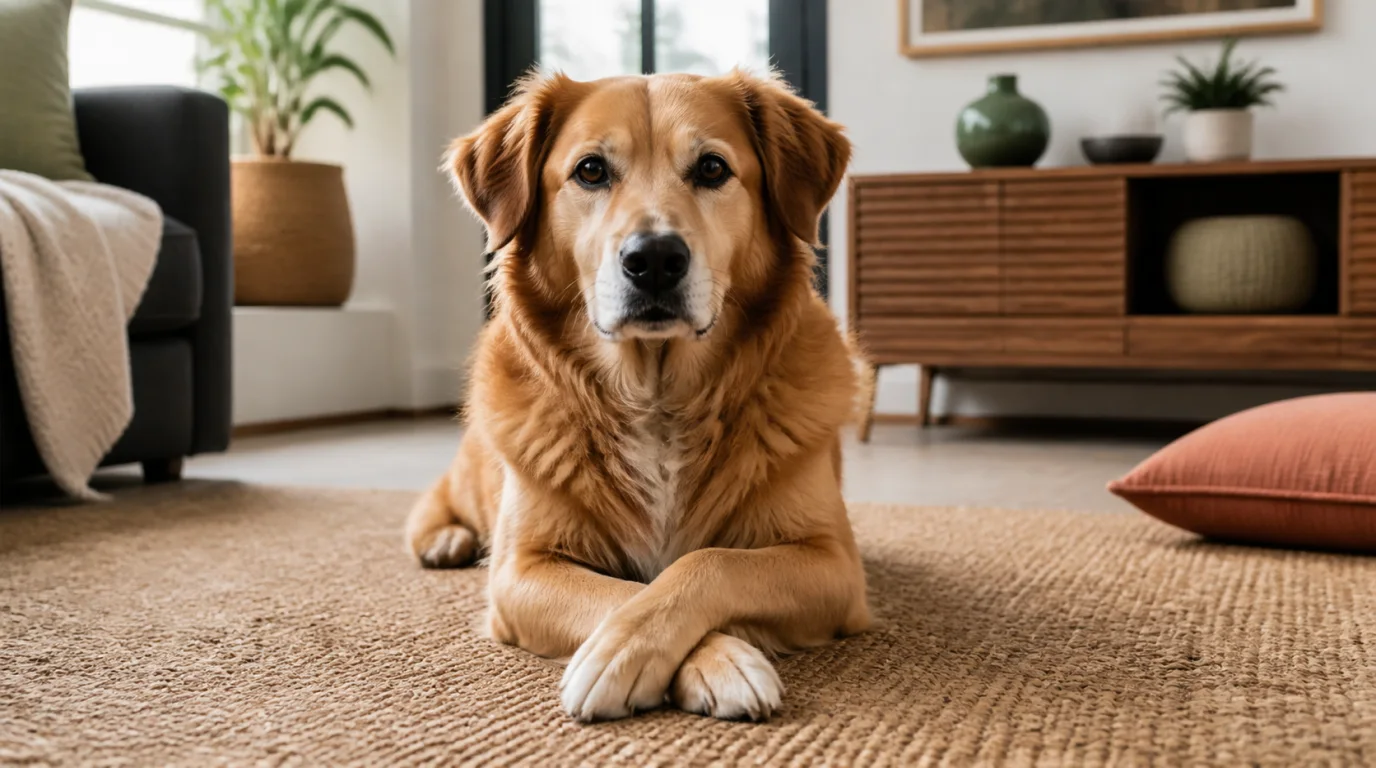
A dog who lies down and crosses the front paws is usually using a comfortable, voluntary resting pose. There is no good evidence that the pose proves a dog is polite, regal, confident or a particular personality type.
The important distinction is movement. A dog resting symmetrically with loose muscles and walking normally is different from a dog whose legs cross while standing or walking.
Resting paws or a movement problem?
| What you see | Other clues | Likely next step |
|---|---|---|
| Front paws crossed while lying down | Loose face and body, normal breathing, changes position easily, normal walk afterward | Usually ordinary; no special action needed |
| One paw laid over the other while resting | Dog licks one paw, protects a limb or resists getting up | Check for other pain signs and contact a veterinarian if new or persistent |
| One paw held off the floor | Weight shifted away from a limb, limping or repeated paw licking | Inspect visually if safe and arrange veterinary care |
| Front or hind legs cross while walking | Scuffing, wobbling, weakness, falling or altered stride | Prompt veterinary assessment |
| Paw folds under so the top touches the floor | Delayed correction, worn nails or abnormal gait | Veterinary assessment; do not use online exercises as a diagnosis |
A photo of crossed paws can answer only the first part: what the limbs looked like in that moment. It cannot show weight transfer, stride or coordination.
Why some dogs rest with crossed paws
Dogs vary in their preferred sleep and observation positions. Limb length, chest width, surface, temperature, flexibility and habit may all influence where the paws land. Some dogs cross them often; others never do.
If the dog settled into the pose voluntarily, the body is soft and the dog rises and walks normally, the simplest explanation is comfort. You do not need to decode a hidden message.
Crossed paws can appear within a relaxed body-language picture, but the paws do not create that conclusion alone. Look for soft eyes, easy breathing, flexible ears and muscles that are not held rigid. The dog body-language guide explains why combinations matter more than isolated parts.
What crossed paws do not prove
Online explanations often assign the pose a precise meaning: confidence, elegance, submission, patience or intelligence. Those descriptions may match how the pose looks to people, but they are not established canine signals.
A signal needs a receiver and a reasonably consistent effect. Dogs do communicate through posture, gaze, movement, facial tension and distance, but a comfortable paw arrangement is not automatically a message.
Breed claims are weak for the same reason. Owners may notice many photos of a particular breed with crossed paws, yet that does not show that the breed performs the pose more often. Photography, body shape and owner attention can all affect what gets noticed and shared.
Compare crossed paws with a paw lift
A front paw lift occurs while the dog is sitting or standing with one paw partly or fully off the ground. It can appear with uncertainty, prey focus, anticipation, learned requests or pain.
Crossed paws usually refer to both forelimbs resting on the floor while the dog lies down. The physical demand and context differ. If your dog crosses one paw over the other because they will not load a limb normally, treat that as an unloading or pain question rather than a cute pose.
When crossing during movement matters
Veterinarians assess gait because coordination, strength, balance and musculoskeletal comfort affect where each foot lands. Ataxia describes impaired coordination. Weakness and lameness are different problems, although they can overlap in what an owner sees.
Concerning observations include:
- paws or legs crossing the body's midline while the dog walks
- a narrow, wobbling or weaving gait
- scuffed nails or dragging toes
- the paw folding under
- falling, stumbling or difficulty turning
- repeated reluctance to rise, jump or use stairs
- sudden change after trauma
Do not perform a “knuckling test” from a social video and use it to clear or diagnose your dog. A neurologic examination interprets paw placement alongside reflexes, strength, posture and the rest of the nervous system.
Signs that add concern to a resting pose
A crossed-paw rest deserves attention when it is new and paired with:
- licking or chewing one foot or joint
- swelling, heat, a damaged nail or pad injury
- stiffness after rest
- a shorter stride or head bob
- panting or inability to settle
- avoiding touch or ordinary activity
- appetite, sleep or social changes
Pain often shows through behavior and posture rather than crying. The older-dog pain guide covers subtle routine changes, and the stiff-body guide helps separate whole-body social tension from physical stiffness.
How to record the difference safely
If your concern is the resting pose, take a photo from the front without moving the paws. Then wait for the dog to rise on their own.
If your concern is gait, record several ordinary steps from the side, front and behind on a safe, non-slip surface. Note whether the change appears after rest, after exercise, on turns or on one surface. Do not ask the dog to run, jump or use stairs to make the sign more obvious.
Share the original-speed clips with your veterinary team. Slow motion can help review foot placement, but it should not replace the normal-speed sequence.
What a photo or video can show
A photo can show whether the dog is lying down, which paw is on top, body symmetry and facial tension. Video adds rising, weight bearing, stride, toe placement and recovery.
PetTranslator.ai can list visible posture markers and uncertainty. It cannot diagnose pain, lameness or neurologic disease from crossed paws.
Frequently asked questions
Do crossed paws mean my dog is relaxed?
They can occur during relaxed rest, but confirm that with the whole body and normal movement. The paw arrangement alone does not prove an emotional state.
Are crossed paws more common in certain breeds?
There is no reliable evidence for a breed rule. Body shape and individual habit may influence the pose, but online photo patterns are not frequency data.
Why did my senior dog suddenly start crossing the front paws?
A new resting preference may be harmless, but senior dogs have a higher likelihood of orthopedic and neurologic change. Look for stiffness, licking, weakness and altered gait, and discuss a persistent change with a veterinarian.
Sources
- Merck Veterinary Manual. Lameness in dogs.
- Merck Veterinary Manual. The neurologic examination of animals.
- AAHA. What’s wrong? Common pet pain signs.
- AAHA. 2022 Pain Management Guidelines for Dogs and Cats.
Khabir Mughal is the founder of PetTranslator.ai. This article was researched against current veterinary pain, gait and neurologic guidance. It was last reviewed on September 1, 2026.