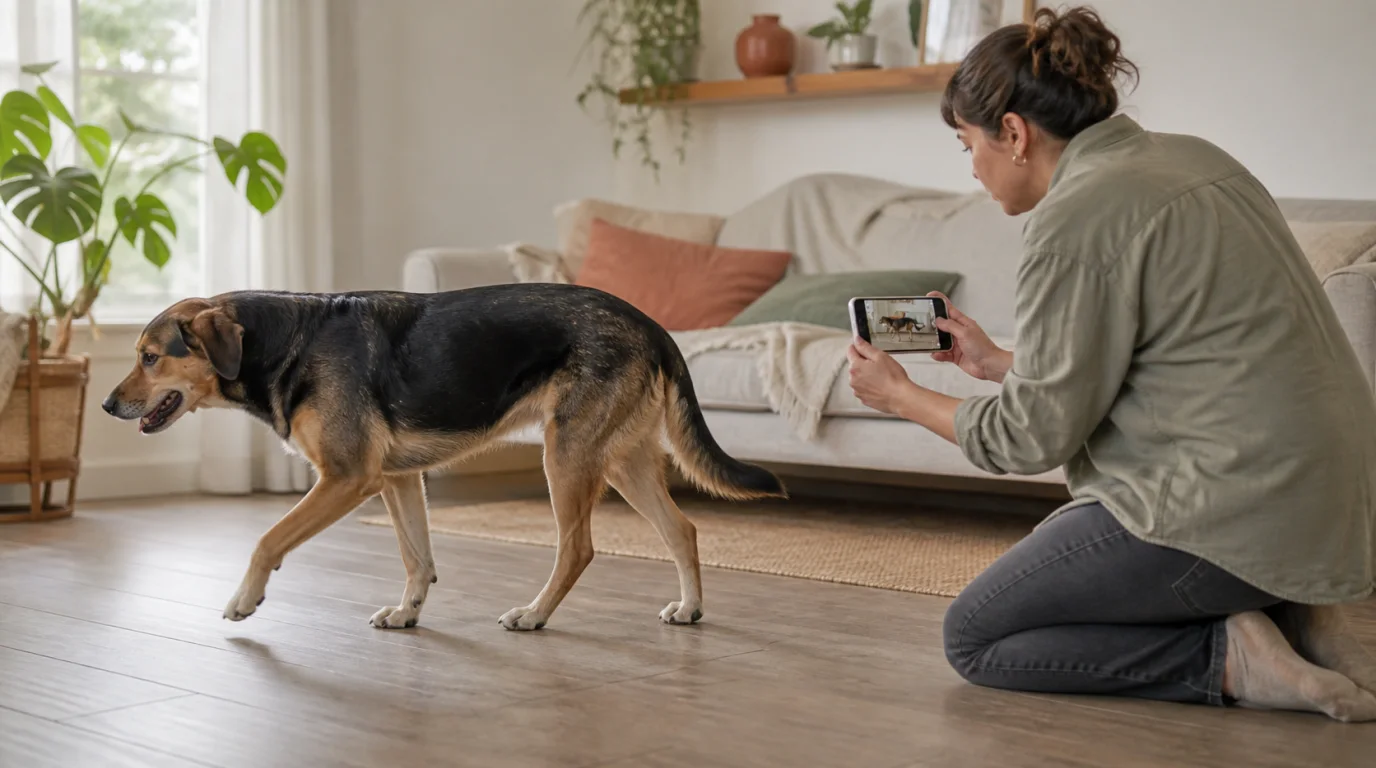
Dogs can repeat a limp, paw lift or posture that has produced attention, but that is learned behavior, not proof of deliberate deception. More importantly, a painful dog may look normal during excitement and limp again later. Treat the symptom as genuine until a veterinarian has assessed it.
The useful question is not “Is my dog lying?” It is “What pattern am I seeing, and what medical causes need to be ruled out?”
Why an injury can look inconsistent
Pain and lameness do not have to appear every second. A dog may move differently with speed, surface, fatigue, temperature or the direction of a turn. Rest can reduce discomfort temporarily. Excitement can also change how strongly a dog responds to pain without removing the underlying problem.
That means these observations do not prove a dog is uninjured:
- the limp disappears when a ball appears
- the dog still runs or jumps
- the dog bears weight sometimes
- touching the leg does not produce a cry
- the symptom is absent at the clinic
- it happens only after exercise or after getting up
Lameness is a sign, not a diagnosis. Paw injury, nail damage, muscle or tendon strain, joint disease, spinal pain and neurologic problems can alter movement in different ways.
How learned behavior can enter the picture
Suppose a dog hurts a paw and holds it up. The family gathers around, speaks softly and delivers treats. After the paw heals, lifting it may still produce the same useful result. Behavior followed by attention or food can become more likely.
The dog does not need to plan a fraud. Learning can connect an action with an outcome. Some dogs may repeat a paw lift, slow approach or request posture in a particular context while moving normally elsewhere.
Consider learned repetition only after a veterinary examination has excluded pain and disease. If a clinician clears the dog but the behavior continues, review what happens immediately afterward. Attention, access to furniture, escape from a task or food may be maintaining it.
Possible pain versus possible learned repetition
| Observation | Why it matters | What to do |
|---|---|---|
| Same limb repeatedly affected | Local pain or neurologic change remains possible | Record and arrange a veterinary assessment |
| Worse after exercise or after rest | Common timing pattern in orthopedic problems | Note duration and activity; do not test with more exercise |
| Swelling, heat, wound, torn nail or licking | Visible tissue or paw concern | Prevent licking if safely advised and contact a vet |
| Scuffing, crossing limbs while walking, weakness or falling | May be neurologic rather than a simple limp | Seek prompt veterinary care |
| Behavior appears only before a disliked task after medical clearance | Escape may be reinforcing the posture | Lower task difficulty and reward a clear alternative |
| Paw lift appears when attention stops, then ends when interaction resumes | Attention may be part of the consequence | Discuss a reinforcement plan after medical clearance |
No row in this table diagnoses the cause. It helps you collect information without turning your home into a test lab.
What to record for the veterinarian
Short, ordinary-life video can be more useful than repeatedly walking a sore dog at the clinic. Record only if your dog is already moving voluntarily.
Capture:
- The dog walking from the side, front and behind on a safe, level surface.
- The first steps after getting up, if that is when the change appears.
- Which limb seems affected and whether the paw touches the ground.
- The date, time, surface and activity that came before it.
- How long the episode lasts.
- Any licking, swelling, appetite change, panting, sleep change or reluctance to jump.
- Medications and supplements already given.
Do not force running, stairs, jumping or sharp turns to make the limp visible. The pet behavior journal guide offers a simple event-log format, and a vet-ready behavior report can organize the timeline.
When veterinary care should not wait
Contact a veterinarian promptly if the limp persists, recurs, or follows an injury. Same-day assessment is appropriate when the dog will not bear weight, has marked pain, swelling, a torn nail, a wound, a deeply embedded object or a sudden major change in movement.
Seek urgent care after significant trauma, with obvious deformity, uncontrolled bleeding, collapse, breathing difficulty, severe weakness, dragging limbs or loss of bladder or bowel control.
The pain signs in older dogs guide covers quieter changes such as altered sleep, reduced social contact and hesitation before ordinary movement.
What to do after medical causes are excluded
If the veterinary workup is reassuring, track the exact sequence around the behavior:
- What cue or event comes first?
- What does the dog do?
- What do people do next?
- What outcome does the dog gain or avoid?
Change the consequence without frightening the dog. For example, if a paw lift reliably starts play, ask for a comfortable behavior the dog already knows, such as standing on a mat, and begin play after that. If the posture appears before nail care, do not ignore possible handling fear. Break the task into smaller cooperative-care steps.
Use reward-based methods. Scolding, leash corrections and forced movement can add fear and hide useful pain or stress signals. The dog body-language guide can help you watch the whole dog while adjusting the plan.
Why “caught faking” is a risky conclusion
Owners sometimes see a dog switch legs, run after wildlife or stop limping when distracted and conclude the behavior was false. Those details are worth reporting, but none settles the medical question alone.
Pain can be intermittent. Two conditions can coexist. A dog can also develop a learned response after a real injury and still have residual discomfort. A clean story is emotionally satisfying; the body does not always provide one.
If a veterinarian finds no cause but episodes continue, ask what the next diagnostic or observation step should be. Do not increase exercise to prove the dog is fine.
What a photo or video can show
A photo can show a lifted paw or altered stance, but it cannot establish gait, weight transfer or duration. Video may capture shortened stride, head movement, scuffing, speed changes and recovery.
PetTranslator.ai can organize visible posture and movement markers for discussion. It cannot diagnose orthopedic or neurologic disease or certify that a dog is pretending.
Frequently asked questions
Can a dog fake a limp for attention?
A dog can learn to repeat a limp-like behavior that brings attention. Rule out pain first, because a real limp can also be intermittent or change during excitement.
Why does my dog limp only when I am watching?
Your presence may be part of a learned sequence, but timing alone cannot exclude injury. Record when it happens, which limb is involved and how the dog moves when not directly engaged, then share the pattern with a veterinarian.
Should I ignore the limp to see if it stops?
No. Observe without dramatizing the episode, restrict unsafe activity as advised, and contact your veterinary team. Ignoring a genuine problem can delay care.
Sources
- AAHA. 2022 Pain Management Guidelines for Dogs and Cats.
- AAHA. Chronic pain assessment in dogs.
- Merck Veterinary Manual. Lameness in dogs.
- Merck Veterinary Manual. The neurologic examination of animals.
- AAHA. Changing behaviors.
- AVSAB. Humane dog training position statement.
Khabir Mughal is the founder of PetTranslator.ai. This article was researched against current veterinary pain, gait and behavior guidance. It was last reviewed on September 1, 2026.